Thi Diem My Ta, Salman Nazir, Per Haavardtun, Leif Inge Magnussen (2026). Instructors’ Perspectives on AI in Maritime Simulator Training: A Qualitative Study. In: Training, Education, and Learning Sciences. AHFE Open Access, vol. 231, pp. 9–17. https://doi.org/10.54941/ahfe1007991
Simulator-based training has long been a cornerstone of maritime education and training, where human instructors play a central role in designing and implementing effective training strategies. However, as technological innovation advances, artificial intelligence (AI) is becoming increasingly embedded across maritime operations and learning environments, with emerging applications ranging from collision avoidance, forecasting and predictive analytics to adaptive learning. These developments raise important questions about the role of human instructors in simulator-based training with AI. In this context, this study aims to explore maritime instructors’ perceptions of AI integration in simulator-based training and develops a conceptual framework centred on perceived usefulness, psychological safety, and social embeddedness. Accordingly, we aim to answer the following research questions: (1) How do instructors perceive their professional identity with AI-integrated simulator training? (2) What boundaries do instructors envision regarding AI uses in simulator-based training? and (3) What factors facilitate the use of AI into simulator-based training in future? To address these research questions, we conducted qualitative semi-structured interviews with twelve experts in simulator-based training. Data was analysed using thematic analysis approach, grounded in instructors’ anticipatory perceptions of the use of AI in their professional training practice. The data analysis reveals that AI has potential to alleviate instructor’s workload in designing, implementing and assessing instructional practice. However, our informants consistently position AI as a form of pedagogical scaffolding rather than a replacement for human expertise. Human instructors perceived their role as indispensable, especially in highly ambiguous training contexts. Particularly, their roles remain central to effective pedagogy when it comes to observation, stimulating reflective thinking and developing interpersonal relationship with learners. Our analysis also suggests that the future of simulator training with AI appears to be shaped by a triadic interplay of perceived usefulness, psychological safety and social embeddedness. Whether AI should be integrated into simulator-based training remains contingent upon the maturity of the technology and the demonstrable value it can provide. Given the opacity of AI systems, often referred to as “black boxes”, it is imperative to foreground ethical awareness about the potential and limitations of AI use. Additionally, informants believe that as AI becomes increasingly integrated into everyday professional life. Hence, it is important to develop informed strategies that maximise its pedagogical utility while safeguarding the human factors in professional training practice.
Simulator-based training is central to maritime education and training, enabling experiential learning and the development of operational competence (Kolb, 2014). Within this setting, instructors play a critical role
not only in delivering content but also in guiding learners’ progression into professional communities of practice (Lave & Wenger, 2001). At the same time, instructors must ensure that the instructional activities align with regulatory requirements within the International Convention of Standards of Training, Certification and Watchkeeping (STCW Convention).
However, this instructor-centric model might be challenged by the emergence of artificial intelligence (AI) (Kolb, 2014). As technological innovation advances, AI is becoming increasingly integrated in maritime operations and learning environments (Munim & Kim, 2023; Sharma et al., 2023). Recent research documents that AI-driven analytical approaches offer the potential to provide comprehensive insights into the behavioural, cognitive, and physiological dimensions of maritime training by leveraging data from simulation logs, eye-tracking systems, and advanced speech analytics (Fan & Yang, 2023; Martius et al., 2024; Munim & Kim, 2023). Despite these advances, little is known about how instructors interpret the integration of AI into simulator-based training, particularly in relation to their professional identity and pedagogical authority. As such data-driven insights can substantially enhance the effectiveness of maritime training by enabling more objective feedback and improved assessment practices. This phenomenon raises important questions: (1) How do instructors perceive their professional identity with AI-integrated simulator training? (2) What boundaries do instructors envision regarding AI uses in simulator-based training? and (3) What factors facilitate the use of AI into simulator-based training in future?
Instructors’ responses to AI may also be shaped by path dependency, where established practices and professional identities constrain openness to innovation (Sydow et al. (2005). In maritime training, such lock-in may manifest in adherence to traditional instructional approaches, potentially limiting the integration of AI into pedagogical practice. In the assessment of the learners, the MET-instructors can be influenced in four ways: (i) cognitively through self- inflicted blind spots, such as “this is the best way to do it”; (ii) emotionally through the understanding of one’s own identity, linked to being a captain on large vessel; (iii) socially through inheriting a certain way of interpreting the instructor’s role. The latter is linked to (iv) resources, such as the number of learners and the amount of time available. Liebowitz and Margolis (1995) point out that such track-boundness or institutional inertia generally follows three distinct levels. The first two levels reflect the situations in which historical events influence current practices without producing lasting inefficiencies or irreversible commitments. However, the third form involves a deeper form of lock-in, where institutions become committed to the inferior solutions and difficult to reverse. Two of the tracks are fairly obvious, while the last one challenges both the traditions and ways of thinking that AI can be included in present and future MET. This research therefore examines instructors’ reflections on how AI may reshape the core pedagogical relationships between instructors, learners, and content, and the deliberative processes through which instructors interpret and transform subject matter in relation to learners’ needs (Klafki, 1995). The core of teaching (learners, instructors and content) will be used as a backdrop in the interpretations of MET-educators’ perspectives on AI.
Instructors’ Perspectives on AI in Maritime Simulator Training 11 Based on semi-structured interviews with maritime instructors, this study examines how AI integration reshapes professional identity, pedagogical boundaries, and future training practices. We show that instructors position AI as a supportive rather than substitutive tool and propose a conceptual framework in which AI adoption is shaped by perceived usefulness, psychological safety, and social embeddedness.
METHOD
We adopted an exploratory qualitative design to capture instructors’ perceptions and experiences (Eisenhardt, 2021). Data collection was conducted using semi- structured interviews. This approach allows the participants to freely elaborate on questions and give us the flexibility to probe and follow up emerging insights that arose during the interview. Purposive sampling was used to recruit participants who have experience with simulator-based training. We also used snowball sampling where initial participants recruit others from their social network. Potential participants were identified through professional networks and contacted via an email invitation. In total, twelve experts were recruited for this study, comprising ten males and two females. Previous research shows that between nine and seventeen interviews are typically sufficient to achieve data saturation (Hennink & Kaiser, 2022). Accordingly, twelve interview conducted in this study represent an adequate sample.
Ethical approval for this study was obtained from the Norwegian Agency for Shared Services in Education and Research (Sikt) before data collection. The participants were clearly informed about their rights to withdraw at any time without any consequences. Moreover, the participants were notified that the recorded data would be deleted at the end of 2026. They were also informed that the collected information will be treated confidentially and anonymously. The interviews were conducted in person or digital with an average duration of 40 minutes. We developed an interview guide designed to elicit instructors’ perceptions of current and future integration AI in simulator-based training. The guide also included questions aimed at delineating the boundaries of AI’s usefulness and contexts in which AI might be insufficient for professional training practice.
The data were analysed using thematic analysis. Transcripts were first read iteratively to achieve familiarisation, followed by open coding. Codes were then grouped into higher-order themes aligned with the research questions. The analysis was conducted iteratively to refine themes and ensure internal consistency.
RESULTS
Perception of Professional Identity in AI-Integrated Simulator-Based Training Our data analysis pointed out that participants perceived the effectiveness of maritime simulator-based training is grounded based on perspective that expertise is embodied, tacit, and relational. In other words, competence or skill acquisition emerges as a result of established connection between perception
and action (embodied), integration of multiple cues into immediate, seemingly effortless decision making (tacit) and in connection with team coordination (relational). As theory of situated learning posits, skill development is realised when learners transit from peripheral participation toward full participation in a community practice (Lave & Wenger, 1991). In this light, instructors are not merely theory explainer or information transfer but custodians of a professional practice, guiding novices in their development toward expertise, including tacit knowledge and how to act properly in a complex real-time situation.
“The only task in simulator is to behave and run the vessel” (P8), so “You have to take into account where are we going? What’s the traffic? It’s not only about understanding the theory, you have to be able to do it in real life. And I don’t think AI can help them with that” (P2). “I am not sure that AI can create a learning space, relation that we build up where they trust me, I trust them” and “relationship between the craftsman and the apprentice” (P1, P5).
It is also worth noting that the meaningful value of education and training does not merely lie in getting the correct answers, but in the process of engaging with training scenario through reasoning - “It’s not necessarily wrong, but I want you to know why you do as you do” (P5), reflection - “What have you been doing and why did you choose that?” (P11), and interaction with peers and instructors - “how they organise themselves into teams and support each other’s role.” (P3), “as an instructor, I’m the rest of the crew, so it’s like being an actor, if they call me, I help them” (P5). One participant noted “It is not only about have been successful, but the way you operate and you come to the end of the voyage.” (P8).
Participants further emphasised that learners exhibit diverse needs and learning styles, thereby requiring human instructors to adjust their pedagogical approaches to the specific characteristics of each training group. One participant noted “I can’t use anything from the former group, because it’s perhaps quite different problem in the next group, even though they have been conducting the same exercise... exactly the same every time”, “due to the human factor…the exercise evolves differently every time. So, the issues in one team aren’t the same as the next team” (P2). In this situation, the role of instructors becomes indispensable, while also opening the perspective of deliberations of how, what and why and to whom the training should be directed. The participant continued: “I need to find out what’s his issue. What is he struggling with? Why is he not able to delegate his workload?” (P2). Additionally, human instructors can pick up interpersonal and behavioural nuances from learners “How the student is behaving...insecure… too fast or too slow” (P1), “observe what they do during the session and then you will give them feedback what has been done wrong or right” (P8). The ability to observe and response to learners’ emotional nuances enable instructors to provide personalised and context-sensitive feedback.
Boundary of AI Uses in Simulator-Based Training Our data analysis showed that participants perceived AI as a probabilistic system that can “compress knowledge” (P11) in a more efficient way
Instructors’ Perspectives on AI in Maritime Simulator Training 13 than human beings thanks to the computational capacity. Hence, AI can outperform human in the accumulation of theoretical knowledge and the processing of large datasets: “our database of knowledge is limited… the database of the AI can be like 100,000 human beings” (P1). However, the usefulness of contemporary AI systems is constrained by the specialised nature of maritime knowledge. The nautical knowledge remains sparsely in public data source, making it challenging for AI systems to provide accurate domain-specific terminology, and contextually appropriate responses within the maritime domain. “Some parts when I ask AI and I get back some a little bit weird in the wording and the sentences I can’t use” (P8).
Participants positioned AI as a scaffolding instrument to support instructors in delivering high-quality teaching and training. However, achieving good professional practice is not solely accumulating technical knowledge but also the ability to perceive, evaluate situations and respond as “good practitioners” would in real-time, dynamic, and risk-laden situations (Bailey et al., 2025). AI can explain the theory, but it remains limited when it comes to train leaners how to operate and behave on a vessel, where situational awareness, team communication, embodied practices remain important.
“AI cannot outperform humans in seeing the big picture…you need years of experience” (P7), “They have to perceive their environment, they have to know the vessel, they have to know how to manoeuvre the vessel and know the COLREGs and relate to all the vessels” (P8). “As it is right now, the leadership aspects, the bridge team dynamic…are too complex for AI.” (P6).
Although AI has potential to support the training assessment, its effectiveness remains limited because simulator-based training solutions are often ill-defined and highly dependent on contextual factors: “The situations, they differ. Even though they are sailing in the exact same waters. one minute in difference in the transit, that’s quite a big difference in how the exercise evolves” (P4). The absence of one-size-fits-all solution can challenge the capacity of AI to provide meaningful support, “AI could make some algorithms and rules to assess learners, but I think different captains or professors will have some other solutions on the same situation, assessment could be different” (P8). “You can either turn to starboard, turn to port, reduce speed… maybe all solutions are okay” (P5), “you can have maybe have three, five, or whatever number of possible, solutions” (P11). Besides. AI could not fully observe, interpret, and evaluate the simulator- training situation, limiting AIs ability to replace or replicate human instructional judgment and provide feedback. “You have to have a screen recording and record every click of the students. Because a lot of these actions from the students are not possible to extract from the simulator data: if they have set up the radar correctly, of the clock of this target, and this is not possible to extract” (P12).
However, AI can be particularly useful for basic training with highly structured and rule-based solution: “like two ships meeting each other, are easy enough for AI to handle”, the routine procedural skills such as “how to operate radar,… how to give way in simple situations” and tasks in the engine- room training: “if they turn valve number one instead of valve number two, a message pops up” (P5). The basic training could be effectively integrated into cloud-based simulators.
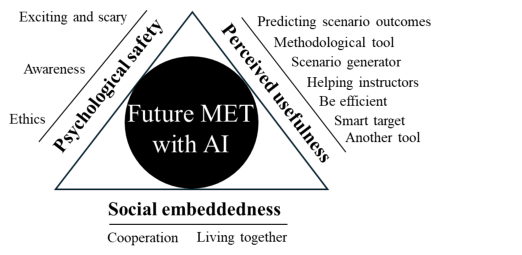
Factors Facilitate Future Maritime Simulator Training With AI All participants were asked to think of the first words coming to their mind when thinking about the future maritime simulator training with AI and elaborate their word choice. Based on this data, we develop a framework positioning that the use of AI in future maritime simulator training is potentially shaped by three factors: perceived usefulness, psychological safety and social embeddedness.
Figure 1: Triangular framework of future maritime simulator training with AI.
The first factor perceived usefulness refers to the extent to which instructors believe that using AI would enhance their job performance (Davis, 1989). Notably, none of the participants reported to use AI in simulator-based training at the time of the interviews. Hence, whether AI can be integrated in simulator-based training will depend on to what degree AI can facilitate the existing tasks of instructors. As one participant noted “A lot of seafarers are a bit conservative. So I think the first thought would be, let’s just see how good it works first. So kind of a cautious apprehension where let’s just have a look at this before we dive into it.” (P6). AI should increase efficiency of instructor workload by “making better and quicker exercise” (P3, P4, P5, P7, P8; P12). The participants anticipated several potential benefits, including the ability to generate training scenarios and smart target, predict scenario outcomes in real-world settings, or “methodological tools that we will have to teach learners to use properly” (P3).
The second factor psychological safety is reflected through keywords: awareness, ethics and the perception of AI as simultaneously “exciting and scary”. Previous literature defines psychological safety as individuals’ perceptions of the consequences associated with taking interpersonal risks within a particular context (Edmondson, 1999). In our context of AI-integrated simulator training, psychological safety functions as a precondition for safe and effective use of AI systems, which requires human instructors to develop critical thinking in validating AI output, remain in control of decision-making and constantly reflect on the emerging practices to apply it ethically. “We have to use our critical thinking and not let AI take over too much too fast before we have complete control of the AI.” (P1). “You have to be sure that you’re using or that this AI is used ethically correct and you have to be aware that it’s artificial. AI doesn’t have its own
Instructors’ Perspectives on AI in Maritime Simulator Training 15 mind and has to be 100% independent on you” (P10). The use of AI may enhance enjoyment by allowing the possibility to try out different inputs. “AI is a lot of fun to work with and to experiment with and test it out how and what is possible and not possible to do” (P12). However, AI can also trigger negative emotion or perception since new risks are potentially emerging from interaction with autonomous AI-driven systems, where human is unaware of what is handled inside the AI black boxes, as one participant noted “more and more automated systems and operators on board don’t have any knowledge on what’s actually going on with the system. Just trust what you get from them” (P12).
The third factor social embeddedness is reflected through keywords: living together and cooperation. The concept of social embeddedness originates from economic sociology, positing that the economic actions are not taken by isolated actors but in ongoing social relationships among individuals and institutions (Granovetter, 1985; Polanyi, 2002). By analogy, the social embeddedness of AI can be understood as the success of AI adoption and deployment depends on the social environment AI is introduced and integrated and how well AI perceived usefulness aligns with the existing social relationships, practices and institutional contexts. By cooperation, an participant means to express that AI could become human’s companion and act as an extension of oneself, where “you are talking to yourself…you can ask specific questions, which usually you will try and rarely, you could find the proper answer. So basically, this reflection of yourself and cooperation first and foremost of yourself is going to expand” (P11). On the other hand, living together emphasises that AI has potential to become an essential part of existing and future work processes, making the integration of AI unavoidable, which “you have to keep up with the pace of everything” (P11). However, the development and deployment of AI remain fundamentally human-directed. Rather than expressing fear of replacement, the participant highlight the collective responsibility to ensure that AI use remains aligned with human interest, values and within human control “from my perspective, we are not necessarily too worried about our replacement by the AI for the human beings, but we should think about the maximize the use of AI for our education, our research. Because AI was created by the human, so AI should not go further beyond the human beings. We should control the expansion of the AI in the certain limitations” (P2).
CONCLUSION
Our research shows that human instructors perceive their professional identity as indispensable in simulator-based training despite recent technological advances and the expanding adoption of AI. Their ability to deliver personalised, context-sensitive, and immediate feedback continues to be crucial for effective skill development and knowledge transfer. While AI has potential for training and assessment, it remains challenging to train AI to produce meaningful and contextually appropriate feedback for simulation scenarios that are highly ambiguous and context-dependent, involve dynamic interactions, and require evaluation of non-technical skills such as teamwork,
stress management. Hence, the role of AI is best described as a conditional efficiency tool or scaffolding instrument rather than a pedagogical actor that could substitute human instructors in facilitating professional training.
Additionally, we propose a triangular framework suggesting that the future maritime simulator-based training with AI will be shaped by three interrelated factors: perceived usefulness, psychological safety and social embeddedness. First, AI system should demonstrate clear incremental or transformational value in enhancing the quality and outcomes of professional training before they can be universally integrated into institutional practices. The technology must reach a sufficient level of maturity and reliability for its potential benefits to be meaningfully realised. Second, the integration of AI should consider the psychological safety factor. Particularly, human instructors must retain control over AI functionalities and expansion and be aware of AI’s limitation. Finally, the advance of technology is an inherent part of professional and societal evolution, practitioners and institutions should focus on understanding how AI can be effectively and efficiently integrated into existing workflows by developing appropriate strategies to evaluate AI uses and ensure AI strengthens, rather than hinders the existing training cultures and values.
LIMITATION AND FUTURE RESEARCH DIRECTION The findings of our research are based on the anticipatory perception of maritime simulator instructors. Our study investigates how their professional identity may evolve with the introduction and integration of AI in simulator-based training. Since none of the institutions have yet used AI in their professional training practice, our findings reflect projected beliefs and expectations rather than lived, practice-based experiences. Hence, we encourage future research to address this expectation–reality gap once the technology becomes more mature to confirm whether our findings still hold when instructors encounter the technology in practice.
Besides, the qualitative interviews are grounded in the maritime training context and shaped by the institutional cultures of the organisations from which instructors were recruited. Subsequent research should extend our findings by incorporating more diverse and larger samples to enhance the theoretical robustness and empirical generalisability. Comparative analysis would be particularly valuable especially studies contrasting the perceptions of instructors in institutions that have already incorporated AI into their training practice with those who still deliver training without such technologies. Smart use of AI can facilitate change in the lessons taught, reduce the reluctance to change and effort required to implement those changes. Hence, more research is needed to investigate the potential of AI as a catalyst in training program change at the practical level.
Finally, our proposed triangular framework offers a promising foundation for further empirical development. Future work could use quantitative approaches to test its validity and to identify the antecedents that shape the adoption and effective use of AI in simulator-based professional training.
ACKNOWLEDGMENT
The data used in this research belong to the research project with Sikt reference number 386903.
REFERENCES
Bailey, N., Winchester, N., & Ellis, N. (2025). What is your intention? Tacit knowledge and community-based learning for collision avoidance in the global maritime industry. Journal of Vocational Education & Training, 77(2), 343–363. Davis, F. D. (1989). Perceived usefulness, perceived ease of use, and user acceptance
of information technology. MIS quarterly, 13(3), 319–340. Edmondson, A. (1999). Psychological safety and learning behavior in work teams.
Administrative science quarterly, 44(2), 350–383. Eisenhardt, K. M. (2021). What is the Eisenhardt Method, really? Strategic Organization, 19(1), 147–160. Fan, S., & Yang, Z. (2023). Towards objective human performance measurement
for maritime safety: A new psychophysiological data-driven machine learning method. Reliability Engineering & System Safety, 233, 109103. Granovetter, M. (1985). Economic action and social structure: The problem of embeddedness. American journal of sociology, 91(3), 481–510. Hennink, M., & Kaiser, B. N. (2022). Sample sizes for saturation in qualitative
research: A systematic review of empirical tests. Social Science & Medicine, 292, 114523. https://doi.org/https://doi.org/10.1016/j.socscimed.2021.114523 Klafki, W. (1995). Didactic analysis as the core of preparation of instruction (Didaktische Analyse als Kern der Unterrichtsvorbereitung). Journal of Curriculum Studies, 27(1), 13–30. Kolb, D. A. (2014). Experiential learning: Experience as the source of learning and
development. FT press. Lave, J., & Wenger, E. (1991). Situated learning: Legitimate peripheral participation.
Cambridge university press. Liebowitz, S. J., & Margolis, S. E. (1995). Path dependence, lock-in, and history. The Journal of Law, Economics, and Organization, 11(1), 205–226. Martius, C., Nakilcioğlu, E. Ç., Reimann, M., & John, O. (2024). Refining maritime
Automatic Speech Recognition by leveraging synthetic speech. Maritime Transport Research, 7, 100114. Munim, Z. H., & Kim, T. E. (2023). A review of learning analytics dashboard and a novel application in maritime simulator training. Training, Education, and Learning Sciences. Polanyi, K. (2002). The great transformation. Readings in economic sociology,
38–62. Sharma, A., Undheim, P. E., & Nazir, S. (2023). Design and implementation of AI chatbot for COLREGs training. WMU Journal of Maritime Affairs, 22(1), 107– 123. https://doi.org/10.1007/s13437-022-00284-0 Sydow, J., Schreyögg, G., & Koch, J. (2005). Organizational paths: Path dependency
and beyond. 21st EGOS Colloquium,
LISTED IN THE AHFE DIGITAL BOOKSTORE CATALOGUE
Explore the complete digital volume
Training, Education, and Learning Sciences
Read this individual research paper free through the original publisher, or explore the full digital proceedings book.
ISBN 979-8-950676-07-9
Explore this ISBN in the AHFE Bookstore ↗Listed in the July 2026 bookstore catalogue; search by ISBN to confirm current availability · Digital book purchase optional