Salman Nazir, James Badu, Rune Elvegard, Natalia Andreassen (2026). Technology-Enhanced Learning for Emergencies: Mapping the Impact of Simulator and VR Training. In: Training, Education, and Learning Sciences. AHFE Open Access, vol. 231, pp. 207–218. https://doi.org/10.54941/ahfe1008012
1 University of South-Eastern Norway, Faculty of Technology, Natural Sciences and Maritime Sciences, Department of Maritime Operations, Post office box 4, 3199-Borre, Norway ↗
2 Nord University, Business School, Center for Crisis Management and Collaboration, Post office box 1490, 8049-Bodø, Norway ↗
Technology-enhanced training using simulators and virtual reality (VR) has gained prominence in preparing professionals for emergencies in safety-critical domains. This systematic evidence mapping review synthesises 27 empirical studies published between 2016 and 2025, exploring how simulator-based, VR, and related modalities impact emergency preparedness outcomes. Studies were coded by modality, domain, scenario type, fidelity, target group, assessment approach, and outcome direction. The analysis reveals that training effectiveness depends more on the alignment between modality and training goals than on the technology itself. Several studies report positive short-term outcomes such as procedural performance and self-efficacy, but evidence of long-term behavioural transfer is limited. Team-level benefits emerge when scenarios are designed for interdependence, yet many VR systems remain structurally individual. Outcome measurement critically shapes conclusions: behavioural assessments yield stronger evidence than self-report alone. This review offers a structured evidence map and design-evaluation insights, guiding future research and practice in technology-enhanced emergency training toward goal-modality fit and performance-based evaluation.
Over the last decade, technology-enhanced learning for emergencies has expanded beyond classroom instruction and traditional drills to include desktop and full-mission simulators, immersive VR, augmented and mixed reality (AR/MR), serious games, remote virtual simulation, and, in some settings, digital twins and co-simulation environments (Martini et al., 2025; Pasquier et al., 2026; Symeonidis et al., 2023; Ketelaars et al., 2025; Abensur Vuillaume et al., 2024; Rudinsky & Hvannberg, 2017). However, the evidence base is uneven and difficult to compare across domains, such as in mass casualty simulations, military operations, or pandemic response (Pasquier
et al., 2016; Harari et al., 2025). Most studies report short-term outcomes, while fewer examine behavioural performance or long-term transfer (Keya et al., 2025; Jackson et al., 2025; Hamdi & Thobaity, 2023; Conges et al., 2023). As a result, conclusions about whether technology ‘works’ can be misleading, as effects appear contingent on alignment between objectives, modality, scenario design, and assessment (Zhang et al., 2025; Rudinsky & Hvannberg, 2017; Pratticò et al., 2021). In this review, emergency preparedness is understood as the capacity of individuals or teams to perform appropriate actions under crisis conditions. It is operationalised as cognitive, behavioural, and perceived preparedness. These dimensions reflect both what trainees can do in simulated crisis situations and how prepared they perceive themselves to be, while recognising that perceived readiness is not equivalent to observable performance.
Thus, the guiding research question is: What does empirical research from 2016–2025 show about the patterns of simulator-based training, VR, and related technologies on emergency preparedness and crisis management outcomes in safety-critical domains, and under what training conditions modality, scenario type, fidelity, target group, and assessment approach pertain? This paper contributes a structured evidence map and identifies patterns explaining variation in reported effects.
METHOD
This study adopts systematic evidence mapping approach to synthesise empirical research on technology-enhanced training for emergency preparedness in safety-critical domains. The review focuses on studies published between 2016 and 2025 that examine simulator-based training, virtual reality (VR), augmented reality (AR), or related digital simulation technologies used as core components of training for emergency or crisis situations.
A structured search strategy was applied using predefined keywords combining terms related to simulation and immersive technologies (e.g., simulation, virtual reality, augmented reality, serious games, digital twins) with terms related to emergency preparedness and crisis management (e.g., emergency response, disaster training, crisis management, preparedness). Fidelity was coded as conceptual, functional, or immersive to reflect differences in realism and training affordances. These distinctions matter for learning because higher functional and immersive fidelity can support embodied action, temporal pressure, and coordination demands that are difficult to reproduce in low-fidelity formats, whereas lower-fidelity representations may be sufficient for rehearsing decision logic, task sequencing, or communication structures. Fidelity was therefore treated not as an absolute quality marker but as a design choice that influences what type of learning is likely to occur.
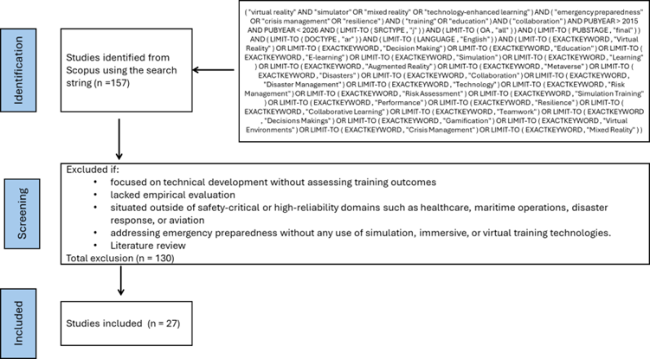
Searches were conducted in the Scopus database and were limited to peer-reviewed journal articles and conference papers published in English between 2016 and 2025. Titles and abstracts were screened to identify potentially relevant studies, followed by full-text assessment
Technology-Enhanced Learning for Emergencies: Mapping the Impact 209 to confirm eligibility. Studies were included if they reported empirical findings using simulation or immersive technologies for emergency preparedness outcomes. Studies were excluded if they focused solely on entertainment, non-emergency training contexts, or purely algorithmic or engineering performance without human training or learning outcomes. This process resulted in a final sample of 27 studies as can be observed in Figure 1.
Figure 1: Flow of studies identification process.
Each included study was coded using a structured coding scheme derived from the review question and recorded in a spreadsheet. The coding dimensions were: domain (e.g., healthcare, disaster management, crisis management, public safety, military), modality (e.g., VR, simulator, AR, serious game, mixed systems), scenario type (e.g., fire, evacuation, triage, command and control), level of fidelity (conceptual, functional, or immersive), target group (individuals or teams), assessment approach (self-report, behavioural or performance-based, or mixed), and outcome type (e.g., procedural performance, situational awareness, coordination and communication, decision-making quality, perceived readiness or self- efficacy). Each study was classified according to the direction of its reported outcomes as predominantly positive, neutral, or mixed/negative. A study was coded as positive if the authors reported statistically significant or clearly described improvements in preparedness-related outcomes (e.g., performance, coordination, or perceived readiness) compared with baseline or comparison conditions. A study was coded as neutral if no meaningful differences or improvements were reported, or if results were inconclusive. A study was coded as mixed when improvements were reported for some outcomes or subgroups but not for others, or when positive effects were accompanied by notable limitations or countervailing findings. This classification reflects the main conclusions reported by the original authors rather than independent effect-size estimation.
RESULTS
We classified the selected studies into themes (Table 1) to align their main patterns. Early years show modest activity, but publication volume accelerates from 2023 onward, reflecting growing academic and practical interest in simulation, VR, and related modalities.
Table 1: Key research themes and patterns.
Table available in the original PDF paper.
Research Theme Main Pattern Modality effects are goal- dependent
Training impact depends more on how well the modality supports the training goal (e.g., procedural action, coordination, workflow support) than on whether it is labelled VR, simulator, or AR.
Most positive effects are short-term and proximal
Studies mainly report improvements in immediate outcomes (procedural performance, confidence, coordination within exercises), while evidence of long-term transfer to real operations is limited.
Team and interprofessional benefits depend on scenario design
Preparedness gains at team level are strongest when scenarios are designed for role interdependence and supported by facilitation and debriefing; many VR systems remain structurally individual, creating a mismatch with collective crisis work.
Neutral or mixed results cluster around design and implementation problems
Weaker effects are associated with misaligned fidelity, usability friction, and practical constraints in implementation rather than with technology per se.
Assessment approach strongly shapes conclusions
Studies using behavioural or performance-based measures provide stronger evidence of preparedness gains than those relying mainly on self-report, which often overstates impact and under captures transfer.
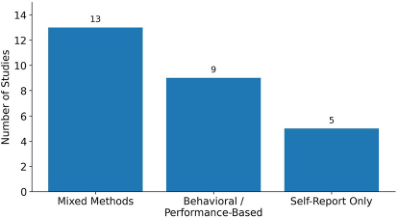
The 27 studies span multiple domains, with healthcare and disaster management most represented. VR is the most common modality, followed by simulators. Most studies use mixed assessment methods, followed by behavioral/performance-based measures and self-report only. Across studies, modality effects are best interpreted in relation to what actions trainees can rehearse and what instructors can observe and assess. Immersive VR is primarily used to rehearse rare or hazardous embodied actions (e.g., evacuation, triage), whereas AR is often deployed as workflow or decision-support training. Remote and distributed simulations emphasize communication and command interaction rather than physical co-presence. Fewer studies examine behavioral transfer across scenarios or retention over time. Where behavioral endpoints are used (e.g., coded performance, adherence failures, assessor ratings), findings are more robust than when based solely on self-report.
Table 2: Distribution of included studies by domain and training modality (N = 27).
Table available in the original PDF paper.
Category Subcategory Number of Studies All All domains and modalities 27
Preparedness gains at team level are strongest when scenarios embed role interdependence and structured facilitation. Many VR systems remain structurally individual, requiring pedagogical adaptations (role allocation, group debriefing) to address collective crisis work. Multi-user systems narrow this gap by enabling real-time coordination and information sharing. Neutral or mixed findings cluster around three issues: limited transfer beyond the training setting, mismatches between realism and actual work practices, and reliance on self- report outcomes. These patterns suggest that constrained effects are more often attributable to design and assessment choices than to technology limitations.
Figure 2: Count of studies by measurement type.
DISCUSSION
Study Characteristics Across the reviewed studies, simulator-based training, VR, and XR are best understood as different training tools rather than different labels for the same intervention, because each modality makes certain parts of emergency
work easier to practise and easier to observe. This is why modality choice consistently shows up as a design and measurement issue, not only a “technology” issue. Brown et al. (2020) argue that immersive simulation should be judged by how well it supports realistic work demands and credible measurement, rather than by immersion alone. Pratticò et al. (2021) make a similar point from a training-design perspective by showing how VR can function as a “mock-up tool” for training providers, helping them test timing, spatial constraints, and ordering of actions before committing to full-scale exercises again linking modality value to what can be practised and evaluated. When the training goal is embodied action in rare but high- risk tasks, immersive VR is commonly used to provide repeatable exposure without real-world danger, and its value becomes clearest when outcomes are measured as behaviour rather than only as satisfaction or confidence. Behavioural advantages of immersive VR are most evident when outcomes are measured through performance rather than self-report. Where the goal is cognitive support and protocol completeness in time-critical clinical crises, the literature positions AR less as “immersive training” and more as an aid to train a workflow behaviour. Harari et al. (2025) demonstrate that AR-enhanced crisis checklists reduce failures to adhere compared with paper checklists or no checklist in simulated operating-room emergencies, and they quantify this using retrospective video analysis across multiple key processes. This not only strengthens the claim that AR can improve crisis- task execution, but also highlights that AR introduces new design trade- offs (such as cognitive load and integration into routines) that should be treated as part of preparedness, not as secondary usability issues. A third modality pattern appears in remote and distributed formats, where the main constraint is access and scalability and where the “modality effect” is partly produced by facilitation and scenario design rather than by the hardware. Wijkmark et al. (2019) report that remote virtual simulation for incident commanders can still generate a strong sense of presence and engagement through concentrated attention and well-acted verbal counterplay, while emphasising that each format involves different compromises compared with live simulation and real incidents. In other words, outcomes in remote simulation depend heavily on interaction quality, scripting, and facilitation reinforcing that the technology’s contribution cannot be separated from how the exercise is designed and run.
Moreover, studies focused on implementation and usability reinforce that a modality only enables learning if learners can actually operate within it without friction. Jackson et al. (2025) show that VR workplace- violence training can be engaging and perceived as valuable, but usability and navigation barriers can distract from learning objectives and require refinement before wide adoption. Keya et al. (2025) similarly report strong enthusiasm for VR fire-evacuation preparedness in schools, while stressing that sustained use depends on technical and instructional support and that VR should complement rather than replace regular drills and professional validation. Taken together, these findings support the central argument of this theme: modality matters most through the actions it makes possible to practise and the evidence it makes possible to collect, and “successful”
Technology-Enhanced Learning for Emergencies: Mapping the Impact 213 training depends as much on measurement-ready design and implementation conditions as it does on the technology label itself.
Training Modalities Across domains, the easiest training benefits to demonstrate are proximal outcomes such as post-training knowledge and skill scores, perceived self- efficacy/confidence, usability and engagement, and performance within the exercise setting itself. Across domains, studies consistently report improvements in short-term outcomes such as knowledge, confidence, and in-simulation performance. At the same time, the literature suggests that “positive” findings become more convincing when they are demonstrated through behavioural endpoints rather than only through self-report. Farra et al. (2019) provide a clear example of outcome sensitivity: VR neonatal evacuation training did not outperform a comparison condition on knowledge or self-efficacy, yet it did lead to significantly better performance in a live evacuation exercise, implying that the training effect is visible in enacted behaviour even when survey measures look neutral. Harari et al. (2025) show a similar advantage of behavioural measurement in simulated operating-room crises by using retrospective video analysis to quantify failures to adhere (FTA) across hundreds of key processes and reporting interrater reliability; the AR checklist condition reduces FTA compared with paper and no-checklist conditions, which allows the study to claim a measurable change in crisis-task execution rather than a change in attitudes alone. Beyond healthcare, Wijkmark et al. (2019) include both experiential measures (presence) and assessed performance (summative grades given by an examiner), which illustrates another route to linking “feeling present” to observable performance within remote virtual simulation for incident commanders. Zhang et al. (2020) report experimental results showing that a serious game design encouraged participants to proactively manage emergency department human resources, framing impact as improved decision-making behaviour within the simulated work system rather than as a change in confidence alone. Perceived readiness often improves but does not reliably indicate operational preparedness without behavioural validation.
Across the reviewed literature, preparedness is repeatedly framed as something that is produced through collaboration and coordination rather than owned by any single person. Studies that focus on crisis work as “extreme teaming” argue that effective response depends on shared situation awareness, communication, and coordinated decision-making under pressure, which is why simulation is often used to surface team processes rather than only individual skills (Brown et al., 2020). In parallel, research on voice communication and crisis training shows that crisis performance relies on structured, time-sensitive communication practices, and that voice interaction is central enough to be treated as a design requirement for virtual training environments rather than an optional feature (Rudinsky & Hvannberg, 2017).
This collective nature of preparedness is especially clear in healthcare and other professional education settings where interprofessional coordination is an explicit learning target. Interprofessional mental health simulation reports
improvements that are strongly tied to communication, interprofessional understanding, reflective practice, and confidence outcomes that make sense mainly at the level of how people work together (Attoe et al., 2019). Similarly, AR crisis checklists in simulated operating room crises target team execution of critical actions; by measuring “failure to adhere” across many processes, the study treats preparedness as coordinated performance rather than only as individual knowledge or attitudes (Harari et al., 2025).
At the same time, many VR systems remain structurally individual (one headset, one user), which creates a recurring mismatch between the unit of crisis work (collaborative teams) and the unit of technology (individual trainees). Abensur Vuillaume et al. (2024) study on disaster medicine VR makes this tension explicit and addresses it by turning a single-player VR triage experience into a group learning exercise through role allocation (immersed responder, paper triage, communications) and structured debriefing; the study reports increased perceived self-efficacy with retention at two months, while also noting practical limits when group size increases. This same “workaround logic” appears in other education-focused immersive studies that treat collaboration, feedback, and structured interaction as key mechanisms for team learning even when the immersive environment itself is not truly multi-user.
Where multi-user interaction is built into the virtual environment, the teamwork gap narrows because interdependence becomes part of what is trained and what can be measured. For instance, Wong and Lee (2025) test a multiplayer VR environment for collaborative fire response and show that real-time indoor navigation and information sharing can reduce response time and support more proactive, coordinated action across different emergency participants (Wong & Lee, 2025). Remote virtual simulation for incident commanders similarly frames learning around command communication and coordination: it reports high experienced presence and links training value to “verbal counterplay” and interaction design, making the case that teamwork outcomes depend on scenario enactment and facilitation as much as on the underlying technology (Wijkmark et al., 2019).
Furthermore, several studies reinforce that team preparedness is shaped not only by the training medium but also by how exercises handle realism, uncertainty, and organisational coordination. The study by Ketelaars et al. (2025) shows that “normal exercises” can become repetitive and risk “normalising” crises, and it argues for training designs that introduce unforeseen events to trigger adaptive coordination and resilience at individual, collective, and organisational levels (Ketelaars et al., 2025). Related crisis- management VR work explicitly positions the crisis response as multi-actor sensemaking and information sharing aiming to support collaboration and shared situational awareness across stakeholders and even remote experts (Conges et al., 2023). Overall, these arguments are consistent with broader digital crisis-management and training research that targets collaborative decision-making and shared information flows as the core of preparedness, whether the platform is a simulation, a serious game, or an immersive environment (Zhang et al., 2020; Symeonidis et al., 2023).
Technology-Enhanced Learning for Emergencies: Mapping the Impact 215 Team Preparedness and Coordination
A first recurring constraint is transfer beyond the training setting. Even where studies report clear short-term gains, several explicitly signal that stronger evidence is needed to show that training effects hold across different scenarios and carry into practice. In the AR crisis checklist study by Harari et al. (2025), for example, the authors call for larger studies, more varied crisis scenarios, and real-world validation, while also noting practical barriers such as cost, accessibility, and training requirements that could limit implementation at scale. Similar transfer constraints are visible in the VR disaster training study by Abensur Vuillaume et al. (2024), which reports improvements in confidence or perceived self-efficacy but frames these as early indicators rather than proof of operational readiness.
A second recurring constraint concerns realism understood as alignment with “work-as-done,” not only sensory fidelity. In remote virtual simulation for incident commanders, experienced presence is attributed to interaction quality such as concentrated attention and well-acted “counterplay” implying that realism can be socially produced through facilitation and scenario enactment rather than being reducible to physical co-location or graphical detail (Wijkmark et al., 2019). In school-based VR fire evacuation training (Keya et al., 2025), strong engagement does not automatically translate into seamless training value because realism also includes organisational fit. Keya et al. (2025) show that adoption depends on technical and instructional support and highlight the importance of external validation (e.g., firefighters) and integration with existing preparedness routines, indicating that “realistic training” also requires legitimacy and compatibility with how preparedness is actually practised. Related work on crisis exercises by Ketelaars et al. (2025) further supports this point by arguing that routine, overly scripted exercises can normalise crises and fail to train adaptive capacity, suggesting that realism also comes from uncertainty, surprise, and the need to improvise within constraints.
A third recurring constraint is assessment design. Several studies improve credibility by using behavioural endpoints (e.g., coded adherence, assessed performance, drill performance), yet the broader pattern remains that many evaluations rely heavily on self-report and short follow-up windows, which makes it difficult to distinguish confidence gains from genuine preparedness improvements. Harari et al. (2025) strengthen the evidence base by using retrospective video analysis and interrater reliability to quantify failures to adhere to key crisis actions, demonstrating a more rigorous approach than satisfaction-based outcomes alone. By contrast, interprofessional simulation studies often show strong pre–post gains in confidence and attitudes, but these measures remain mainly self-reported, and the literature itself notes the need to clarify effects on subsequent practice in the context of other training (Attoe et al., 2019). Brown et al. (2020) reinforce the methodological implication by arguing that immersive simulations can improve ecological validity, but that this promise depends on matching sophisticated environments with equally robust measurement strategies capable of capturing team processes and performance under stress.
Furthermore, several studies implicitly or explicitly emphasise complementarity rather than replacement, which further reflects the transfer boundary between virtual rehearsal and real, embodied execution. VR disaster medicine training that is adapted for group learning positions itself as a feasible and engaging addition to training, but not as a substitute for interprofessional team practice in real settings (Abensur Vuillaume et al., 2024). School-based VR evacuation research makes a similar argument by stressing that VR should complement, not replace, regular drills and validated preparedness routines (Keya et al., 2025). More broadly, crisis exercise research oriented toward resilience suggests that preparedness depends on repeated exposure to variation and unforeseen situations an aim that likely requires a blended approach across modalities rather than reliance on a single technology (Ketelaars et al., 2025).
Recommendations This review highlights key priorities for advancing education and training in emergency preparedness using simulation and immersive technologies. First, instructional design should prioritize modality-to-goal alignment. For instance, selecting VR, simulators, or AR should be based on what skills need to be practiced (e.g., procedural accuracy, decision-making, or team coordination) rather than on novelty. Second, training realism must go beyond visual fidelity to reflect real-world conditions, including uncertainty, coordination challenges, and workflow constraints. For example, scenarios should embed role interdependence, realistic communication demands, and disruptions that reflect crisis conditions.
Third, educators should incorporate team-based learning structures, especially in domains where crisis response is collective. This includes designing multi-user simulations, allocating roles in single-user systems, and integrating structured debriefings to support interprofessional learning. Fourth, assessment strategies must shift toward behavioural and performance-based measures to meaningfully capture preparedness gains. In this view, surveys and self-reports alone are insufficient, evaluators should use checklists, video analysis, or task completion metrics linked to real crisis competencies.
Moreover, training programs should be embedded within broader preparedness systems, ensuring integration with existing protocols, validation by professionals, and sustained follow-up. To build long-term capacity, immersive training should complement, not replace, drills and experiential learning, with repeated exposure and scenario variation to support adaptive readiness.
CONCLUSION
This mapping review shows that simulator-based training, VR, and related tools can improve emergency preparedness, but the benefits depend on choosing the right modality for the right training goal and designing scenarios that reflect real work conditions. Across the included studies, positive effects are most consistent for short-term outcomes (e.g., knowledge, confidence, adherence, or performance in simulated tasks), while stronger evidence of long-term transfer to real operations remains limited and uneven. The findings also highlight a persistent teamwork gap: crisis work is collective, yet
Technology-Enhanced Learning for Emergencies: Mapping the Impact 217 many VR solutions remain individual unless they are deliberately embedded in team-focused scenarios, facilitation, and debriefing. Future research should therefore prioritise better reporting of scenario design and fidelity choices and use more robust, behaviour-based and longitudinal assessment approaches to clarify when technology-enhanced training produces reliable preparedness gains.
ACKNOWLEDGMENT
The first author acknowledges the funding support from the “Centre of Excellence in Maritime Simulator Training and Assessment (COAST)” at the University of South-Eastern Norway. The second, third and fourth authors acknowledge the support of the project “Collaboration Complexity in Nuclear Emergency Preparedness in the Maritime Arctic” (ATOMEX), funded by the Research Council of Norway, grant agreement No. 336285.
REFERENCES
Abensur Vuillaume, L., Goffoy, J., Dubois, N., Almoyner, N., Bardet, C., Dubreucq, E., . . . Ghuysen, A. (2024). Collaborative virtual reality environment in disaster medicine: moving from single player to multiple learners. BMC medical education, 24. doi:https://doi.org/10.1186/s12909-024-05429-8 Attoe, C., Lavelle, M., Sherwali, S., Rimes, K., & Jabur, Z. (2019). Student
interprofessional mental health simulation (SIMHS): evaluating the impact on medical and nursing students, and clinical psychology trainees. The Journal of Mental Health Training, Education and Practice, 14(1), 46–58. doi:https://doi. org/10.1108/JMHTEP-06-2018-0037 Brown, O., Power, N., & Conchie, S. M. (2020). Immersive simulations with extreme teams. Organizational psychology review, 10(3–4), 115–135. doi:https://doi. org/10.1177/2041386620926037 Conges, A., Breard. L., Patruno, W., Ouro-Sao, A., Salatge, N., Fertier, A., . . . Benaben,
F. (2023). Situational awareness and decision-making in a crisis situation: a crisis management cell in virtual reality. International Journal of Disaster Risk Reduction, 97. doi:https://doi.org/10.1016/j.ijdrr.2023.104002 Farra, S., Hodgson, E., Miller, E., Timm, N., Brady, W., Gneuhs, M., . . . Bottomley, M. (2019). Effects of virtual reality simulation on worker emergency evacuation of neonates. Disaster medicine and public health preparedness, 13(2), 301–308. doi:https://doi.org/10.1017/dmp.2018.58 Hamdi, A., & Al Thobaity, A. (2023). Enhancing Disaster Triage competencies
through Simulation-based training: an interventional study among undergraduate nursing students. Sustainability, 15(21). doi:https://doi.org/10.3390/su152115513 Harari, R., Altaweel, A., Anderson, E., Pozner, C., Grossmann, R., Goldsmith, A., & Shokoohi, H. (2025). Augmented Reality in Enhancing Operating Room Crisis Checklist Adherence: Randomized Comparative Efficacy Study. JMIR XR and Spatial Computing. doi:https://doi.org/10.2196/60792 Jackson, D., Wongphothiphan, T., Luna, J., Maa, T., Fristad, M., Huang, Y., . . .
Sezgin, E. (2025). Virtual Reality for Workplace Violence Training of Health Care Workers: Pilot Mixed Methods Usability Study. JMIR Serious Games, 13. doi:https://doi.org/10.2196/70817
Ketelaars, E., Flandin, S., & Poizat, G. (2025). From ‘normal exercises’ to ‘resilience training exercises’. A phenomenological study on participants’ engagement with unforeseen situations. Cognition, Technology & Work, 27, 359–374. doi:https:// doi.org/10.1007/s10111-025-00801-0 Keya, R. T., Heldal, I., Patel, D., Murano, P., & Wijkmark, C. H. (2025). Implementing
Virtual Reality for Fire Evacuation Preparedness at Schools. Computers, 14(7). doi:https://doi.org/10.3390/computers14070286 Martini, T., Boigk, M., Catal, F., Dietze, S., Gerold, M., Lukau, E., . . . Pfennigschmidt, S. (2025). Digital twin representation of socio-technical systems through a distributed co-simulation approach for crisis management. Environment Systems and Decisions, 45. doi:https://doi.org/10.1007/s10669-025-10035-0 Pasquier, P., Mérat, S., Malgras, B., Petit, L., Queran, X., Bay, C., . . . Perez, J. (2016).
A serious game for massive training and assessment of French soldiers involved in forward combat casualty care (3D-SC1): development and deployment. JMIR serious games, 4(1). doi:https://doi.org/10.2196/games.5340 Pratticò, F. G., De Lorenzis, F., Calandra, D., Cannavò, A., & Lamberti, F. (2021).
Exploring simulation-based virtual reality as a mock-up tool to support the design of first responders training. Applied Sciences, 11(16). doi:https://doi.org/10.3390/ app11167527 Rudinsky, J., & Hvannberg, E.T. (2017). Transferability of Voice Communication in Games to Virtual Teams Training for Crisis Management. International Journal of Sociotechnology and Knowledge Development, 9(1), 1–25. https://doi. org/10.4018/IJSKD.2017010101 Symeonidis, S., Samaras, S., Stentoumis, C., Plaum, A., Pacelli, M., Grivolla, J., . . .
Vrochidis, S. (2023). An extended reality system for situation awareness in flood management and media production planning. Electronics, 12(12). doi:https://doi. org/10.3390/electronics12122569 Wijkmark, C. H., Heldal, I., & Metallinou, M. M. (2019). Can remote virtual simulation improve practice-based training? Presence and performance in incident commander education. Presence: Teleoperators and Virtual Environments(28), 127–152. doi:https://doi.org/10.1162/pres_a_00346 Wong, M. O., & Lee, S. (2025). Quantitative analysis of the effectiveness of real-
time indoor navigation and information sharing for collaborative fire response. Developments in the Built Environment, 23. doi:https://doi.org/10.1016/j. dibe.2025.100690 Zhang, C., Härenstam, K. P., Meijer, S., & Darwich, A. S. (2020). Serious gaming of logistics management in pediatric emergency medicine. International Journal of Serious Games, 7(1), 47–77. doi:https://doi.org/10.17083/ijsg.v7i1.334 Zhang, Z., Bai, E., Xu, Y., Adelgais, K., & Ozkaynak, M. (2025). Can you see what
I see? Examining the Impact of Smart Glasses on Communication Dynamics in Distributed Emergency Medical Teams. Proceedings of the ACM on Human- Computer Interaction, 9(7), 1–34. doi:https://doi.org/10.1145/3757565
LISTED IN THE AHFE DIGITAL BOOKSTORE CATALOGUE
Explore the complete digital volume
Training, Education, and Learning Sciences
Read this individual research paper free through the original publisher, or explore the full digital proceedings book.
ISBN 979-8-950676-07-9
Explore this ISBN in the AHFE Bookstore ↗Listed in the July 2026 bookstore catalogue; search by ISBN to confirm current availability · Digital book purchase optional