Rune Elvegard, Natalia Andreassen, Emmi Ikonen, Minna Markkanen, Matti Kropsu (2025). Collaborative Risk Assessment in the Arctic: Lessons from the ATOMEX Tabletop Exercise and INCLUS Assessment Tool. In: Training, Education, and Learning Sciences. AHFE Open Access, vol. 193, pp. 134–144. https://doi.org/10.54941/ahfe1006654
This paper explores the ATOMEX discussion-based tabletop exercise (TTX) and the experiences of using the INCLUS tool to map and assess risk perception based on different expertise. The study investigates how interactive browser-based assessment tool contributes to a shared understanding of risk evaluation in the Arctic. The paper discusses the importance of incorporating expert knowledge in shaping maritime risk awareness and decision-making processes. It highlights the need for expanded risk evaluation methodologies that prioritize key risk information and utilize visual representations of expert judgments. The survey conducted by the INCLUS tool with Arctic maritime rescue professionals and radiological and nuclear authorities provides insights into risk and preparedness perceptions. The findings emphasize the necessity of predefined guidelines, better training, clear roles and responsibilities, and improved communication systems to mitigate risks effectively. The ATOMEX exercise also emphasizes the complexity of Arctic maritime nuclear preparedness and the critical role of interactive data visualization tools like INCLUS in fostering a shared understanding of risks and enhancing collaborative decision-making.
The Arctic’s harsh climate, severe weather, and unique environmental challenges pose significant risks to maritime nuclear preparedness and crisis response operations. Maritime nuclear search and rescue (SAR) operations involve multiple organizations and experts, where both maritime SAR and nuclear preparedness systems must collaborate. The High Arctic’s extreme conditions necessitate thorough risk assessments for safe navigation, as recommended by the Polar Code. Effective decision-making during such emergencies requires detailed information about vessels, passengers, crew, ice conditions, and weather.
Maritime nuclear preparedness systems involve many organizations and experts. Interdependencies and many converged actors working together
may hamper coordination and emergency response, amplify consequences, and cause cascading effects on the community and environment (Kapucu & Hu, 2014; Pescaroli & Alexander, 2015). Radiation emergencies can induce severe stress, due to the fear of invisible dangers and a lack of knowledge among emergency workers. However, in the case of a nuclear accident, the most important consequence-reducing effort is rapid notification and the implementation of protective measures (Choi et al., 2022). There is a need to emphasize how various experts’ opinions can be utilized to shape risk awareness in the Arctic collaboratively and to support effective decision- making processes concerning the preparedness efforts of local governments.
The purpose of this paper is to investigate how an interactive browser- based assessment tool contributes to a shared understanding of risk evaluation in the Arctic. The paper begins by drawing on a theoretical framework connecting the concepts of situation risk awareness, risk assessment and expert judgments. The method is the risk assessment conducted during a tabletop exercise (TTX) within maritime radiological crisis response in the Arctic by means of the desktop tool INCLUS, which collects expert judgments on a given situation. We then describe the case of exercise and the scenario and situation of uncertainty, which necessitates collaborative decision-making and the results of INCLUS risk assessments during the exercise. We discuss the importance of incorporating expert knowledge in shaping maritime risk awareness in the Arctic and draw conclusions on future projections.
THEORETICAL FRAMEWORK Situation Risk Awareness
In the last few decades, the ways of thinking about the risk concept have shifted from narrow perspectives, based on probabilities, to conceptions, that highlight events, consequences, and uncertainties (Aven, 2012). The concept of risk awareness can be defined as knowledge of the presence of possible events, consequences, and uncertainties or vulnerabilities. Similar to Endsley’s (1995) concept of situational awareness, the notion of risk can be connected to the perception of elements in the environment, the comprehension of their meaning and significance, and the projection of their status in the near future. Perception is about sensory detection of important signals from the environment. Comprehension involves grasping the meaning or importance of this information and forming a complete understanding. Projection is the process of predicting how this information will influence future states of the operating environment (Endsley & Garland, 2000; Naderpour et al., 2014).
Knowledge and experience play an important role in shaping risk awareness in different situations (Mondino et al., 2020). The level of awareness contributes to the use of this knowledge in decision-making.
Risk Assessment Generally, a risk assessment follows a multi-step process: estimation of the situation likelihood, estimation of the situation severity and estimation of
the situation risk (Naderpour et al., 2014). The likelihood estimation states stem from analyzing prior experiences and understanding of the overall situation and trends. The consequence states of an understanding of the hazards are usually determined by analysis which concerns what may follow the occurrence of a hazardous situation. The estimated risk of the situation combines these directions in a certain way often by adding dimensions of vulnerability, complexity, uncertainty, or difficulty in coping with arouse situations. The goal of risk assessment is to enhance understanding of the risk, to use that understanding to evaluate the significance, and to rank alternatives with respect to risk (Aven & Tekdi, 2022, p. 68).
Discussions of Arctic risk uncertainties and consequences add a focus on including the preparedness and vulnerability dimensions, with information on the allocation of preparedness resources and the development of infrastructure (Marchenko, 2018). Arctic risk factors may escalate an emergency of any size and severity. Lack of resources, coordination complexity, longer response times, cold climate complexities, and other risk factors may interact with each other, representing amplifying factors for disaster risk in the Arctic. Even a minor accident in this region may have ripple effects far beyond its political, functional, or time boundaries (Andreassen & Pincus, 2022). Risk has been an important issue in the maritime industry because of public concern about catastrophic accidents. Understanding what makes people vulnerable is key in informing the risk management process. While there are a few available assessments of risk in the Arctic Sea regions, it is important to take the subjective opinions of first responders and local communities into consideration.
Expert Judgments and Uncertainties Expert judgments are widely used to support analysis and decision-making, especially when available evidence is scarce, of varying quality, or only indirectly relevant. Situations requiring expert judgment are typically marked by uncertainty (O’Hagan, 2012). Expert judgments are often linked to the concept of uncertainty. Experts can assess uncertainties within their field of expertise, but these judgments can also be easily criticized for being subjective (Uusitalo et al., 2015).
From a management perspective, uncertainty is essentially the absence of precise knowledge, no matter what causes this lack of information (Refsgaard et al., 2007). Expert knowledge plays a crucial role in shaping maritime risk awareness and decision-making processes in situations of uncertainty. Co-creating risk understanding by acquiring more perspectives from relevant stakeholders helps reduce uncertainties (Johannessen et al., 2025). Consequently, collaborative risk assessment with various experts can enhance risk awareness.
There is a need to expand risk assessment methodology with knowledge and experience that enable the understanding and prioritization of key risk information. Consequently, easily obtained data through simple time- efficient processes represent a variable of how people think and talk about a specific hazard in their environment. As Paton (2003) argued, the relative importance of variables can be reflected in the frequency of expert assessments.
Collaborative Risk Assessment in the Arctic 137
METHOD
Expert assessment is a well-established method for estimating relationships that are either too costly or impractical to observe directly, such as hypothetical scenarios (e.g., Krueger et al., 2012). Estimating value is a challenging task, especially if many environmental factors need to be taken into account simultaneously (O’Hagan et al., 2012).
Expert assessment needs to consider which experts to choose, how to determine the model, relevant knowledge on understanding the dynamics of a system, and possible variables. Several experts can be used, and each can evaluate uncertanties related to their area of expertise.
INCLUS Assessment Tool INCLUS is an assessment tool used to collect expert judgments on the weights and rankings of risk. It is an innovative collaborative risk management software tool for identifying, understanding, and managing risks. The tool has been used extensively in various assessments around the world, such as SARC rescue exercises (Hario, 2018). The views and assessments of the experts are assisted by automatic data sorting and visualizations.
The survey for the ATOMEX TTX 2024 was designed to map risk perception and risk understanding between the SAR and nuclear safety authorities, as well as the academic participants. In total, 10 respondents participated in the survey. In all categories, there were novices and experts.
The first part of the survey aimed to identify which risks were the most relevant for the participants in the dedicated maritime radiological scenario. The risks, uncertainties, and challenges of the INCLUS surveys were selected based on interviews with experts in advance. The content of the risk assessment surveys targeted three aspects of risk understanding and decision-making: likelihood, impact and difficulty in coping with the risks.
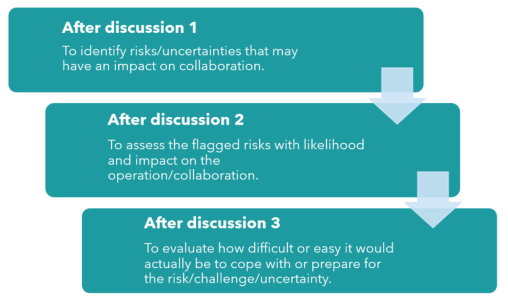
Figure 1: Three stages of the INCLUS survey tool during ATOMEX TTX 2024.
In the next step, experts with sufficient domain knowledge about the different risk categories were engaged to identify and assess the risks during the exercise. The participants were asked to complete three different surveys (Figure 1). The goal of the first risk identification survey was to identify what each participant perceives as potential risks or uncertainties affecting collaboration and which risks are relevant to assess in the next stages. The participants were asked to flag all pre-identified risks and uncertainties that they found relevant or thought could have an impact on the operation and collaboration. If the participants had further suggestions, they could add their suggestions, and that risk was added to the next two surveys. Risks that did not receive any flags were discarded from the surveys.
In the second survey, the participants were asked to assess the likelihood of the risks as well as how large of an impact those risks would have on operational handling from their perspectives. They also had the opportunity to further explain their answers in a comment box for each risk. The goal of the second survey was to understand risk perceptions based on different levels of expertise and experience.
In the final assessment survey, the participants assessed each risk based on how easy or difficult it was to cope with it. The idea was to assess the challenge level for the risks in order to understand how difficult it actually was for the different authorities to prepare for or deal with the identified risks and uncertainties. Once again, the participants were encouraged to explain the answers further in a comment box. The inspiration for this assessment comes from the possible, implement, challenge, and kill (PICK) decision analysis methods on the prioritization of processes (George & George, 2003; Badiru & Thomas, 2013; Jones et al., 2023). Jones et al. (2023) utilized the PICK method to prioritize and classify practitioner needs for research and innovation across Arctic maritime safety and security actors by importance and level of difficulty (challenge). This method allowed them to set attainable priorities for future activities on maritime safety and security in the Arctic and, on the other hand, discard the ones that were too difficult to implement. Drawing from this method, the goal of the final assessment was to identify priorities for learning and collaboration activities among the authorities and to focus on further research agendas. We aimed to analyze the difficulty of coping with the risks, together with the impact assessment, to see which risks have a large impact and are difficult to cope with.
At the end of the survey, the participants were asked to list three main preparedness challenges in maritime nuclear SAR operations from their perspectives. The experts could provide their ideas while simultaneously seeing each other’s suggestions and allowing comments and dialogs on the identified risks. The tool assisted via automatic data sorting (Pyykönen & Kivinen, 2020).
Collaborative Risk Assessment in the Arctic 139
TABLETOP EXERCISE “ATOMEX – 2024” A TTX “ATOMEX – 2024”was held on 07 October 2024 in Espoo, Finland, on the campus of Laurea University of Applied Sciences. The purpose of the TTX was to identify risks and uncertainties related to preparedness and collaboration in radiological or nuclear maritime SAR operation by using the INCLUS survey tool. A tabletop is a discussion-based exercise type in which all participants gather and communicate in one common room (Elvegård & Andreassen, 2023).
The scenario involved a container ship in a position north of the small Norwegian city Honningsvåg, coming from the Russian city Murmansk with a cargo of 4000 containers bound for the Swedish city Gothenburg with a speed of 20knots. Among the cargo were radioactive and nuclear materials. The vessel experienced a minor explosion on board, allowing exercise participants discuss and assess the situation. After a while a fire developed, and the participants discussed a situation with ongoing release or exposure.
Nuclear preparedness in Norway is organized through a Crisis Committee for Nuclear Preparedness under the leadership of the Norwegian Authority for Radiation and Nuclear Safety (DSA). The committee has a mandate and is responsible for taking measures to reduce the impact of a nuclear accident. The DSA delegates authority to the Crisis Committee in the acute phase of a nuclear incident. Norway currently has a permanent contingency plan against nuclear incidents. The objective of national nuclear preparedness is to handle all potential incidents, regardless of probability. Maritime nuclear safety preparedness is characterized by complexity, especially in cases of SAR operation, because multiple organizations and at least two emergency preparedness systems are involved: maritime SAR and nuclear preparedness (Badu et al., 2024). This organizational complexity represents an uncertainty for collaborative risk assessments.
INCLUS Assessment Results The participants identified several key risks and challenges in nuclear emergency preparedness in the maritime Arctic, focusing on communication, competence, and coordination. The survey results highlighted various risks and challenges associated with nuclear emergency preparedness in the maritime Arctic, focusing on issues such as a lack of adequate protective equipment, communication difficulties, insufficient information, and coordination challenges among different authorities.
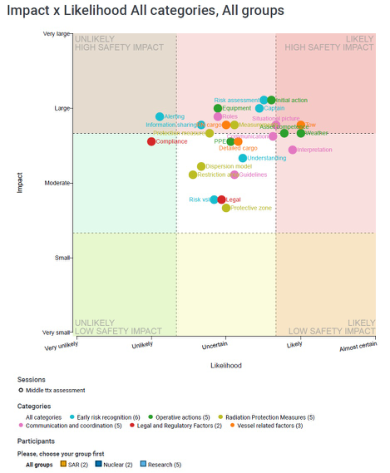
The three risk assessment surveys provided results for expert judgments of the estimation of identified risk probability, estimated impact, and the difficulty of coping with them. The results are presented in Figures 2, 3 and 4.
Figure 2 presents the results for all categories of risks for all exercise participants including SAR experts, nuclear safety experts and researchers. Quite a few risks were ranked high in the likelihood and impact that they could have on the operation. One major concern was how long the expert advice and radiation risk assessment would take or whether there was a
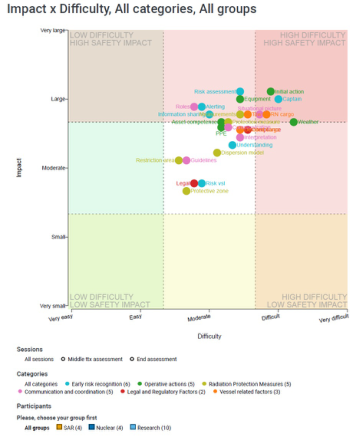
challenge in assessment consistency due to rapid changes in the situation, which influenced how to plan initial actions, assign assets, and conduct any operational handling without expert advice. This is due to the SAR system being reliant on quick and sound advice from radiation safety authorities on safety aspects for rescue crews. This, in turn, increases the risk of a window of opportunity to act or evacuate any possibly injured people. Both of these risks were also ranked high in the impact and difficulty assessments as seen in Figure 3.
Other notable risks that were perceived as high were uncertainties and challenges linked to the captain of the distress vessel not giving sufficient information about the situation and any possible risk with radioactive or nuclear cargo, as well as not having adequate response equipment and lack of a common situational picture with the authorities and other stakeholders involved in the emergency.
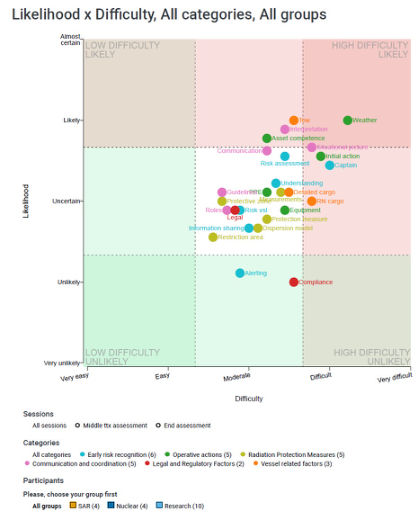
As seen in Figure 4, the participants estimated that the risk of weather conditions further increasing the radiological and nuclear risks is quite likely but also difficult to cope with. The participants also deemed that the likelihood and difficulty of having challenges in setting tow for the distress vessel with potential risk of radiation exposure was high. In addition, the participants were concerned that the authorities, volunteers and lay people may have different interpretation of the same risk data, such as dose rates and prognosis.
Figure 2: INCLUS survey results, impact and likelihood, all categories, and all groups.
Collaborative Risk Assessment in the Arctic 141
Figure 3: INCLUS survey results, all categories, and all groups.Figure 4: INCLUS survey results, all categories, and all groups.
DISCUSSION AND CONCLUSION The incorporation of expert judgment is crucial in shaping maritime risk awareness and decision-making processes. This study highlighted the importance of integrating expert knowledge to enhance the understanding
and management of maritime risks. Various assessments from different participant groups highlighted the need for understanding situation-specific aspects, such as recognizing radiation risk elements, and the early involvement of ship captains. Clear roles and responsibilities, harmonized guidelines and procedures across authorities, and well-defined legal responsibilities and actions were also emphasized.
The participants consistently pointed out the necessity for predefined guidelines, better training, clear roles and responsibilities, and improved communication systems to effectively mitigate risks. Risks that were considered difficult to cope with but deemed to have a major impact on the operation were related to potential delays in expert risk assessment and the initial actions of rescue assets. As these risks are intertwined and may hamper operational capability, it is crucial to prioritize these risks in further collaboration activities. The early involvement of experts and the consistent sharing of reliable information were deemed essential for ensuring a coordinated response.
The assessments revealed variability in the probability distribution indicating the likelihood of various collaborative outcomes.
The ATOMEX TTX exercise identified the need for collaborative risk assessments based on multiple criteria to enhance the understanding and management of risks. Future qualitative studies should explore techniques for combining uncertainty estimates from multiple experts to assess the same variables. This approach could provide a more comprehensive understanding of uncertainties.
However, the study’s limitations, such as the small number of respondents, restrict the ability to draw definitive conclusions about the overall risk level. Despite this, collaborative risk assessment and data visualization have the potential to significantly map group risk awareness and enhance mutual trust, as part of exercise activities (Elvegård et al., 2024). In conclusion, the integration of expert judgment and collaborative approaches in risk assessment can substantially enhance maritime risk awareness and decision- making processes.
ACKNOWLEDGMENT
The authors would like to acknowledge the support of the project “Collaboration Complexity in Nuclear Emergency Preparedness in the Maritime Arctic” (ATOMEX), funded by the Research Council of Norway, grant agreement No. 336285. We would like to thank Norwegian Radiation and Nuclear Safety Authority and Joint Rescue Coordination Centre Norway.
REFERENCES
Andreassen, N., & Pincus, R. (2022). Disaster definitions from an Arctic perspective.
In M. Aronsson-Storrier & R. Dahlberg (Eds.), Defining disaster: Disciplines and domains. Edward Elgar Publishing. Aven, T. (2012). The risk concept—Historical and recent development trends.
Reliability Engineering & System Safety, 99, 33–44. Aven, T., & Thekdi, S. (2022) Risk Science: An Introduction. Oxon: Routledge.
Collaborative Risk Assessment in the Arctic 143
Badiru, A. B., & Thomas, M. U. (2013). Quantification of the PICK chart for process improvement decisions. Journal of Enterprise Transformation, 3(1), 1–15. Badu, J., ElvegÃ¥rd, R., Nazir, S. & Andreassen, N. (2024). Situation Awareness in
Crisis Management – A Case Study from the Arctic Region. Training, Education, and Learning Sciences, Vol. 155, 102–113, http://doi.org/10.54941/ahfe1005395 Choi, J., Lee, S., & Choi, H. Y. (2022). The Influence of Knowledge, Trust, and Perceived Risk on Firefighters’ Preparedness and Willingness to Respond to Nuclear Emergencies: The Case of South Korea. International Journal of Disaster Risk Science. 13 (4), 536–548. Elvegård, R., & Andreassen, N. (2023). Exercise design for interagency collaboration
training: The case of maritime nuclear emergency management tabletop exercises. Journal of Contingencies and Crisis Management, 32(1), https://doi.org/10.1111/ 1468-5973.12517 Elvegård, R., Andreassen, N., & Badu, J. (2024). Building collaboration and trust in emergency preparedness: a model for planning collaboration exercises. Safety in Extreme Environments, Vol. 6, 319–331 https://doi.org/10.1007/s42797-024- 00107-w Elvegård, R., & Andreassen, N. (2023). Exercise design for interagency collaboration training: The case of maritime nuclear emergency management tabletop exercises. Journal of Contingencies and Crisis Management, 32(1), https://doi.org/10.1111/1468-5973.12517 Endsley, M. R. (1995). Toward a theory of situation awareness in dynamic systems.
Human Factors, 37(1), 32–64. Endsley, M. R., & Garland, D. J. (2000). Situation awareness: Analysis and measurement. Lawrence Erlbaum. EPPR. (2019). EPPR ARCSAFE Summary Status Report. http://hdl.handle.net/11374/2395 George, M. L., & George, M. (2003). Lean six sigma for service (p. 273). New York,
NY: McGraw-Hill. Hario, P. (2018). Arctic Search and Rescue Training Survey conducted in SARC: An example of a side-project by good networking and successful track record, Laurea Journal, 29.08.2018. Johannessen, S., Andreassen, S. M. H., Haavik, T. K., Taarup, J., & Kruke, B. I.
(2025). Co-creation of risk in evacuation settings A risk governance approach to natural hazards risks. Safety Science, 185, 106780. Jones, D., Labib, A., Willis, K., Costello, J. T., Ouelhadj, D., Ikonen, E. S., & Cainzos, M. D. (2023). Multi-criteria mapping and prioritization of Arctic and North Atlantic maritime safety and security needs. European Journal of Operational Research, 307(2), 827–841. Kapucu, N., & Hu, Q. (2014). Understanding the multiplexity of collaborative
emergency management networks. The American Review of Public Administration, 46(4), https://doi.org/10.1177/0275074014555645 Krueger, T., Page, T., Hubacek, K., Smith, L. & Hiscock, K. (2012). The role of expert opinion in environmental modelling, Environ. Model. Softw., 36, pp. 4–18, https://doi.org/10.1016/j.envsoft.2012.01.011. Marchenko, N., Andreassen, N., Borch, O. J., Kuznetsova, S., Ingimundarson, V.,
& Jakobsen, U. (2018). Arctic shipping and risks: Emergency categories and response capacities. International Journal on Marine Navigation and Safety of Sea Transportation, 12(1), 107–114. Mondino, E., Scolobig, A., Borga, M., & Di Baldassarre, G. (2020). The role of experience and different sources of knowledge in shaping flood risk awareness. Water, 12(8), 2130.
Naderpour, N., Lu J., & Zhang, G. (2014). A situation risk awareness approach for process systems safety. Safety Science, 64, 173–189. O’Hagan, A. (2012). Probabilistic uncertainty specification: Overview, elaboration
techniques and their application to a mechanistic model of carbon flux, Environ. Model. Softw., 36 (2012), 35–48. Paton, D. (2003). Disaster preparedness: A social-cognitive perspective, Disaster Prevention and Management: An International Journal, 12(3), 210–216. Pescaroli, G., & Alexander, D. (2015). A definition of cascading disasters and
cascading effects: Going beyond the “toppling dominos” metaphor. GRF Davos Planet@Risk, 3(1), Special Issue on the 5th IDRC Davos 2014, March. Pyykönen, J., & Kivinen, L. (2020). Rapport om evaluering av effektiviteten av krisehåndtering og evalueringskriterier, Regjeringsrapporter 2/2020, http://urn.fi/ URN: NBN: fi-fe2020111189997. Refsgaard, J. C., van der Sluijs, J. P., Højberg, A. L., & Vanrolleghem, P. A.. (2007).
Uncertainty in the environmental modelling process – a framework and guidance, Environ. Model. Softw., 22, 1543 https://doi.org/10.1016/j.envsoft.2007.02.004. Uusitalo, L., Lehikoinen, A., Helle, I., & Myrberg, K. (2015). An overview of methods to evaluate uncertainty of deterministic models in decision support, Environmental Modelling & Software, Volume 63, 2015, 24–31, ISSN 1364– 8152, https://doi.org/10.1016/j.envsoft.2014.09.017.
LISTED IN THE AHFE DIGITAL BOOKSTORE CATALOGUE
Explore the complete digital volume
Training, Education, and Learning Sciences
Read this individual research paper free through the original publisher, or explore the full digital proceedings book.
ISBN 978-1-964867-69-4
Explore this ISBN in the AHFE Bookstore ↗Listed in the July 2026 bookstore catalogue; search by ISBN to confirm current availability · Digital book purchase optional