Nathan Sonnenfeld, Alexis Sanchez, Nelly Dragu, Sierra Outerbridge, Blake Nguyen, Stephen Fiore, Florian Jentsch (2025). Crafting Recall: Impacts of Narrative on Semantic vs. Episodic Memory & Perceptions for an Aviation Procedure. In: Training, Education, and Learning Sciences. AHFE Open Access, vol. 193, pp. 123–133. https://doi.org/10.54941/ahfe1006653
This work examines considerations for integrating narratives into instructional design for individual and team training. Narrative, touted for its potential to enhance comprehension and retention, serves an important role in professional learning in safety-critical domains such as defense and aviation. However, not much is known about “how” and “why” narrative works. This work synthesizes concepts, theories, and findings on narrative to address gaps in the literature on its use within simulation training, focusing specifically on enhancing the memorability of instructional narrative. We present a systematic framework for crafting memorable narratives to support episodic facilitation through the grounding and framing of simulation training. We also examined the applications of this framework, through a pilot study supporting a program of research on the role and value of episodic memory (EM) within aviation training, Participants (n = 53) reviewed a text describing the steps of an exterior preflight inspection as a procedural checklist or an instructional narrative, then completed a battery of tests of their episodic recall and semantic knowledge. The narrative intervention had positive and significant effects on EM, including composite measures of tacit knowledge and EM formation, on individual features of episodic representation, and on the degree of integration of EM. As anticipated, the use of narrative failed to have any effect on semantic memory, and there were no effects on a set of affective or motivational factors as conventionally associated with narrative. The results of our study advance the concept of episodic facilitation for instructional design and provide preliminary validation of an approach to the measurement of EM for instructional events. This research may provide researchers and training practitioners the basis of a toolkit for applying and assessing the use of instructional narratives for simulations in safety-critical domains.
Narrative is often promoted as an effective instructional technique; narratives are said to be read twice as fast, yet remembered twice as long (Graesser et al., 2002; Riedl & Young, 2014). There is a rich precedent for the use of narrative in safety-critical domains such as aviation and defense (Andrews et al., 2010; Finlayson & Corman, 2013). However, narratives tend to be underutilized
in simulation training contexts, and there is a lack of consensus regarding “why” narrative works and “how” it may effectively support training. Specifically, there is a dearth of guidance on how to craft and implement a memorable narrative. To address this gap, we developed a framework for instructional narrative following a review of narrative concepts, theories, and findings, focusing specifically on enhancing the memorability of instructional narrative to support episodic facilitation for individual and team training. We then tested an application of this framework.
Instructional Narrative: Definitions & Concepts Narratives represent series of events with a persistent subject (Abbott, 2020; Prince, 1987). They integrate story—an abstraction of causally related agents, actions, affects, and contexts—with discourse, its expression and mediation (Bal, 1998; Bruner, 1991; Finlayson & Corman, 2013). In terms of comprehension, we focus on how relations between agents, objects, contexts are generated and encoded in coherent narratives (Graesser et al., 2002; Riedl & Young, 2014).
Narrative Interventions. For brevity, we reserved a more detailed overview of interventions for the paper presentation. Before training, elicitation, mental practice, and scaffolding may be used (e.g., Andrews et al., 2010; Klein, 1999). During training, case-/story-/project- and scenario-based approaches have been applied (Andrews et al., 2010; Höfler et al., 2017). Afterward, narratives may be used to guide debriefing, after-action review, and reflection (Fiore et al., 2005).
Narrative Elements & Features. The core elements of narrative include agents, intentions, conflict, actions, context, and structure (e.g., Klein, 1999). Further, there are unique features of meso-level narratives that support memorability (cf. Hühn et al., 2014). Plausibility ensures that an acquired situation model is comparable to others when a narrative is coherent (locally and globally) and the plot aligns with the promises inherent at the onset (Andrews et al., 2010; Graesser et al., 2002; Sanderson, 2020). Tension arises from the learners’ retrospection on the narrative past (curiosity), prospection (suspense), and recognition (surprise) (Leshchenko, 2018); learners empathize with the conflicts experienced by characters, and the resolution of tension through narrative events (plot) provides a medium for the acquisition of insight (Klein, 1999; Sanderson, 2020). Novelty may be surmised by the concept of the “breach of canonicity”, the subversion of expectation; i.e., the narrative offers a unique perspective and interpretation of events (Bruner, 1991, p. 11; Klein, 1999). Recurrence may take many forms within narrative; through the pacing of tension (e.g., rising and falling action), via the synchronicity of events, or through characterization in shared and contrasting qualities of agents. These recurrences—within and across narratives—may culminate in motifs, tropes, archetypes, and they form the basis of canonicity (Goodwyn, 2013; Bruner, 1991). Prosody, the patterns of rhythm, sound, and intonation within a narrative, factor into its resonance (Goodwyn, 2013). Experientiality promotes memorability through vivid details and concrete categories that are easier to visualize and mentally simulate (Goodwyn, 2013; Hühn et al., 2014; Klein, 1999).
Crafting Recall: Impacts of Narrative on Semantic vs. Episodic Memory 125
Effects of Narrative. Well-crafted narratives can evoke a sense of presence in learners, allowing them to vicariously experience situations through visualization and social learning (Andrews et al., 2010; Dautenhahn, 2003; Klein, 1999). Narrative is a means by which tacit knowledge is expressed and acquired (McDaniel et al., 2010), fostering pattern recognition, analogical reasoning, and the generation of dynamic context-sensitive relational schemas within imagery-rich mental simulations. These processes help transfer meaning and inferences to the operational environment (Andrews et al., 2010; Sonnenfeld et al., 2023a). Ultimately, narratives support the acquisition of intuition, enabling learners to recognize patterns in situational dynamics—and, importantly, anomalies (Klein, 1999). These effects underscore the prevalence of narrative in both informal (e.g., hangar talk, field stories) and formal (e.g., scenario-based) training contexts.
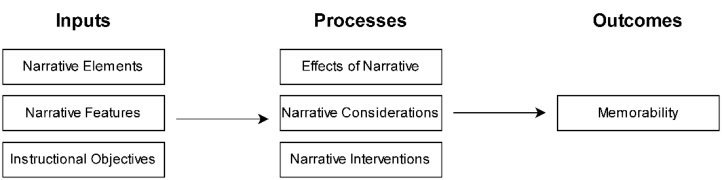
Crafting Memorable Instructional Narratives Based on our review of relevant narrative theories, concepts, and findings, we developed a simple input-process-output (IPO) framework for enhancing the memorability of instructional narrative to support episodic facilitation in individual & team training (see Figure 1). Below, we focus on three specific considerations to enhance memorability: characterization, competence, and canonicity.
Figure 1: IPO framework for enhancing the memorability of instructional narrative.
Characterization concerns features (e.g., drives, values, motives) which define characters as more memorable than simple actors/agents (Samsonovich & Aha, 2015). It concerns how these traits are expressed through characters’ goal-directed interactions—shaping their attention, perceptions, and behavior (Sanderson, 2020). It may be used to support coherence and reinforce instructional objectives, while different characterizations can represent alternative perspectives on a topic.
Competence refers to the extent to which characters (e.g., the protagonist) are shown to have instructionally relevant skills—and complementary shortcomings—and their agency to apply those skills and overcome flaws (Emmons, 2020; Sanderson, 2020). When aligned with training objectives, this element provides a basis for the learners’ sense of relatability to characters to enhance memorability.
Canonicity and breach, for Bruner (1991), drive memorability. Breach is the deviation or violation of an “implicit canonical script” (p. 11); that is,
expectations and procedures that are culturally and institutionally normative. This breach should align with training objectives and require an inversion of the character’s misbelief to resolve the operational dilemma, making the instructional value of the narrative salient to learners’ attention (Finlayson & Corman, 2013; Goodwyn, 2013).
We applied each of these in the narrative used in our study. We exhibited competence by having the protagonist reflect on their career as an airline captain, and applied characterization through their safety attitudes and a frame of concern for the families of passengers. We also established a breach of canonicity through the specification of a deviation from the normal routine of preflight inspection.
METHOD
We aimed to test the application of the framework by conducting an online study. We examined the impact of narrative on learning the steps of exterior preflight inspection of an airliner. We investigated the effects of Episodic Facilitation (Used; Not Used) on learning processes and outcomes: including story quality and narrativity, and analyses of semantic/episodic memory formation and perceptions.
Participants A total of 100 undergraduate psychology students were recruited for this online pilot study conducted via the Qualtrics platform, Data were excluded following checks for withdrawals, missing data, and malingering (e.g., timing, probable use of generative AI). After cleaning and those exclusions, the final sample included 53 participants, ages 18–30 (18–20: 88.7%; 21–30: 11.3%), majority female (60.4%), randomly assigned to one of two conditions: Episodic Facilitation (Used; n = 26) and Episodic Facilitation (Not Used; n = 27).
Procedure Instructional Intervention. After random assignment, completion of demographic and psychometric surveys, and presentation of the instructional objective, participants were given 6 minutes to review the only instructional material for this study, an advance organizer (AO). An AO introduces key concepts prior to instruction and can be presented graphically, visually, or textually in the form of an outline or narrative (Vogel-Walcutt et al., 2013). Episodic facilitation was represented by a ‘Narrative AO’, which presented a brief story of a pilot performing the task; participants in the Episodic Facilitation Not Used condition instead received a ‘Procedural AO’, which outlined the steps of the task as based on actual training material used at an air carrier, and consisted of a purpose statement, a checklist of components, and a list of conditional statements regarding their condition. The Narrative AO provide the same information but with added narrative context including characterization, competence, and breach of canonicity (i.e., conflict; a clogged pitot tube), based on our instructional narrative framework. Content for both AOs consisted of exterior preflight inspection steps from the nose
Crafting Recall: Impacts of Narrative on Semantic vs. Episodic Memory 127
section, around the right (starboard) side of the aircraft, through the tail section.
Narrativity Check. Participants completed other surveys (e.g., personality, cognition & metacognition, gaming & aviation experience), including the Perceived Story Quality Index (Baron & Bluck, 2011), a question of narrativity (bespoke, whether the participant considered the text to be a narrative/story), and an open response to explain their answer. Participants then completed a battery of tests of their episodic recall and semantic knowledge.
Episodic Recall Tests. Untimed, these included (1) a delayed free recall task; (2) a what-where-when (WWW) task; and (3) a spatiotemporal mapping task.
Delayed-Free Recall Task. Participants were asked to recall every detail they could remember about the exterior preflight inspection task, as reviewed during the instructional intervention. They were instructed to verbalize and submit an audio recording of their responses using the Qualtrics platform. A text response option was also provided to account for technical or other issues. A preliminary scoring approach was applied to the response transcripts to assess features of episodic representation as a proxy for tacit knowledge. This included simple counts of listed components (specificity), sensory details (vividness), who/how/why context statements (coherence), affective terms (affect) and total word count (fluency), a 4-point rubric-based rating (quality), and a measure of the average level of what-where-when integration for each component listed (integration). Use of the delayed-free- recall task, a more autobiographical assessment approach (e.g., Levine et al., 2002), was intended to support the triangulation of tacit knowledge by accounting for top-down EM processes (e.g., Conway, 2009).
WWW-Paradigm Assessment. Next, we adapted a novel approach to the what-where-when task (WWW; Laurent et al., 2016), integrating item/object memory (what) with the spatial (where) and temporal (when) context of the memory. This supported triangulation of tacit knowledge by accounting for feature-binding—integrating intrinsic object information (i.e., item/object memory; “content”) and extrinsic spatiotemporal contextual information (i.e., source memory; “context”) into a higher-level representation (e.g., Barclay, 2019). Scoring was rank-ordered, such that all item responses had to be correct to qualify as episodic recall, with incorrect responses corresponding to non-EM at successively lower orders of integration. Participants were asked to recall the names of up to ten (10) aircraft components (the “what”) from the instructional material. They then indicated “where” each component should be inspected, selecting from a list of the sections of the aircraft. Finally, participants indicated “when” the component should be inspected, relative to the component listed prior (i.e., “Before”, “Concurrently”, “After”), with an “NA/Not Sure” option for each. Additional responses (items on egocentric/allocentric perspective, remember/know/guess, retrospective confidence judgements) were collected but not included in our reporting here.
Spatiotemporal Mapping Task. Last, we tested participants’ spatial configuration knowledge—their mental/cognitive map, as an allocentric
representation of points of interest and routes in context of environmental spaces and boundaries (Bendell & Williams, 2023). We adapted Bendell & Williams’ (2023) point/route configuration knowledge test protocol, prompting participants to digitally sketch a map of the locations of the ten (10) aircraft components (as listed and numbered in the WWW assessment) and connecting routes/paths of the inspection, from an allocentric reference frame (here, a reference image outlining the aircraft). These scores are not reported here, as the task simulation was not implemented; responses were solely used to inform future use of the approach.
Semantic Knowledge Test. Participants also completed a semantic knowledge test of the exterior inspection task adapted from our prior work (Nguyen et al., 2023), which included a subset of 4 items of varying formats—multiple choice, rank-order, pick & group, and open response— corresponding to levels of semantic knowledge integration (see Sonnenfeld et al., 2023b). Participants had 5 minutes to complete the test to facilitate automaticity in semantic retrieval processes. Total scores were calculated as the arithmetic mean of item scores, based on response accuracy or a 4-point rubric as adapted from prior work (Nguyen et al., 2023).
RESULTS
Narrativity & Story Quality Narrativity. We conducted a Fisher’s Exact Test to examine if there was a positive association between the use of episodic facilitation and its perceived narrativity (Narrative/Story vs. No Narrative/Story). The test indicated a strong and statistically significant association between the use of episodic facilitation and its perceived narrativity (p <.001, ϕ = −0.78; OR –4.05; 95% CI [–∞, –2.52]). Participants in the condition that used Episodic Facilitation were four times more likely to consider the intervention a narrative/story (41.82%) compared to the group where episodic facilitation was not used (5.46%).
Story Quality. Next, we conducted an independent two-sample t-test to examine whether the use of episodic facilitation resulted in higher perceived story quality (PSQI Total). The test indicated that the Narrative AO was associated with significantly higher PSQI Total scores (M = 25.3, SD = 5.9) than the Procedural AO (M = 20.1, SD = 4.5), t(53) = 3.73, p <.001, d = 1.01, indicating a large effect with a mean difference of 5.2 on a 40-point scale (∼13 percentage points).
Story Quality Features. An exploratory MANOVA was conducted to examine the effect of episodic facilitation on specific PSQI items. It showed a similar effect of the intervention on the combined index (V = .393, F(8, 46) = 3.719, p = .002), with follow-up univariate ANOVAs suggesting that the source of the difference in story quality may have originated from, amid other features, participants’ ratings of whether the text evoked emotion (F(1, 53) = 23.70, p <.001), imagery (F(1, 53) = 18.63, p <.001), and engagement (F(1, 53) = 4.33, p = .042), providing context to the subsequent analyses, and informing future directions for this research.
Crafting Recall: Impacts of Narrative on Semantic vs. Episodic Memory 129
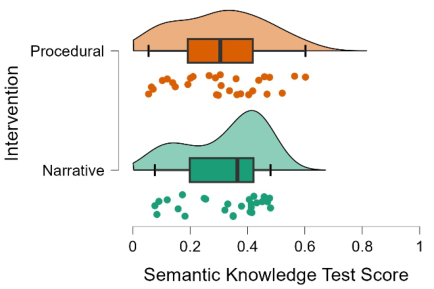
Semantic Memory Formation & Knowledge Semantic Knowledge. We conducted an ANOVA to determine whether episodic facilitation impacted semantic knowledge as operationalized by overall semantic knowledge test score (as an arithmetic mean of correct responses). Results of the ANOVA failed to show any effect of episodic facilitation on overall semantic knowledge test scores, F(1, 53) = 0.176, p = .676, η2p < 0.01. The nonparametric Kruskal-Wallis test showed similar non-significance, H(1) = 0.35, p = .555. There were no differences in overall semantic knowledge test score between participants given the Narrative AO (Episodic Facilitation—Used; M = 32.2%; SD = 13.6%) and the Procedural AO (Episodic Facilitation—Not Used; M = 30.5%, SD = 15.5%), suggesting that episodic facilitation did not significantly impact semantic memory formation in this instructional context (Figure 2).
Figure 2: Overall semantic knowledge test score distributions by intervention.
Semantic Memory Formation. Next, we conducted a one-way MANOVA to determine whether episodic facilitation impacted semantic memory formation as operationalized by the composite of individual response scores. We applied Pillai’s Trace to address a violation of homogeneity. Results of the omnibus MANOVA failed to show any effect of episodic facilitation on the composite of individual semantic knowledge test responses (V = .057, F(4, 49) = 0.74, p = .572).
Integration of Semantic Memory. A series of ANOVAs conducted as follow-up verified that episodic facilitation did not have any effect on levels of semantic knowledge integration, including: (Q1) pre-structural (remembering), F(1, 52) = 0.25, p = .618; (Q2) structural (understanding), F(1, 52) = 0.02, p = .898; (Q3) multi-structural (applying), F(1, 52) = 2.91, p = .094; and (Q4) relational (evaluating), F(1, 52) = 0.56, p = .458. There were no substantive differences between episodic facilitation conditions among semantic knowledge items.
Episodic Memory Formation & Tacit Knowledge Episodic Representation. To begin, we conducted a one-way MANOVA to determine how episodic facilitation affected measures of tacit knowledge
within EM (here, Specificity, Vividness, Coherence, Affect, Fluency, Integration, & Quality). We applied Pillai’s Trace. Results of the MANOVA showed a significant effect of episodic facilitation on the composite measures of episodic representation (V = .281, F(7, 43) = 2.40, p = .036).
Follow-up ANOVAs indicated that episodic facilitation had differential effects on subsets of the measures. Use of episodic facilitation had a statistically significant effect of medium size on (1) vividness (F(1, 49) = 4.16, p = .047, η2p = 0.08), (2) affect (F(1, 49) = 5.12, p = .028, η2p = 0.10), and (3) fluency (F(1, 49) = 6.65, p = .013 η2p = 0.12); however, the intervention was nonsignificant for (4) specificity (F(1, 49) = 0.01, p = .922, η2p < 0.01), (5) coherence (F(1, 49) = 1.34, p = .253, η2p = 0.03), (6) integration (F(1, 49) = 7.20, p = .400, η2p = 0.02), and (7) quality (F(1, 49) = 0.35, p = .556, η2p = 0.01). These results suggest that use of the narrative intervention had an observable effect on certain measures of episodic representation, but not others, suggesting a need for further scoring refinement.
Episodic Memory Formation. Next, we conducted a one-way MANOVA to determine how episodic facilitation affected measures of EM as operationalized by the WWW task (Non-Episodic/Object, Partial Episodic— Spatial, Partial Episodic—Temporal, Full Episodic). Given the robustness of MANOVA, we proceeded with the planned analysis acknowledging a violation of normality and applied Pillai’s Trace to address a violation of homogeneity.
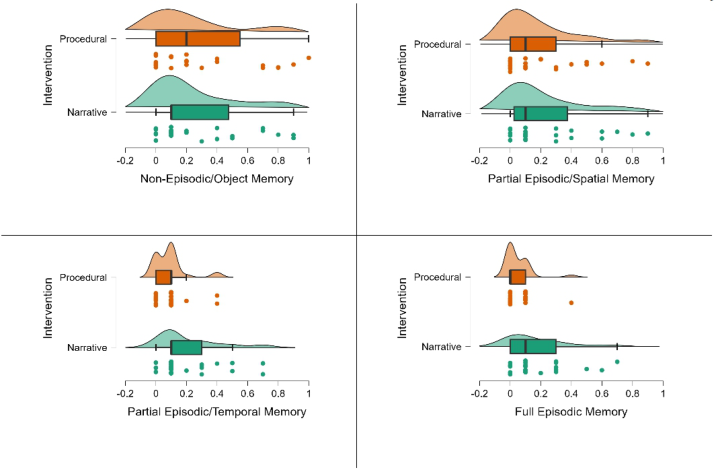
Results of the omnibus MANOVA indicated an effect of episodic facilitation on the composite for EM formation assessed by the WWW task (V = .317, F(4, 48) = 4.37, p <.001, η2p = 0.03), accounting for a large effect size of 31.7% of the multivariate variance in the combined WWW task scores, but a small effect size of 3% when accounting for error variance in the observed data. Examining EM integration, follow-up ANOVAs indicated that episodic facilitation had no effect on Non-Episodic/Object Memory (i.e., the “what”), (F(1, 51) = 0.07, p = .795), and no effect on Partial Episodic/Spatial memory (i.e., the “where”), (F(1, 51) = 0.23, p = .636). However, use of episodic facilitation had a significant effect on Partial Episodic/Temporal memory (i.e., the “when”), (F(1, 51) = 7.20, p = .010, η2p = 0.12), and a significant effect on Full EM, (F(1, 51) = 8.10, p = .006, η2p = 0.14), with medium effect sizes accounting for 12–14% of the variance in Temporal and Full EM scores, respectively. Results suggest that the Narrative AO intervention was an effective technique for episodic facilitation in this learning context, and moreover may provide further validation for the use of the WWW task for differentiating between semantic and episodic representations in memory.
As illustrated above (Figure 3), there were no significant differences between conditions in Non-Episodic/Object and Partial Episodic: Spatial memory scores. Significant differences emerged through the Partial Episodic: Temporal measure, with the Narrative AO group (M = 0.21, SD = 0.20) scoring higher than the Procedural AO group (M = 0.09, SD = 0.11), and culminating in the Full Episodic measure, with the Narrative AO group
Crafting Recall: Impacts of Narrative on Semantic vs. Episodic Memory 131
(M = 0.17, SD = 0.20) consistently outperforming the Procedural AO group (M = 0.05, SD = 0.09), accounting for the observed effect of episodic facilitation on temporal processing. Overall, given the limited time for reviewing the instructional material and the lack of a corresponding task simulation, it was empirically meaningful that an observable effect of episodic facilitation emerged as measurable by the WWW task, lending credibility to the use of this measure in this type of learning context.
Figure 3: Episodic memory measure distributions by intervention for WWW responses.
Perceptions Finally, we conducted a series of Mann-Whitney U-tests to examine whether episodic facilitation had any effect on learners’ perceptions of the instructional intervention, across a subset of different outcomes—focusing on post-intervention measures of satisfaction, perceived learning, perceived usefulness, perceived relevance, self-efficacy, and motivation. There were no significant differences in any of the measured outcomes arising from the use of episodic facilitation.
DISCUSSION & CONCLUSION In our study, we found that the narrative intervention had positive significant effects on various measures of EM—without any significant effects on measures of semantic memory, or other affective and motivational factors— validating that narrative affected learning through EM rather than via semantic memory. These results contribute to the concept of EM for instructional design and provide preliminary validation of an approach for
measuring EM of instructional events. This research may provide the basis of a toolkit for applying and assessing the use of instructional narratives in safety-critical domains.
ACKNOWLEDGMENT
The views expressed herein are those of the authors and do not reflect the views of the institutions to which they are employed, any sponsors, or the University of Central Florida.
REFERENCES
Abbott, H. P. (2020). ‘Defining narrative’, in The Cambridge Introduction to Narrative. Cambridge University Press. pp. 12–28. Andrews, D. H., Hull, T. D., DeMeester, K. (eds.) (2010). Storytelling as an
Instructional Method. Brill. Bal, M. (1998). Narratology: An Introduction to the Theory of Narrative. University of Toronto Press. Barclay, P. (2019). The effects of presence and cognitive load on episodic memory in
virtual environments. Ph.D. Thesis. University of Central Florida. Baron, J. M., Bluck, S. (2011) ‘That was a good story! Preliminary construction of the perceived story quality index’, Discourse Processes, 48(2), pp. 93–118. Bendell, R., Williams, J. (2023). ‘Assessing spatial knowledge and mental map
development under virtual training conditions’, Proceedings of the Human Factors and Ergonomics Society Annual Meeting, 67(1), pp. 1611–1616. Bruner, J. (1991). ‘The narrative construction of reality’, Critical Inquiry, 18(1), pp. 1–21. Conway, M. A. (2009). ‘Episodic memories’, Neuropsychologia, 47(11), pp. 2305–2313. Dautenhahn, K. (2003). ‘Stories of lemurs and robots: The social origin of story-
telling’, Narrative Intelligence, 46, pp. 63–90. Emmons, A. (2020, June 17). How to find your character’s misbelief [YouTube video]. Finlayson, M. A., Corman, S. R. (2013). ‘The military interest in narrative’, Sprache
und Datenverarbeitung, 37(1–2), pp. 173–191. Fiore, S. M., Johnston, J. H., McDaniel, R. (2005). ‘Applying the narrative form and XML metadata to debriefing simulation-based exercises’, Proceedings of the Human Factors and Ergonomics Society Annual Meeting, 49(25), pp. 2135–2139. Goodwyn, E. (2013). ‘Recurrent motifs as resonant attractor states in the narrative
field: A testable model of archetype’, Journal of Analytical Psychology, 58(3), pp. 387–408. Graesser, A. C., Olde, B., Klettke, B. (2002). ‘How does the mind construct and represent stories?’, in M. C. Green, J. Strange, T. C. Brock (eds.), Narrative Impact: Social and Cognitive Foundations. Mahwah NJ: Lawrence Erlbaum Associates, pp. 231–263. Höfler, E., Zimmermann, C., Ebner, M. (2017). ‘A case study on narrative structures
in instructional MOOC designs’, Journal of Research in Innovative Teaching & Learning, 10(1), pp. 48–62. Hühn, P., Meister, J. C., Pier, J. Schmid, W. (2014). Handbook of Narratology (2nd ed.). Berlin, München, Boston: De Gruyter. Klein, G. (1999). Sources of Power: How People Make Decisions (2nd ed.) The MIT
Press.
Crafting Recall: Impacts of Narrative on Semantic vs. Episodic Memory 133
Laurent, X., Ensslin, A., Marí-Beffa, P. (2016). ‘An action to an object does not improve its episodic encoding but removes distraction’, Journal of Experimental Psychology: Human Perception and Performance, 42(4), pp. 494–507. Leshchenko, H. (2018). ‘Narrative tension within the framework of cognitive
modeling’, Cognition, Communication, Discourse. Series: Philology, 16, pp. 51–63. Levine, B., Svoboda, E., Hay, J. F., Winocur, G., Moscovitch, M. (2002). ‘Aging and autobiographical memory: Dissociating episodic from semantic retrieval’, Psychology and Aging, 17(4), pp. 677–689. McDaniel, R., Fiore, S. M., Nicholson, D. (2010). ‘Serious storytelling: Narrative
considerations for serious games researchers and developers’, in Serious Game Design and Development: Technologies for Training and Learning. IGI Global, pp. 13–30. Nguyen, B., Sonnenfeld, N. A., Duruaku, F., Jentsch, F. G. (2023). Modern Training Practices: Studying the Use of Virtual Reality for Training Procedures in Flightcrew Training. Orlando: University of Central Florida. Prince, G. (1987). A Dictionary of Narratology. University of Nebraska Press,
Lincoln. Riedl, M. O., Young, R. M. (2014). ‘The importance of narrative as an affective instructional strategy’, in R. Sottilare, A. Graesser, X. Hu, B. Goldberg (eds.), Design Recommendations for Intelligent Tutoring Systems: Volume 2 Instructional Management. Orlando, FL: U.S Army Research Laboratory, pp. 57–70. Samsonovich, A. V., Aha, D. W. (2015). ‘Character-oriented narrative goal reasoning
in autonomous actors’, Goal Reasoning: Papers from the ACS Workshop (GT-IRIM-CR-2015-001). Atlanta, GA: Georgia Institute of Technology, pp. 166–181. Sanderson, B. (2020). 2020 Creative Writing Lectures at BYU [YouTube series]. Sonnenfeld, N. A., Nguyen, B., Gomez, C., Jentsch, F. G., Fiore, S. M. (2023a). ‘On episodic memory in experiential learning for flightcrew training’, Proceedings of the Interservice/Industry Training, Simulation, and Education Conference, 23396. Sonnenfeld, N. A., Nguyen, B., Duruaku, F., Alonso, A., Carney, M., Smith, E.,
Jentsch, F. G. (2023b). ‘Flightcrew procedures experimental training: Simulation testbed design, development, & interactive demonstration’, Proceedings of the Human Factors and Ergonomics Society Annual Meeting, 67(1), pp. 253–258. Vogel-Walcutt, J. J., Del Giudice, K., Logan, F., Nicholson, D. (2013). ‘Using a video game as an advance organizer: Effects on development of procedural and conceptual knowledge, cognitive load, and casual adoption’, Journal of Online Learning and Teaching, 9(3), pp. 376–392.
LISTED IN THE AHFE DIGITAL BOOKSTORE CATALOGUE
Explore the complete digital volume
Training, Education, and Learning Sciences
Read this individual research paper free through the original publisher, or explore the full digital proceedings book.
ISBN 978-1-964867-69-4
Explore this ISBN in the AHFE Bookstore ↗Listed in the July 2026 bookstore catalogue; search by ISBN to confirm current availability · Digital book purchase optional