Mika Morishima, Momoka Fujii (2023). Pilot study on the filtration efficiency of non-medical facemasks according to fit. In: Healthcare and Medical Devices. AHFE Open Access, vol. 79, pp. 266–271. https://doi.org/10.54941/ahfe1003496
A non-medical facemask is one of the health care products used to prevent harmful substances from entering the human body. In the wake of COVID-19 outbreak, the effect of wearing a facemask has been researched all over the world. However, the comfort based on fit while wearing a facemask in the community setting continues to be an issue. Therefore, we have been studying the fit and comfort of non-medical facemasks in an effort to develop our own design. In this presentation, we report the filtration efficiency (FE) of our prototype facemask based on the patterns with four sizes. The patterns were analysed in an earlier study. The FEs of the facemasks against particles with a particle size of 0.3–5.0 µm, from smallest to largest size, were 45.4%, 95.2%, 98.0%, and 98.3%. The prototype facemask with larger sizes statistically demonstrated a high FE. The FE depended on the area of the facemask and fit against the facial surface. The patterns were useful from the viewpoints of protection against particles.
The filtration efficiency (FE) and other aspects of facemasks, the N95 respirator, and others used as personal protective equipment were studied. There was limited research on non-medical facemasks in daily life, howe- ver, the spread of COVID-19 led to a drastic increase in research related to non-medical facemasks. Groups around the world such as the World Health Organization (World Health Organization, 2023), Centers for Disease Control and Prevention, and the Ministry of Health (Centers for Disease Control and Prevention (US), 2021), Labor and Welfare in Japan promoted the wearing of non-medical facemasks in community settings. Evidence sho- wed that properly wearing a facemask was an important countermeasure for infection control, in addition to social distancing and hand hygiene. However, the comfort of wearing a facemask continues to be an issue (Morishima et al., 2021) (Gericke et al., 2022) (Gholamreza et al., 2022). Therefore, we have been studying the fit and comfort of non-medical masks against the face with complex unevenness in an effort to develop our own design.
This presentation comprises of a prototype facemask and its FE. First, for the prototype pattern proposed in our previous research (Morishima and Mitsuno, 2019) (Morishima and Yoneda, 2022), we introduced an experi- mental method, analysis method, and acquired two-dimensional patterns.
Pilot Study on the Filtration Efficiency of Non-Medical Facemasks According to Fit 267
Second, using the proposed two-dimensional patterns with four sizes, we manufactured prototype non-medical facemasks without ear loops. Third, we built a simple system to count particles passing through the facemask. Fourth, using the system, the FE for the prototype non-medical facemask was calculated based on the measured particle numbers.
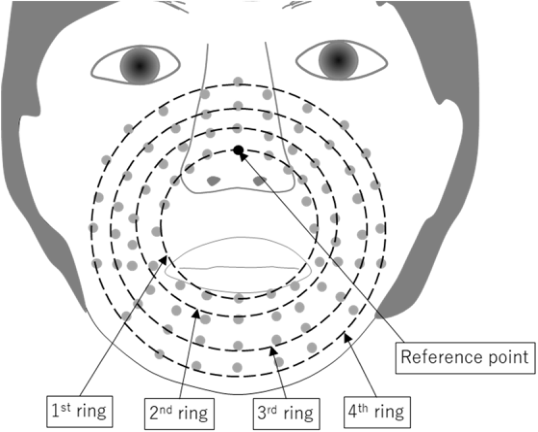
FACEMASK PATTERN In our previous study to explore the design and fit for younger Japanese fema- les, we analysed two-dimensional facemask patterns with four sizes based on the three-dimensional facial shape for 68 female Japanese participants. Figure 1 shows measurement points.
There were 18 measurement points on the 1st ring, 22 points on the 2nd, 3rd and 4th ring each on a female facial shape. The 1st ring was the smallest pattern to cover over only the nose and mouth. As a reference to the 1st ring, the larger rings of the 2nd, 3rd and 4th rings, had grading size with inte- rvals of 10mm. The hemisphere reflective markers with a diameter of 3mm were set on the measurement points. A three-dimensional motion capture system (DippMotionPro ver.2.24d, Ditect) measured the three-dimensional coordinates of each point. A combination of polygons composed the nose tip point and adjacent points on each ring, forming a facemask with four sizes by affine transformation. Figure 2 shows the analysed pattern with four sizes. To make it easy to understand, these patterns printed out on paper are illustrated in Figure 2. The smallest and largest patterns corresponded to the 1st and 4th ring, respectively. The two-dimensional pattern of the 1st ring was resembled an ellipse in shape. The pattern of the 2nd, 3rd, and 4th rings was similar to heart shape with two points on the dorsum of the nose. In
Figure 1: Measurement points.
268 Morishima and Fujii
Figure 2: Analysed two-dimensional patterns and three-dimensional models.
making a prototype facemask using fabric, the two points were joined. The two-dimensional fabric was converted into the three-dimensional product.
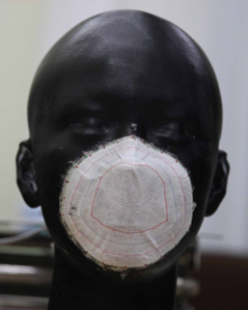
TRIAL MANUFACTURE OF PROTOTYPE FACEMASK In making of the facemask, an ink jet printer directly drew the analysed pat- tern onto the nonwoven fabric. The fabric picked out was a filter sheet in the middle layer of commercial 3-ply non-medical facemask from the Japanese market. The commercial facemask had 99% FE according to the manufa- cturer. A filter media in the middle layer was used as the sample fabric for the test. The prototype facemask without ear loops was worn by a female dummy using double-sided tape to secure it. The dummy with the average head characteristics of a Japanese female was built based on the Anthro- pometric Database of Japanese Head 2001 of mean head characteristics published by the National Institute of Advanced Industrial Science and Tech- nology (Kouchi and Mochimaru, 2008). Figure 3 shows the 1st and 4th ring facemasks worn as examples.
MEASUREMENT OF THE NUMBERS OF PARTICLES We constructed a simple measurement system to count the number of parti- cles. The condition of the test room was 25 ± 2
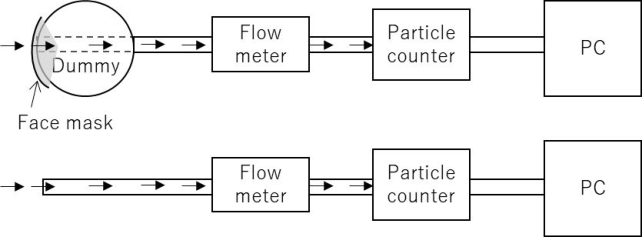
C and 40% ± 5% relative humidity. The test was conducted under daily life conditions and the parti- cles were not controlled. Figure 4 shows a dialog of the counting system of particle numbers while wearing the facemask. The upper schematic view was counting the particle numbers in conditions wearing the prototype facemask. The lower schematic counted particles in conditions without the facemask.
The system comprised of two handheld particle counters, two flow meters, and the female dummy. The particle counter had 6 channels of 0.3 to 0.5 µm,
Pilot Study on the Filtration Efficiency of Non-Medical Facemasks According to Fit 269
Figure 3: Prototype facemask worn by the dummy.Figure 4: Dialog of the counting system of particle numbers while wearing the facemask.
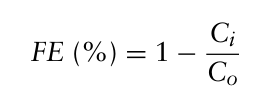
0.5 to 0.7 µm, 0.7 to 1.0 µm, 1.0 to 2.0 µm, 2.0 to 5.0 µm, and more than 5.0 µm. Each particle counter counts the number of particles flowing in and out of the prototype facemasks worn by the dummy. The set flow rate of the particle counter was 2.83 L/min. Real flow rate measured by the flow meter provided concentration of particle numbers per unit volume. Using inward (Ci) and outward (Co) concentrations, FE was calculated using Equation (1) (Pan et al., 2021). The measurement time was 60 seconds. In succession, a sample was tested for 10 minutes. The last five data measurements out of 10 taken for each sample were employed to calculate FE. The test was conducted three times per sample type.
Equation reproduced from the original PDF.
× 100 (1) Co
Calculated FEs were compared among 4 types of rings by t-test.
FILTRATION EFFICIENCY OF PROTOTYPE FACEMASK Mean values and standard deviation (S.D) of 0.3 to 0.5 µm, 0.5 to 0.7 µm, 0.7 to 1.0 µm, 1.0 to 2.0 µm, 2.0 to 5.0 µm, and these totals were calculated
270 Morishima and Fujii
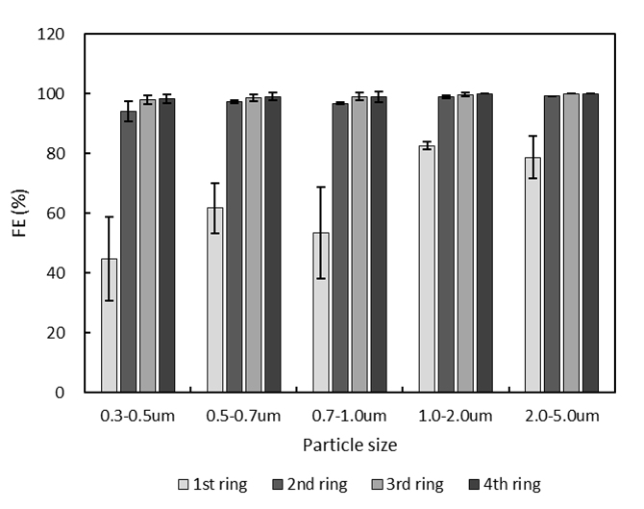
for the samples. Figure 5 shows the FE of each channel in the range of 0.3 to 5.0 µm for the prototype facemask. In all ranges of particle size, the 1st ring had FEs of 44.7% in 0.3 to 0.5 µm and 82.5% in 1.0 to 2.0 µm. Meanwhile, the other ring in each range of particle size had more than 90% FE. From these results, the prototype non-medical facemask made along our analysed patterns had high filtration efficiencies except the smallest size. FEs based on the total particle num- bers for 0.3 to 5.0 µm were 45.4%(1st ring), 95.2%(2nd ring), 98.0%(3rd ring), and 98.3%(4th ring). All FEs were lower against the 99% illustrated on the available products. Air gaps between the face and facemask by wearing may have influenced these results and caused a decrease of FE from 53.6% (1st ring) to 0.7% (4th ring).
Focusing on the difference in the size, in spite of the same material among the samples, the 1st and the 2nd rings had lower FEs than the other rings (1st ring; P = 0.003< 0.01, 2nd ring; P = 0.03< 0.05). There were no differences between the 3rd and 4th rings (P = 0.813> 0.05).
Penetration through the facemask media and intrusion from air gaps betw- een the face and the facemask were factors of total inward leakage of the particle. It seemed to influence the sample area, liner velocity, and fit against the dummy’s face. Overall, the analysed pattern with larger sizes provided a high FE. The pattern of 3rd and 4th rings was of a superior design to better fit against the facial surface.
Figure 5: Filtration efficiency (FE) for the prototype facemask.
Pilot Study on the Filtration Efficiency of Non-Medical Facemasks According to Fit 271
CONCLUSION
The non-medical facemask was a helpful hygiene product for prevention and as a countermeasure against harmful substances. This presentation reported FE of a prototype non-medical facemask made based on the analysed pattern in earlier research. Shape and size of the 3rd ring and 4th ring provided high FEs of 98.0% and 98.3%, respectively. In the near future, we will use the high-FE design to improve the comfort of wearing a facemask.
ACKNOWLEDGMENT
This work was supported by JSPS KAKENHI Grant Number 20K02342.
REFERENCES
Centers For Disease Control and Prevention (US) 2021. Science Brief: Community Use of Masks to Control the Spread of SARS-CoV-2. Gericke, A., Militke, J., Venkataraman, M., Steyn, H. & Vermaas, J. 2022. The Effect
of Mask Style and Fabric Selection on the Comfort Properties of Fabric Masks. Materials, 15, 2559. Gholamreza, F., Nadaraja, A. V., Milani, A. S. & Golovin, K. 2022. Enhanced protection face masks do not adversely impact thermophysiological comfort. PLOS ONE, 17, e0265126. Kouchi, M. & Mochimaru, M. 2008. Anthropometric Database of Japanese Head
2001. Japan: National Institute of Advanced Industrial Science and Technology. Morishima, M. & Mitsuno, T. 2019. Analysis of hygienic face mask patterns for young people. Textile Research Journal, 89, 4670–4680. Morishima, M. & Yoneda, A. 2022. Necessary conditions of the length and cor-
rect way of wearing of a nonmedical mask for younger Japanese women. Textile Research Journal, 92, 2340–2356. Morishima, M., Kishida, K. & Fukagawa, M. 2021. Investigating facemask problems associated with wearing comfort and fit. International Journal of Clothing Science and Technology, 33, 980–993. PAN, J., Harb, C., Leng, W. & Marr, L. C. 2021. Inward and outward effectiveness of
cloth masks, a surgical mask, and a face shield. Aerosol Science and Technology, 55, 718–733. World Health Organization. 2023. WHO updates COVID-19 guidelines on masks, treatments and patient care [Online]. Available: https://www.who.int/news/item/ 13-01-2023-who-updates-covid-19-guidelines-on-masks--treatments-and-patient -care [Accessed 2023/5/6 2023].
LISTED IN THE AHFE DIGITAL BOOKSTORE CATALOGUE
Explore the complete digital volume
Healthcare and Medical Devices
Read this individual research paper free through the original publisher, or explore the full digital proceedings book.
ISBN 978-1-958651-55-1
Explore this ISBN in the AHFE Bookstore ↗Listed in the July 2026 bookstore catalogue; search by ISBN to confirm current availability · Digital book purchase optional