Xinwei Guan (2023). Flow Theory-based Non-violent Communication App Design for Children. In: Design for Inclusion. AHFE Open Access, vol. 75, pp. 93–102. https://doi.org/10.54941/ahfe1003330
The characteristics of verbal violence in the family distinguish it from other forms of domestic violence: the intimate nature of the space, the persistence, multiplicity and widespread nature of the behaviour, and the interactive nature. In recent years, there has been an overall trend of increasing research articles related to domestic verbal violence, and the phenomenon of domestic verbal violence has gained more social attention and research by scholars. In order to improve the emotional experience of the abused in domestic verbal violence, while using the APP to do communication training, allowing the user to be in a mind-flow experience can improve the user experience of not being able to focus on the training during the use of the communication training APP, and the training based on the mind-flow experience can effectively improve the situation of family verbal communication and enhance the mental health of children.In order to improve the emotional experience of the abused in domestic verbal violence, while using the app to do communication training, the user can improve the user experience of not being able to focus on the training during the use of the communication training app, and the training based on the mind flow experience can effectively improve the situation of family verbal communication and enhance the mental health of children. This project investigated 131 young users who had suffered from family verbal violence in their families through questionnaires, and analysed the immersion training behaviour of 6 target users (parents and children) by using the interview method. Through in-depth analysis of the data obtained from the research through SPSS, the characteristics and performance of the user experience stages were summarised, and the corresponding elements and design factors of the mind-flow experience were extracted. The design principles of 16 children's psychological training APPs were summarised in four dimensions: clear target tasks, pleasant interface performance, effective operational interaction and motivating and immersive emotional experience. On this basis, a design model for a psychological communication training APP from the perspective of the mind-flow theory was developed, and WEIRDO WORDS APP was designed with non-violent communication as an example.The parent-child communication training APP prototype guided by the design strategy generated in this study can effectively enhance the user experience in training, stimulate the user's mind-flow experience, and increase the user stickiness of users using the training APP.Introducing mind-flow theory into the design study of communication training APPs can significantly influence users' behavioural motivation, satisfy their emotional needs and create a rich and comprehensive interactive experience. With the market prospect that children's mental health services are receiving more and more attention, introducing the mind flow theory into the design of children's psychological education APPs has important theoretical significance and practical value, and also provides new methods and new ideas for the design of children's psychological education APPs.
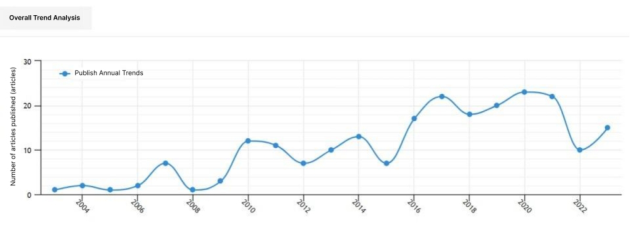
After searching the CNKI NET (see Figure 1), a total of 56 research articles related to domestic language violence were found, among which 12 articles focused on domestic language violence, 12 articles focused on language viole- nce and 9 articles focused on family language, showing an overall increasing trend and gaining more attention in recent years. For example, an article on the need for systematic treatment of domestic verbal violence (Chen, You, 2023) shows that the victims of domestic verbal violence are often children with low power of speech, mostly from the family, and that minors are affe- cted in a more significant and long-lasting way because their minds are not yet mature, their emotional control centres are not yet well developed, and their social resources and attachments are not independent from their fami- lies of origin. This shows that verbal violence, especially in the family, has attracted social attention and research by scholars.
Verbal violence is a form of verbal or written violence, usually involving the use of abusive language such as verbal abuse, contempt, ridicule, etc., which
Figure 1: Trend of Research Articles Related to Domestic Verbal Violence (Guan Xinwei 2023).
causes emotional and psychological damage to the victim. The characteri- stics of domestic verbal violence distinguish it from other forms of domestic violence. According to some researchers, there are three characteristics of domestic verbal violence: firstly, the intimate nature of the space, secondly, the persistent, multiple and widespread nature of the behaviour, and thirdly, the interactive nature.
OVERVIEW OF FLOW THEORY A mind-flow experience is a feeling of total commitment of one’s mental energy to an activity, a state of forgetfulness, and a high level of euphoria and fulfilment that accompanies the generation of mind-flow. A concept of positive psychology first developed by psychologist Mihaly Csikszentmih- alyi in the 1960s, it is a psychological theory of human mental states and interactive experiences. In the initial stages, Professor Mihaly proposed nine characteristics of mind-flow experiences and subsequently divided them into four stages based on his research; in the decades since then, as theoreti- cal research has developed and empirical studies have advanced, researchers have divided these characteristics into three stages: mind-flow antecedents, mind-flow experiences and mind-flow outcomes, which bring about behavi- oural and emotional changes in individuals These include positive affective experiences, which help users achieve their goals better.
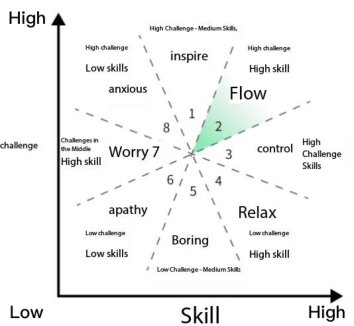
This project uses the Flow Theory to investigate the user experience of non-violent communication with children (See Figure 2 for the Flow Theory models). The horizontal axis represents the individual skill level, the vertical axis represents the challenge difficulty of the task, the individual skill level and the task challenge difficulty are two important factors affecting the flow. According to the combination of “skill” and “challenge”, eight experiences can be obtained: stimulation, flow, control, relaxation, boredom, indiffere- nce, apprehension and anxiety. If the challenge of the task is too difficult and the skill level is too low, the person will feel anxious; if the challenge of the task is too difficult and the skill level is too high, the person will feel bored; if the challenge of the task is too difficult and the skill level is low, the person will abandon the task. A state of mind-flow only occurs when the level of personal skill matches the difficulty of the challenge of the task.
Flow Theory-Based Non-Violent Communication App Design for Children 95
Figure 2: The Model of Flow (Guan Xinwei 2023).
Based on the research and analysis of the mind-flow theory of cognitive psychology, it is proposed that interaction design methods and guiding ideas such as providing users with clear and explicit goals, timely and valuable feedback, challenges balanced with skills, smooth operations and comforta- ble interfaces can enhance the user experience and create Internet products that can generate a mind-flow experience.
ANALYSIS OF THE DESIGN OF A CHILD PSYCHOEDUCATION APP IN A MINDSTREAM EXPERIENCE Mindstream theory is used to enhance the user’s mood and improve their mental state. In the case of children’s mental health education, it is often diffi- cult for psychologically educated children to maintain concentration for long periods of time. The research was conducted by designing a questionnaire on children’s psychology and behaviour and conducting in-depth interviews based on the questionnaire questions. Through literature research, the follow- ing terms were found to be associated with the mind-flow experience: satisfa- ction, pleasure, curiosity, goal clarity, focus, challenge and ability matching, immediate feedback, interactivity, immersion, entertainment, focus, reward, goal achievement and re-experience.
Mindstream experience is the best state of user experience. The user expe- rience of children’s mental health APP mainly includes emotional experience, interactive experience and sensory experience, and each stage of experie- nce has corresponding experience characteristics and performance, which designers should adopt different design means to address. Research on the behaviour of target users during the experience of using children’s mental health APP, distill the performance of users’ experience characteristics in the experience stages of entry, training interaction and social interaction, analyse the corresponding design factors, and at the same time combine the special characteristics of children’s groups to summarise the elements that stimulate children’s mindstream experience (there are: visual experience, task goals and
96 Guan
Table 1. Competitive Analysis (Guan Xinwei 2023).
Table available in the original PDF paper.
emotional experience). The design analysis of children’s mental health app under the mindstream experience is shown in Table 1.
Based on the ranking of downloads, an in-depth analysis of the five pop-up apps on the market, Simple Psychology, One Psychology, Snail Sleep, Tide, Psychologist and other mental health APPs, yielded the following main pro- blems: 1. Single form of APP content: mainly video or audio courses; 2. Low user stickiness: lack of attraction to children; 3. Lack of features in interface design: visual experience is not beautiful enough; 4. No continuity of con- tent: difficult for users to stick to it; 5. Poor interaction experience for users: the interaction form is boring and the training results cannot be quantified.
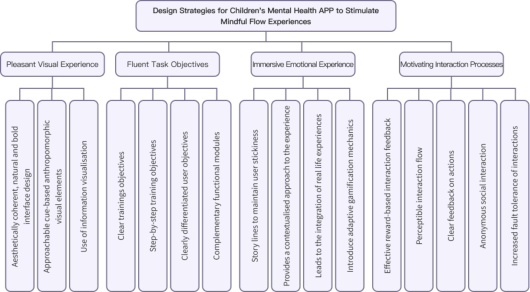
Design Strategies for Children’s Psycho-Educational APPs to Stimulate Mindful Flow Experiences A model of a child psychoeducational app design strategy that stimulates a mind-flow experience is shown in Figure 3 and includes a pleasurable visual experience, a fluid task goal, an immersive emotional experience, and a stimulating interactive process. 1. Pleasant visual experience
(1) Aesthetically coordinated, natural and bold interface design. The inter- face should be beautifully coordinated, natural and bold, with bubbles in the interface, vividly rounded but not completely regular fonts, but- tons shaped like dialogue bubbles, and at the same time, the style and size of interface elements such as charts and graphs should be standar- dized and consistent, and the visual effect should be uniform; the use of colours in the interface should be bold. Reds and yellows are more attra- ctive to children, and while attracting children’s attention, they should also be contrasted and coordinated to ensure the comfort of the visual effect.
Flow Theory-Based Non-Violent Communication App Design for Children 97
Figure 3: Strategic model of child psychology app design for stimulating mindful flow experiences (Guan Xinwei 2023).
(2) Friendly cue-based anthropomorphic visual elements. The use of anth- ropomorphic visual elements is beneficial to children’s users, incre- asing the stickiness and interest of the user group, and using clue- based visual elements to complete the story line of the training process. (3) The use of information visualisation. Efficient and concise information visualisation helps users to quickly access useful information and to obtain analysis of changes over time, more directly communicating to users (and guardians) the information they need.
2. Fluent task objectives
(1) Clear training objectives. Through preliminary analysis, different users need different elements of training, and different training paths are pro- vided for different psychological elements, in order to provide more accurate help to users. (2) Step-by-step training objectives. The process of achieving psychological training goals is analysed and refined, and the training goals are mea- surable to facilitate users (and guardians) to understand and view the completion of the goals, so that users (and guardians) can more clearly grasp the progress of the whole mental health training process. The obje- ctives are related to the individual characteristics of the user and mainly highlight the design concept of personalisation. (3) Clearly differentiated user goals. By conducting research on the target users in order to obtain the training elements required by the users, the training is divided into different categories according to the different training elements and user characteristics in order to provide a targeted application experience. (4) Functional modules that complement each other. Users train mental elements through different task paths, while there are supplementary functions to complement the tasks of the theme, helping users to reach the task goal more smoothly.
98 Guan
3. Immersive emotional experience
(1) Provide a story line that maintains user adhesion. The design incorpo- rates a story line into the training, starting with the user’s psychology. The user’s own curiosity will lead to an increase in user stickiness and thus drive user motivation. (2) Provide a contextualised experience, allowing children to experience the story in a home situation. The training app allows children to learn and experience in a contextualised way, starting with the familiar picture book experience, which makes it easier for users to participate in the interactive training process. (3) Guidance combined with real life experiences. The experience and gui- dance in the application is brought in and applied in the life scenario, which will produce a continuous emotional experience. It should be in line with children’s cognitive range, cognitive rules and built around life-like scenarios. (4) Introduce adaptive gamification mechanisms. The introduction of gami- fication mechanisms in children’s psychological training APP, the use of “light game”experience to improve the user’s fun in the training process, enhance the user’s enthusiasm and sense of participation.
4. Incentive interaction process
(1) Effective reward-based interactive feedback. The reward mechanism of children’s APP mainly includes honorary rewards and emotional rew- ards. Encouragement is mainly through medals and ranking system to let users get recognition from other people and the system, so as to motivate users to persist in training for a long time; emotional encouragement is to provide users with good interactive communication scenarios through the social function of the psychological APP, so as to stimulate users’ emotional experience. (2) Perceptible interaction flow. Through bubbles and buttons with diffe- rent colours and forms of change, instant feedback pages, animations, etc., users can know more clearly the state of interaction they are in and whether they have completed the operation correctly, helping them to understand the operation status. (3) Clear operational feedback. For the immediate operation with the user, fast and clear operation feedback for the user, so that the user perceives the effect of the operation and the completion of the situation, so that the whole interaction process is more smooth. (4) Anonymous social interaction. The participation of appropriate social attributes in the psychological APP can meet the user’s desire to talk, and the anonymous social interaction can help users express themse- lves more authentically, and the talking process can enhance the effect of psychological training, which in turn helps users gain a sense of achievement and motivates them to continue using. (5) Improve the fault tolerance rate of the interaction. Due to the chara- cteristics of the child user group, the interaction process needs to be more fault tolerant, limiting unnecessary interactions, expanding the
Flow Theory-Based Non-Violent Communication App Design for Children 99
actionable area and increasing the user’s confidence in the interaction process.
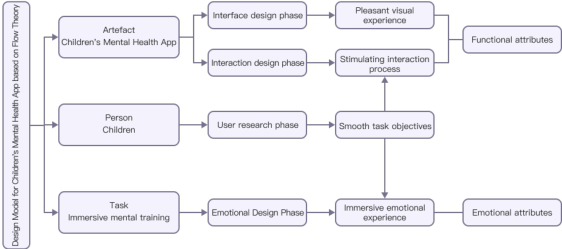
Design Model of Child Psychology Education APP Based on Flow Theory Based on the extraction and analysis of the elements of children’s mental health APP experience, a model of children’s mental health APP design based on the mind flow theory was constructed, see Figure 4. The figure visually illustrates the relationship between the user research stage, interaction design stage, interface design stage and emotion design stage in the process of chil- dren’s mental health APP design, which serves as a guide for the practice of children’s mental health APP design. The diagram illustrates the relati- onship between the user research phase, interaction design phase, interface design phase and emotional design phase in the children’s mental health app design process, which serves as a guide for children’s mental health app design practice. 1. Substitution of Mind Flow Theory Base Model Through the summary of scholars’ research on mind flow theory, Finneran and Ping Zhang proposed the “Person - Artefact - Task”model, referred to as the PAT model. In the model of children’s mental health APP design, “Person” refers to children, “Artefact” refers to mental health APP, and “Task” refers to immersive psycho-education.
(1) Guidance on design strategies for children’s mental health APPs that stimulate mind-flow experiences Combining the psychological and behavioural characteristics of children, the design of the app is guided by a highly colourful and stimulating inter- face, a smooth and natural interaction process, and an immersive emotional experience, thus forming a virtuous cycle of mind-flow experiences.
(2) Children’s Mental Health App Design Process The design process of children’s mental health APP mainly includes the user research stage, interaction design stage, interface design stage and emotional design stage. The user research phase corresponds to the fluent task objecti- ves in the APP design strategy, the interaction design phase corresponds to
Figure 4: Design model for children’s mental health app based on flow theory (Guan Xinwei 2023).
100 Guan
the stimulating interaction process, the interface design phase corresponds to the pleasant visual experience, and the emotional design phase corresponds to the immersive emotional experience. Clear tasks advance the interaction and visual experience, while goals guide the emotional experience. Intera- ction design and interface design are the 2 phases of functional realisation; adding the emotional design phase to this stimulates the mind-flow experie- nce of children in mental training. Function is a prerequisite for stimulating the mind-flow experience, and mind-flow is a sublimation of function, the two are interlinked and mutually reinforcing in a positive way.
Design Practice Parent-child communication is receiving more and more attention, and chil- dren’s psychological training can not only guide children’s psychological growth and form a healthy psychological state, but also promote parent-child relationship and maintain parent-child bonding. Psychological APPs are not designed for different target users and cannot achieve the best effect of mental health training or guidance. In order to produce good usage effects and sti- mulate mind flow when child users use mental health education APPs, based on the above research, the design of Weirdo APP was used as an example to achieve the purpose of design verification theory.
(1) Functional structure design The Weirdo APP mainly includes 5 modules: Home, Diary, Communica- tion Training, Social, and Personal Space, and the specific functional structure is shown in Figure 5.
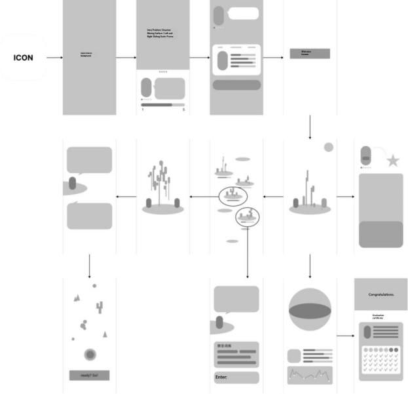
(2) Interaction design On the basis of the functional structure design of the Weird People Weird Words APP, the experience logic of the Weird People Weird Words APP is sorted out clearly to avoid logical misunderstandings in the design process of visuals, and the interaction design process of the Weird People Weird Words APP Figure 6.
(3) Visual design 1) Icon design. The icon of Odd Man Odd Language APP has a friendly and distinctive green background, with purple, white and purple-pink as
Figure 5: Functional structure of Weirdo APP (Guan Xinwei 2023).
Flow Theory-Based Non-Violent Communication App Design for Children 101
Figure 6: Weirdo App Interaction Design Process (Guan Xinwei 2023).
the theme colours, reflecting the more jumpy and entertaining nature of children’s psychological education; the main shape is like a small monster, reflecting the unhealthy children’s psychology as if it were a monster in the mind; the visual style is bold and harmonious, and the flat design reflects the vitality of children’s psychological education process, Odd Man Odd Language The effect of the APP’s LOGO design is shown in Figure 7.
2) The main frame interface design. The theme framework interface of the Odd Man Odd Language APP is mainly coloured in light yellow and light pink, with white as the secondary colour, while the theme function pages are bold and jumpy in colour, reflecting the child-centred design concept based on affinity; the interface is functional and simple in layout, allowing child users to participate in a more immersive way in the “gamified”The interactive design of the interface relies on the psychological characteristics of children to enhance the user’s enjoyment of the app and user stickiness, in order to stimulate the mind-flow experience of child users.
Figure 7: Logo Design for Weirdo APP (Guan Xinwei 2023).
102 Guan
CONCLUSION
Nowadays, children’s mental health services are receiving more and more attention, and with the prospect of a flourishing mental health market, the author takes the design of a children’s psychological education APP as an example and studies the design method of a children’s psychological educa- tion APP based on the mind flow theory. As a positive emotional interaction experience, mind flow can make children more focused during psycholo- gical training and enhance the training effect. Therefore, introducing mind flow theory into the design of children’s psychological education APP has important theoretical significance and practical value, and also provides new methods and new ideas for the design of children’s psychological education APP. At the same time, this paper lacks a definition of the differentiation of training effects for children of different ages and does not take into account the diversity of interaction patterns.
REFERENCES
Chang, C. C. (2013). Examining users′ intention to continue using social network games: A flow experience perspective. Telematics and Informatics, 30(4), 311–321. Chen, You. (2023). Family language violence requires systemic treatment. Language
Strategy Research (01), 8–10. CSikszentmih, A. L. Y. I., & Flow, M. (2008). The Psychology of Optimal Experience. Li Xiang, Huang Jin, Tian Feng, Liu J, Wang Hongan & Dai Guozhong. (2019). A review of Story-Telling methods with modern interactive technologies. Journal of Computer-Aided Design and Graphics (03), 349–363. Qi, Dao-Lin & Zhou, Li-Zhe. (2021). A review of research on domestic verbal vio-
lence in China - a literature analysis based on 2009–2020. Education Watch (07), 27–30. doi:10.16070/j.cnki.cn45-1388/g4s.2021.07.009. Van Schaik, P., Martin, S., & Vallance, M. (2012). Measuring flow experience in an immersive virtual environment for collaborative learning. Journal of Computer Assisted Learning, 28(4), 350–365. Wu, H. C., Ge, Q. Y., Cao, P. Y., Yang, J. L., Liu, X. X., Wenxin... & Liang, Xiaohui.
(2022). Analysis of the influencing factors and harmfulness of verbal violence. Psychological Monthly (12), 5–8+17. doi:10.19738/j.cnki.psy.2022.12.002. Xu Xiaoyun, Li Fengyan & Yang Pei. (2020). A review of product interaction design research based on mind flow theory. Packaging Engineering (24), 14–21. doi:10.19554/j.cnki.1001–3563.2020.24.003. Zhu Jihong & Zhao Yuechao. (2020). A study of app interface interaction design for
preschoolers based on children’s cognitive development. Packaging Engineering (10), 42–48. doi:10.19554/j.cnki.1001–3563.2020.10.008.
LISTED IN THE AHFE DIGITAL BOOKSTORE CATALOGUE
Explore the complete digital volume
Design for Inclusion
Read this individual research paper free through the original publisher, or explore the full digital proceedings book.
ISBN 978-1-958651-51-3
Explore this ISBN in the AHFE Bookstore ↗Listed in the July 2026 bookstore catalogue; search by ISBN to confirm current availability · Digital book purchase optional