Liyuan Bao, Le Xu, Liu Ying (2023). Inclusiveness in the Design of Mobile Payment Products for Chinese Elderly Users. In: Design for Inclusion. AHFE Open Access, vol. 75, pp. 203–213. https://doi.org/10.54941/ahfe1003341
As the world is facing a sudden public health crisis and an aging population, mobile payment products are widely used in the epidemic because of their ease of transaction and contactless security. However, data show that there are few mobile payment users over 60 years old in China, and this emerging digital technology has excluded many silver-haired generations. Through market research, product analysis, and user interviews, this study finds that the reasons for the low usage of mobile payment products by older users in Chinese society include: poor product inclusiveness and the lack of acceptance of digital products by older people. Most research in this area has focused on using technology acceptance model (TAM) and creating "elder models" specifically for the elderly. However, traditional TAM and polarized "normal model" and "elderly model" product models have made it difficult to expand the inclusiveness of products. This study innovatively introduces an inclusive design approach to constructing a TAM to optimize existing mobile payment products. The study selects WeChat Pay, which has the highest usage rate in China, as the research object. Through qualitative and quantitative survey methods, the study deeply investigates the pain points and needs of silver-haired people and integrates them with the needs of regular users, distills the key influencing elements in the new model to build an inclusive TAM, and finally gives recommendations for inclusive and age-appropriate design. The optimized design of WeChat Payments is based on the recommendations. Finally, the usability test is conducted with 15 elderly and 15 normal users to verify that the optimized design is inclusive.
According to the seventh national census, China's population over the age of 60 has reached 264 million. According to operator statistics, nearly 140 million elderly people in China still use feature phones or smart phones, but they cannot access the Internet and cannot truly integrate into the Internet like other age groups. The "Statistical Report on Internet Development in China" released by the China Internet Network Information Cen- ter (CNNIC) shows that the growth of Internet users has shifted from youth
groups to minors and the elderly. With the outbreak of the new crown epide- mic in 2020, the non-inclusiveness between the elderly group and the digital age and smart devices has become more and more prominent.
(Qiuhui, 2008) The subject of the study was to identify user interface design methods for the use of cell phones by older adults. The theme of (Zhou, 2014) was to identify the factors that influence the continued use of mobile payments. The aim of (Cao et al., 2018) was to investigate mechanisms for building trust in the transition from online to mobile payments, as well as the objective of examining the impact of trust on the satisfaction and continued willingness of mobile payment users. (Zhukovska, 2020) is to substantiate the need for inclusive development of municipalities, outlining its main determi- nants and methods of realization. Significance of the study: the findings help to conceptualize and understand the effectiveness of gamification in techno- logy adoption, especially among the silver generation. (Dumbaugh, 2008) summarizes the existing literature on travel-related needs, abilities and pre- ferences of older adults. There is an urgent need for a user-friendly mobile payment solution to support mobile users in making secure and reliable pay- ment transactions using their mobile devices. (Gebrehans et al., 2020) again suggest that TAM’s model structure (perceived usefulness and perceived ease of use) is the dominant factor in adoption intentions. (Luarn et al., 2010) exa- mine the mediating role of technology trust on the firm dimension trust of the Technology Acceptance Model (TAM) in the context of Near Field Com- munication (NFC) mobile payment services. (Li et al., 2014) investigate the factors and mechanisms influencing the willingness to adapt to mobile pay- ments in China based on the TAM model, social psychology, and diffusion of innovation theory. (Ubam et al., 2021) aims to conduct a requirements analy- sis of user interface and user experience (UI/UX) design when using mobile banking applications for older adults in Malaysia. More and more scholars are entering into research on the use of mobile payments for senior citizens, in which scholars often use technology and subjective models to study the user experience.
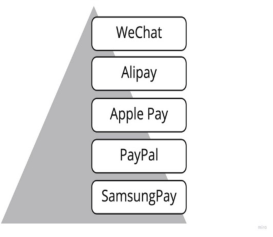
As shown in Figure 1, by the end of 2020, China’s two largest mobile payment products, WeChat Pay and Alipay Pay, had the highest number of active mobile payment users in the world. Among them, WeChat Pay has
Figure 1: Ranking of active users of major global mobile payment platforms in 2020 (Source: Compiled by Foresight Industry Research Institute).
Inclusiveness in the Design of Mobile Payment Products 205
1.151 billion annual active users, which is the highest in the world; there- fore, this study selects WeChat Pay as a representative object to explore the inclusiveness of the WeChat Pay platform for older Chinese users.
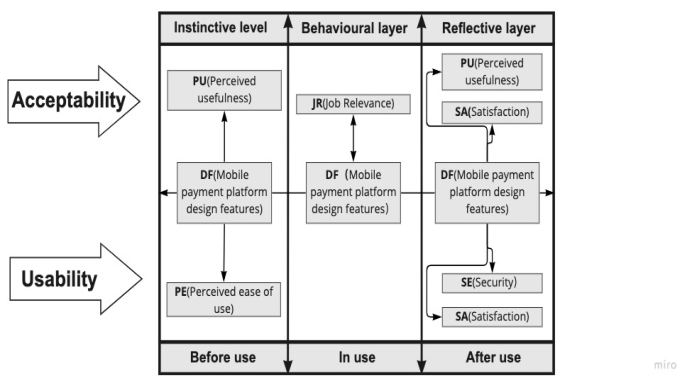
INCLUSIVE TECHNOLOGY ACCEPTANCE UX INTEGRATION MODEL The model construction of inclusive user experience and acceptability resea- rch is carried out in three time periods with three dimensions of instinctive, behavioral, and reflective levels: before, during, and after user use, guided by goal-oriented design theory. The inclusiveness of the mobile payment plat- form is expressed in the usability and acceptability to users, i.e., allowing more users to have a better user experience and maintain a lasting accepta- nce of the technology platform. This study uses an integrated model of user experience technology acceptance to investigate the design metrics of mobile payment platforms in order to prepare for the development of more inclusive mobile payment platforms.
INCLUSIVE MOBILE PAYMENT PLATFORM DESIGN FEATURE ELEMENT EXTRACTION The author summarizes the design features of the mobile payment platform into six indicators, and the specific design feature indicators are integra- ted and screened against the actual operating mobile payment behavior of the research elderly users. 33 secondary design feature indicators are finally screened and coded as Table (1-1) through the cooperation of four doctors related to experience design, interaction design and two interaction design practitioners, respectively.
DF1:Service function feature: Service function refers to the use function set by the developer for the whole system of mobile payment. Service function is
Table 1. Extraction of mobile payment design features.
Table available in the original PDF paper.
Mobile Design Features Mobile
Design Features
payment platform design features
payment platform design features
DF1:Service
DF 4:
functional characteri- stics
Interface Text Features
DF 4–1 Font type DF 4–2 font size DF 4–3 font color DF 4–4 Font thi- ckness DF 4–5 font spacing
DF 1–1 Sweep code to pay DF 1–2 Show QR code to pay DF 1–3 Transfer money DF 1–4 Send and receive red packets DF 1–5 Wealth management DF 1–6 Pension management DF 1–7 Health insurance management DF 1–8 Living expenses DF 5: DF 2: Infor-
speed DF 3–2 Binding bank card speed DF 3–3 Payment speed DF 3–4 Password unlocking speed DF 3–5 Payment status prompt DF 3–6 Easy to find the corresponding function
also the main feature of mobile payment, which reflects the specific practi- cal meaning of mobile payment. It includes features such as sweeping code payment, presenting QR code payment, transferring money, sending and receiving red packets, financial management, pension management, medical insurance management, and life payment.
DF2:Information input mode features: Information input mode refers to the information that needs to be input during the mobile payment pro- cess, such as personal information binding, amount input, etc. Its features mainly include typing input, voice input, photo input, fingerprint unlock, face unlock, acoustic unlock, etc.
Inclusiveness in the Design of Mobile Payment Products 207
DF3: Task feedback features; task feedback is an important indicator of user perception of mobile payment experience, which is specifically expressed in the perceived feedback information of the user’s operation of the mobile payment process, which includes features such as information input speed, binding bank card speed, payment speed, password unlock speed, payment status prompt, easy to find the corresponding function, etc.
DF4: interface text features: interface text is the main medium of infor- mation interaction between the mobile payment platform and the user, the reading perception of text is also an important indicator of user experience, which contains features such as font type, font size, font color, font thickness and font spacing.
DF5: interface icon features: interface icon is an important human- computer interaction of the important perceptual media, it can provide visual guidance for the user’s operational perception of convenience. The interface icon features include icon shape, icon color, icon symbolism, etc. in mobile payment.
DF6 security features: security also has an important performance in mobile payment design features, carrying a variety of passwords, monitoring, firewall, etc. are security design features. The features specifically include password piggyback location, password type, privacy protection, payment monitoring, bill upload (guardian), etc.
VALIDATION OF INCLUSIVE MOBILE PAYMENT PLATFORM DESIGN FEATURE ELEMENTS A questionnaire was designed prior to the start of the study based on an inclusive technology acceptance user experience integration model, and 460 questionnaires were returned from March 2022 to April 2022, of which 443 were valid, and these data were used for subsequent model validation.
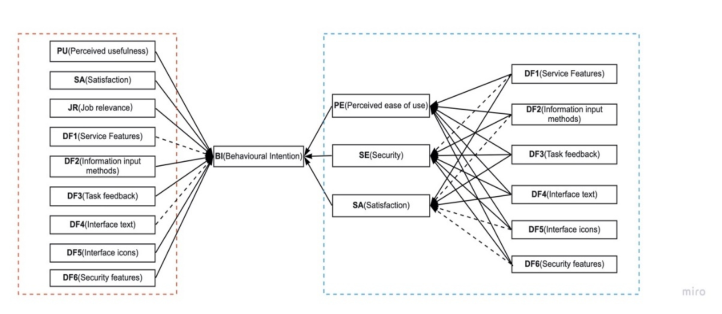
The hypothesis of the relationship between the subjective influencing ele- ments of older users on the design features of the mobile payment platform is described with the hypothesis of the relationship between the elements ori- ented to behavioral intentions. The influence of DF1, DF2, DF3, DF4, DF5, and DF6 on that element of PU, PE, PA, JR, and BI in the model is specifically explored in order to facilitate the final mobile payment platform inclusive design principles based on the WeChat payment platform study.
Before validating the relevant hypothetical relationships in the model for the mobile payment platform design special, it is necessary to conduct exploratory factor analysis on the second and third level indicators in the ele- ments of the mobile payment platform design special screened above. Firstly, the collected questionnaires are collated for data analysis, and the structural equation model is constructed through the questionnaire data and analyzed by SPSS, and it is found that DF1 has no effect on SE, DF2,DF5,DF6 have no effect on SA There was no effect of DF1 on SE, DF2, DF5, DF6 on SA, and no effect of DF1 and DF4 on BI. Finally, the relationship between the design characteristics of mobile payment platform and other elements between the models was derived.
Figure 3: The relationship between mobile payment platform design features and other elements between models.
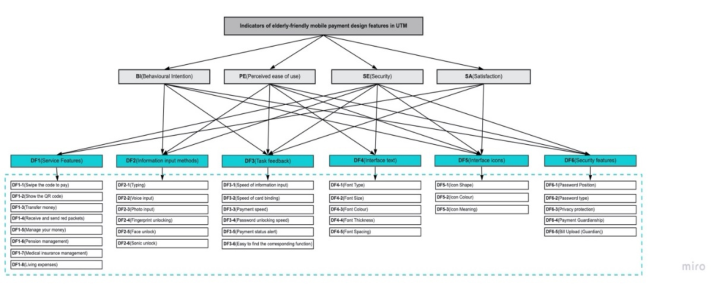
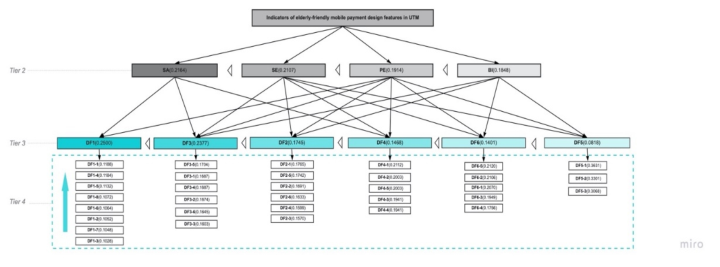
INCLUSIVE MOBILE PAYMENT PLATFORM DESIGN METRICS Hierarchical relationships were constructed to determine the weights of spe- cific indicators for the mobile payment platform design features validated above. The first tier is the design indicators of the age-appropriate mobile payment platform; the second tier is BI behavioral willingness, PE percei- ved ease of use, SE security, and SA satisfaction; the third tier is DF1: service function features, DF2: information input method features, DF3: task feedback features, DF4: Interface text features, DF5:Interface icon features, DF6:Security features; the fourth level is DF 1–1 sweep code payment, DF 1– 2 present QR code payment, DF 1–3 transferring money, DF 1–4 sending and receiving red packets, DF 1–5 financial management, DF 1–6 pension mana- gement, DF 1–7 health insurance management, DF 1–8 life payment, DF 2–1 typing input, DF 2–2 Voice input, DF 2–3 Photo input, DF 2–4 Fingerprint unlock, DF 2–5 Face unlock, DF 2–6 Sonic unlock, DF 3–1 Information input speed, DF 3–2 Binding bank card speed, DF 3–3 Payment speed, DF 3–4 Pas- sword unlock speed, DF 3–5 Payment status prompt, DF 3–6 Easy to find the corresponding function, DF 4–1 Font type, DF 4–2 font size, DF 4–3 font color, DF 4–4 font thickness, DF 4–5 font spacing, DF 5–1 icon shape, DF 5–2 icon color scheme, DF 5–3 icon symbolic meaning, DF 6–1 password piggyback location, DF 6–2 password type, DF 6–3 privacy protection, DF 6–4 payment guardianship, DF 6–5 bill upload (guardian). The data from the recovered questionnaires were imported into SPSS analysis, and the weights of the secondary indicators PE, SE, SA, and BI were calculated by the entropy value method The final results are shown in Table 2.
The final results of calculating the weights by entropy method for the secondary indicators PE, SE, SA, BI corresponding to the tertiary indicators and the quaternary indicators are shown in the table below.
The above data are used to rank the elements of the second, third and fourth tiers, and the ranking process has a decreasing importance relation- ship. As shown in Figure 5, satisfaction SA has the highest weight value in
Inclusiveness in the Design of Mobile Payment Products 209
Figure 4: Mobile payment platform design features hierarchy.Table 2. Summary of the results of calculating weights by entropy method for secondary indicators.
the second level, so it is the most important indicator to satisfy users’ fee- lings in the design of the age-friendly mobile payment platform, followed by security SE, perceived ease of use PE, and behavior willingness BI. Security is also a more important indicator in the whole design process. The service function DF has the highest weight value in the third level, so it has the most important influence on the associated elements in the second level, and it is also the most important three-level indicator element that should be conside- red in the design of the age-friendly mobile payment platform. Next in order are: DF3 task feedback, DF2 information input method, DF4 interface text, DF6 security, and DF5 interface icon. The fourth level of related indicators is also organized to do the weighting order for the construction of the design criteria of the age-friendly mobile payment platform based on the inclusive technology acceptance user experience model.
Table 3. Summary of the results of the entropy method of calculating the weights of the three or four level indicators.
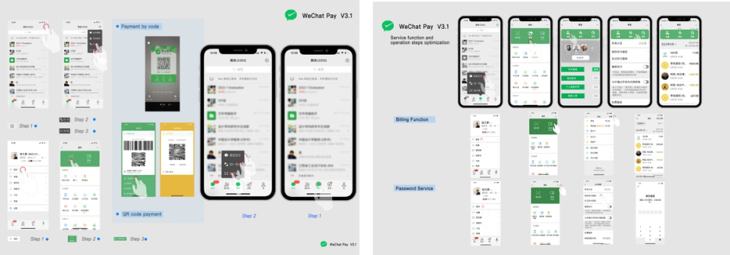
In order to verify the above conclusion, the WeChat Pay “Elder Mode” version 3.1 was optimized and designed using AXURE software. WeChat Pay “Elder Mode” version 3.1, mainly adds a “help” mode to the service function. Elderly users can tap on the help mode to seek help from their children’s friends, providing them with password verification and amount recharge service. Once again, WeChat Pay has increased the display area,
Inclusiveness in the Design of Mobile Payment Products 211
shortened the operation steps, and added the important functional indicators of “bill inquiry” and “password service” to the payment page.
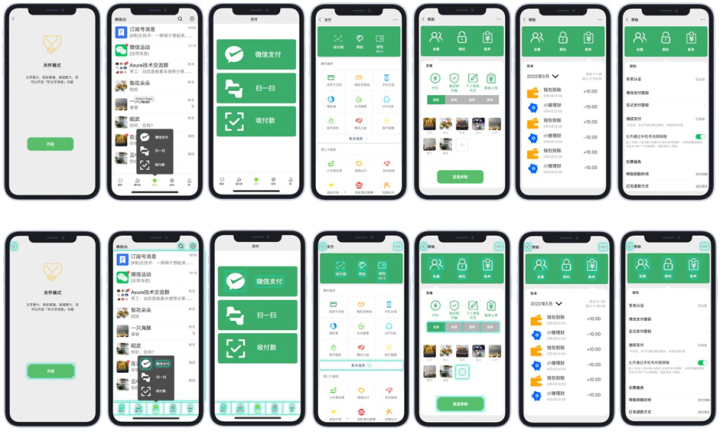
The mobile payment elder-friendly design indicators based on UTM model validation were optimized from three points. DF1: service function; DF2: information input; DF3: task feedback. The “help” function was added and WeChat payment was prominently added to simplify the operation steps [Figure 5-6]. A workable prototype of the WeChat Payments 3.1 “Care Mode” was modeled using AXURE software, and the link to the prototype is https://bjs7v7.axshare.com/#id = 8va5jh&p=%E5%85%B3%E6%80% 80%E6%A8%A1%E5%BC%8F. A questionnaire for scoring the design feature elements of the mobile pay- ment platform was designed using SUS (System Usability Scale) to compare WeChat Pay “Elderly Mode” 3.1 with the previous WeChat Pay “Elderly Mode”. 15 elderly WeChat Pay users over 55 years old and 15 young WeChat Pay users between 18 and 30 years old were selected for interview scoring in Tianshui City, Gansu Province, in December 2022. The usability scores of the final results of the influencing factors of the final result optimization design indicators are all greater than 70, which indicates that the usability of the optimized WeChat Pay 3.1 for users of different age groups is very high. Therefore, the inclusive mobile payment design indexes obtained after the above verification are reliable.
Figure 5: Ranking of the weight values of the elements at each level.Figure 6: WeChat Pay 3.1 elder friendly design process.Figure 7: Actionable prototype of WeChat Pay 3.1 “Care Mode” using AXURE.
CONCLUSION
The The design features of an inclusive mobile payment platform based on goal-oriented design principles are.
(1) Age-appropriate mobile payment instinctive layer design criteria. In the instinctive layer, mobile payment design criteria should focus on perceived ease of use (PE) followed by behavioral intention (BI). The mobile payment design features that affect perceived ease of use (PE) are, in order of priority: DF1: service function features; DF3: task feedback features; DF2: informa- tion input features; DF4: interface text features; DF6: security features; DF5: interface icon features.
(2) Appropriate old mobile payment behavioral layer design criteria.In the behavioral layer mobile payment design criteria should focus on beh- avioral willingness (BI). The mobile payment design features affecting behavioral willingness (BI) in order of emphasis are: DF3:task feedback features; DF2:information input method features; DF6:security features; DF5:interface icon features.
(3) Age-appropriate mobile payment reflective layer design criteria.In the instinctive layer mobile payment design criteria should focus on satisfaction (SA) followed by security (SE) and finally behavioral willingness (BI). The mobile payment design features that affect satisfaction (SA) are, in order of priority: DF1: service function features; DF3: task feedback features; DF4: interface text features. The design features of mobile payment that affect security (SE) are, in order of priority: DF3: task feedback features; DF2: infor- mation input features; DF4: interface text features; DF6: security features; DF5: interface icon features.
ACKNOWLEDGMENT
The authors would like to acknowledge.
Inclusiveness in the Design of Mobile Payment Products 213
REFERENCES
Alina Zhukovska; “DETERMINANTS OF INCLUSIVE DEVELOPMENT OF MUNICIPAL ESTABLISHMENTS”, 2020. Elizabeth Ubam; Irwandi Hipiny; Hamimah Ujir; “User Interface/User Experience (UI/UX) Analysis & Design of Mobile Banking App for Senior Citizens: A Case Study in Sarawak, Malaysia”, 2021 INTERNATIONAL CONFERENCE ON ELECTRICAL ENGINEERING AND..., 2021. Eric Dumbaugh; “Designing Communities to Enhance The Safety and Mobility of
Older Adults”, JOURNAL OF PLANNING LITERATURE, 2008. F. Y. Li. (2020). Mobile payments, online shopping difficult for seniors”look at health insurance business operations. China Market, (21), 194–198. J. Li. (2019). Analysis of Barriers to the Promotion of E-payment among the Elderly.
Value Engineering, 38(03), 145–147. Jing Li; Jia-Le Liu; Huan-Yong Ji; “Empirical Study of Influence Factors of Adaption Intention of Mobile Payment Based on TAM Model in China”, INTERNATIO- NAL JOURNAL OF U- AND E- SERVICE, SCIENCE AND..., 2014. Pin Luarn; Wei-Jr Juo; “The Role of Trust in Technology Within The TAM in The Context of NFC Mobile Payment”, JOURNAL OF INFORMATION AND OPTIMIZATION SCIENCES, 2010. Tao Zhou; “Understanding The Determinants of Mobile Payment Continuance Usage”, IND. MANAG. DATA SYST., 2014. Wang Qiuhui; “The Effects of Interface Design About Mobile Phones 0nOlder Adults’ Usage”, 2008 4TH INTERNATIONAL CONFERENCE ON WIRE- LESS..., 2008. X. Q. Jing & Z. X. Xiao. (2019). Research on the Willingness of the Middle-aged
and Elderly to Use Mobile Payment--based on Perceived Value Theory. China Circulation Economy, (04), 5–9. X. Zhang. (2021). Research on User Experience Design of Smartphones for Early Elder People. Guangdong Univer 2008. Xiongfei Cao; Lingling Yu; Zhiying Liu; Mingchuan Gong; Adeel Luqman; “Under-
standing Mobile Payment Users’ Continuance Intention: A Trust Transfer Perspe- ctive”, INTERNET RES., 2018. Xiongfei Cao; Lingling Yu; Zhiying Liu; Mingchuan Gong; Adeel Luqman; “Understanding Mobile Payment Users’ Continuance Intention: A Trust Transfer Perspe- ctive”sity of Technology.
LISTED IN THE AHFE DIGITAL BOOKSTORE CATALOGUE
Explore the complete digital volume
Design for Inclusion
Read this individual research paper free through the original publisher, or explore the full digital proceedings book.
ISBN 978-1-958651-51-3
Explore this ISBN in the AHFE Bookstore ↗Listed in the July 2026 bookstore catalogue; search by ISBN to confirm current availability · Digital book purchase optional