Xin Chen, Hongling Ji, Le Xu (2023). Design of Ergonomics-based Bath Chair for the Elderly. In: Human Factors in Aging and Special Needs. AHFE Open Access, vol. 88, pp. 133–141. https://doi.org/10.54941/ahfe1003670
Today, with the global population aging, more and more older people live alone. Daily bathing becomes extremely difficult, or even dangerous, for these older people who live alone with little legs. In this study, a questionnaire survey (195 older people were invited to participate in the questionnaire), user profile, and in-depth interview (3 older people with typical characteristics were profiled and interviewed) were used, and a user journey map of older people's bathing was drawn to understand their bathing process and needs more clearly. Then, we analyzed the problems of existing elderly bathing products by combining the physiological and psychological characteristics of the elderly. The product combines ergonomic principles and integrated design theory. Subsequent evaluation experiments were conducted through prototypes, and we also increased the details of the product according to the activities of the elderly when bathing in order to achieve thorough safety protection for the elderly group. This study can effectively reflect the potential perceived needs of the elderly for furniture products and the updated, relevant ergonomic data and provide adequate references for the design practice of furniture for the elderly.
Since the 21st century, the world has generally entered into an ageing popu- lation society. The degree of population ageing in developed countries has deepened significantly while developing countries have not yet entered the ranks of an ageing population. From a global perspective, the world’s total population has increased by 1.65 billion people from 2010 to 2020; during the same period, the ageing population in developed countries is relati- vely deep and much higher than the overall level of the world. Developing countries (excluding China) have a milder degree of population ageing(Tong Yufen. 2021), and the process is significantly slower than in the rest of the world. They have not yet entered an ageing society in general. (See Table 1) The ageing process of China’s population is significantly faster than that of the whole world and faster than that of developed countries (Liu houlian et al. 2021). From 2000 to 2020, 130 million of the 440 million older people in the world will be contributed by China. China will still bear the pressure of a huge population aging in the future.
RESEARCH STATUS OF BATHING PRODUCTS The elderly industry has received early attention in developed countries such as Europe and the United States. The research results and practices of bath- room products for the elderly are relatively advanced, and the functions and details are very humanized. Based on thoroughly studying the needs of the elderly, the concept of universal design has been integrated to meet the psych- ological needs of the elderly who refuse to be considered particular users (He Jingnan et al. 2011).
As the first country in Asia to enter the aging society, Japan has formed a significant market scale and has many mature product designs for the elderly, such as special seats for the elderly, special health monitors, and safety han- drails to help the elderly get up. Given the bathing problem of the elderly, Japan has divided the elderly toilets into various types according to the phy- siological needs of the elderly at different ages. 1) Toilet for people who can stand on their own. 2) A toilet for people who can move in a wheelchair but can stand independently. 3) Toilet for people who can move in a wheelchair but cannot stand independently. Japanese designers’ research on toilets used by the elderly is not limited to their internal layout and bathroom product configuration. They also designed and studied sanitary products according to the needs of the elderly at different stages and their physiological dimen- sions and characteristics, including installation location, installation form, operation mode, color, and materials (Chen Xin et al. 2012).
Europe was the first to enter the aging era (Long Lili. 2006), and the UK, which was the first to implement the welfare policy, paid particular attention to the living life of the elderly. As early as 1969, it stipulated the classification requirements of the classification standard of residential buildings for the elderly. According to the physical conditions of the elderly at different stages, it divided the types of elderly buildings are accordingly. It adopted a series of unique bath ware for the elderly that is convenient for the elderly to use (Zheng Lin. 2015).
Design of Ergonomics-Based Bath Chair for the Elderly 135
The United States has made outstanding contributions to the humanized bathroom design for the elderly through innovative research. Michael Gra- ves, an American postmodern architect, designed a bathing appliance for the physically disabled in 2003. This bathing appliance is a removable hand-held shower head with a brush designed for the physically disabled and the elderly. The shower head is appropriate to the size of the palm of the elderly, and it is convenient for the elderly to hold the shower head with one hand. When the user needs to wash locally, he can press the red button on the shower head to remove the original shower head and replace it with a shower head with a brush. The soft brush can help the user complete the action of one hand rubbing the body (Huang Qun. 2019).
USER RESEARCH Human physiological functions reach their peak after the age of 18. After 30, human physiological functions will continue to decline and are irreversible. By the age of 70 or so, people’s physiological function is only about 50% of the peak period. With the increase of age, the elder’s ability to care for themselves will gradually decrease or eventually become completely exhau- sted. This physiological law also reflects the health law of the elderly. (Xiang Xin and Wang Yi. 2021).
Most of the actions of the elderly in the process of bathing need lower limb strength to achieve. However, with the gradual decline of human physi- ological function, lower limb strength will also gradually lose, and the more inferior limb ligaments and muscles will significantly decline and decline with the increase of age. The loss of various functional elements of the elderly will lead to the elderly becoming weak. If we ignore the fall, it will have dire consequences, which will be a heavy blow to the physical and psychological health of the elderly (Zhao Fang. 2003). The results of the sampling survey show that 90.8% of the elderly have difficulties completing bathing activities independently, and bathing as an essential daily activity needs help urgently (Mei Yangyang et al. 2015).
QUESTIONNAIRE SURVEY ON BATHING FOR THE ELDERLY In order to fully understand the difficulties and specific needs of the elderly when bathing, we obtained the bath problem descriptions of 195 elderly people (over 70 years old) in Hangzhou Binfen Community through offline survey. The research results show that more than 62.05% of the elderly com- plete bathing with the help of their families and nursing staff. 75.90% of the elderly are worried about the slippery floor and fall down when taking a bath, and 82.56% of the elderly will feel tired when taking a bath.
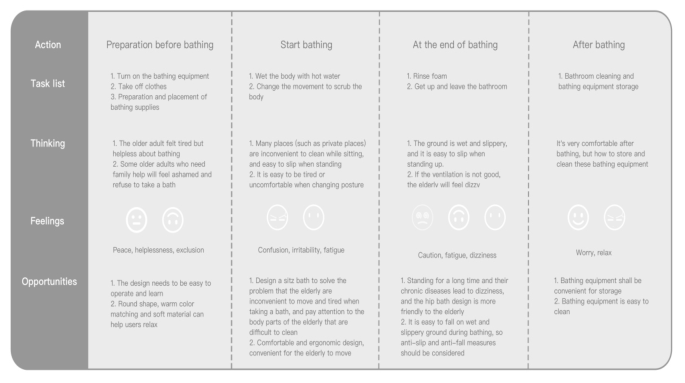
To further understand the actual demands of older adults on bathing, we selected several older adults in the course of the questionnaire to con- duct in-depth interviews. Through talking with them, we learned about the problems that older adults often encounter in bathing and their views and fee- lings about it. We drew the user journey map (see Figure 1) and summarized opportunities that can help the following design research.
Figure 1: User journey map.
DESIGN PROCESS User interviews and desktop research provide clues for the design scheme. According to the above study and data, even the elderly who seem healthy and able to complete the bath independently also need the help of others. Gene- rally speaking, the elderly have difficulty in joint movement due to decreased body function. The help bath can help clean the parts that the elderly can not wash and are not convenient to pass, such as the back, the belly of the legs, and private functions. Among them, the elderly’s need for assisted bathing is extreme when their body is not in good time. This behavior can effe- ctively reduce the burden on the elderly and protect their safety.Therefore, this paper proposes an improved solution of independent bath chair for the elderly family.
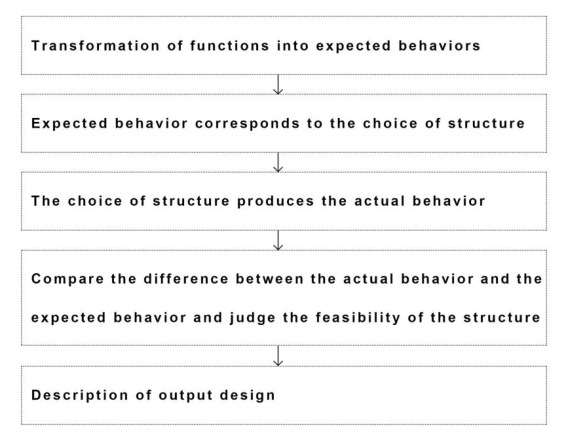
FBS MODEL DESCRIPTION FBS is an innovative design model proposed by Professor Gero (GERO J S. 1990), which includes three variables: “function,” “behavior,” and “structure.” (see Figure 2) Designers can transform user needs into expected product functions through this model, thus obtaining a specific implemen- tation structure. Researchers usually supplement the design process with other models to get user needs. Zhou Qi and others proposed an innova- tive design method based on fuzzy Kano and situational FBS models (Zhou Qi et al. 2020), which is used to solve the problem of insufficient innovation of situational products to improve user satisfaction with the product.
FBS DESIGN PROCESS FOR BATHING BEHAVIOUR OF THE ELDERLY Based on the FBS model and from the perspective of user needs, this paper finds out the opportunity points of product design by mapping the pain
Design of Ergonomics-Based Bath Chair for the Elderly 137
Figure 2: FBS model.
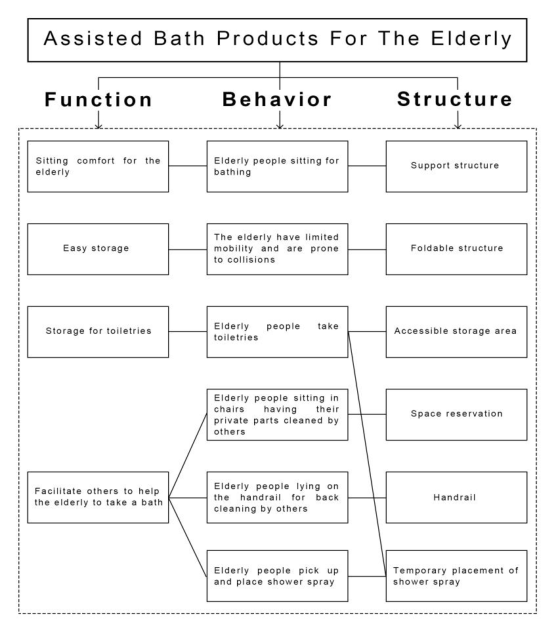
points in the elderly bathing scene to the functions, behaviours, and structu- res of the FBS layer by layer and then proposes feasible product solutions. The design process of bathing behavior for the elderly based on FBS is shown in the figure(see Figure 3). The results of the FBS model provide a basis for the subsequent improvement of product usability and com- fort. In behaviour-function mapping, there is a one-to-many relationship between behaviour and function. To ensure the integrity of the process, different structural modules are required to meet the corresponding user behaviour.
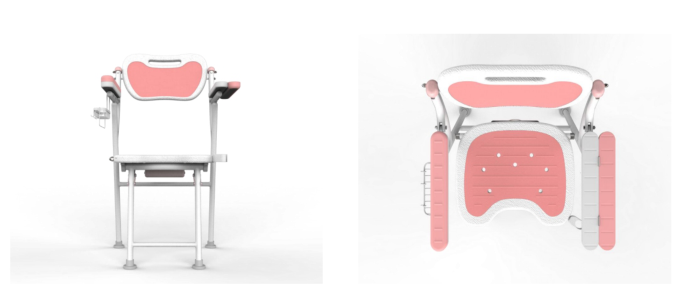
ERGONOMIC ANALYSIS BASED ON USER REQUIREMENTS To better meet the user’s user experience in the bathroom environment, the structure is quickly hand-painted, modelled, and verified, which is conducive to the overall control of the product, and the specific functions are sorted out to avoid functional omission and contradiction in the complex environ- ment. Finally, the product is designed to be suitable for the elderly to wash independently and others to help bath(see Figure 4).
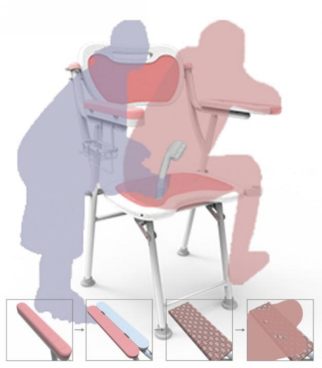
A. Back bath aid The handrails on both sides are provided with expandable planes, which can be easily flipped. (see Figure 5) Considering that the elderly need to main- tain a comfortable and safe position when they are served and bathed by others, the design case proposes a multi-directional armchair in which the elderly can lie on the armchair facing left or right. The width of the standard seat armrest is about 70mm. The product increases the width of the armrest to 152mm through the folding structure, which increases the contact area
Figure 3: Design of elderly bathing chair based on FBS model.Figure 4: Bath chair rendering.
between the user’s hand and the armrest, and improves the comfort of the elderly in the use process.
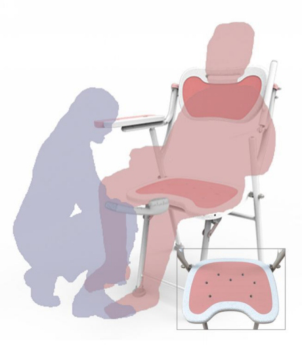
B. Private bath aid The chair surface is designed as a “U” shape (see Figure 6). Bathing atten- dants can more easily clean up the private places of the elderly. The elderly can
Design of Ergonomics-Based Bath Chair for the Elderly 139
Figure 5: Assistance with back bathing.Figure 6: Assistance with private bathing.
only move forward slightly to clean up the private places, avoid the elderly needing to stand to complete this process, and reduce the risk of the elderly sliding.
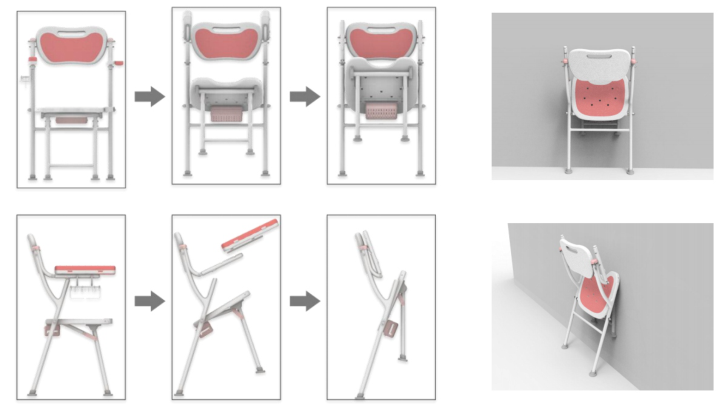
C. Foldable seats The product uses an innovative structure to enable the elderly to fold the chair independently and efficiently. (see Figure 7) Considering the inconve- nience of the elderly, increasing the available space in the bathroom and reducing the volume of collision objects can effectively reduce the risk. At the same time, anti-skid pads are set on the legs of the chair to make it firmly rely on the wall.
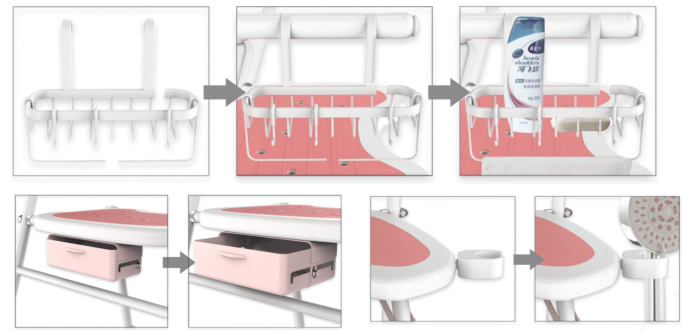
D. Storage structure Two storage structures are designed in this scheme. (see Figure 8) An iron basket that temporarily stores bath articles is hung at the left armrest, and the structure is removable. In the sitting position, the elderly can get the bathing
supplies he wants within the range of hand movement. Similarly, there is a storage box under the chair, which can store clothes. To prevent the clothes of the elderly from getting wet in the bath, the storage box is designed as a retractable pull-out structure. In addition, there is a socket at the right front of the chair surface where the shower nozzle can be temporarily placed, which is convenient for the elderly and bath attendants to take and place the shower nozzle.
E. Seat ergonomic dimensions To improve the comfort of the elderly using the bath chair, the product refers to the human body static measurement method, which calculates the average height of the elderly, the width between the two elbows, and the length of the lower limbs in the sitting posture (Yu Yang et al. 2016). It obtains that the chair height of the product is 480mm, the seat depth is 390mm, the
Design of Ergonomics-Based Bath Chair for the Elderly 141
seat width is 520mm, and the arm height is 700mm. The pillow surface is skin-friendly protein skin, and the internal soft support material is a sponge. Through this program, the sense of the bathing experience of the elderly can be improved, and the safety and space utilisation rate can be increased.
CONCLUSION
The case design of the innovative bath chair solves the safety and comfort problems of the elderly in the complex bathroom environment. Through user interviews and desktop research, this paper analyzes the behavioral chara- cteristics and physiological needs of the elderly, establishes the FBS model to determine the specific design elements to obtain a reasonable and feasible solution strategy, and carries out the model production to verify the feasibility of the innovative design of the elderly bathing chair. In terms of solving the problem of bathing for the elderly, the integrated innovative design method helps researchers find real user needs and provides a practical reference for developing products for the elderly.
REFERENCES
Chen Xin, Zhou Yong, Zhao Dan. (2012) “Research on bathroom design in residential buildings for the elderly in Japan”, new buildings pp. 77–81. GERO J S. (1990) “Design Prototypes: A Knowledge Represen-tation Schema for
Design”, AI Magazine 11 No. 4. pp. 26–36. He Jingnan, Li Ning, Zhang Yi. (2011) “Current situation of population aging at home and abroad and challenges facing China”, Chinese Journal of Clinicians (electronic version) 5 No. 13 pp. 3894–3897. Huang Qun. (2009) “Accessibility. General Design”, China Machine Press. Liu Houlian. (2021) "The Aging Population of the World and China", China
Population and Development Research Center, Beijing 100081. Long Lili. (2006) “Research on Interior Environment Design of Residential Buildings Based on Aging Society”, Huazhong University of Science and Technology, Hubei. Mei Yangyang, Pang Shuqin, Li Mianli, Zheng Lixiu, Wang Tong, Xin Huiming,
Chen Xiaolu. (2015) “Investigation and Analysis of the Time and Content of Day- time Direct Care for the Disabled Elderly in Nursing Homes”, Journal of Nursing 30 No. 15 pp. 43–45. Tong Yufen. (2021) “The latest trends and trends of the Chinese population —— combined with the analysis of the seventh national census data”, Journal of China Institute of Labor Relations, No. 35 pp. 15–25. Xiang Xin, Wang Yi. (2021) “Current situation, characteristics, causes and coun-
termeasures of population aging in China”, Chinese Journal of Gerontology No. 072. Yu Yang, Wang Yu, Hao Junhong, Miao Wensheng, Wu Xiaolan. (2016) “Application report of anthropometric data for the elderly”, Residential 3 pp. 107–112. Zhao Fang. (2003) “Biomechanical study on standing and walking stability of the
elderly”, Journal of Beijing Sport University, No. 2 pp. 188–191. Zheng Lin. (2015) “Research on the Use Behavior and Design of Public Bathroom Space in Elderly Care Facilities”, Overseas Chinese University, Xiamen. Zhou Qi, Li Xu, Zhou Jiyan. (2020) “Innovative design method for integrating fuzzy
Kano and scenario FBS model”, Journal of Graphics 41 No. 5 pp. 796–804.
LISTED IN THE AHFE DIGITAL BOOKSTORE CATALOGUE
Explore the complete digital volume
Human Factors in Aging and Special Needs
Read this individual research paper free through the original publisher, or explore the full digital proceedings book.
ISBN 978-1-958651-64-3
Explore this ISBN in the AHFE Bookstore ↗Listed in the July 2026 bookstore catalogue; search by ISBN to confirm current availability · Digital book purchase optional