Yaxi Wang, Ziyun Tong, Qiangsheng Yin, Xin Chen (2022). Garbage Sorting and Recycling System of the Master and Slave Stations in Commercial Blocks. In: Human Factors and Systems Interaction. AHFE Open Access, vol. 52, pp. 387–395. https://doi.org/10.54941/ahfe1002180
Content From the perspective of the system, the problem is analyzed according to various elements such as the use environment of the trash can, user needs, mall resources, and stakeholders, and combined with AI intelligent visual recognition and voice-assisted recognition technology to assist design practices to explore new forms of waste classification and recycling. Methods Through field research and literature comparative analysis methods, the relevant advanced experience of domestic and foreign garbage classification and recycling is analyzed, and the relevant table method is used to focus the problems, and the current situation of classification and recycling in commercial blocks is analyzed according to my country's national conditions.Conclusion Design a garbage classification and recycling system for the master and slave stations in the commercial block, integrate the resources of the commercial zone, and achieve the purpose of overall garbage classification through the cooperation between the systems, and create a better commercial block environment. Only by solving the front-end treatment of garbage classification and coordinating the back-end garbage recycling can the purpose of harmless treatment of garbage be achieved. Taking the garbage classification in commercial blocks as the starting point, the purpose of efficient classification and recycling of garbage in commercial blocks is realized, and the garbage classification of the people is improved. consciousness.
The phenomenon of garbage siege has been very prominent in the current society. Various policies have been issued at the national level, but the final effect is not ideal. Garbage disposal is an overall concept. In fact, it should be divided into “garbage management” and “garbage management”. Disposal of garbage”. System design is to link the past, present and future, combine people, things, space and environment, and design them as a whole. The pur- pose of design systemization is to seek the most reasonable method and way to achieve the overall design goal, and its means is that the guiding ideology and principle of solving the problem is to proceed from the whole, so the goal of macroscopically overlooking the product design as a whole is realized (Liu Weishang et al. 2019). The problem of garbage sorting and recycling is not
only related to policies and technologies, but also related to the specific envi- ronment in which it is located. Therefore, the design of garbage sorting and recycling should be considered from a system perspective.
RESEARCH STATUS OF DOMESTIC AND FOREIGN GARBAGE CLASSIFICATION The status quo of garbage disposal is that only the end treatment of garbage is emphasized, and there is not enough attention to the front-end garbage sorting collection and transfer. The lack of effective mechanism and speci- fic implementation equipment for front-end garbage sorting collection and transfer has resulted in more and more garbage treatment plants. The vicious circle of more funds has even led to the emergence of some social contra- dictions (Xi Junqing et al. 2003). Garbage classification is an important measure to solve the situation of garbage siege and implement sustainable development.
Analysis of the Status Quo of Foreign Garbage Classification In some developed countries, waste treatment technology has a history of decades of development, and many advanced waste management concepts and technologies have been explored. For example, in Japan, in addition to the common characteristics of good environmental protection concepts, a sound legislative system, an efficient and sound supervision system, and a sound garbage classification system, it also has standard, strict, and detailed specific measures. Japan’s garbage classification is based on guiding classifi- cation. Mainly, go deep into all aspects of life, through the implementation of instructional visual design guidance, logical relationship design guidance, suggestive design guidance and other strategies, the awareness of garbage classification subtly penetrates into the hearts of the people. Garbage classi- fication is not accomplished overnight, and the people need to slow down. Slowly accept garbage classification (Chen Fang, 2019).
Analysis of the Status Quo of Garbage Classification in China Garbage classification has ushered in a mandatory era. With the rapid deve- lopment of technology and economy, the amount of garbage produced in daily life has also shown a substantial increase. According to the statistics of China Urban Environmental Sanitation Association, China produces nearly 1 billion tons of garbage each year, of which household garbage The output is about 400 million tons, the construction waste is about 500 million tons, and the kitchen waste is about 10 million tons. The total amount of waste generated in China ranks in the forefront of the world. With the accelera- tion of China’s urbanization process and the improvement of people’s living standards, urban domestic waste has maintained an annual growth rate of 8%-10%. More than two-thirds of the cities across the country are in the dilemma of “garbage siege”, and garbage sorting and recycling are wide- spread. It is considered to be a key link to solve the predicament and improve the efficiency of resource utilization.
China’s environmental work has always been dominated by the govern- ment, which has caused the public’s mindset. The vast majority of the public
Garbage Sorting and Recycling System of the Master and Slave Stations 389
still believe that garbage classification, collection, transportation and dispo- sal are only the government’s responsibilities, and their understanding of the importance of garbage classification and its impact on the environment Not deep, the public has insufficient enthusiasm and motivation to participate in the classification.
RTRASH CANS IN COMMERCIAL BLOCKS ARE FACING SEVERE CHALLENGES With the development of my country’s tourism and commerce, shopping malls and other tourist trade centers have become one of the places with the largest flow of people. With the increase of flow of people, the amount and types of waste generated in commercial areas have also increased expo- nentially. At the same time, due to the successive promulgation and imple- mentation of garbage sorting policies, ordinary trash cans have been unable to meet the policy implementation of garbage sorting and disposal in com- mercial districts, and various sorting trash cans have begun to appear on the market to meet market demand (Yu Hansheng, Chen Yao, 2018).
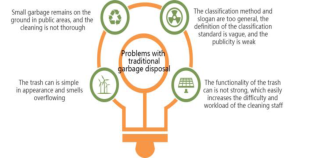
The Problem of Garbage Classification in Commercial Blocks From a design point of view, most of the sorting trash cans currently on the market belong to the “splicing” type of ordinary trash cans. The structural design focuses on the beauty of the appearance rather than its functiona- lity, and is limited to the slogans printed on the exterior (Tan Chang, 2008). The single-function trash can has little effect when the knowledge of garbage classification is not yet fully popularized.
From the perspective of the group, the main service objects of this sorted trash can are tourists and cleaners in commercial areas. Shen Yating et al. (Shen Yating, 2011). found that the public had insufficient understanding of the importance and necessity of garbage classification, insufficient awareness of the hazards of garbage pollution, and understanding of related knowledge about the classification of garbage collection, treatment and disposal proce- dures in the investigation and on-site interviews in 19 districts of Shanghai. Very limited. The flow of people in the business district is relatively fast. It is difficult for tourists to distinguish the types of garbage carefully and put it in correctly it also increases the difficulty and workload of the cleaning staff in the later stage.
Analysis of the Status Quo of Garbage Classification in China Garbage classification has ushered in a mandatory era. With the rapid deve- lopment of technology and economy, the amount of garbage produced in daily life has also shown a substantial increase. According to the statistics of China Urban Environmental Sanitation Association, China produces nearly 1 billion tons of garbage each year, of which household garbage. The output is about 400 million tons, the construction waste is about 500 million tons, and the kitchen waste is about 10 million tons. The total amount of waste generated in China ranks in the forefront of the world. With the accelera- tion of China’s urbanization process and the improvement of people’s living
Figure 1: Problems with traditional garbage disposal.Table 1. List of relevant elements of the garbage collection system in commercial blocks.
Table available in the original PDF paper.
standards, urban domestic waste has maintained an annual growth rate of 8%–10%. More than two-thirds of the cities across the country are in the dilemma of “garbage siege”, and garbage sorting and recycling are wide- spread. It is considered to be a key link to solve the predicament and improve the efficiency of resource utilization. China’s environmental work has always been dominated by the government, which has caused the public’s mindset. The vast majority of the public still believe that garbage classification, colle- ction, transportation and disposal are only the government’s responsibilities, and their understanding of the importance of garbage classification and its impact on the environment Not deep, the public has insufficient enthusiasm and motivation to participate in the classification.
System Analysis of Relevant Elements of Trash Bins in Commercial Blocks From a systematic point of view, product design should analyze the corre- lation of various influencing parameters around the product. The core issue of product design is to coordinate the relationship between people, product and environment and improve overall efficiency (Shi Hongzhang and Bao Jiangchen, 2014). According to the survey results of commercial districts, 31 elements are summarized from the human-machine-environment, and the correlation between the 31 elements is analyzed. Table 1 below shows the waste in the commercial district using the correlation table method. List of relevant elements of the recycling system (see Table 1).
Garbage Sorting and Recycling System of the Master and Slave Stations 391
Analyzing the relevant elements of the system and combining the shop- ping mall’s always-centered concept of customers, it was found that garbage collectors, floor cleaners, and customers in the shopping mall are also key elements that need to be considered in the design process.
(1) For shops: Shops are one of the important sources of garbage in com- mercial areas. According to survey statistics, most of the garbage in shops is classified by shop personnel. The amount of classification is large and miscel- laneous. Only accurate classification from the source can reduce the later garbage The task volume of the classification.
(2) For customers: The commercial area is a gathering place that integrates restaurants, entertainment, snack streets, coffee shops and other shops. The daily flow of people includes office workers dining, friends shopping, and foreigners traveling and sightseeing. The flow of people is large, the amount of garbage generated during peak periods is large, and the messy environment has a greater negative impact on customer emotions.
(3) For managers: The current workload of the cleaning staff has reached a certain level, coupled with the manual secondary classification of garbage, it will cause a greater burden on the cleaning staff. At this time, the mall managers have to consider Investment in human resources.
DESIGN INNOVATION Through systematic integration of waste, the goal of accurate waste classifi- cation is achieved and sustainable development is achieved (Yao Jun, 2020). Garbage treatment is a holistic concept. Garbage classification should start from the source. Garbage classification should be divided into auxiliary gar- bage classification, garbage management, and garbage recycling. It is accurate to every link of garbage classification to achieve accurate classification.
System Construction The waste sorting and recycling system of the master and slave stations in the commercial district is a transitional product designed based on the existing waste sorting situation (Li Xiuli et al. 2014). The system uses the system to efficiently coordinate waste sorting, and can reduce the pressure on the people in the waste sorting process by designing auxiliary waste sorting; The system includes a master station and a slave station. The overall model is an intelligent product plus service system. It aims to create a more convenient and fast garbage sorting and recycling model and popularize garbage sorting knowledge.
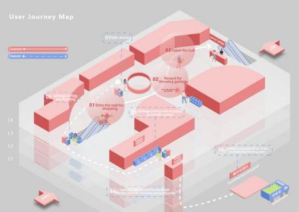
Before classification, customers will identify the garbage category through the scanning port of the slave station; in the classification, the garbage bin of the slave station will display the identified garbage information in a visual form on the display screen; after the classification, the master station will receive the garbage from the slave station Notification of the overflow of the barrel, and timely recovery and cleaning. In this process, two groups of peo- ple, customers and cleaners will be involved, and behavior paths are planned for the two groups of people. Figure 2 below is a user journey diagram of the system for the two types of users (see Figure 2).
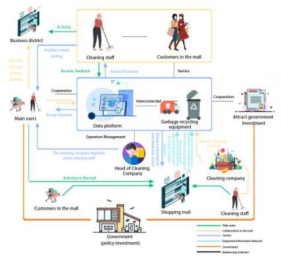
Figure 2: Use flow chart of smart waste sorting users in commercial blocks.Figure 3: Service system diagram.
The master-slave station is a service platform built by the information network that can optimize the service path, assist in littering and recycling of garbage. This system combines new technology and new trends. The clea- ning staff receives real-time information from the trash can according to the service network built, and recycles it according to the received information; in terms of funds, it is mainly to drive government investment and use the display screen of the trash can from the station. The module earns profits in the form of embedded advertisements, and its overall service process is shown in Figure 3 below (see Figure 3).
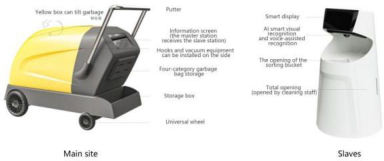
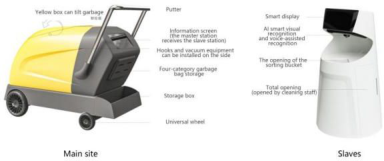
A complete system is composed of three requirements: element, structure, and function (Kong Lingyan and Xie Qingsen, 2013). The overall structure of the garbage sorting and recycling system in the commercial area is mainly divided into four parts: users, application systems, database servers and netw- orks. At the end, the main station garbage sorting and recycling truck has sub-elements such as information receiving interface, vacuum equipment, sor- ted garbage storage bin, four-class garbage bag, and cleaning tool storage bar. The secondary station sorting trash can has AI intelligent visual recognition technology, intelligent voice technology, information visualization interface, four-category trash can, etc.; the user mini program has a garbage classifica- tion knowledge popularization module, points/coupon redemption module, shopping information in shopping malls Modules and so on must belong to.
The main station trash can has an operation interface for receiving infor- mation and a storage bin for sorting garbage. This type of storage bin changes
Garbage Sorting and Recycling System of the Master and Slave Stations 393
Figure 4: Master and slave model diagram.Figure 5: Interface operation diagram of the main station trash can.
the original way that requires manual access, and frees the hands of the cle- aning staff in an intelligent dumping method. At the same time, the trash can of the master station also has the function of vacuuming; the trash can of the slave station is a garbage classification technology that combines AI intelligent visual recognition and voice-assisted interaction. The trash can of the slave station contains four garbage classification bins and an interface display. The user only needs to place the garbage at the end of the scanning port to identify the garbage, (see Figure 4) for the master and slave station model diagrams.
The interface of the main station trash can is mainly used to receive pro- blems such as overflow of the trash can, alarms, power, etc. of the slave station. When the trash can of the master station is opened, it will search for related trash cans, select and connect the trash cans on their own floors, and present the slave stations. The distribution of trash cans and the usage status of the trash cans (information such as garbage overflow, power level, etc.) (see Figure 5).
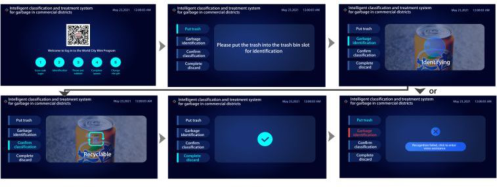
When the trash bin at the slave station has problems such as overflow of garbage, power problems, fire, etc., the trash bin at the master station will receive the message, and the cleaning staff will deal with it in time. The dynamic images of the four garbage classifications from the station are desi- gned to promote the knowledge of garbage classification. In the process of using AI visual recognition, when encountering a situation that cannot be recognized, voice recognition can be performed. The slave station mainly assists the garbage classification of the people. Its overall operation is divided into several modules: scanning and landing, identification, discarding gar- bage, completing points, and redeeming gifts. It can help the garbage sorting while accumulating points and coupon redemption to improve the garbage classification of the people consciousness (see Figure 6).
There are also small programs in the mall, which are mainly used for redemption of points and coupons for garbage classification, which can transmit spam information through the scanning port of the garbage can intelligently identified by the slave station in the business district.
Figure 6: Visual dynamic rendering of the four classifications of waste from the station.Figure 7: Technical system architecture diagram.
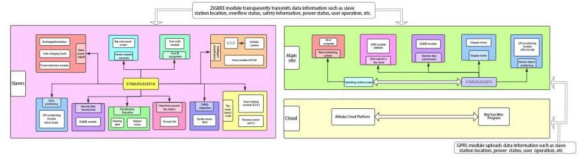
Technical System Realization The slave station transmits the information to the master station, the master station obtains the information, and the slave station end will also con- nect with the applet end to accumulate points and so on. The following figure shows the functional cooperation modules and technical implemen- tation of the master-slave station. The entire system is a garbage sorting and recycling system realized under the scenario of efficient cooperation between the master-slave station. After the master station receives the infor- mation from the slave station, it is responsible for the relevant cleaning of the master station. According to the received information, the personnel will give feedback on garbage collection and maintenance (see Figure 7).
CONCLUSION
Through the analysis of the status quo of domestic waste sorting and recycling, in view of the problem of urban waste sorting, it is necessary to start with policies and use technology to achieve efficient waste sorting and recycling. It is proposed to achieve precise classification of waste in com- mercial areas by means of intelligent interconnection between master and slave stations, to carry out “assisted classification” and “rewards” in an intelligent way, and to use online classification learning and offline auxiliary classification to improve people’s awareness of waste classification , Realize classification from the source, and use design methods to achieve efficient and accurate garbage classification in commercial blocks.
The treatment of urban domestic garbage should focus on the precise classification of front-end garbage. The front-end garbage can be accura- tely classified and the classified garbage can be classified and transported, so as to avoid the second time when the back-end garbage is recycled. Sub- refining, improving the efficient operation of the overall garbage recycling
Garbage Sorting and Recycling System of the Master and Slave Stations 395
system, and realizing the full recycling and reuse of garbage. From the per- spective of system theory, this design research is to build a garbage sorting and recycling system for communication between master and slave stations in the environment of commercial blocks, and use the system to achieve efficient operation of garbage collection in commercial districts.
ACKNOWLEDGEMENT
This research was funded by Project: 2018 Humanities and Social Sciences Foundation Project of Wuhan University of Technology, R201811.
REFERENCES
Chen Fang. Research on Behavior Guidance Design in Japanese Domestic Waste System [J]. Design, 2019, 32(16):99–101. Kong Lingyan, Xie Qingsen. On the application of system design in product design
[J]. Design, 2013(06):184–185. Li Xiuli, Zhou Mingyuan, Fan Li, et al. Research on Urban Waste Sorting and Recycling System Based on Internet of Things [J]. Industrial Safety and Environ- mental Protection, 2014, 40(007):64–66. Liu Weishang, Liu Haoran, Han Deyang. Industrial treatment of municipal solid
waste from the perspective of system design [J]. Packaging Engineering, 2019, 40(10):179–185. Shen Yating, Song Shuowei. Theory and Practice of Solid Waste Recycling Supervision—Investigation on the Status Quo of Municipal Waste Classification in Shanghai and Policy Recommendations [A]. Chinese Society for Environmen- tal Sciences. 2011 Chinese Society for Environmental Sciences Annual Conference Proceedings (Volume 2) [C]. Chinese Society of Environmental Sciences: Chinese Society of Environmental Sciences, 2011:5. Shi Hongzhang, Bao Jiangchen. Analysis on the Effecting Factors of Man-Machine- Environment System in Production Logistics System [J]. Applied Mechanics and Materials, 2014, 3468: Tan Chang. Research on the Spatial Form and Scale of the Pedestrian Commercial
District in the City Center [D]. Tianjin University, 2008. Xi Junqing, Jiang Huohua, Wang Zhiguo, et al. Analysis of the status quo and existing problems of municipal solid waste disposal in my country [J]. China Environmental Monitoring, 2003(01):23–25. Yao Jun. Research on Sustainable Product System Design [J]. Packaging Engineering,
2020, 41(14):1–9. Yu Hansheng, Chen Yao. Research on the Design and Application of Intelligent Garbage Sorting and Recycling System [J]. Packaging Engineering, 2018, 39(18):154–159.
LISTED IN THE AHFE DIGITAL BOOKSTORE CATALOGUE
Explore the complete digital volume
Human Factors and Systems Interaction
Read this individual research paper free through the original publisher, or explore the full digital proceedings book.
ISBN 978-1-958651-28-5
Explore this ISBN in the AHFE Bookstore ↗Listed in the July 2026 bookstore catalogue; search by ISBN to confirm current availability · Digital book purchase optional