Liu Ying, Liyuan Bao (2023). Exploring the Cultivation of Art Archaeology Talents in the Context of “New Liberal Arts” in China —Take “3D Image Design” Course as an Example. In: Ergonomics In Design. AHFE Open Access, vol. 77, pp. 736–743. https://doi.org/10.54941/ahfe1003434
The concept of "New Liberal Arts" encourages universities to promote interdisciplinary integration teaching and enhance the breadth and depth of application of professional course contents, so as to promote the application relationship between disciplines and cultivate application composite talents. At present, there is a growing demand for popularisation of science knowledge, and online museums, short science videos and other forms of virtual visualisation of science have been recognised by the market, so talents in this field need to be trained by universities to replenish the market. However, with the development of the times, limited by the speed of renewal of the art archaeology ontology - archaeological resources, how to maintain the rigour and innovation of art archaeology talents to progress together is a current issue that needs to be addressed. The aim of this study is to focus on the cultivation of innovative art archaeological talents, and to explore the teaching of the course "3D Image Design" from the perspective of interdisciplinary, comprehensive literacy, dialectical thinking training, and the social significance of the course, starting from the curriculum of digital media art. The course proposes a "3D creation-based art and archaeology learning method" and an "integrated software application model" that can optimize the traditional teaching methods of art and archaeology courses and cultivate complex talents with a sense of integration of art and science.
The New Liberal Arts is proposed in the context of the age of artificial intel- ligence, the historical development of socialism with Chinese characteristics and the changing pattern of globalization, mainly to meet the market demand for talents in new industries, promote the deep integration of disciplines and promote innovation. The cross-fertilization of disciplines advocated by the “New Liberal Arts” can be divided into the intersection of liberal arts and liberal arts, and the intersection of liberal arts and science and technology. Art archaeology is an emerging discipline that spans a variety of disciplines, inclu- ding anthropology, history, archaeology, art, art history, and folklore, and has important implications for the improvement of teaching and evaluation in art
Exploring the Cultivation of Art Archaeology Talents in the Context 737
colleges and universities [Lu Fang. Exploration and practice of integrating art archaeology into the teaching of art colleges and universities [J]. Literature and education materials. Xi’an. 2015(13)]. It is a representative discipline in the context of the new liberal arts. The emergence of art archaeology mainly stems from the integration path between the current Chinese traditio- nal culture boom, the demand for science education and the enhancement of the aesthetic consciousness of the public, according to incomplete statistics, China’s Xi’an Academy of Fine Arts and Shandong Academy of Arts have opened art archaeology-related majors, and Sichuan Academy of Fine Arts, Nanjing Academy of Arts and Chongqing Normal University have opened art archaeology-related courses, which shows that art archaeology-related majors and courses are mainly This paper is based on the art archaeology market. Based on the art archaeology market, this paper conceptualizes the principles of art archaeology curriculum framework, explores the way of cul- tivating art archaeology talents, and uses the course “3D Image Design” as a case for specific analysis.
EXPLORING THE CULTIVATION METHOD OF ART ARCHAEOLOGY TALENTS BASED ON MARKET DEMAND At present, the art archaeology industry is widely used in the international market, mainly divided into: museum art restoration displays, archaeology- type science education videos, science book illustrations, archaeology deri- vative products, archaeology derivative film and television, etc. The skills required in these art and archaeology industries include: basic theoreti- cal knowledge of archaeology, literature retrieval and combing, painting techniques, three-dimensional molding techniques, film and television post- effects, etc. Thus, it can be seen that the specialized training of art and archaeology talents is divided into archaeological theory specialization and virtual display specialization. The curriculum and training mode of virtual display are similar to those of film and animation and digital media art majors, and the major difficulty is how to teach students the diversity of archaeological contents in a limited time. Therefore, this study summarizes the training mode of art archaeology talents based on market demand as the following points.
(1) Grasp the regularity of archaeology. Archaeology can be divided into prehistoric archaeology, historical archa- eology, field archaeology and various special archaeology.
Archaeology can be divided into prehistoric archaeology, historical arch- aeology, field archaeology and various special archaeology, etc. The huge theoretical system of archaeology is too large for the teaching content of a single major or course, especially for cross-cutting disciplines. Therefore, the relationship between art and archaeology should be balanced in the cultiva- tion of art archaeology talents. As a major in art colleges, the course should focus on artistic expression while ensuring scientific rigor, positioning the content of archaeological theory courses on archaeological content research methods and laws, and focusing on teaching archaeological characteristics and artistic archaeological laws summarized in project practice.
738 Ying and Bao
(2) Teaching around projects. Archaeology and art are both practical disciplines, and art archaeology was born from the development of the science and culture market.
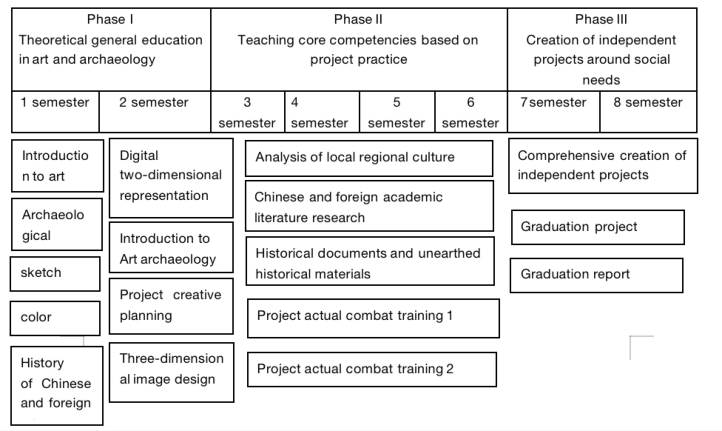
Art archaeology is born from the development of the science and culture market, and should focus more on the practicality of the market. Therefore, the cultivation of art archaeology talents should be divided into three stages: the first stage is the general education of art archaeology theory, the second stage is the teaching of core competencies based on project practice, and the third stage is the creation of independent projects around social needs, so as to achieve the comprehensive integration of market adaptability, disciplinary knowledge and personal qualities.
(3) Focus on the regional nature of teaching platform. The development of art archaeology courses should pay full attention to the archaeological resources and cultural traditions of the region where the teaching platform is located,.
On the one hand, while teaching in a professional way, we combine local culture to make the teaching results have certain regional characteristics; on the other hand, the convenient investigation environment is conducive to the scientific control of archaeological research, and the results of art archaeology can also be quickly applied in the local area.
EXPLORING THE CURRICULUM OF ART AND ARCHAEOLOGY PROFESSIONAL CLASSES Based on the previous chapter’s exploration of market-demanded approaches to art archaeology talent development, this chapter presents the curriculum of art archaeology professional classes in chart form based on three teaching phases and based on eight teaching semesters for Chinese undergraduates.
Figure 1: Course stage.
Exploring the Cultivation of Art Archaeology Talents in the Context 739
EXPLORING THE PRACTICE OF “3D IMAGE DESIGN” COURSE The course of “three-dimensional image design” is now mostly a compul- sory course for animation and digital media art majors, mainly about the process and methods of computer film and television three-dimensional ani- mation production, while the course has a very wide range of applications in the art and archaeology industry, such as: museum art restoration display, archaeology class science education video, science book illustrations, archae- ological derivative products. The course takes MAYA animation software as the main object of explanation. This course focuses on MAYA keyframe ani- mation, animation deformation, advanced character skeleton, particle effects, rigid and flexible bodies, expressions, hair, fluid dynamics and other aspe- cts of knowledge, so as to prepare students for future three-dimensional archaeological restoration creation of technology.
This study bases the artistic archaeological teaching content of “3D Image Design” on the theme of Chinese paleontological fossil community restora- tion, focusing the teaching case on the Chaohu Lake area, one of the five major freshwater lakes in China, and the fossil production area of Chaohu Lake in Anhui Province, which is included in the second batch of 15 natio- nal key protected paleontological fossil concentration production areas. The course hopes to recover the paleontology of Chaohu Lake through the use of three-dimensional molding technology, integrating the above research in the teaching curriculum to carry out a three-step teaching model, creating a plat- form for development. The three steps are: the establishment of a framework for thinking, the exploration of practical creation, and the generalization of course effects.
(1) Thinking framework establishment. In the early stage of the course, we guide the academics to think about the core issues of art archaeological restoration: how to select the most represen- tative, expressive and popularized paleontological creatures for restoration; how to integrate archaeology, art and 3D technology in an interdisciplinary manner; and how to decompose and then integrate the digital stereosco- pic animation technology. In order to better support the establishment of a framework for thinking, the course is preceded by comprehensive research activities, including field research, literature research, film research, etc.
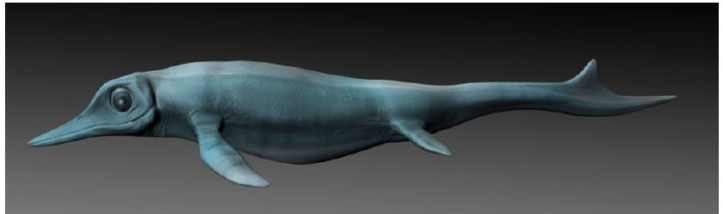
After a series of research and discussion, the course set the archaeologi- cal objects as follows: one of the oldest known ichthyosaur fossils: Turtle Mountain Chaohuosaurus, a soft-wristed shortnose dragon with a tendency to study amphibious reptiles, and a representative of marine arthropods in the Chaohu Lake area: Anki shrimp. Meanwhile, the three-dimensional restora- tion technology is summarized into digital restoration molding technology, digital material texture expression technology, and digital three-dimensional rendering and display technology.
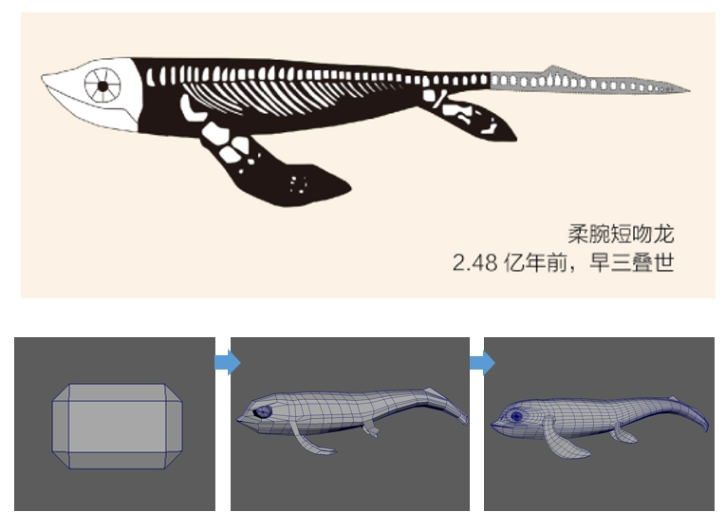
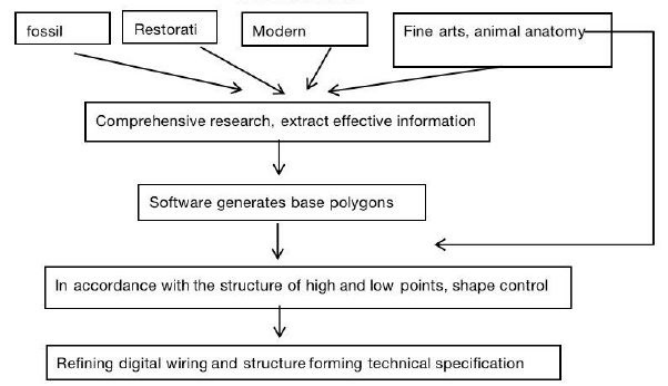
(2) Practical creation exploration. x Digital restoration and shaping stage. The digital restoration modeling is based on fossils, with the restora- tion map as the reference, combined with modern animal growth pattern as the specimen, and the principles of art and animal anatomy as the shaping
740 Ying and Bao
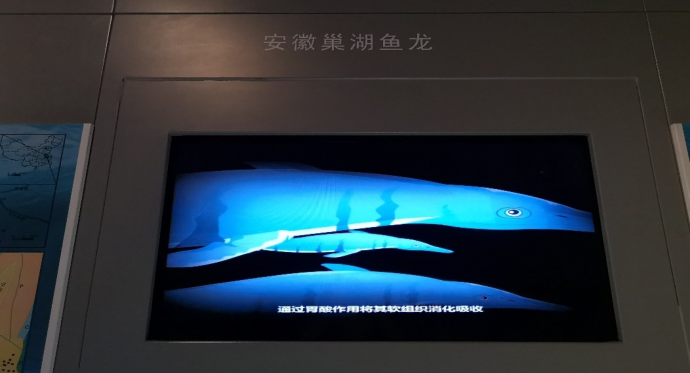
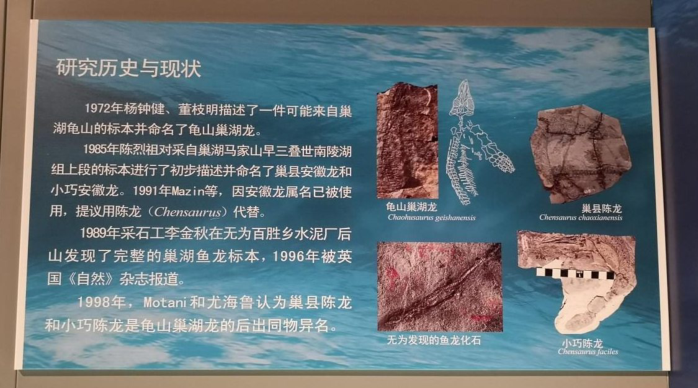
Figure 2: Animation of Chaohu dragon exhibition in Anhui Geological Museum.Figure 3: Anhui Geological Museum Chaohu Dragon Exhibition Board.
principle, and the basic biological model is generated by MAYA software. This technology changes the previous method of molding only with a single software, focusing on the integrated use of multiple software, the technology to create prerequisites for later binding animation, but also allows students in this course of resource modeling to lay a certain foundation of modeling techniques.
y Digital material texture expression stage. By referring to literature and restoration drawings as well as the same type of animal growth color, hair pattern, natural environmental impact, etc., the use of 3D mapping, 2D drawing and other software integration of the combination of color mapping of living organisms, the use of ZBRUSH, MUDBOX and other carving software for the model of the large shape and
Exploring the Cultivation of Art Archaeology Talents in the Context 741
Figure 4: Digital recovery molding technology.Figure 5: The process of making the basic model of the soft-skinned alligator.
texture carving and extraction of normal mapping, thus obtaining color, nor- mal two mapping, the This stage is linked to a variety of software to improve the efficiency and presentation effect. Through this stage, students learn to use the software in an integrated way of thinking, leading the practice in a theory-oriented way.
742 Ying and Bao
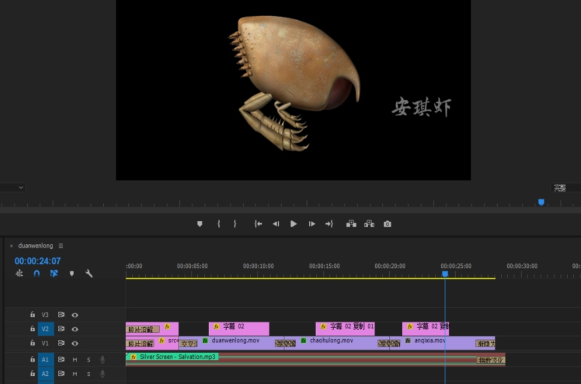
Figure 6: Complete color texture effect.Figure 7: Show video production in the software.
z Digital stereo rendering and display stage. This stage is the final effect display material extraction technology, based on the above material texture perfection after the model, in the MUDBOX, MAYA and other software through stereo lighting debugging, virtual camera position and path settings, and finally through the rendering menu to get transparent channel pictures, sequence frames and other materials.
This stage is also the result stage, the content can be directly transformed into science videos, book illustrations, etc. At the end of the course, students are encouraged to think about the greater applicability of the results.
(3) Summary of course effects. With the help of this “3D Image Design” art and archaeology course, we can summarize the following course effects: First, modeling-based art and archaeology learning methods, art and archaeology majors and even courses can not only use archaeological theory to guide the practice of art creation, but also can be based on 3D creation to learn art and archaeology, through the specific activity of model creation to drive the active learning of knowledge. Second, integrated thinking, art archaeology is an interdisciplinary discipline,
Exploring the Cultivation of Art Archaeology Talents in the Context 743
and its learning and application process, whether it is the integrated use of multiple software in practical creation or three-dimensional archaeological restoration thinking, requires integrated thinking mode to ensure scientific rigor and efficient creation.
CONCLUSION
Art archaeology is an emerging discipline, and the main difficulty in the cultivation of talents lies in the problem of less teaching experience and teaching achievements. With the explosion of the artificial intelligence era, more and more intelligent modelling software has emerged, and there are even intelligent generation tools like ChatGPT under openAI, which brings new challenges and opportunities to the training of digital art archaeology talents. To meet the arrival of the era of artificial intelligence and cultivate art archaeological talents that are relevant to the times.
ACKNOWLEDGMENT
The authors would like to acknowledge.
REFERENCES
Fan Shuying. From teaching research to professional education–thinking about the construction of art archaeology discipline in higher art institutions [J]. Fine arts observation. Xi’an. 2021(08). Hu Xiwei. Theoretical research based on 3D animation and virtual reality technology
[D]. Wuhan: Wuhan University, 2005. Lian Coronation. Teaching plan of the course “Archaeological theory and art archaeology” [J]. Chinese art. Hangzhou. 2021(03). Lu Fang. Exploration and practice of integrating art archaeology into the tea-
ching of art colleges and universities [J]. Cultural and educational materials. Xi’an. 2015(13). Zhou Xiaolu. Art archaeology education talk [J]. Art Education. Xi’an. 2014(10) l. Zhou Zongkai, Cao Shang. Experimental exploration of paleontological restoration development and use [M] Jiangsu Phoenix Art Publishing House. 2016.
LISTED IN THE AHFE DIGITAL BOOKSTORE CATALOGUE
Explore the complete digital volume
Ergonomics In Design
Read this individual research paper free through the original publisher, or explore the full digital proceedings book.
ISBN 978-1-958651-53-7
Explore this ISBN in the AHFE Bookstore ↗Listed in the July 2026 bookstore catalogue; search by ISBN to confirm current availability · Digital book purchase optional