Jose Luis De La Fuente Piñeirua, Rodolfo Martinez Gutierrez, Carlos Antonio Valdez Barrera, Pedro Valdez Barrera (2023). QHS methodology for strategic planning, KPIs and talent management in cross-border transport drivers. In: Human Systems Engineering and Design (IHSED 2023): Future Trends and Applications. AHFE Open Access, vol. 112, pp. 540–545. https://doi.org/10.54941/ahfe1004168
The companies that integrate the supply chain of foreign trade and customs offer the service of transport of goods as a key piece of their business model, to maintain competitiveness in the market before the regulatory requirements and organizational growth it is necessary to manage the specialized talent in positions of Cross-border Transport Drivers, through competency standards and KPI monitoring that integrates the business philosophy, with the implementation of the QHS methodology it is projected as a tool for the development of a corporate strategic plan for consolidation of operations.
This dissemination article is the product of an applied research project of master’s thesis in administration, with the objective of developing a proposal for a Mexican Standard for good practices in the generation of performance indicators and components of strategic planning in Cross-Border Transport Services that specializes in the training of highly qualified drivers as a key factor of their cross-border services. Thus, ensuring leadership in the foreign trade and international logistics market, fulfilling indicators of the vision and mission of business philosophy considering the Mexican Standard NMX-R- 026-SCFI-2016 as a structural reference. Companies specialized in providing cross-border freight transport services as their operational processes mature, develop their own systems and orga- nizational styles, which is why the design of strategic planning has elements that contribute to the phases of the generation of indicators and metrics for the evaluation of operational performance. The great challenges of the man- agement staff and staff in cross-border transport companies is properly the standardization of the processes talent management of the operators of truck tract, the learning curve that drivers must acquire are key factors for the success of the companies, implicitly the fulfillment of the legal requirements
QHS Methodology for Strategic Planning, KPIs and Talent Management 541
before authorities, the internal regulations in the transport companies, as well as the adherence to the procedures and control of documentation of security systems in the handling of goods cross-border.
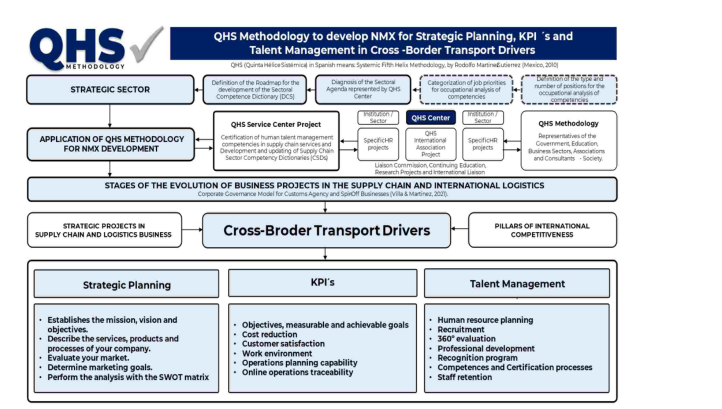
QHS Methodology as a Sectoral Articulation Strategy For the systematic methodological development, the model of the design of the NMX proposal for good practices of Corporate Governance promoted for Customs Agencies has been considered (Garcia, 2021). The roadmap of the Research Project is presented in Figure 1 oriented to the sectoral inte- gration strategy as proposed by the QHS Methodology (2020, 2023), which begins with the definition of job profiles of drivers, proceeds with the work structure of the involvement of specialists from the sectors of the Society linked to cross-border transport, Government sector; the authorities of com- munications and transport, Academy sector; trainers specialized in processes of handling and operation of cross-border transport, Business sector; special- ized in tractor-trailers, sector Associations of transport companies; specialists in legal compliance requirements and Sector Consultants; specialists in pro- cesses of certification of competences of cross-border drivers. The work of in-depth interviews and focus groups will generate the systematic contribu- tions for the design of a proposal for a Mexican Standard to ensure key indicators of Cross-border Drivers.
Figure 1: QHS methodology. (Adapted from Martinez, 2010.)
The competencies of cross-border truck drivers must develop three key competencies within the framework of their learning curve, for the purposes of the certification necessary to exercise their responsibilities as a certified driver. The competencies of the Drivers integrate the following knowledge, skills, and attitudes. a) Verify the operating conditions of the truck tract, b) Drive the truck tract, and c) Perform the procedure of parking and uncou- pling the truck tract. The foregoing under an evaluation process through an
External Training Agent, authorized by the Ministry of Labor and Social Welfare in Mexico. The cross-border transport service is a key piece in the value chain of supply chain services, hence the importance of specialized talent management (Madrigal, 2017).
Table 1 addresses the information contemplated for the systematic analysis of the exercises of Focus Groups of the QHS Methodology (Gutierrez, 2021), integrating the elements and objectives of the EC1145, EC0869 and EC1116 competence standards of transport drivers according to the National System of Labor Competencies of Mexico, with the purpose of creating a new pro- posal for a standard of competences for cross-border transport drivers, and is useful for specialized talent management processes in transport companies. Competency standards integrate knowledge, skills, and attitudes; evaluated through questionnaires for theoretical knowledge, checklists for skills and observation guides to evaluate behaviors.
Table 1. Analysis of driver competency standards.
Table available in the original PDF paper.
Code Standard Name Purpose of the standard EC1145 Truck driving for general cargo transport Among the essential tasks that a person must perform are, the verification of the proper functioning of the vehicle, the review of the load using the appropriate safety and personal protection equipment, driving the vehicle for the transfer of the cargo being always aware of any emergency that may arise during the transfer; and carrying out the procedure of operation and parking of the vehicle in the established space. EC0869 Preventive handling of unit truck type C
Requirements that a person must demonstrate to be considered competent in the preventive handling of unit truck type C, is based on the knowledge of the vehicle and the physical-mechanical review, interpretation of preventive driving instruments during a route and parking maneuvers. EC1116 Federal Freight Carrier Driving
Establishes and defines the elementary functions that a person must perform to be competent in the driving of federal cargo motor transport, coupled with a semi-trailer, which begins with an initial verification of the vehicle, verification of the load, operation and driving of the vehicle for the transfer of its different types of cargo, also establishes the theoretical and practical knowledge that the person in charge of this function must have, as well as the relevant attitudes in their performance.
DEVELOPMENT OF COMPETITION STANDARD PROJECT FOR CROSS-BORDER DRIVERS As a result of the systematic analysis and good practices identified in talent management for Cross-border Transport Drivers, a functional map was built according to the description and profile of the driver’s position, integrating theoretical knowledge in the proposal of the competence standard; aspects of the responsibilities and roles of a driver, the context of transporting goods, the
QHS Methodology for Strategic Planning, KPIs and Talent Management 543
correct operation and detection of failures of the tractor-trailer equipment, the aspects of occupational safety and health when driving.
Table 2 It presents the proposal structure of a training system as a basis for the design of a competency standard for a cross-border driver. The driver must develop technical skills in the operational activities, maneuvers of the loading equipment, the technical knowledge of loading and unloading of goods and security measures, the paperwork of the documentation of legal compliance with the authorities. As well as the behavior of culture, civility, environment, courtesy, and customer service, under the approach of the prin- ciples of philosophy of corporate governance (Larenas, 2017). The design of the standard considers innovative aspects in the skills of handling equipment and intelligent systems of geolocation and traceability of the routes of the tract trucks.
Table 2. Proposal for training systems for cross-border drivers.
Table available in the original PDF paper.
Course Thematic content Cross-border driver training
1. Diagnostic evaluation 2. Introduction to the functions of the cross-border driver 3. Professional culture of the cross-border driver 4. Prevention of accidents on the road and in maneuvers 5. Education and emotional control 6. Regulatory framework and legal compliance requirements 7. Education and road health 8. Comprehensive vehicle knowledge and fault detection 9. Operation and driving of vehicles 10. Cargo handling 11. Coupling, decoupling, and driving of articulated vehicles 12. Most common diseases of the Driver 13. Customer Service and Community Culture 14. Environment 15. Intelligent transport and traceability systems 16. Customer service model in logistics services 17. Basic and technical English 18. Final Evaluation
CONCLUSION
The interinstitutional collaborative work always generates great contribu- tions to the Society, to the strategic sectors it provides the opportunity to document good practices from the experience of the specialists of the differ- ent sectors involved in the performance of a cross-border driver, the standards of competences and the Mexican norms represent a reference guide towards excellence in the provision of professional services (Bernard, 2018). In organi- zations that are part of the supply chain business value chain and specialize
in foreign trade and international logistics businesses, knowledge manage- ment is one of the great challenges to systematize “know how” of operations (Perilus, 2021), contributing to the consolidation of quality management and customer service systems. The competency standards are the set of good prac- tices documented by the technical groups and methodologies in the design of evaluation instruments linked to levels of certification according to the level of rigor according to the International System of Levels of Educa- tion. Strengthening the organizational structure of key positions in critical operations (Madrigal, 2017), learning curves are strategic instruments that systematize how to identify efficiency, effectiveness, productivity, and the installed capacity itself in terms of infrastructure and intellectual manage- ment to meet customer satisfaction levels. The standards of competencies are the set of effort, experience, talent reflected in a guide of good practices in the management of the business of the value chain of the supply chain con- tributing to the organizational success and level of satisfaction of the clients, generating greater confidence in the relationship of the client. (Rios, 2022).
ACKNOWLEDGMENT
Special thanks to Engineer Jorge Vicente Villa Garcia, General Director of the Grupo Atlas, supply chain services specialists in the Cali Baja region. For the confidence to develop a postgraduate program of Master in Admin- istration for the Management Staff, as well as for Engineer Jose Guillermo Cardenas Lopez Director of the Tijuana Institute of Technology (ITT) for its support to the development of Specialized Talent Management projects with international scope in the Center for Research and Innovation of the ITT.
Sincerely Dr. Rodolfo Martinez Gutierrez Member of the National System of Researchers SNI Level 2 – CONACYT Mexico
REFERENCES
Bernard M. (2018) Key performance indicators. The 75 keys that the administrator must know. Trillas. EC1145 (2018) Truck driving for general cargo transport http://www.conocer.gob.
mx/contenido/publicaciones_dof/2018/EC1145.pdf EC0869.01 (2021) Preventive handling of unit truck type C https://www.conocer.go b.mx/contenido/publicaciones_dof/2021/EC0869.01.pdf EC1116 (2018) Federal Freight Carrier Driving http://www.conocer.gob.mx/conteni
do/publicaciones_dof/2018/EC1116.pdf Garcia, J., Gutierrez, R. (2021). Corporate Governance Model for Customs Agency in accordance with Federal Customs Law Article 167-D in Mexico. In: Walde- mar Karwowski, Tareq Ahram, Mario Milicevic, Darko Etinger and Krunoslav Zubrinic (eds) Human Systems Engineering and Design (IHSED2021): Future Trends and Applications. AHFE (2021) International Conference. AHFE Open Access, vol. 21. AHFE International, USA. Website: http://doi.org/10.54941/ahfe 1001203
QHS Methodology for Strategic Planning, KPIs and Talent Management 545
Gutierrez, R. (2021) Methodology of the Fifth Helix Systemic, A Decade of Sectorial Investigations 2010-2020, IOP Conference Series: Earth and Environmental. Website: https://ui.adsabs.harvard.edu/abs/2021E%26ES..690a2061M/abstract Larenas, R. (2017) Corporate Governance for Medium Enterprises, directory for
profitable and enduring companies. USA. Martinez-Gutierrez, R. (2020). Methodology of Dictionaries of Sector Competences (DCS), to Design Standards of Professional Competences, Research and Labor. In: Nazir, S., Ahram, T., Karwowski, W. (eds) Advances in Human Factors in Training, Customs Services- Quality of services provided by customs broker (quality of customs broker) Computing, vol. 1211. Springer, Cham. Website: https://doi.org/10.1007/978-3-030-50896-8_46 Martinez-Gutierrez, R., Ibarra-Estrada, M. E., Carey-Raygoza, C. E., Hurtado-
Sanchez, C., Chavez-Ceja, B. (2022). Observatory of Labor, Professional and Research Competencies of the Economic Sectors in Baja California. In: Ahram, T., Taiar, R. (eds) Human Interaction, Emerging Technologies and Future Systems V. IHIET 2021. Lecture Notes in Networks and Systems, vol. 319. Springer, Cham. Website: https://doi.org/10.1007/978-3-030-85540-6_164 Martinez-Gutierrez, R., Carey-Raygoza, C. E., Hurtado-Sanchez, C., Chavez-Ceja, B., Lara-Chavez, A. (2021). Business Management Engineers: Profile and Compe- tencies of Generations X, Y and Z. In: Trzcielinski, S., Mrugalska, B., Karwowski, W., Rossi, E., Di Nicolantonio, M. (eds) Advances in Manufacturing, Production Management and Process Control. AHFE 2021. Lecture Notes in Networks and Systems, vol. 274. Springer, Cham. Website: https://doi.org/10.1007/978-3-030- 80462-6_36 Martinez-Gutierrez, R., Esther Ibarra-Estrada, M., Hurtado-Sanchez, C., Galvan-
Sanchez, R., & Ernesto Jimenez-Bernardino, A. (2023). Perspective Chapter: Prospective of Sectoral Competences for the Design of Dictionaries of Pro- fessional Competences and Research. Education and Human Development. doi: 10.5772/intechopen.109457 https://www.intechopen.com/online-first/85569 Madrigal-Torres, B. (2017) Management Skills, McGrawHill. Munger K. (2022) Generation Gap. Why the Baby Boomers Still Dominate, American politics and Culture, Columbia University Press. NMX-R-026-SCFI-2016 Customs Services- Quality of services provided by customs
broker (quality of customs broker) – Requirements. Website: https://www.dof.go b.mx/nota_detalle.php?codigo=5464149&fecha=06/12/2016#gsc.tab=0 Perilus B. (2021) Four generations under one organization’s roof. A resource for leading and managing the Baby Boomers, Generation X, The Millennials, and Generation Z. Rios Garcia, D. J., & Hernández Leal, A. (2022). Labor competencies within customs
agencies pre and post Covid 19. Vinculatégica EFAN, 8(4), 15–25. https://doi.or g/10.29105/vtga8.4-197
LISTED IN THE AHFE DIGITAL BOOKSTORE CATALOGUE
Explore the complete digital volume
Human Systems Engineering and Design (IHSED 2023): Future Trends and Applications
Read this individual research paper free through the original publisher, or explore the full digital proceedings book.
ISBN 978-1-958651-88-9
Explore this ISBN in the AHFE Bookstore ↗Listed in the July 2026 bookstore catalogue; search by ISBN to confirm current availability · Digital book purchase optional