Evangelos Markopoulos, Alisia Jordanou, Hannu Vanharanta, Jussi Kantola (2023). Co-opetitive Management and Leadership Methodology for Democratic Organizational Change. In: Human Factors in Management and Leadership. AHFE Open Access, vol. 92, pp. 29–38. https://doi.org/10.54941/ahfe1003731
If change is constant, then change management is constant, but maintaining successful change management programs and strategies can be challenging, especially if the impact of the change is big or the time between the changes is small, or the frequency of changes is high. Organizational changes can be seen as mandatory route for the adaptation of new markets trends, client expectations or response to social and geopolitical situations and events that demand structural and radical changes for the organization to move on. However organizations are composed of humans and change management tends to be more related with human resource management than operations management. It is the degree of effective human involvement that defines and drives a successful change, even if this change has limited human input such as technological changes, supplier changes, etc.Over the years several change management theories have been evolved and adapted in the market. Some use more aggressive and X type or management practices, such as the Kotter’s model for change, while others use more democratic and Y type of management practices such as the ADKAR model for change. In either case, or in the ones that are more in the middle such as the Lewin’s forces for change, the participation of the employees needs to be secured with their willingness to engage constructively and not disruptively. Change is more likely to be adopted, and last longer, if intentionally or unintentionally is conceived as the right thing to do, with individual benefits. Therefore, the management objectives in a change management strategy can be directed under a new leadership type that integrates the democratic, participative, situational and transformational leadership theories.This paper presents a critical and comparative analysis between the Kotter’s Model for change, the ADKAR Model and the Lewin’s Forces for change. The result of this analysis highlights the leadership type that is primarily used and its distance from other the leadership types. It also indicates the switch of the management and leadership practices during the change management process, and the challenges related to that. The result of these analysis attempt to identify the degree of democracy used in the change management process which is essential for the effective and long lasting implementation of a change strategy. Democratic change programs can be implemented with less resistance regardless the impact of the change or the frequency they are executed. Therefore the paper identifies the change management model that is closer related to the Company Democracy Model used primarily for innovation based organizations strategies, and extends the application of this change management model to such type of organizations which are also characterized from their non-hierarchical structures and organizational cultures. These type of neo-liberal organizations are the most difficult to change as their degree or democracy and freedom to operate does not favour change management strategies driven mostly by logic, order and authority. For this a new leadership type is introduced that promotes co-opetitition instead of competition, an non-competitive collective effort to go through a change.The research conducted for this paper is based on an extensive literature review on change management theories, primary research with surveys and interviews but also analysis of case related studies to indicate the need for the critically analyse the two models studied and set the base for a new change management and leadership theory. Furthermore, the paper presents the pre and post-condition for adopting the new theory, highlights research limitations, and identifies areas of further research to be conducted for the optimization of the new theory and its contribution to the science of management and leadership.
If change is constant, then change management is constant, but maintaining successful change management programs and strategies can be challen- ging, especially if the impact of the change is big, the time between the changes is small, or if the frequency of changes is high. Organizational changes can be seen as a mandatory route for the adaptation to new market trends, client expectations, or responses to social and geopoli- tical situations and events that demand structural and radical changes for the organization to move on. However, organizations are composed of humans and change management tends to be more related to human resource management than operations management. The degree of effe- ctive human involvement defines and drives a successful change, even in
changes with limited human input such as technological changes, supplier changes, etc.
Over the years several change management theories evolved and have been adopted in the market (Gali, 2018). Some use more aggressive and X-type of management practices, such as Kotter’s model for change (Appelbaum, 2012), while others use more democratic and Y-type of management practi- ces such as the ADKAR model for change (Prosci, 2023). In either case or in the ones that are more in the middle such as Lewin’s Field Force Analysis (Swanson & Creed, 2014), the participation of the employees and their wil- lingness to engage constructively and not disruptively must be secured before any process begins. Change is more likely to be adopted, and last longer, if employees are convinced, intentionally or unintentionally, that this is the right thing to do, with personal first, but also organizational benefits. Therefore a change management strategy must be directed under a new leadership type that integrates democratic, participative, situational, and transformational leadership theories and traits.
LITERATURE REVIEW. ADVANCES IN CHANGE MANAGEMENT Change management is a term involving the organizational mechanisms that must be adjusted to reach a strategic change (Alvesson & Sveningsson, 2015). One theory is that a company needs to be transformed when it suffers from the “Burnout Syndrome”, characterized by uncontrolled change, excessive growth, and autocratic leadership (Probst & Raisch, 2005). When employees are aware that change management and organi- zational changes occur, friction and resistance to the procedure might be created, which can hinder or even boycott the mission. Disobedience to new regulations can occur as a result of this sense (Alvesson & Sveningsson, 2015). Shifting the focus to the sources of change, these are divided into planned and emergent. The first refers to planned change such as change programs that are designed by managers and supported by Human Resources or exter- nal consultants. Such changes can be restructuring, outsourcing, downsizing, and redefining quality standards (Alvesson & Sveningsson, 2015).
In a significant manner, change agents have a central role in supporting and implementing organizational changes, as they are strategically coordi- nate and integrate challenging and complex change projects to transform the organization, after the company’s weak spots and issues have been identified (Caldwell, 2003). Some characteristics of the change agency aspect include teams that are self-managed, task groups, and quality circles (Caldwell, 2003). Therefore, the essence of this tactic focuses on the team rather than individual work, and this can be due to the fact that it sheds light on diminishing hierarchical control and enhancing horizontal coordination throughout the various units, divisions, and work contexts (Caldwell, 2003). Therefore, change management is a structured procedure in which the stra- tegic partners are expected to take action and fill the organizational gaps by building the relevant tactics to address them and involving the change
Co-Opetitive Management and Leadership Methodology 31
agents. Simultaneously, it ensures that the changes implemented are smo- oth and thorough, to achieve lasting change effects (Goyal & Patwardhan, 2013).
THE ADKAR MODEL FOR CHANGE In 1998, the ADKAR model was built by Jeff Hiatt; Prosci Research as a mechanism for assessing whether the activities of change management provi- ded the results required (Goyal & Patwardhan, 2013). Essentially, to achieve effective management of change, the framework focuses on five compounds (Goyal & Patwardhan, 2013). Firstly, the change management is expected to raise awareness about the need for change, which is followed by the desire to support the forthcoming organizational alteration, and then, thirdly, to pro- vide relevant knowledge and information on the ways that the procedures will be implemented (Goyal & Patwardhan, 2013). The fourth goal involves the ability to incorporate the daily tasks and finally, the reinforcement of main- taining the change in the organizational context. Ultimately, the framework encourages the employees to be change sponsors and to be involved in the procedure, making them feel part of the change (Goyal & Patwardhan, 2013).
KOTTER’s MODEL FOR CHANGE The Kotter model established in 1996, aspires to vanish any doubts emplo- yees have and to enhance their engaged spirit within the organizational space (Alvesson & Sveningsson, 2015). After identifying the gaps, the framework introduces a series of 8 steps to achieve employee commitment. Initially, a sense of urgency is established, where there is an extensive market exami- nation and crisis analysis to locate the exact gaps and needs that need to be addressed. Secondly, to build a guiding coalition which is defined by the action of forming a change group of capable individuals; responsible for the change mission. Thirdly, it is crucial to develop a strategy (to sup- port the vision) and vision (to guide the change journey) that can function as the organization’s compass. The fourth step includes the communication of the change vision through multiple communication channels to share the stra- tegy and vision with the support of the guiding coalition to navigate through any extreme behaviors.
The fifth stage involves empowering actions regarding the obstacles to demolishment, diminishing structures and systems that challenge the change procedure, and promoting risk-taking and openness to new experiences. Consequently, the sixth phase supports the action of celebrating short-term wins, as they are a sign of progress and they reward the efforts, encoura- ging the employees to go on. Within the seventh step, the procedure becomes even more intense, as all the policies, systems, and structures that don’t align with the new strategy are thrown away. Lastly, the anchoring stage encourages effective management and leadership, boosted productivity, and generally ensures that the changes introduced are here to stay; even a small habit towards the change direction can have quite an effect on the employees’ behaviors.
LEWIN’s FORCE FIELD ANALYSIS Lewin’s Force Field Analysis was developed in 1951 (Baulcomb, 2003) and involves the school of Group Dynamics and Organizational Development (OD). The framework emphasizes on change at the group level, as it is beli- eved that the employees are part of small groups within the organizational sphere and that their behavior is affected by the cliques’ existing roles, norms, and values (Alvesson & Sveningsson, 2015). There is a focus on participative and evolutionary change with a direction towards organizational changes that have as focal points managerial and integrative scopes (Alvesson & Sveningsson, 2015). The changes that include strategic, revolutionary, and cultural components are also underlined, in combination with the fact that the OD framework especially supports long-term changes instead of tem- porary ones, for their everlasting effect. An additional note is that the OD supports external change agents to implement the organizational change, as they can constantly apply their expertise to behavioral patterns and scientific knowledge (Alvesson & Sveningsson, 2015).
COMPARATIVE ANALYSIS ADKAR, Kotter’s, and Lewin’s theories from three change management phi- losophies. The ADKAR model tends to follow a more liberal approach with strong democratic elements in employee contribution and development. Kot- ter’s model, on the other hand, significantly reduces the degree of democracy, following a more conservative, take-it-or-leave-it approach, while Lewin’s model stands in the middle of ADKAR and Kotter, helping make a change decision but not implement it.
Each approach has a different philosophy and characteristics. Table 1 pre- sents an indicative comparison analysis. The ADKAR model is close to the Y-type management theory, KOTTER’s is closer to the X-type, and Lewin’s is in the middle as it facilitates participation in the decision-making process.
Table 1. ADKAR-KOTTER-LEWIN comparison table.
Table available in the original PDF paper.
Characteristic ADKAR KOTTER LEWIN Y-X type Y X Neutral Philosophy Liberal Aggressive Logical Strategy type Short term Long term - Leadership type Democratic Transactional Situational HR approach People driven Leader driven - Staged 5 stages 8 stages 3 stages Time orientation Long term Short term Immediate Expected results End of process Gradually Immediate Participation Volunteer Imposed Requested Complexity Communication Maintain control Rationality Project Driven Yes, can be No Yes Degree of democracy High Low High
Co-Opetitive Management and Leadership Methodology 33
RESEARCH GAP The three major change management models indicate three different schools of thinking and indicate a research gap on any integration among them that can deliver a more agile and efficient change process and strategy. On the one hand, the liberalism of being very democratic and people-oriented (ADKAR) takes time, needs patience, and efficiency sacrifices until people are convinced to participate in a change. On the other hand, the conservatism on implemen- ting change by force as people generally don’t like to change (Kotter’s), can result in high employee turnover, sooner or later, dismissing any quick results gained.
The same applies to intentional neutrality (Lewin’s forces) which needs strong leadership to manage the outcome of a voting process. If the result is not unanimous or strong the leader much bridge the gap between those who were against it, or conditional power can be given to those against the change to run the organization in a more efficient way without changing anything.
THE COMPANY DEMOCRACY MODEL AS A CHANGE CATALYST In this attempt, to integrate the three change management theories, the Company Democracy Model (CDM) will be used as the common deno- minator of this equation. CDM is an incentivized knowledge management and participative management methodology where knowledge derives from all the employees in a company to address a business need, innovation, or operations challenge (Markopoulos & Vanharanta, 2014). In all cases the participation of the employees in any organizational change is essential, therefore CDM will be used as the platform on which the selected change management model will be used to implement the change. The staged stru- cture of CDM on achieving an organizational strategic goal is used to adjust the change management intensity through this process based on the change management model selected (Markopoulos & Vanharanta, 2015).
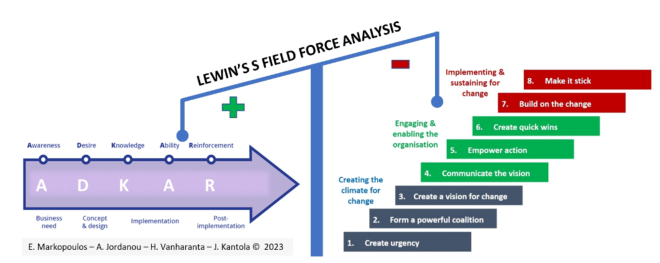
To initiate this process an organization needs to select first the changed management model that can work with the CDM per organizational change. For this decision, Lewin’s forces can be used (Figure 1).
Figure 1: Lewin’s field force analysis for the selection of a change management model.
COMPANY DEMOCRACY ON ADKAR MODEL The liberal approach of the ADKAR model is based on democratic leadership aiming to help everyone, or almost everyone, in an organization, understand the need for change and actively participate. Such participative thinking is aligned with the CDM philosophy. However, organizational change might require more than voluntary knowledge contribution to the resolution of organizational challenges. Therefore, even though the two models seem to have democracy as their significant factor, their operational conditions and organizational urgency can bring them apart.
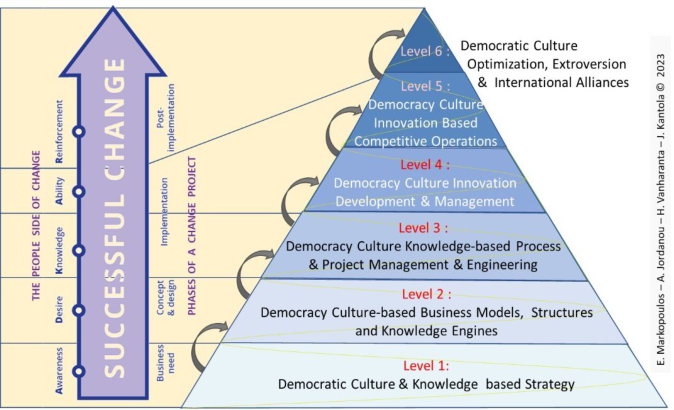
The implementation of the ADKAR model using the CDM can be achieved by mapping the ADKAR stages in the CDM levels (Figure 2).
Figure 2: Implementation of the ADKAR model with the company democracy model.
ADKAR’s awareness (A) is implemented with the support of CDM’s level 1 to identify the willingness of the employees to change. The desire (D) stage is implemented with level 2 where the awareness, that has been turned into desire, is tested for its strength and commitment to deliver the change. The knowledge (K) stage is implemented at level 3 where the first pilot appli- cations of the change are completed and the results are tested for validity, acceptance, impact and the process needed to carry on with the change. The ability (A) is implemented at levels 4 and 5 where the success of the pilot changes achieved in level 3 is rolled out into the organization as new inno- vative operations processes (level 4) that give an organizational competitive advantage (level 5). Lastly, the reinforcement (R) stage is implemented at level 6 where success must be maintained and increased.
COMPANY DEMOCRACY ON KOTTER’s MODEL The conservative approach of Kotter’s model for change does not leave much room for democratic leadership due to the speed needed for radical changes to
Co-Opetitive Management and Leadership Methodology 35
happen, especially in complex environments. In such cases, transactional, and autarchic leadership is required to get things done with the least resistance and time. To reduce the decree of anarchism and increase at least reactive participation, the Company Democracy Model is used.
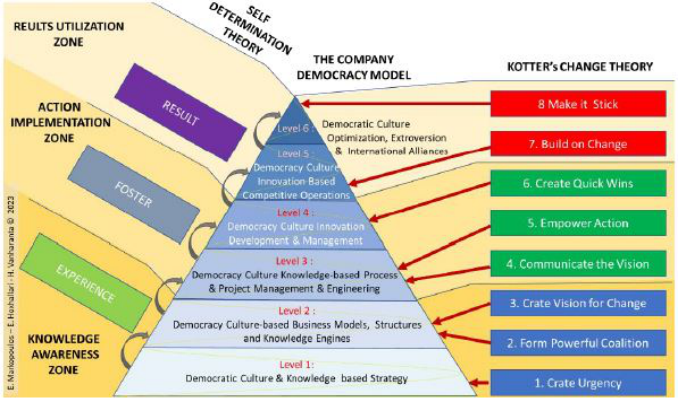
The integration of Kotter’s Model and the CDM has been introduced in the work of Markopoulos, Hoxhallari, and Vanharanta on an application of CDM towards governmental corporate entrepreneurship for the tran- sformation of the public sector in the Balkan region (Markopoulos et al, 2021). This work distributes Kotter’s 8 stages in the CDM’s six levels with three categories that reflect the three elements of the self-determination theory. The first 3 stages of Kotter are linked with CDM levels 1 and 2 forming the ‘Knowledge Awareness’ zone. The next three Kotter stages are linked with CDM levels 3 and 4, forming the ‘Action Implementation’ zone, and the last 2 Kotter stages are linked with CDM levels 5 and 6, forming the ‘Results Utilization’ zone. The three zones are related to the Self Determination Theory elements where ‘Experience’ is expressed in the Knowledge Awareness zone, ‘Foster’ is within the Action Implementation and ‘Results’ is within the Results Utilization zone. This work is being revi- sed to indicate the relationship of Kotter’s stagers with the CDM levels in a more precise and one-to-one relationship (Figure 3).
Figure 3: Implementation of Kotter’s model with the company democracy model.
CO-OPETITIVE DEMOCRATIC ORGANIZATIONAL CHANGE In an attempt to integrate the distant philosophies and operations of the ADKAR and Kotter’s change management models the Company Democracy Model has been used to stand in the middle and promote co-opettion instead of competition among employees (Markopoulos & Vanharanta, 2017).
Co-opetive organizational cultures utilize the contributions of all for a common goal regardless of how these contributions are derived. When they
come voluntarily and democratically, democratic co-opetition is achieved with ideal conditions and clear benefits for each one involved prior to the initiation of a change process. On the other hand, when contributions derive by force, co-opetition is achieved in an attempt to first survive the shock from the change, and then gradually, in a collective way, benefit from the change, or get used to it.
In both cases, co-opetition is needed, and competition must be avoided. Co-opetitive management and leadership unite everyone with a common goal regardless if that goal is to progress or to survive. Collective thinking and acting are key processes of co-opetitive leadership, while patience, sharing, caring optimism and are key leadership traits.
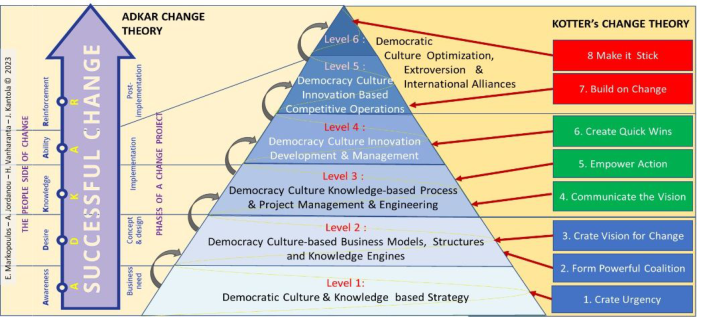
Figure 4 presents the holistic integration of the ADKAR, Kotter’s, and Lewin’s models for change within the CDM levels of knowledge maturity.
This holistic approach to organizational changes starts with the execution of the Lewin Field Force Analysis to identify the main change approach to be adopted in the implementation of the organizational change. This critical lea- dership decision sets the management model to be used (ADKAR or Kotter). In both cases, and regardless of the selected change model, CDM stands in the middle to facilitate the execution of the change with the participation of the employees and their knowledge contributions to the change implementation process from the first stage to the last.
Due to the significant differences in the philosophies of the Kotter and ADKAR models, switching from one model to the other is not easy. Therefore, the Lewin forces have a critical role in carefully determining the change model to be used which affects the way CDM will support it.
LIMITATIONS AND AREAS OF FURTHER RESEARCH The limited available literature review on the integrated change mana- gement approaches impacted the secondary research and its attempt to integrate change management with knowledge management. The proposed co-opetitive change management approach needs to be developed further
Co-Opetitive Management and Leadership Methodology 37
in terms of defining key metrics to measure the execution effectiveness of each stage within the related CDM levels. This will determine if the change management process shall be continued, changed, or stopped. The goal is to develop a process that can switch, change or combine management models as the change process evolves at the CDM levels. If, for example, ADKAR is used in CDM level 1 with limited participation then Kotter’s stages 1 and 2 can support ADKAR’s stage 1. This is a complicated dynamic approach as the parameters needed to make such decisions cannot be predicted with- out systemic thinking and ontologies to provide the needed agility (Salo, 2017) Therefore new and reactive co-opetitive leadership types and manage- ment practices need to be developed to support continuous and agile change implementation performance.
CONCLUSION
Democratic change programs can be implemented with less resistance regard- less of the impact of the change or the frequency they are executed. This paper identified a new change management and leadership approach based on the Company Democracy Model which is used primarily for innovation- based organizations characterized by their non-hierarchical structures and organizational cultures. These types of neo-liberal organizations are the most difficult to implement changes as their degree of democracy and freedom to operate does not favor change management strategies driven mostly by logic, order, and authority. The proposed Democratic Change Management Model promotes co-opetition instead of competition, a non-competitive collective effort to go through a change, and a new agile and democratic leadership type applied based on the organizational strategy per case. As change remains constant, so does democracy must be, where justified thoughts and opi- nions avoid social and economic disasters while contributing to effective, sustainable and rewarding changes for all.
REFERENCES
Alvesson, M. and Sveningsson, S., (2015). Changing organizational culture: Cultural change work in progress. Routledge. Appelbaum S. H., Habashy S., Malo J-L, and Shafiq H. (2012). Back to the future:
revisiting Kotter’s 1996 change model. Journal of Management Development Vol. 31 No. 8, pp. 764–782 Emerald Group Publishing Limited 0262–1711. Baulcomb, J. S., 2003. Management of change through force field analysis. Journal of nursing management, 11(4), pp. 275–280. Boca, G. D., 2013, March. Adkar model VS. quality management change. In Inter-
national Conference Risk in Contemporary Economy; Faculty of Economics and Business Administration, Dunarea de Jos University of Galati. Caldwell, R., 2003. Models of change agency: a fourfold classification. British Journal of Management, 14(2), pp. 131–142. Donald James Swanson & Andrew Shawn Creed (2014) Sharpening the Focus of
Force Field Analysis, Journal of Change Management, 14:1, 28–47. Galli B, J. (2018), "Change Management Models: A Comparative Analysis and Concerns," in IEEE Engineering Management Review, vol. 46, no. 3, pp. 124–132.
Goyal, C. and Patwardhan, M., (2018). Role of change management using ADKAR model: a study of the gender perspective in a leading bank organisation of India. International Journal of Human Resources Development and Manage- ment, 18(3-4), pp. 297–316. Markopoulos E., Hoxhallari E., Vanharanta H. (2021) Democratic Governmental
Corporate Entrepreneurship for the Transformation of the Public Sector in the Balkan Region. Advances in Creativity, Innovation, Entrepreneurship and Com- munication of Design. AHFE 2021. Lecture Notes in Networks and Systems, vol 276, pp 153–161. Springer. Markopoulos E., Vanharanta H. (2015). ‘Company Democracy Model for Development of Shared Value’, Elsevier, Procedia Manufacturing, Volume 3, Pages 603-610, 2015. Markopoulos E., Vanharanta H. (2017) Space for Company Democracy. In: Kantola
J., Barath T., Nazir S., Andre T. (eds) Advances in Human Factors, Business Mana- gement, Training and Education. Advances in Intelligent Systems and Computing, vol 498. 275–287. Springer, Cham. Markopoulos E., Vanharanta H.. (2014). ‘Democratic Culture Paradigm for Organizational Management and Leadership Strategies - The Company Democracy Model. ‘ In: Charytonowicz J. (ed) Advances in Human Factors and Sustaina- ble Infrastructure. 5th International Conference on Applied Human Factors and Ergonomics. vol 20. pp. 190–201 (2014). Probst, G. and Raisch, S., 2005. Organizational crisis: The logic of failure. Academy
of Management Perspectives, 19(1), pp. 90–105. Prosci (2023). The Prosci ADKAR Model. A powerful yet simple model for facilitating individual change. Prosci website: https://www.prosci.com/methodology/ adkar. Salo M., Markopoulos E., Vanharanta H., Kantola J. I. (2017) Degree of Agility with
an Ontology Based Application. In: Kantola J., Barath T., Nazir S., Andre T. (eds) Advances in Human Factors, Business Management, Training and Education. Advances in Intelligent Systems and Computing, vol. 498. Springer.
LISTED IN THE AHFE DIGITAL BOOKSTORE CATALOGUE
Explore the complete digital volume
Human Factors in Management and Leadership
Read this individual research paper free through the original publisher, or explore the full digital proceedings book.
ISBN 978-1-958651-68-1
Explore this ISBN in the AHFE Bookstore ↗Listed in the July 2026 bookstore catalogue; search by ISBN to confirm current availability · Digital book purchase optional