Naoto Shoji, Yuito Matsuoka, Takanori Yoshida (2023). Scoping review to identify key concepts for building sports organizational integrity. In: Human Factors in Management and Leadership. AHFE Open Access, vol. 92, pp. 109–118. https://doi.org/10.54941/ahfe1003739
Integrity has gained increasing attention in sports recently. Integrity in sports is often associated with issues such as doping, harassment, violence, betting, match-fixing, corruption, ethical deviance, and lack of governance. Currently, protecting and strengthening integrity involves two approaches: (1) attempting to maintain integrity by establishing rules and ensuring people comply with them (the rules approach), and (2) seeking to maintain integrity by looking to the future and aiming to avoid negative evaluation (the means approach). However, we hypothesize that adopting an approach that attempts to maintain the integrity by drawing out the altruistic and socially respectful traits inherent in people is also possible, and we set out to build a system to address this as an organization through a holistic approach. In this study, we aim to identify the relevant concepts that are important in building a mechanism to enhance integrity as an organization through a scoping review conducted using a standardized protocol in PRISMA-ScR. The research design was a scoping review, and the procedure followed the PRISMA-ScR to select and eligibility the articles. The central concepts of the eligibility articles were then extracted. Results of scoping review, we identified 63 review articles, excluded 7 articles because of duplication, and selected 56 articles. The first eligibility criterion for inclusion was that the research must be related to sports integrity, which resulted in the selection of 33 articles. The second eligibility criterion was organizational research, leading to the selection of 10 papers based on their eligibility. The 7 central keywords in the 10 selected papers were: gender, accountability, stakeholders, governance, coaching, leadership, and organizational performance. Some of the concepts, such as gender, accountability, and stakeholders, were not commonly found in previous sports integrity research, suggesting new perspectives on how to build a system to strengthen integrity in an organization.
Integrity in sports has increasingly been recognized as an important value in recent years. Integrity in sports is often associated with issues such as doping, harassment, violence, betting, match-fixing, corruption, ethical deviance, and lack of governance. Currently, protecting and strengthening integrity invo- lves two approaches: (1) attempting to maintain integrity by establishing rules and ensuring people comply with them (the rules approach, which commonly used methods at problem sites where behavior is restricted by
rules, codes, oversight, and behavioral principles) and (2) seeking to main- tain integrity by looking to the future and aiming to avoid negative evaluation (the means approach, which is similar to the commercial integrity Gardiner (2017) presented). However, we hypothesize that adopting a third approach that attempts to maintain integrity by drawing out the altruistic and socially respectful traits inherent in people is also possible, and we set out to build a system to address this as an organization through a holistic approach. There- fore, in this study, we aim to identify the relevant concepts that are important in building a mechanism to enhance integrity as an organization through a scoping review conducted using a standardized protocol in PRISMA-ScR.
Sports integrity means the manifestation of the ethics and values that pro- mote community confidence in sport (Australia Sports Integrity, 2022). In addition, Katsuta (2016) introduced “Integrity is the integration of outw- ard actions and inner values”. We refferd their definition, defined integrity building as following in this study. Integrity building is to create a state integration of moral internal values and outward actions.
METHODS
The research design employed for this study was a scoping review, and PRISMA-ScR was adopted as the methodological framework for the scoping review. First, Google Scholar was used as the database, and “sport-integrity” and “sports-integrity” were used as search terms. The search was performed by checking the checkboxes for articles and without specifying a time period. Next, the checkbox for review articles was checked, and the articles to be included in this scoping review process were limited to review articles. The search period for the articles was from December 2, 2022 to December 13, 2022. We selected 63 articles for inclusion in this study. The articles were che- cked for duplicates, and the duplicates were excluded. Next, the abstract of each paper was analyzed to evaluate eligibility on two levels. First, we evalua- ted whether the research was related to sports integrity. Second, we evaluated whether the research was organizational in nature. We then extracted the cen- tral keywords and related concepts that are important for building a system to enhance organizational integrity from those papers that were deemed eligi- ble through screening. The extracted concepts were organized in a table, and new perspectives for building a system to enhance integrity were discussed.
RESULTS
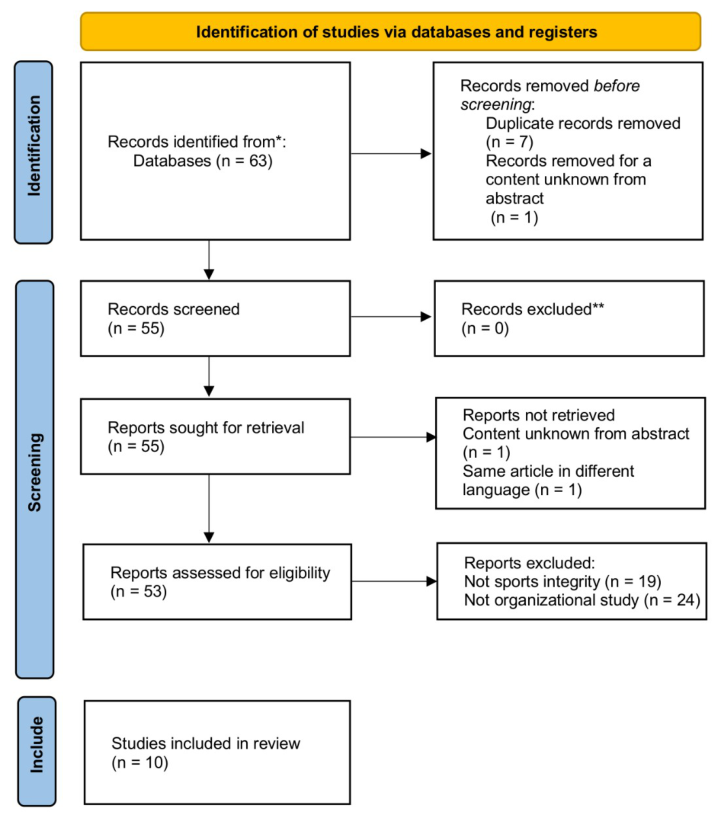
Through the scoping review, we identified 63 review articles. Out of these, we excluded 7 articles because of duplication, and an article because of unknown content from abstract and selected 55 articles (see Figure 1). The first eligi- bility criterion for inclusion was that the research must be related to sports integrity, which resulted in the selection of 34 articles (19 articles were exclu- ded). The second eligibility criterion was organizational research, leading to the final selection of 10 articles (24 articles were excluded). The identi- fied 11 central keywords in the 10 selected articles were: 1) governance, 2)
Scoping Review to Identify Key Concepts for Building Sports Organizational Integrity 111
Figure 1: Identification of studies via databases and registers. (Adapted from Page MJ, et al. 2021.)
humanistic leadership, 3) pedagogy, 4) leadership, 5) organizational perfor- mance, 6) stakeholder, 7) coaching, 8) transformational leadership, 9) gender, 10) accountability, and 11) coaches’ role (see Table 1). Moreover, 52 impor- tant concepts to enhance organizational integrity were presented from the 10 selected articles (see Table 1).
DISCUSSION
The results of this study may be useful in examining methods of integrity building in sports organizations. When problems concerning integrity occur, it is common for organizations to establish rules and strengthen monito- ring to prevent similar situations from reoccurring. In addition, integrity
Table 1. Central keywords and important concepts to enhance integrity.
Table available in the original PDF paper.
Title Central keywords
Important concepts to enhance organizational integrity Governance Vision, mission and strategy*4
*1A review of good governance principles and indicators in sport
Structures, regulations and democra- tic process*4 Highest level of competence*4 Athletes’ involvement, participation and care*4
Harmonious relations with govern- ments while preserving autonomy*4 Clarity of propose/objectives*5 Delegation and committees*5
Governance Respect for oneself and for others*7 Moral responsibility*7 Moral accountability*7
Fair play*7
Sports betting-motivated corruption in Australia: An under-studied phenomenon
Respect for the game*7 Sportspersonship*2*7 Positive personal values*7
Compassion for others*7 Honesty in following the rules*7 Ethics Positive culture towards preserving integrity Codes of conduct*8
Good governance*8 Promoting values*8 Governance Encouraging acts of whistleblowing Democratize their decision-making processes*9
Reforming global sport: Hybridity and the challenges of pursuing transparency
Multistakeholder involvement/engagement*9 System of checks and balances*9
Governance Humanistic leadership
The role of humanistic leadership on good governance in sport organization: A literature review
Governance External involvement External supervision/constraint of independence Gender balance
Humanistic leadership Transparency Democracy Check and balance Solidarity Communication No struggle, no progress: The historical significance of the governance structure reform of the international Association of athletics Athlete and coach-led education that teaches about abuse: an overview of education theory and design considerations Pedagogy Narrative pedagogy Pedagogy culturalized and speciali- zed to each country, sport, and com- petition level Respectfully challenge to acceptance of normalised types of abuse
Continued
Scoping Review to Identify Key Concepts for Building Sports Organizational Integrity 113
Table 1. Continued.
Table available in the original PDF paper.
Title Central keywords
Important concepts to enhance organizational integrity Moral*10
Ethic*10
A review of good governance principles and indicators in sport
Ethics in leadership/ Coaches ‘ ethical leadership*11
Leadership Organizational performance Stakeholder
Transparent and balanced environment*12 Better person*13 Transformational leadership
Coaching Transformational leadership
Transformational leadership in sport coaching: Review and future directions
Challenges and opportunities in international sport organizations: Investigation of barriers hindering the Asian Football Confederation from better governance Match-fixing threats: Effective responses of coaches
Coaches’ role Financial health-check Protect inside information Instil in players a ‘best efforts’ mentality *1 This article is an evaluation of 9 international good governance indicators and covers a wide range of concepts. Concepts that overlap with other papers were excluded. *2 Sportsmanship was used in the article. *3 This concept was generated by referencing the context of some sentences by the author. *4-14 Articles introducing the important concepts were presented with the marks and numbers in reference list.
protection and enhancement are often implemented as a means to avoid negative evaluation due to the occurrence of problems in the future. Some of the papers that met the eligibility criteria in this study also argued for the important of monitoring and control. Lastra (2016) argued that the importa- nce of building integrity by utilizing human altruism and respect for others, rather than the rules approach or the means approach, should be addressed. Abbott and Sheehan (2013) and Forrest (2012) asserted that awareness, edu- cation, and training are the basic elements of effective corruption prevention, while Lastra (2016) argued that we should rely on other methods developed through codes of conduct and good governance rather than education, and, as in this study, that it is necessary to work at the level of sports organizations. It was inferred that Lastra (2016) departed from the approach of rules, regula- tions, and monitoring and rather intended to focus on the good aspects of the person. This study focuses on key concepts that could be considered effective in the construction of an approach that utilizes good human characteristics. Thus, this study contains a set of concepts useful for the construction of soft low (Henne, 2015), jurisprudentially speaking.
Among them, gender, stakeholders, and accountability would be considered new frontiers that have rarely been examined in integrity research in the sport context to date.
Table 2. Year of publication and target for improvement of the subject study.
Table available in the original PDF paper.
Title Year Target for improvement
2016 ISO, IF
A review of good governance principles and indicators in sport Sports betting-motivated corruption in Australia: An under-studied phenomenon
2015 IF
2016 IF, NF, Club (Team), Individual Reforming global sport: Hybridity and the challenges of pursuing transparency
2021 Club (Team)
The role of humanistic leadership on good governance in sport organization: A literature review
2018 IF
No struggle, no progress: The historical significance of the governance structure reform of the international Association of athletics
2022 Club (Team), Coach, Athlete
Athlete and coach-led education that teaches about abuse: an overview of education theory and design considerations Stakeholders leadership approaches in soccer context 2022 Club (Team), Coach Transformational leadership in sport coaching: Review and future directions
2020 IF
2022 Club (Team), Coach Challenges and opportunities in international sport organizations: Investigation of barriers hindering the Asian Football Confederation from better governance Match-fixing threats: Effective responses of coaches
2021 Club (Team), Coach
Gender balance could be one of the central issues in future sports inte- grity research. Previous studies that address gender include Kreiger (2019), Akramov (2020), and MrKonjic (2016). In all of these studies, it is clear that gender balance is intended to democratize and improve the transparency of the decision-making process. All three studies were conducted on internati- onal sports organizations, which is an issue that is being actively addressed by international organizations. However, some studies on gender do target clubs and teams.
Stakeholders are another concept that could be a central issue in the future. Henne (2015) identified multistakeholder involvement and multistakehol- der engagement as important factors for democratizing the decision-making process in governance. Akramov (2020), in his discussion of stakehol- der representation, states that many modern sports organizations fail to involve athletes, coaches, referees, media partners, and sponsors in the decision-making process and that the lack of stakeholder involvement in the decision-making process is a major factor hindering the democratization of the decision-making process in governance. Garcia and Welford (2015) argue that fan involvement can lead to increased transparency and accountability in sports organizations. In addition, Akramov (2020) identified stakeholder
Scoping Review to Identify Key Concepts for Building Sports Organizational Integrity 115
engagement as a central issue for increasing governance proficiency. Multi- stakeholder involvement is an essential element of the holistic approach and will be an important factor in the future development of sports. It will also be an essential element when considering how to build the integrity of sports organizations and sports teams.
Accountability is a concept that has been seen in many studies with gover- nance as a keyword. Through the review of this study, we believe that sports organizations are required to be transparent because of their influence and that accountability is a key concept to enhance transparency. Accountability should not be viewed as an after-the-fact response to a problem. It is impor- tant to have a constant awareness of accountability to create a positive state of accountability and transparency.
Turning to the study of teams, in which leaders and players are the main stakeholders, more humanistic concepts, such as being a better person, moral/ethical responsibility, ethics, positive personal values, and solidarity, were prominent among the key concepts mentioned (Hartarto et al., 2021; McMahon et al., 2022; Neto et al., 2022; Natsuhara, 2022; Young, 2021). In addition, many studies that focused on teams discussed integrity in rela- tion to leadership, and several leadership theories were addressed (Hartarto et al., 2021; McMahon et al., 2022; Neto et al; Natsuhara, 2022). Their leadership theories included: 1) humanistic leadership, 2) ethical leadership, and 3) transformational leadership.
Finally, although mainly inspired by McMahon et al. (2022) and Akramov (2020), this study takes into account the individual characteristics of the orga- nization, its situation, its cultural and regional background, and its age and emphasizes the importance of longitudinal benchmarking to see whether the organization has improved compared to a certain point in time, rather than comparing it with other organizations. In other words, this study conclu- des that it is important to aim to realize resilient integrity building through localized longitudinal benchmarking. In addition, to realize effective integrity building, Henne (2015) introduces the “hard low” mechanism and the “soft low” mechanism of Trebeck and Trebeck (2005), which are “a combination of a binding mechanism (hard low) and a non-binding mechanism (soft low).” The idea that “binding mechanisms (hard low) and non-binding mechanisms (soft low) merge to force social change,” introduced by Trebeck and Trebeck (2005), may be necessary. Continued efforts in this direction will likely foster the positive culture of integrity maintenance cited by Lastra (2016).
CONCLUSION
In considering the future of integrity building, we have identified some conce- pts that need to be focused on. Among others, morality and ethics, which are related to positive human traits, are concepts that should be focused on. Gen- der balance and stakeholder involvement/engagement are also relatively new concepts in sports integrity research, but they are essential for improving tran- sparency and high-quality decision-making. When evaluating the integrity of a sports organization, it is important to keep these concepts in mind and loca- lize them according to the situation and characteristics of the organization.
Localized longitudinal benchmarking should be used to evaluate whether the organization has improved compared to a certain point in time, rather than comparing it with other organizations. We conclude that it is important to use localized longitudinal benchmarking, which can be localized to the situ- ation and characteristics of the organization while keeping these concepts in mind.
ACKNOWLEDGMENT
This study was supported by JSPS KAKENHI Grant Number JP 21K17607. We would like to thank enago (www.enago.jp) for the English language review.
REFERENCES
Abbott, J. and Sheehan, D. (2013). “The INTERPOL Approach to Tackling Match Fixing in Football. in: Haberfeld, M. and Sheehan, D. (eds) Match-Fixing in Inter- national Sports. Springer, Cham. doi: https://doi.org/10.1007/978-3-319-02582- 7_14. Akramov, Z. (2020). “Challenges and opportunities in international sport organiza-
tions: Investigation of barriers hindering the Asian Football Confederation from better governance, Seoul National University, doi: https://dcollection.snu.ac.kr/co mmon/orgView/000000161262. Australia Sports Integrity. (2022). “Australia sports integrity, Annual Report 2021–22, Canberra, https://www.sportintegrity.gov.au/sites/default/files/SIA003- 0722_ANNUAL%20REPORT_WEB_ACCESSIBLE3.pdf. (Accessed 25/02/2023) *14Chappalet, J. L. (2018). “Beyond governance: The need to improve the regu- lation of international sport”, Sport in Society, Vol. 21, No. 5, pp. 724–734, doi:10.1080/17430437.2018.1401355. *6Chappelet, J. L. and Mrkonjic, M. (2013). “Basic Indicators for Better Governa- nce in International Sport (BIBGIS): an assessment tool for international sport governing bodies”. IDHEAP Working Paper, Lausanne. *10Constandt, B., De Waegeneer, E. and Willem, A. (2018). “Coach Ethical Leader- ship in Soccer Clubs: An Analysis of Its Influence on Ethical Behavior”, Journal of Sport Management, Vol. 32, No. 3, pp. 185–198. doi:10.1123/jsm.2017–0182. *11Constandt, B., and A. Willem. (2019). “The Trickle-Down Effect of Ethical Lea- dership in Nonprofit Soccer Clubs”, Nonprofit Management & Leadership, Vol. 29, No. 3, pp. 401–417, doi:10.1002/nml.21333. *12Denton, A. (2013) “Can Business Leaders Build Teams Like Alex Ferguson?”, Strategic Direction, Vol. 29, No. 9, pp. 3–5. *5European Commission. (2013). “EU Work Plan for Sport: Principles of good governance in sport”, https://ec.europa.eu/assets/eac/sport/library/policy_docum ents/xg-gg-201307-dlvrbl2-sept2013.pdf. (Accessed 25/02/2023). *11Fielding-Lloyd, B., and L. Mean. (2011) “I Don’t Think I Can Catch It: Women, Confidence and Responsibility in Football Coach Education”. Soccer and Society, Vol. 12, No. 3, pp. 345–364, doi:10.1080/14660970.2011.568102. Forrest, D. (2012). “The Threat to Football from Betting-Related Corruption”, Inter-
national Journal of Sport Finance, Vol. 7, No. 2, pp. 99–116. García, B. and Welford, J. (2015). “Supporters and football governance, from customers to stakeholders: A literature review and agenda for research”, Sport
Scoping Review to Identify Key Concepts for Building Sports Organizational Integrity 117
Management Review, Vol. 18, No. 4, pp. 517–528, doi: https://doi.org/10.1016/ j.smr.2015.08.006. Gardiner, S., Parry, J. and Robinson, S. (2017) . “Integrity and the corruption debate in sport: where is the integrity?”, European Sport Management Quarterly, Vol. 17, No. 1, pp. 6-23, doi: 10.1080/16184742.2016.1259246. Hartarto, A., Castyana, B., Mega Anggita, G., Ditya Candra, A. R. and Setyawati,
H. (2021). “The role of humanistic leadership on good governance in sport orga- nization: A literature review”, Jurnal SPORTIF : Jurnal Penelitian Pembelajaran, Vol. 7, No. 3, pp. 378–399, doi: https://doi.org/10.29407/js_unpgri.v7i3.14997. Henne, K. (2015). “Reforming Global Sport”, Law & Policy, Vol. 37, pp. 324–349, doi: https://doi.org/10.1111/lapo.12044. *13Hodge, K., Henry, G., and Smith, W. (2014). “A case study of excellence in elite sport: Motivational climate in a world champion team”, Sport Psychol., Vol. 28, pp. 60-74. *4IOC. (2008). “Basic Universal Principles of Good Governance of the Olympic and Sports Movement”, https://stillmed.olympic.org/media/Document%20Library/O lympicOrg/IOC/Who-We-Are/Commissions/Ethics/Good-Governance/EN-Basic -Universal-Principles-of-Good-Governance-2011.pdf. (Accessed 25/02/2023). Katsuta, T., Tomozoe, H., Takemura, M. and Sasaki, K. (2016). “Protecting and Enhancing Sport Integrity through Education: Various Approaches by Sports-Related Organizations/Institutions”, Japanese Journal of Sport Education Studies, Vol. 36, No. 2, pp. 31–48, doi: https://doi.org/10.7219/jjses.36.2_31 Krieger, J. (2019). ”No Struggle, No Progress: The Historical Significance of
the Governance Structure Reform of the International Association of Ath- letics Federation”, Journal of Global Sport Management, Vol. 4, No. 1, pp. 61–78, doi: 10.1080/24704067.2018.1477522. Lastra, R. (2016). “Sports betting-motivated corruption in Australia: an understudied phenomenon”, International Journal of Social Science Research, Vol. 4, No. 1, pp. 61–82. McMahon, J., Lang, M., Zehntner, C. and McGannon, K. R. (2022). “Ath-
lete and coach-led education that teaches about abuse: an overview of education theory and design considerations”, Sport, Education and Society, pp. 1–15, doi: 10.1080/13573322.2022.2067840. Mrkonjic, M. (2016). A review of good governance principles and indicators in sport, Council of Europe. Natsuhara, T, Nakayama, M., Kawakita, H., Araki, K. and Ichimura, S. (2022). ”Transformational leadership in sport coaching”, Japan Journal of Phy- sical Education, Health and Sport Sciences, Vol. 67, pp. 379-396, doi: https: //doi.org/10.5432/jjpehss.21123. Neto, L. V. D. S., Miragaia, D. A. M. and Ibáñez, S. J. (2022). “Stakeholders leadership
approaches in soccer context: a systematic review”. Soccer & Society, Vol. 23, No. 8, pp. 987–1009, doi: https://doi.org/10.1080/14660970.2021.1993197. *8Transparency International. (2014). “Staying on side: How to stop match-fixing”, Transparency International International Secretariat, Berlin, Germany, https:// images.transparencycdn.org/images/2014_Stop_MatchFixing_EN.pdf. (Accessed 25/02/2023) *9Transparency International. (2011). “Safe hands: Building integrity and tran- sparency at FIFA”, Transparency International International Secretariat, Ber- lin, Germany, https://images.transparencycdn.org/images/2011_FIFASafeHands_ EN.pdf (Accessed 25/02/2023).
*9Transparency International. (2009). “Corruption and Sport: Building Inte- grity and Preventing Abuses”, Transparency International International Secreta- riat, Berlin, Germany, https://images.transparencycdn.org/images/Working_Pape r_032009_Sport_EN.pdf (Accessed 25/02/2023). *7Treagus, M., Cover, R. and Beasley, C. (2011). “Integrity in sport”. Canberra, ACT: Australian Sports Commission, https://citeseerx.ist.psu.edu/viewdoc/download. Trubek, D. M. and Trubek, L. G. (2005). Hard and soft law in the construction of social Europe: the role of the open method of co-ordination. European Law Journal, 11(3), 343–364. Young, J. A. (2021). “Match-fixing threats: Effective responses of coaches”, ITF
Coaching & Sport Science Review, Vol. 29, No. 83, pp. 4–6, doi: https://doi.org/ 10.52383/itfcoaching.v29i83.45.
LISTED IN THE AHFE DIGITAL BOOKSTORE CATALOGUE
Explore the complete digital volume
Human Factors in Management and Leadership
Read this individual research paper free through the original publisher, or explore the full digital proceedings book.
ISBN 978-1-958651-68-1
Explore this ISBN in the AHFE Bookstore ↗Listed in the July 2026 bookstore catalogue; search by ISBN to confirm current availability · Digital book purchase optional