Patricia Castillo-Galván (2023). Technology Implementation Model for the Integration of Mexican SMEs into Global Markets. In: Human Factors in Management and Leadership. AHFE Open Access, vol. 92, pp. 9–17. https://doi.org/10.54941/ahfe1003729
One of the biggest challenges that SMEs in Mexico face for their growth, is finding a way to increase their participation in global markets. The global economic situation of recent years, after the pandemic restrictions, has made evident the fact that the micro, small and medium-sized companies (which in Mexico represent more than 95% of the established ones) require strategies that allow them to rapidly integrate into global markets in search of economic growth. Technological developments in the Industry 4.0 environment are presented as a tool that drives this growth, however, situations such as lack of budget, drop in sales, lack of government support, and general ignorance of technology and its use, seem to be barriers that SMEs must overcome at this time. Based on previous works (Castillo-Galván, P; Méndez, J. 2021; Castillo-Galván, P; Cervantes, L, 2020) where the Digital Technological Environment in the world is analyzed, this document presents a Technology Implementation Model for SME companies that allow them to establish individual strategies with a view to being able to integrate into global supply chains. The strengths and weaknesses of small and medium-sized Mexican companies are analyzed and a sequence of technological transfer and implementation is proposed, which they can carry out to respond to the demands of globalized markets.
Schwab (2016) describes the current era as a time to revolutionize the organization of Global Supply Chains, due to the increasing use of vir- tual and physical manufacturing systems, the fusion of technologies and the interaction between both through physical domains and digital. However, not all organizations experience change in the same way and at the same time.
At this time, where Global Economic situation after the pandemic restricti- ons, has made evident the fact that micro, small and medium-sized companies (which in Mexico represent more than 95% of those established), require to stablish strategies that allow them to grow and integrate rapidly into global markets looking to obtain an economic growth. To understand these needs, the first thing is to understand the basic concepts and, mainly the differences between Supply Chain and Value Chains.
The Council of Supply Chain Management Professionals (CSCMP) (Council of Supply Chain Management Professionals, 2020) defines Supply Chain Management (SCM) as “the process that encompasses the plan- ning and management of all activities involved in sourcing and acquisition, conversion and all logistics management activities”, while the concept of Global Value Chain refers to the internal operations of a particular com- pany. According to Trend, the difference between the two is that the Value Chain is an internal concept, and the Supply Chain includes both internal and external operations.
The difference between these two concepts is that the first one covers beyond the horizon of the company and its operations, going from the sup- plier’s activities to the client, seeking to achieve efficiency in costs and lead time. supply (Council of Supply Chain Management Professionals, 2020). While the value chain focuses on the primary and support activities of the organization, in order to establish strategies to make the company com- petitive (Gereffi, 2015). It is because of these differences that, to manage information, companies need different types of management and, therefore, different tools for managing it.
To manage Value Chains, it will be necessary to control information that allows a better planning of internal activities and that also enhances the abi- lity to take advantage of the links between activities, both inside and outside it. While for the Supply Chain Management, technology is required to solve the distortions of information on market demand generated by the alteration of production plans and instability in inventories.
At the Global Value Chains Model presented by Gareffi in 2015, the most important actors are the companies and, in order to integrate them into the Global Value Chains of the world economy, it is necessary to enter internati- onal design, production and marketing networks formed by many different companies (Gereffi, et al., 2001). It is then the economic challenge to iden- tify the conditions in which companies in developing countries can move up the value chain, going from carrying out basic assembly activities and cheap labor to advanced forms of supply and integrated manufacturing (Gereffi, 2015). According to Ageron et al., (2020) the development of digital informa- tion systems and the adoption of innovative technologies that will help strengthen the integration and agility of the Supply Chain and, there- fore, improve customer service and customer service. sustainable perfor- mance of the organization. Before digitization, the information systems used by companies to manage Supply Chains were understood as modu- les of a disconnected system. In the era of digitization, what is sought is to integrate technologies, focus on customers / consumers, reduce intra- and inter-organizational costs, and create more value for organizations (Ageron, et al., 2020).
Thus, the application of Technology in Supply Chains will be useful tools to reduce and eliminate waste or waste from the Supply Chain, as well as to improve communication between the people who work in the processes and the relationship between business partners.
Technology Implementation Model for the Integration of Mexican SMEs 11
Research Model For this research, a mixed method was used employing quantitative (surveys) and qualitative (focus groups) research tools. The first part was an explora- tory stage where the current situation was identified; the second, a descriptive stage, to identify the main components of the phenomenon to be studied and a third part for a predictive nature.
Due to the area of influence that it has, this research will focus on SMEs installed in the metropolitan area of the city of San Luis Potosí (724), emphasizing the strategic automotive, logistics and informa- tion technology sectors, this for the collaborative work carried out by these three sectors and which are established as priorities for the State Government.
Analysis population. Due to the restrictions imposed on physical proximity due to the pandemic environment (access to people) and time availability, convenience sampling was applied.
For this part of the study, a smaller universe of 235 small, medium and large companies installed in the metropolitan area of San Luis Potosí was used, limiting it to companies that belong to the automotive sector, as it is the sector with the greatest impact on the economy of the region. The objective was to survey at least 25% of this Universe, which translates into 51 compa- nies. As mentioned above, for confidentiality reasons, the list of companies that responded to the survey will be made available upon request.
Sample size and type. For the work with focus groups, according to the recommendations of Hernández Sampieri (2010) the use of three to five groups is adequate to work under this approach. For the application of surveys, an estimated sample size of 41 surveys was calculated for a popula- tion of 724 and a margin of error of 15%, this due to social restrictions due to the pandemic.
DEVELOPING THE TECHNOLOGY IMPLEMNTATION MODEL User Profile Definition
The first need was to define the user profile of the model, for which, the focus group technique was used as a tool to obtain information, and a Canvas Model was used to manage information. Three one-hour meetings were held with experts in the manufacturing industry in the areas of manufacturing, industrial engineering and information technology. The meetings were held virtually, due to the restrictive effects of the pandemic.
As a result of these meetings, it was possible to identify the target users of the model for the transfer of use of digital technologies to the industry in San Luis Potosí.
Companies supplying products and services in the automotive industry (current or potential)
Companies interested in developing technological development projects in the context of Industry 4.0.
Personnel hired by companies in the automotive industry and its sup- ply chain and people dedicated to the development of information technologies.
12 Patricia
Professionals in search of professional development.
Researchers from educational institutions and research centers.
Local, state or federal government units interested in developing informa- tion technology projects.
Diagnosis of Knowledge and Use of Technologies in the Industry of San Luis Potosí To strengthen the information obtained in the focus groups and to know in depth the needs of the companies installed in San Luis Potosí in terms of tech- nologies related to Industry 4.0, it was decided to collect field information through the application of surveys that were applied electronically.
In this survey, company representatives were asked about their knowledge of Industry 4.0 Technologies, which resulted in companies having grea- ter knowledge and using tools such as the Cloud (70.2%), Cyber Security (68.1%) and Simulation (53.2%), They report that they know, although they do not use Virtual and Augmented Reality (61.7%), Additive Manufacturing (51.1%) and Artificial Intelligence (53.2%). And among the technologies that they would be interested in learning about and applying are Blockchain (38.3%), Internet of Things (25.5%), and Analysis and Big Data (21.3%) (Table 1).
Regarding the use of Industry 4.0 Technologies considered in this study, the companies stated that they use Technology in Manufacturing, administrative and quality processes. In the manufacturing processes they use Autonomous Robots (65.9%), Simulation (45.9%) and additive manufacturing (34.3%). In the administration, the most used is the management of information in the Cloud (41%), Cyber Security (33.3%), the Internet of Things and Inte- gration (ERP). Regarding quality processes, information analysis (14.3%) and information management in the Cloud (12.8%). Horizontal and ver- tical integration (ERP) in the management of the Supply Chain were also mentioned.
Among the factors that influence being able to implement new technolo- gies in organizations, they reported factors such as the lack of knowledge of
Table 1. Knowledge and management of technologies in the potosina industry (Castillo-Galván, P 2022).
Table available in the original PDF paper.
It is known Known but
Not known and
and used not used
Not known but interested not interested Analítics & Big data 42.6 29.8 21.3 6.4 Cloud 70.2 12.6 12.8 4.3 Cyber Security 68.1 14.9 10.6 6.4 Horizontal and vertical integration 46.8 27.7 14.9 10.6 Internet of Things 44.7 25.5 25.5 4.3 Aditive Manufacturing (3D printing) 21.3 51.1 17 10.6 Virtual and Augmented Reality 14.9 61.7 17 6.4 Autonomous Robots 48.9 29.8 17 4.3 Simulation 53.2 25.5 17 4.3 Artificial intelligence 23.4 53.2 19.1 4.3 Blockchain 14.9 27.7 38.3 19.1
*Numbers are presented in percentage
Technology Implementation Model for the Integration of Mexican SMEs 13
the technologies, the lack of personnel trained in the management of tools, the budget, the acquisition and the lack of nearby specialized courses. to your location, directly in that order of importance.
Based on this information, it was found that:
To connect to Global Supply Chains, trained personnel are required in the use of Information Technology Tools (ICT).
It is required to optimize the use of resources in organizations by impro- ving and controlling their processes considering that the use of Digital Technology can help them.
Users recognize that their current way of working is leading to produ- ctivity losses due to quality failures and production stoppages and this also prevents them from meeting the requirements of global companies, so they consider it necessary to update their control systems and production management and resource management.
It is necessary to visualize as an investment the use of technology that by increasing its use will become more accessible to your budget.
Layering of Current Digital Technologies As Rüßmann et al. (2015) suggest, Industry Technology 4.0 (Digital Technology) is based on nine pillars that are transforming the production of isolated and optimized cells, into a fully integrated, automated and optimi- zed production flow. These technologies are Simulation, Internet of Things, Additive Manufacturing, Autonomous Robots, Cyber Security, Augmented Reality, Integration, Cloud and Analytics and Big Data.
For this work, these current digital technologies were divided into three types: those that require investment in specialized equipment, those that require ICT (digital) trained personnel, and those technologies that require both to function. Once divided into groups with similar characteristics, they were also stratified based on their relationship and/or dependence between one another.
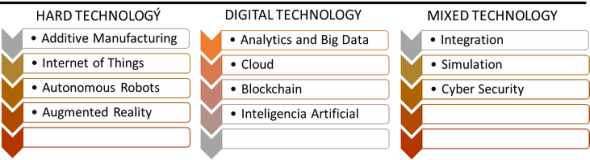
Within the nine base technologies of Industry 4.0 they were classified as follows (Figure 1):
Hard Technologies that require a large investment in highly specialized equipment. Companies that wish to implement them must have, in addi- tion to the investment in equipment, trained personnel for the installation, start-up and subsequent use of the technology. In this category are Additive Manufacturing, Autonomous Robots and Virtual and Augmented Reality.
Figure 1: Layering of current digital technologies (Castillo-Galván, P 2022).
14 Patricia
Soft technology (Digital Technology) that does not require a high inve- stment in equipment but rather requires more trained personnel for its development and management. Among these are: Analytics and Big Data, Internet of Things, Cloud, Artificial Intelligence and Blockchain.
Mixed Technologies are those that require a high investment in equipment and also in highly trained personnel, including Simulators, Horizontal and Vertical Integration and Cyber Security.
Key Elements That Affect and Interact Within the Model At this stage, based on the information obtained with the research instru- ments, it was possible to detect six main elements that influence the development of the model.
1. Global economic environment: the current environment is characteri- zed by factors such as: the large amount of information available, the disruptive speed and the acceleration of innovation. At this stage in history, organizations must deal with markets with constant fluctuati- ons and must be able to react and respond to changes in market demand (Illustration 2. Innovation agents (technology generators): Innovation processes, mainly in technology, are easier to develop for large companies due to the num- ber of resources that need to be invested, which is why one of the important elements of the model They are the large companies that develop digital technology. 3. Transfer technology: large organizations are making use of high techno- logy and, regardless of their characteristics, they develop and comple- ment each other. They are the ones who possess the knowledge for its application. 4. Support agents for the transfer: The elements to support the transfer of technologies in this model are based on the Triple Helix model: Educa- tional or research institutions, government entities and business organi- zations, potentially considering including society and the environment, elements of the Quintuple Helix 5. Model’s User Agents: the profile was defined at the beginning of the inve- stigation, the Key users will be: SME companies that provide products and services in the automotive industry; companies interested in techno- logical development in the context of Industry 4.0; professionals hired by companies in the automotive industry and its Supply Chain and people dedicated to the development of Information Technologies; Researchers and Professors working in research centers; and Federal, State or Local Government Units interested in developing technology projects.
Integration of the Technology Transfer Model That Meets the Needs of SMEs To face a global business environment characterized by being volatile, uncer- tain, complex and ambiguous, companies must have agile and flexible production processes and resource management, while maintaining control over them.
Technology Implementation Model for the Integration of Mexican SMEs 15
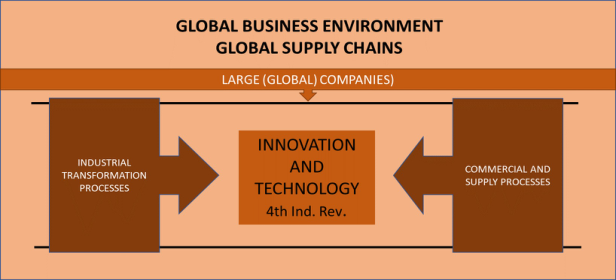
The basis of the canvas on which the model is developed is the Global Busi- ness Environment, it is what defines the needs of companies to integrate new businesses into the Supply Chains. As already mentioned, this environment is characterized by accelerated growth and high uncertainty, which, when mismanaged, generates uncertainty and stress in organizations (Figure 2).
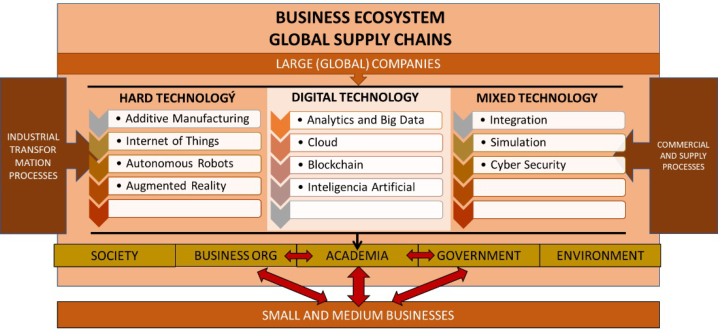
Innovation Agents are, on the one hand, the large companies that develop and generate new technologies that apply and complement each other. They are the ones, due to their economic capacity, who invest in research and deve- lopment for the application, and on the other hand, the Digital Technologies themselves, And to complete this model, the elements to support the transfer of tech- nologies in this model are based on the Triple Helix model: Educational or research institutions, government entities and business organizations, poten- tially considering including society and the environment, elements of the quintuple helix.
After classifying the Technologies into Hard, Digital and Mixed and their interactions with the global environment, the potential that SMEs have to implement in their internal processes was analysed, in a way that would allow
Figure 2: Global business environment (Castillo-Galván, P 2022).Figure 3: Technology implementation model for the integration of mexican smes into global markets.
16 Patricia
them to grow rapidly and respond safely to the requirements of Global Envi- ronments. That is why, due to the low investments in equipment to implement that they require, the line of digital technologies is the one that the model proposes to implement (Fig. 3).
CONCLUSION
Currently, the global business environment is characterized by the influence of factors such as the availability of a large amount of information, the speed with which changes are generated and accelerated innovation. At this time, organizations must face constantly fluctuating markets in addition to being able to react and respond to changes in market demand.
It should be considered that the Latin American economy, including Mexico, are characterized by the predominance of micro and small compa- nies that are often disconnected from Global Markets and whose productivity is low, they are incapable of reacting to these Global Environments. Technolo- gical transformation, especially digital, can provide an opportunity for those companies to overcome the obstacles that the region faces and that limit their development. The OECD (2020) maintains that “digitization is an effective instrument for development, but only if it is universal and inclusive” (OCDE, 2020). Understanding the current business environment allows recognizing requi- rements and identifying the needs that small and medium-sized organizations need to meet to integrate into global markets. Large organizations have understood this and are setting the pace to respond to the needs of the markets through innovation and technology development.
There is a paradigm in which organizations assume that the use of Technology is expensive, that it requires high investments in equipment and trained personnel, however this is not entirely true, not all current technologies are the same and in this work they were analysed and classified.
Starting from those technologies that require a high investment in equi- pment (Hard Technology), going through those that their greatest investment is in personnel training (Digital Technologies) and those that by their nature require investment in both (Mixed Technologies), it was concluded that for SMEs as they aspire to be integrated into global markets, they must start by addressing technological implementation on the line of Digital Technology.
To achieve this technology transfer, the intervention of agents is requi- red to enable the linkage, communication and support between innovative companies and technology generators. For this reason, the intervention and participation of Universities and Research Institutes, Business Organizations and Government Offices (Triple Helix) are important. In the end, the other elements that complement the Fivefold Helix (Society and Environment) must also be incorporated.
REFERENCES
Ageron, B., Benthar, O. & Gunasekaran, A., 2020. Digital supply chain: challenges and future directions. Supply Chain Forum: An International Journal, p. 133–138.
Technology Implementation Model for the Integration of Mexican SMEs 17
Castillo-Galván, P., 2022. Modelo Estratégico Tecnológico para Sistemas de Información que integren Empresas PyME.. Queretaro, Qro: UAQ. Council of Supply Chain Management Professionals, 2020. CSCMP. [En línea]
Available at: https://cscmp.org/. Gereffi, G., 2015. Global value chains and international competition. The Antitrust Bulletin, 56, pp. 37–56. Gereffi, G., Humphrey, J. & Stürgeon, T., 2001. Gereffi, G., HumphreIntrodu-
ction: Globalisation, value chains and development. IDS bulletin, 32(3), 1–8. IDS bulletin, 32(3), pp. 1–8. Hernandez Sampieri, R., Fernandez Collado, C. & Baptista Lucio, P., 2010.
Metodología de la Investigación. México: Mc Graw Hill.. México: McGraw Hill. OCDE, 2020. Perspectivas Económicas de América Latina 2020 Transformación Digital para una Mejor Recontrucción, Paris: OECD Publishing. Rüßmann, M. y otros, 2015. Industry 4.0: The future of Productivity and Growth
in Manufacturing Industries. [En línea] Available at: https://www.bcg.com/ publications/2015/engineered_products_project_business_industry_4_future_ productivity_growth_manufacturing_industries. Schwab, K., 2016. Schwab, K. (2016). La cuarta revolución industrial. Debate.
Dabos: Debate.
LISTED IN THE AHFE DIGITAL BOOKSTORE CATALOGUE
Explore the complete digital volume
Human Factors in Management and Leadership
Read this individual research paper free through the original publisher, or explore the full digital proceedings book.
ISBN 978-1-958651-68-1
Explore this ISBN in the AHFE Bookstore ↗Listed in the July 2026 bookstore catalogue; search by ISBN to confirm current availability · Digital book purchase optional