Patricia Castillo-Galván, Juan José Mendez Palacios (2022). Digital technology as a tool for the growth of Mexican SMEs in San Luis Potosi. In: Human Factors in Management and Leadership. AHFE Open Access, vol. 55, pp. 1–6. https://doi.org/10.54941/ahfe1002224
In a world of constant change and accelerated growth, the use of information systems based on digital technology, integrated into manufacturing processes and resource management, has become a necessity for Mexican small and medium-sized companies (SMEs). who intend to grow globally and maintain their competitiveness in the market in which they operate. They see digital technologies as a tool that would allow them to achieve their development and growth plans, based on the concept of exponential growth organizations who, without many physical resources but with intensive use of technology, have managed to grow in short periods of time. However, it is not so simple, they face greater challenges such the lack of expert personnel to advise and guide them in the implementation and management of the technology, this is a barrier that they must overcome. This paper presents the challenges and opportunities of the use of digital technologies a ass a tool to promote the growth of the Mexican SMEs established in the state of San Luis Potosí, in global markets,
In the world, great revolutions have occurred when profound changes have been triggered in economic systems and social structures, driven using new technologies or new ways of perceiving the world.
Today, a fourth revolution in industry is taking place, identified as Industry 4.0. This movement drives the change in Global Value Chains Organization using Virtual and Physical Manufacturing Systems cooperating with each other across physical and digital domains (Schwab, 2016).
In 2011, authors such as Durheim and Toffler (Burcet, 2011) already mentioned an acceleration in economic, political, cultural, social, and envi- ronmental models, where each new change takes place in an exponentially shorter period. This acceleration and having to face unknown contexts with constant changes, generates a great amount of stress in the environment.
Schwab (2016) suggests that to reduce this stress and improve the response of economic and work systems, it is necessary to adopt new work models that are quickly absorbed, models that must be dynamic since the disruptions will not stop, but on contrary, its acceleration will increase.
Some organizations have already begun to outline proposals to respond to this dynamic context. The Organization for Economic Cooperation and Development (2020), in the Latin American Economic Outlook 2020 report, addresses digital transformation as an opportunity to overcome the decepti- ons of development that the region faces. It further argues that “digitization is an effective tool for development, but only if it is universal and inclusive” (OCDE, 2020, pág. 3) According to Schwab (2016), the world in general has experience the burst of productivity generated by the wave of new technologies arising with the Fourth Industrial Revolution (Schwab, 2016). However, it should be conside- red that the Latin American region, including Mexico is characterized by the predominance of micro and small companies whose productivity is low and which are often disconnected from their markets (OCDE, 2020). Therefore, according to the OECD, it is necessary to reduce the digital gaps and the use of technology, so the benefits of the transformation reach everyone.
According to the Ministry of Economy of the Federal Mexican Govern- ment, Mexico is the second economy in Latin America with a Gross Domestic Product (GDP) of 1,291 billion dollars (mdd) and represents the 15th eco- nomy in the world (1.67% of world GDP). Also, according to published data, it ranks as the 13th economy with commercial management in the world with about $397.129 million dollars (million dollars) in exports and $399.977 million dollars in imports (DataMéxico.org, 2021).
In 2019, the state of San Luis Potosí, located in central Mexico, was the eighth most stable economy in the country, according to competitiveness data reported by the National Chamber of the Transformation Industry (CANA- CINTRA) to national level, and was number twelve in industrial performance (CANACINTRA, 2019).
DIGITAL TECHNOLOGY Gay (2002) defines technology as “the ordered set of knowledge and the corresponding processes, whose objective is the production of goods and services, taking over the technique, science and the economic, social and cul- tural aspects involved” (Gay, 2002, pág. 6). Technology is present in almost all aspects of modern society and its influence has modified the behavior and actions of people, companies, and institutions.
Betancourt (1998) points out that companies have found technology to be a long-term strategic factor, seeing it as a pillar for profitability and sustained growth. Porter in his book “The Competitive Advantage” said that techno- logy is contained in each value activity of the company and is considered important if it positively affects the competitive advantages and the structure of the industrial sector (Porter, 1990).
Companies need technology to advance in the competitive environment within the industrial sector in which they are located, and this need should drive the search and incorporation of technological capabilities. This requi- res a detailed selection and subsequent acquisition of technology through licensing or purchase for its subsequent assimilation, adaptation, and disse- mination (Betancourt, 1998).
Digital Technology: A Tool for the Growth of Mexican SMEs in San Luis Potosi 3
Industry 4.0 technology (Digital Technology) is based on nine pillars: Simulation, Autonomous Robots, Integration, Internet of Things, Cyber Security, The Cloud, Additive Manufacturing, Augmented Reality and Big Data. All those are transforming the production of isolated and optimized cells to a fully integrated, automated, and optimized production flow. This leads to greater efficiency and change in traditional production relationships between suppliers, producers, and customers, as well as between humans and machines (Vaidya, Ambad, & Bhosle, 2018).
Technology in Supply Chains The information systems used until a few years ago in Supply Chains Mana- gement can be considered outdated, as they were a combination of analog (spreadsheet) and digital (disconnected software) processes. However, in recent years there has been a growing interest from companies to digitize processes (McCrea, 2021).
Ageron et all (2020), define the digital supply chain as “the development of information systems and the adoption of innovative technologies that streng- then the integration and agility of the supply chain and, therefore, improve the service to the customer”. customer and the sustainable performance of the organization” (Ageron, Benthar, & Gunasekaran, 2020). They also mention the benefits of digitizing the supply chain, which helps its greater integra- tion, where it represents the degree to which a manufacturer collaborates strategically with its partners and collaboratively manages intra- and inter- organizational processes, achieving effective flows. and efficient products and services, information, money, and decisions, to provide maximum value for the customer.
Before digitization, the information systems used by companies to manage Supply Chains were understood as modules of a disconnected system. In the digitalization era, what is sought is to integrate technologies, focus on custo- mers / consumers, reduce intra- and inter-organizational costs and create more value for organizations (Ageron, Benthar, & Gunasekaran, 2020). To achieve this integration, companies are using digital technologies such as Arti- ficial Intelligence (AI), Blockchain, Big Data and the Internet of Things (IoT). Illustration 6 describes the evolution of information systems and their inte- gration over time, from the creation of MRP (Material Resource Planning) systems to EBI (Electronic Business Integration) used in companies. with a worldwide presence Technological needs of SMEs in San Luis Potosí
Schwab (2016) describes the current era as a time to revolutionize the orga- nization of global supply chains, due to the increasing use of virtual and physical manufacturing systems, the fusion of technologies and the intera- ction between both through physical domains and digital. However, not all organizations experience change in the same way and at the same time.
In order to know in depth, the needs of SME companies installed in San Luis Potosí regarding the knowledge and use of digital technologies, it was decided to collect field information through the application of surveys. Due
4 Patricia and José
Table 1. Use of technology in SMEs processes (Self-created).
Table available in the original PDF paper.
Specialized Business Handmade Own Not Software Software work Dev used MRP 31% 27% 18% 9% 16% ERP 22% 24% 13% 16% 24% CRM 22% 22% 22% 11% 22% EOS 20% 20% 11% 11% 31% ECR 18% 20% 22% 11% 29% WMS 22% 18% 22% 11% 27% TRP 13% 27% 11% 7% 42% Traceability 20% 16% 13% 13% 38% PDR 20% 16% 18% 9% 38%
to the restrictions imposed in the current pandemic environment on physical proximity (access to people) and time availability, convenience sampling was employed and applied electronically.
With a universe of 724 SME companies (INEGI, DENUE, 2021), the expe- ctation was to be able to survey 15% of this Universe (for confidentiality reasons, the list of companies that responded to the survey will be made available if required).
Sixty-four percent of the companies that responded to the survey men- tioned managing their resource management processes manually with free software (Excel) or having developed their own software with the limitations that this entails or simply not managing some type of information (Table 1).
In addition, they were asked about the use of technology in the processes of the organizations, and they mentioned not using (knowing use or application) technologies such as simulations (77.3%), Artificial Intelligence (79.5%) or information management with Big Data (63.6 %).
These same companies referred to three aspects with respect to which they need help: Government support for the development of projects (36%) and specialized advice on administrative processes (36%) and manufacturing (36%). Based on these needs, a comparative table was made explaining how a digital technology coming out of Industry 4.0 can help companies solve pro- blems more quickly and boost the growth of their businesses within global markets (Table 2).
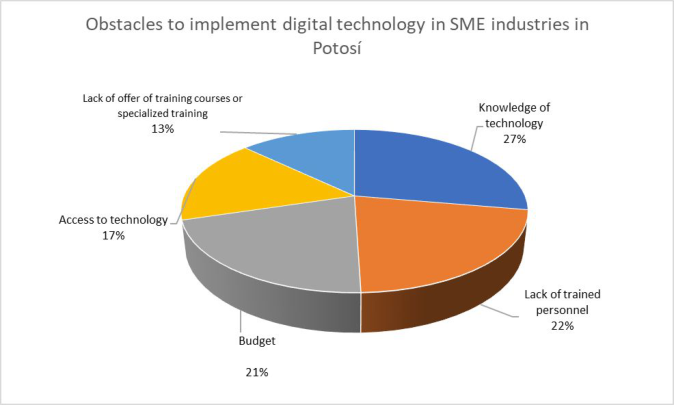
Regarding the obstacles faced by companies for the implementation of technologies, they reported the lack of knowledge of the technologies, the lack of personnel trained in the handling of the tools, the budget, the acquisi- tion, and the lack of nearby specialized courses. to their location, these factors directly affect them in that order of importance.
CONCLUSION
Schwab describes the current era as a time to revolutionize the organization of global value chains, due to an increasing use of virtual and physical manu- facturing systems, the fusion of technologies, and the interaction between the two across physical, digital, and virtual domains. biological. However,
Digital Technology: A Tool for the Growth of Mexican SMEs in San Luis Potosi 5
Table 2. Relationship between digital technology and the problem it solves for SMEs (Self-created).
Table available in the original PDF paper.
Digital Tool Need solved Big data and Analytics Use of the information generated by the machines and the analysis of it for decision making Cyber Security Protection of company assets through and information using monitoring applications Horizontal and Vertical Integration
Integrated administration of company departments through the use of specific ERP systems for small and medium-sized companies Simulation Specialized training of workers in a specific machine or process Virtual and Augmented Reality
Quick response to changes in the production environment Internet of things (IoT) Advanced interaction of objects with an existing environment and immediate response if something changes
Figure 1: Obstacles to implement digital technology in SME industries in Potosí (Self- created).
Schwab himself refers to the particular concern of these times about the ine- quality that these technological and digital changes mean, technology and digitization are revolutionizing everything. However, he points out that not everyone will be experiencing this change at the same time or in the same way, 17 percent of the world still lacks electricity, and more than 50 percent of the world’s population does not have access to the internet (Schwab, 2016) From this perspective, and as expressed in an interview by the President of the Consulting Council of the Secretary of Municipal Economic Develo- pment, Luis Gerardo Ortuño Díaz Infante (Ortuño Díaz Infante, 2021)“the economy of the state is based on small companies with shortcomings. , not
6 Patricia and José
in the knowledge and management of manufacturing processes, but rather access to financing, trained personnel and strategic management of organi- zations”, for the same reason it is necessary to look for the technological gap through networks and strategic alliances of research and technology transfer to the industrial sector favoring innovation and competitiveness (Gobierno del Estado SLP, 2016, pág. 14) If local government pursue to promote the growth of small and medium- sized companies in the state, by integrating them into the Supply Chains of the Global Companies, the next step would be to develop a strategy that allows them to have access to cutting-edge technology and highly trained personnel to handling them. Among the proposed strategies are:
Support the integration of local SMEs into Global Supply Chains through the use of technology in their processes.
Promote the modernization of work machinery in SMEs, through support and/or financing.
Establish agreements with universities and research institutes to develop personnel trained in new Industry 4.0 technologies applied to all processes in organizations.
Encourage the update of the contents in technical and professional educa- tion, so that they adapt to the requirements of the new era.
Support dual education programs to develop staff with the skills required at work.
REFERENCES
Ageron, B., Benthar, O., & Gunasekaran, A. (2020). Digital supply chain: challenges and future directions. Supply Chain Forum: An International Journal, 133–138. Betancourt, J. (1998). Conceptos Básicos sobre Tecnología. Revista Universidad
Eafit, 117–132. Burcet, J. (2011). Teoría de los saltos de escala en la comunicación. Barcelona. CANACINTRA. (2019). Escenario Económico de San Luis Potosí. Obtenido de https://issuu.com/canacintraslp/docs/escenario_economico_de_san_luis_potos __-_2019 DataMéxico.org. (09 de 2021). Data México Org. Obtenido de https://datamexico
.org/es/profile/geo/mexico Gay, A. (2002). La ciencia, la técnica y la tecnología. Tecno Red Educativa, INET, Serie Educación Tecnológica, 1, 77–91. Gobierno del Estado SLP. (2016). Plan de Desarrollo 2015–2021. San Luis Potosí. McCrea, B. (05 de 2021). How the Global Pandemic Accelerated Supply Chain
Visibility, Digitalization, and Automation. Obtenido de SupplyChain247: https: //www.supplychain247.com/article/how_the_global_pandemic_accelerated_supp ly_chain_visibility_digitalization/elementum?oly_enc_id=2915H1522089C2W OCDE. (2020). Perspectivas Económicas de América Latina 2020 Transformación Digital para una Mejor Recontrucción. Paris: OECD Publishing. Ortuño Díaz Infante, L. (21 de Jun de 2021). Presidente del Consejo de Desarrollo
Económico de San Luis Potosi. (P. Castillo-Galván, Entrevistador) Porter, M. (1990). Ventaja competitiva: creación y sostenimiento de un desempeño superior. Grupo editorial patria. Schwab, K. (2016). Schwab, K. (2016). La cuarta revolución industrial. Debate.
Dabos: Debate.
LISTED IN THE AHFE DIGITAL BOOKSTORE CATALOGUE
Explore the complete digital volume
Human Factors in Management and Leadership
Read this individual research paper free through the original publisher, or explore the full digital proceedings book.
ISBN 978-1-958651-31-5
Explore this ISBN in the AHFE Bookstore ↗Listed in the July 2026 bookstore catalogue; search by ISBN to confirm current availability · Digital book purchase optional