Eric Brangier, Blandine Brangier (2022). What do you like or dislike about your work? First explorations on a general feeling of work. In: Human Factors in Management and Leadership. AHFE Open Access, vol. 55, pp. 88–95. https://doi.org/10.54941/ahfe1002236
Workers habitually say « I love my job » or « I hate my work » to define what they like or dislike about their professional situation. Thus, love and hate of work are often confused with other concepts: pleasure, suffering, commitment, satisfaction, well-being... Rare are the definitions of love or hate of work. The purpose of this paper is threefold. First, it proposes a conceptualization of the love and hate of work, as a “general feeling of work”. Second, it presents an automated textual analysis (performed with the IRaMuTeQ system) on 7359 French employees in 29 companies. Third, it gives recommendations for promoting love of work and reducing hate of work. On the one hand, professional opportunities, positive relationships, autonomy, diversity, work content develop love, and on the other hand, lack of opportunity, deleterious relationships, hierarchical failures, excessive demands, and poor working conditions lead to dislike job.
Work occupies a central place in our lives. It involves operating modes, beh- aviors, representations and emotions. These emotions can be associated with negative feelings of violence, anger, injustice, envy, hatred, but also positive feelings of benevolence, appeasement, satisfaction, well-being, attachment and pleasure (Fortino, Jeantet & Tcholakova, 2015). Work leaves you with a general sense of what you love about it and what you hate about it.
But how does love at work get constructed? How does an individual come to hate or even loathe his or her activity, the organization and the people associated with his or her organization? What is expressed in the love of work? The notions of love and hate of work are still very vague in the minds of many workers. In order to understand these questions, we will take a quick theoretical look at love vs. hate of work, and then we will see how these two notions are expressed in the workers’ discourses.
LOVE VS. HATE… LIKE VS. DISLIKE… A GENERAL FEELING OF WORK?
“I like my job”, “I hate my workplace”, “I enjoy what I do at work”or “I hate my work” are expressions that are often heard. They are a direct expression
of a feeling. They synthesize an impression, a global point of view perceived at a given moment. But what is this love or hate of work? These positive and negative affects are related to the love and hate that individuals experience during their activity. We seek to understand the relationships of love and hate that an individual has with his work. We will construct a definition and explanatory models of these notions.
Ergonomics, psychology, sociology, and globally all the sciences related to human and organizational factors (Vallery, Bobillier Chaumon, Brangier & Dubois, 2019; Brangier & Vallery, 2021) have developed many notions to detail this global feeling: Well-being, Hedonics, Pleasure, Suffering, Organi- zational Commitment, Disengagement, Involvement, Attachment, Meaning of work, Habilitation, Involvement, Empowerment, Satisfaction, Dissatisfa- ction… In short, the concepts are numerous and often refer to two themes raised by workers: what do you like about your work and what do you dislike?
“I Love My Work” Love is an invisible force that creates extremely positive abstract cognitions. It is a profound source of fulfillment (Foster, Pingle & Yang, 2019). It represents deep emotional states that cause individuals to experience intense feelings, affection, and attachment toward someone or something. These states incite them to try to have a physical, intellectual and imaginary proximity. To love is to choose a good, a thing, an object identified as exceptional among others in a thoughtful or confused way. The choice is guided according to a prefe- rence which cannot be explained in a rational way towards a singular object of love, unique and impossible to confuse. Thus, to love one’s work is first to choose it, to evaluate it positively, even to idealize it, and then to feel a great variety of deep and positive feelings. While working, the individual can feel a general pleasure, an attraction and a more or less powerful attachment that pushes him to continue his activity. This feeling will be a source of sati- sfaction, loyalty and will allow the development of trusting relationships. In addition, the more the work feeds an experience, making use of the technical and/or intellectual skills of the individual, the more he will value his activity reinforcing the affects for his work. Work that is loved and respected will be recognized, defended; it will not be forgotten, replaced or abandoned (Song, Wang, & Han, 2018). The love of work is therefore a balance between a positive side represented by the human virtue of work and a negative side: the moral flaw of work. Virtue corresponds to kindness, compassion, empa- thy and human affection. The love of work is thus the devoted concern for all forms of counterparts, loyal and benevolent towards the organization. Along with the negative component, the moral defect is associated with vanity, sel- fishness, jealousy and self-love. This vice can potentially lead people to a type of mania, or obsession. This invasion is a codependency of the individual to his work called workaholism. It has damaging consequences for the indivi- dual, their entourage and the organization. Moreover, love at work is not permanent. Indeed, a negative event in the work can weaken the favorable affects and cognitions until they are insufficient to continue loving (Foster,
90 Eric and Blandine
Pingle & Yang, 2019). Conversely, a positive event can reinforce this feeling and create a beneficial and protective inertia.
“I Hate My Work” Hatred of work is a taboo and inadmissible feeling in most societies. It is a violent feeling, an intense antipathy of an individual that pushes them to wish harm to someone or something, here the organization; and to rejoice in the harm that is caused. Hate is a psychological state of deep dislike for the work that the hater does. Hate of work is first an extremely negative judgment of the work, which then gives rise to negative affects, and then engenders evil behaviors towards the organization. Hatred is often incoherent, unju- stifiable, because it is driven by passions. To hate one’s job is to be unable to blossom and experience pleasure in one’s activity. The individual can no longer admit to anything other than the hatred he or she feels. The feeling of deep rage towards one’s work pushes the individual to destruction, to make what they have identified as the source of their malaise disappear. Contrary to the love of work which provokes and develops social relations, hatred is a feeling said to be alienating which creates tensions within organizati- ons. Envy, jealousy towards colleagues and hierarchy are sources of intense conflict for the employee, which will lead to hatred of their work and of oth- ers. Dissatisfaction, suffering, malaise, frustration, lack of control over work, repetitiveness, fragmentation of activities ... lead to feelings of dehumaniza- tion in his work. Hate is internalized, it becomes a reductive and destructive vision that leads to increased anxiety, depression, shame and reduced intel- lectual performance (Baldissarri, Andrighetto, & Volpato, 2016). Hate leads to increased and excessive irritability, which results in misunderstandings, interpretation problems, altercations, conflicts with colleagues and hiera- rchy. It can then lead to withdrawal and distrust of colleagues. Hatred of one’s work can lead to malice, aversion and disgust towards the organization to which the individual belongs. It would incite to have deleterious behavi- ors (or attempts of behaviors), or not to have pro-organizational behaviors. These behaviors can compromise the company, its members, managers, custo- mers or users. These sabotaging behaviors constitute a real risk and threat to the organization that can have significant material, economic, financial and psychosocial damages.
PROBLEM What does love or hate of work mean? What do employees tell us about their situation? How do they give an overall assessment of their work? Our questions are general and exploratory in nature.
METHOD
Population 7,358 employees from 29 French companies were questioned online. The collected verbatims were analyzed with the IRaMuTeQ (Interface de R pour
What Do You Like or Dislike about Your Work? 91
les Analyses Multidimensionnelles de Textes et de Questionnaires) software and method.
The sample is composed of 4427 women and 2647 men. Within the companies 8.84% of employees (651 individuals) were under 26 years old, 32.17% (2367) were between 26 and 35 years old, 44.1% (3245 individu- als) were between 35 and 45 years old and 14.17% (1043) were over 45 years old. Individuals were categorized according to their occupational sta- tus. 1753 were managers, 1249 were supervisors, 4185 were laborers and 135 were technicians. 94.73% of employees had a full-time contract, and 4.68% were part-time.
Questionnaire The SATIN questionnaire (Grosjean, Kop, Formet-Robert, Althaus, 2017) assesses working conditions and health, focusing on the prevention of psych- osocial risks. It reveals the real representations of tensions experienced in terms of health and work situation, in order to promote well-being in organi- zations. It includes 75 psychometric questions and two open-ended questions: “In my job I like...” and “In my job I don’t like...” The verbatims of these two questions have been analyzed with IRaMuTeQ.
Text Analysis Method The use of free software IRaMuTeQ (Sarrica, Mingo, Mazzara, & Leone, 2016) allows the analysis of textual data. It is an automatic analysis softw- are, i.e., apart from the parameterization of the analysis, it performs most of the analysis. However, the data submitted to the software requires pre- processing. A statistical lexicography was made from those sub-corpora and, from it we carried out a descending hierarchical classification (Costa, Reis, Sousa, Moreira, & Lamas, 2017).
FINDINGS Ergonomics and human factors have sometimes tacitly considered that emo- tions are something uncontrollable or buried, not governed by social or professional rules. If we consider the nature of emotions or general fee- lings, and the nature of our capacity to try shaping it, we are reached by the scope of social rules and therefore we cannot separate emotion and cogni- tion. The results show that there are many conceptual links in the variables relating to emotional experiences of work. The results are very rich and will be summarized in two clouds and one dendrogram.
Clouds of Words First, the lexicographical analysis shows a distribution of the words love / hate:
– Love of work is linked to (1) Team, colleague, contact, atmosphere, rela- tionship, trust, (2) Task, the material worked on, model, (3) Diversity (4) Autonomy, freedom, possibilities (5) Timetable.
92 Eric and Blandine
Figure 1: French words clouds of love of work (left) and of the hatred of work (right).
Figure available in the original PDF paper.
– Hatred of work is related to (1) loss, lack, evil (2) Time, pressure, production, stress (3) Communication, team, manager, atmosphere, (4) Responsibility, recognition, (5) Task, quality and (6) Salary.
Taxonomic Classification: Dendrograms of the Descending Hierarchical Classification It contains partitions and contents of the corpus which represents the conce- ptions of lave vs hate. It is linked to the semantic universes related to verbatims:
– We like our work for Professional Relationships, Career Opportunities, Freedom of Action, Varied Work, Know-How, Benefits and Value of Work. – We don’t like our work for Deleterious relationships, Hierarchical failures, Lack of vision on the future, The effect of time demands, Working time, Working conditions.
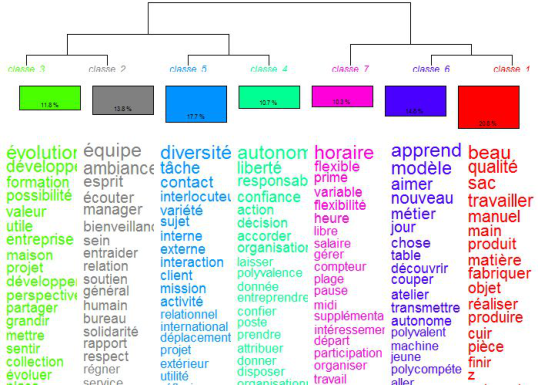
The Figure 2 shows the corpus “In my job I like…”. The dendrogram is composed of 7 classes. It highlights that 1258 enunciated forms out of 4742 are present at least 3 times in the studied text corpus. Finally, it has classified 6473 segments out of 6847 or 94.54% of the segments in total within the dendrogram.
– Class 1 expresses the future opportunities of the employees. It contains 11.8% of the corpus content. Here, people address their questions, doubts or hopes in terms of training, career development, salary and the develo- pment of the company. They also express the opportunities offered by the organization. They like: “the prospects for training and development, the development of my manual and intellectual abilities and the discovery of a new world”. – Class 2 (13.8%) refers to the importance of positive professional rela- tionships. These relationships are based on very positive feelings and behaviors, close to love: benevolence, trust, mutual aid, solidarity and respect. For example: “the atmosphere within the team as well as the follow-up, the support and the listening of my managers in my early days in the company.” These relationships include colleagues as well as manage- ment. Professional opportunities and professional relationships are linked in the dendrogram. They are also close to the next two classes.
What Do You Like or Dislike about Your Work? 93
Figure 2: Top-down hierarchical classification of love of work (in French).
– Class 3 (10.7%) deals with autonomy and freedom in one’s work: “I like the autonomy and freedom of action given to me by my superior, the trust given to me by my colleagues”. – Class 4 stresses the importance of diversity and variation at 17.7%. The operators appreciate the variations in tasks, contacts, operating methods and even production sites. This change in work is linked to a sense of com- petence and accomplishment. Class 3 and 4 are linked on the dendrogram representation. They express a kind of power, through the skills that allow individuals to be independent and versatile.
The first 4 classes express the place of the individual within the organiza- tion, in relation to the others, their skills and theirfuture. These classes have little connection with the 3 following classes.
– Class 5 (14.8% of verbatims) refers to the rich and ancient know-how of one’s profession. It emphasizes the acquisition of know-how that must be maintained and perfected. For example, one participant said: “I like to learn new things every day, new ways, new processes, new models”. – Class 6 is the largest with 21% of the corpus and shows the value of work. The workers underline the feeling of pride in making products that they are attached to. It is also associated with the pleasure of the feelings of working well. This class lists all the content of the work. One partici- pant likes “working by hand and making beautiful products with quality craftsmanship from start to finish.” – Class 7 (10.3%) addresses salary benefits, such as flexible hours, salary, bonuses, company car, for example.
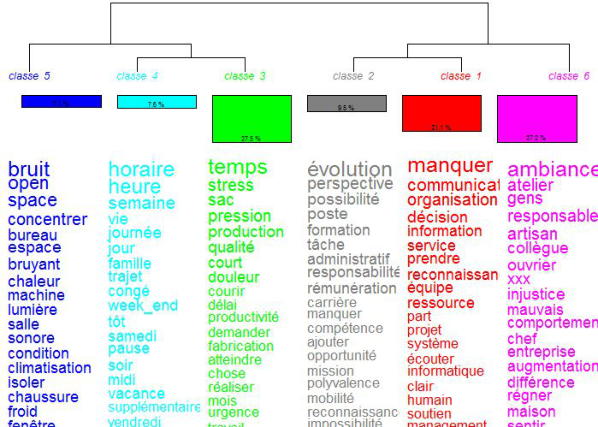
The Figure 3 shows the corpus “In my job I dislike…”. The dendrogram is composed of 7 classes.
94 Eric and Blandine
Figure 3: Top-down hierarchical classification of the hatred of work
– Class 1 (21.1%) is made up of the terms “miss”, “communication”, “evo- lution”, “organization”, “recognition” and highlights the failures of the hierarchy. This class of words is particularly present in the corpus, it appe- ars in 3 classes. We don’t like the “lack of communication, coordination and decision making on the part of our management”. – Class 2 (9.5%) relates to the visions of individuals on their future within the company, in their professional relationships. For example, one respon- dent regretted: “the career management policy, the opaque evolution perspectives”. – Class 6 is also close to classes 1 and 2 (27.2%). It deals with nega- tive professional relations at work. In this class, employees describe the deleterious aspects of professional relations in terms of “injustice”, “con- temptuous behavior”, “jealousy”, or the “spreading of false information”. This class reflects the important weight of relationships with colleagues and subordinates on a daily basis.
These first three classes are statistically distant from the next three classes.
– Classes 3 (27.5%) and 4 (7.6%) address the issue of time. The fourth class addresses the issue of work time and schedules. People describe “late hours”, “overtime”, “lack of flexibility” and “having to do it”. The third class is the most important, describing the consequences of work sche- dule demands. Employees are subject to “stress”, “production pressure”, “pain”, they “chase time”. Class 3 is the most important with 42.2% of the responses. It refers to the demands of the work, in particular “time”, “quality” and its effects “stress”, “fatigue”, “pain”. – Class 5 reflects the working conditions that lead to a dislike of work. Here, it is mainly the noise and the absence of natural light and the equipment
What Do You Like or Dislike about Your Work? 95
that alter the good execution of the work. They complain about not being able to “concentrate”, or the lack of privacy, but also the lack of material means that makes the work more difficult. Thus, a “desk, a chair not adapted”, the absence of a place in the canteen, a meeting room to isolate oneself alone or in a small group is a problem for the participants. This overcrowding and poor facilities are the problems of this fifth class.
CONCLUSION
The results have shown that a global appreciation of work exists and can be defined on the base of what we love or hate at work. A general structure of global appreciation of work appears. It should be defined by studies on a larger number of issues.
ACKNOWLEDGMENT
The authors wish to acknowledge support from Lucie Denisart regarding the overall content, fruitful discussions, and textual analysis.
REFERENCES
Andrighetto, L., Baldissarri, C., & Volpato, C. (2016). (Still) Modern Times: Objectification at Work: Objectification of Factory Workers. European Journal of Social Psychology, 47, 25–35. https://doi.org/10.1002/ejsp.2190 Brangier, E. & Valléry, G. (Eds) (2021). Ergonomie : 150 notions-clés, dictionnaire
encyclopédique. Dunod. Costa, A. P., Reis, L. P., Sousa, F. N. d., Moreira, A., & Lamas, D. (2017). Computer Supported Qualitative Research. Switzerland: Springer. Grosjean, V., Kop, J., Formet-Robert, N., & Althaus, V. (2017). SATIN version
3.0 : un questionnaire d’évaluation de la santé et du bien-être au travail pour la prévention, le diagnostic et l’intervention. Manuel d’utilisation. HAL CCSD. Fortino S., Jeantet A. & Tcholakova A., (2015). Emotions au travail, travail des émotions : présentation du corpus. La nouvelle revue du travail. https://hal.arch ives-ouvertes.fr/hal-01506879/ Foster, G., Pingle, M., & Yang, J. (2019). Are we addicted to love? A parsimonious
economic model of love. Journal of Economic Behavior and Organization, 165, 70–81. http s://doi.org/10.1016/j.jebo.2019.07.009 Hochschild, A. R. (1979). Emotion Work, Feeling Rules, and Social Structure. American Journal of Sociology, 85(3), 551–575. http://www.jstor.org/stable/2778583. Sarrica, M., Mingo, I., Mazzara, B., & Leone, G. (2016). The effects of lemmatiza-
tion on textual analysis conducted with IRaMuTeQ: results in comparison. Paper presented at the 13eme Journées internationales d’Analyse statistique des Données Textuelles, Nice. Song, H., Wang, J., & Han, H. (2019). Effect of image, satisfaction, trust, love, and respect on loyalty formation for name-brand coffee shops. International Journal of Hospitality Management, 79, 50–59. https://doi.org/10.1016/j.ijhm.2018.12.011 Valléry, G., Bobillier-Chaumon, M-E., Brangier, E., & Dubois, M. (Eds) (2019).
Psychologie du travail et des organisations : 110 notions-clés. Dunod.
LISTED IN THE AHFE DIGITAL BOOKSTORE CATALOGUE
Explore the complete digital volume
Human Factors in Management and Leadership
Read this individual research paper free through the original publisher, or explore the full digital proceedings book.
ISBN 978-1-958651-31-5
Explore this ISBN in the AHFE Bookstore ↗Listed in the July 2026 bookstore catalogue; search by ISBN to confirm current availability · Digital book purchase optional