Olushola Akinshipe, Clinton Aigbavboa, Douglas Aghimien, Ayodeji Oke (2022). Securing Project Goals: The Art of Guarding against Construction Project Failure. In: Human Factors in Management and Leadership. AHFE Open Access, vol. 55, pp. 7–13. https://doi.org/10.54941/ahfe1002225
Construction project failures are often attributed to the slackness of different project stakeholders. However, it is important to note that the success or failure of construction projects can span from characteristics that could either be internal or external to the project. Avoiding project failures that could lead to premature project closure is pertinent in all projects. Every project’s goal is to fulfil its objectives and ultimately reach a successful ending. Therefore, it is imperative to explore the measures that secure project goals and, by extension, lead to success in projects. Thus, this study explores the success factors of construction projects and how failure can be avoided. Data for the study was gathered through a survey of construction professionals in South Africa. The questionnaire survey was designed to collect data pertinent to achieving the aim of the study. The data gathered was analysed using descriptive analysis to rank the measured factors. The results revealed that effectively planning for and managing all the resources needed for a project are the important elements that should be considered for guarding against premature closure of construction projects. Resources encompassing human resources, material resources, machinery resources must be properly and adequately provided for projects to reduce the probability of project flow interruption, thus reducing the risk of closing projects prematurely.
STUDY BACKGROUND “Construction” is too broad to fit into a single definition as a general term. Because defining construction relies so heavily on the tasks and activities being performed, we all have different perspectives on what it entails. Defi- ning construction work encompasses a wide range of activities. Construction work, despite differing perspectives, can be agreed to be a high-risk acti- vity requiring careful management from procurement to completion of the actual structure (Safety, Health and Welfare at work Regulations, 2006). Construction projects are large and complicated, and they encompass decon- structions, new constructions, repairs, maintenance, renovations, additions, alterations and rehabilitation of buildings, roads, facilities or infrastructures (Behm, 2008). Gabula (2012) offered that a project is a series of activities
and tasks that are carried out to achieve specific objectives and are governed by time, budget, resources, and technical specifications.
Similarly, Baars, et al. (2006) characterised projects as having four disti- nct features: a group of people, an objective, limited time and resources, and uncertainty about whether the goals will be met. Abrignani, Gomes and De Vilder (2000) The goal of a project is to propose a solution or solutions to an existing problem that will long-term impact society. The goals and objecti- ves of a project are laid out in detail. Construction projects must be feasible and realistic, taking into account the available resources, both financial and human.
A project is typically limited by space and time constraints, making it impossible to continue indefinitely. Due to the wide range of stakeholders involved, projects are particularly difficult to plan and implement. To be successful, projects must be managed by teams comprised of a variety of sta- keholders, each with specific responsibilities and contributions to make. New ideas and concepts are at the heart of every project (Akinshipe, et al., 2021). Hence, it is imperative to explore the measures that secure project goals and lead to success in projects. Thus, this study explores the success factors of construction projects and how failure can be avoided.
RESEARCH DESIGN AND SURVEY ATTRIBUTES The nature of the study is descriptive as it explores how to avoid project failure. This research was conducted in South Africa through a survey of construction professionals. Retrieved survey results were deemed usable and formed the basis of data analysis for the study. In order to determine the level of importance of each rated factor, the five-point scale from the questionnaire was converted into Mean Item Score (MIS) for each of the rated factor. The collated data were tested to check its reliability with the aid of Cronbach’s alpha test. They returned a value of 0.921, indicating that the collected data set is very reliable and fit for this study.
All participants in this study are construction industry professionals, with the majority of them being project managers. Other professionals from the built environment who have previously managed construction projects also participated in the study. The majority of participants have between two and ten years of industry experience, with a few having more than ten years. A large number of participants work in both the public and private sectors, and the engagement sector is evenly split between the two. An even distribution of respondents indicates that this study is credible.
FACETS OF CONSTRUCTION PROJECTS According to Elbeltagi (2009), the construction industry is the world’s largest. The construction industry is a good indicator of a country’s economic state because it employs a large number of people, thereby creating jobs. It is the primary objective of a construction project to build something useful. In the construction industry, projects tend to be large, unique, and built on-site. For a project to succeed, it must have a clearly defined objective, specific tasks,
Securing Project Goals: The Art of Guarding against Construction Project Failure 9
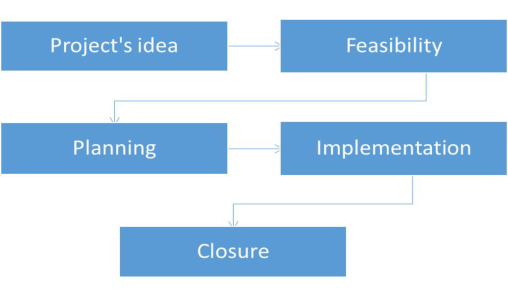
Figure 1: Project phases.
a clearly defined beginning, and a clearly defined end. As a guide to efficient project management, the basic process for every project is as follows the chart depicted in Figure 1.
To begin, the project must be approved for initiation, then for planning, then for implementation, then for closure, and finally for completion. Each of these steps must be completed before moving on to the next. In con- trast to other industries, the construction industry is unique and challenging because every project is unique. The parties involved may be at odds; proje- cts are high-risk and defined by money, time, and quality; and there is a high probability of project failure (Elbeltagi, 2009). Because every project has a beginning and an end with specific objectives to accomplish, project failures can be a problem for the parties involved. Pre-construction, construction, and post-construction are the three main phases of a construction project. Con- struction begins with the client’s conceptualisation, planning and budgeting, progresses through design, and finally comes to fruition when a contractor is hired. According to Anderson, Huhn, Rivera and Susong (2006), a more accurate description of construction is that it is more of an art than a scie- nce. To describe it as an art would be an understatement, as it entails a great deal of work at each stage of the construction process: from a client’s initial planning and budgeting to design, through to hiring a contractor, to constru- ction and finally, delivery. Coordinated teamwork among all relevant parties involved in all project phases is required to ensure its success and smooth operation.
The project life cycle is divided into four phases by Elbeltagi (2009): pre- construction, procurement, construction, and closeout. For simplification, the pre-construction phase can also be broken down into conceptual plan- ning, schematic design, design development and contractual obligations. The client places a high value on the early stages of conceptual design. Clients typically hire a designer and a project manager at this point in the project’s lifecycle. The client must also decide whether or not to proceed with the pro- ject. At this point, any alternate design solutions and materials that may be available are examined. The project’s main components are designed as part of the design development phase. Bid documents, such as contracts, bills of quantities, are prepared and reviewed carefully. After the design stage has
been completed, the project moves to the procurement phase. Bidders are invited to participate in this phase through a public call for bids or selection and interviews of specific contractors (Elbeltagi, 2009). It’s critical to select and work with contractors who have a proven track record of success. The building process begins as soon as a contractor has been selected. The physical construction of the project begins and continues until the project is comple- ted. If the previous phases are not adequately carried out, the construction phase will not be as smooth sailing as possible. The closeout phase is the final phase of the construction project life cycle. It is the responsibility of the pro- ject management team at this point to provide the client with the necessary documentation. The project performance is also evaluated to avoid making the same mistakes for future projects (Omonori and Lawal, 2014).
The project lifecycle phases are designed to help construction projects to run smoothly and be completed successfully. However, projects don’t always go as planned. It is said that projects end when their goals have been achieved (Havila, Medlin and Salmi, 2013). When a project comes to an end because its goals were not met or a need no longer exists, the project has failed.
GUARDING AGAINST PROJECT FAILURE Each project is indeed unique because no two projects are the same; know- ing the reasons for a project’s failure ahead of time can help avoid it. One of the primary causes of project failure is when the project’s objectives are not clearly documented. There will be a wide range of expectations and assumptions about the project if the functional, performance, and reliabi- lity requirements are not documented and discussed in detail. There will be a premature end to the project if team members don’t work together to achi- eve the same goals. There should be clear goals for projects, and stakeholders should help each other out (Nicholas and Steyn, 2012). Lack of proper sche- dule planning may also lead to project failure. Phases of a project are broken down into smaller units called milestones. Many people will have ideas about what needs to be done if milestone deliverables and deadlines aren’t clearly documented and communicated. To achieve long-term goals, a project team must agree on what short-term tasks must be completed (Nicholas and Steyn, 2012). Another significant cause of project failure is poor project initiation. Accor- ding to Haughey (2014), while it may be alluring to get a project up and running as quickly as possible, this can often lead to issues and even failure. It is always essential to plan properly before starting a project to ensure its successful completion. Similar, lack of skill can be another cause for project failure. The failure of a project may be attributed to a lack of staff members. According to Omonori and Lawal (2014), it is crucial to have a well-trained management team. In the same vein, failing to address risks and issues can also cause project failure. Risks and issues may be discovered before or during project execution. Failing to clearly define the requirements, new technology that causes unforeseen problems and poor technical design are just some of the risks and issues that Haughney (2014) identifies. All these issues may easily lead to project failure.
Securing Project Goals: The Art of Guarding against Construction Project Failure 11
Table 1. Management competencies required for construction project success.
Table available in the original PDF paper.
Success Factors Mean Std. Deviation Rank Proper resource allocation and usage 4.99 0.110 1 Use of verified and tested equipment 4.98 0.155 2 Established leadership 4,96 0.189 3 Implementation of proper safety measures 4.96 0.189 3 Engagement of adequate skills and expertise 4.95 0.217 5 Proper task scheduling and management 4.95 0.217 5 Setting realistic goals and expectations 4.93 0.262 7 Clear documentation of project goals 4.91 0.281 8 Managing conflict effectively 4.91 0.281 8 Effective progress monitoring 4.91 0.322 8 Proper evaluation of possible risks 4.91 0.322 8 Effective communication 4.90 0.299 12 dissemination of objectives and goals 4.90 0.337 12 Proper project initiation 4.88 0.365 14 Feasibility and viability establishment 4.88 0.427 14 Clear definition of roles and responsibilities 4.87 0.343 16 Updating technology capacity of the team 4.84 0.508 17
Similarly, construction health and safety should be taken seriously in every project as they can cause a project to fail. Availability of personal protective equipment on construction sites can avoid unnecessary accidents (Muiruri and Mulinge, 2014). Additionally, fall protection for workers working in heights should be taken seriously, noise should be handled well, and warning signs should be in place to prevent workers from falling and slipping into trenches (Alcumus, 2021). Inadequate health and safety standards on con- struction sites may lead to regulatory bodies shutting down projects. Hence, construction project failure may be avoided by ensuring that all site safety and health regulations are strictly adhered to.
There is always some risk involved in any project. Even though no one can predict the final outcome of a project, good project management practices can be learned through experience. A person’s ability to discern what should be done is enhanced by their participation in both successful and unsuccessful projects throughout their lives. This means that experience is extremely valu- able as a leader and team member, as nothing is ever new. Potential threats previously encountered can be used as a reference point in the future by pro- ject team members (Nicholas and Steyn, 2012). Gustafson and Yadav (2013) suggest that once these issues have been identified, thorough planning and an awareness of the work’s potential pitfalls can be helpful. All projects have some degree of risk, regardless of their uniqueness. Since no one can foresee the future, there is always some degree of uncertainty at the start of a project. However, project managers who have seen both good and bad outcomes can put their experience to good use by employing sound project management techniques that increase a project’s likelihood of success.
No matter how high-tech, any project requires some familiarity with pre- vious work. New projects can benefit greatly from previous projects’ records
and documentation of processes and operations, which can guide in spot- ting and avoiding problems. Project management leadership is required to meticulously plan project work, especially those requiring innovation, to understand the challenges ahead and anticipate many potential risks of fai- lure. The success factors that can be used to guard against project failure are presented in Table 1. The table also presented the result from the survey of construction professionals on how vital the success factors are.
DISCUSSION AND CONCLUSION A project can be declared a failure if its goals are not met. Numerous factors can hinder the achievement of project goals, including financial constraints, natural disasters beyond anyone’s control, economic changes and conditions, political changes and conditions, and instructions from the client. Due to external factors, or unforeseen circumstances, a project may fail if the budget for time and cost is exceeded or if the budget has to be reconsidered due to external factors. Results from the study offer some insights into how failures can be avoided in construction projects.
Resource allocation and usage are vital during the project’s planning and execution. All resources must be planned for and made available in a time- ous manner during project execution to avoid delays and possible project failures. Similarly, equipment resources must also be sourced explicitly from dependable suppliers who have tested the equipment. This helps in preven- ting wastages and delays. Effective leadership must be well established from the outset to keep projects on track and avoid misunderstandings about who is in charge of what. This will also help plan tasks and allocate responsibili- ties for individual task objectives. Management teams involved in the project must engage people with the necessary skills and plan appropriately to avoid project failure. It is vital never to start a project before proper initiation.
A lack of clarity in defined objectives can lead to a lack of clarity in defi- ning functional, performance and reliability requirements; hence there is a need to properly document and disseminate project objectives beforehand. Poor project initiation should be avoided because getting a project started quickly without proper planning can lead to problems and even failure. Pro- ject failure can be caused by a lack of adequate staffing and expertise. Risks and issues can be identified before or during the execution of a project. Fai- ling to address these issues adequately is a recipe for disaster. Every project has several distinct tasks that can be broken into manageable chunks. Proper scheduling and management are essential to achieving project success. Pro- ject management leadership is required to meticulously plan project work, especially those that require innovation, to understand the challenges ahead and anticipate many of the potential risks.
REFERENCES
Abrignani, B., Gomes, R. and De Vilder, D. (2000) Project management Toolkit Council of Europe Pub.
Securing Project Goals: The Art of Guarding against Construction Project Failure 13
Akinshipe, O. Aigbavboa, C, Thwala, W.D. Mutshaeni, M. (2021) External Components of Premature Construction Project Closure. S. M. Ahmed et al. (eds.), Collaboration and Integration in Construction, Engineering, Management and Technology, Advances in Science, Technology & Innovation, https://doi.org/10. 1007/978-3-030-48465-1_47 Alcumus (2021) Top ten health safety risks in construction. Alcumus Group. Available from: https://www.alcumus.com/en-gb/insights/blog/top- ten-health-and-safety-risks-in-construction/ [Accessed: 21 January 2022] Anderson, J. Huhn, M. Rivera, D. Susong, M. (2006) Phases of the construction
project. Klinger, M. and Susong, M (red.). Construction Project: Phases, People, Terms, Paperwork, Processes, 4–40; Chicago: American Bar Association Baars, W. Harmsen, H. Kramer, R. Sesink, L. Van Zundert, J. (2006) Project management handbook. Version 1.1-July 2006. Behm, M. (2008) Construction sector. Journal of safety research, 39(2): 175-178. Elbeltagi, E. (2009) Construction site layout planning. Lecture notes faculty of
engineering. Structural Engineering Department, Mansoura University. Gabula, Z.H. (2012) Factors influencing the construction project success rates of Reconstruction Development Programme (RDP) housing projects in the Eastern Cape: a quality perspective: a census study. Durban University of Technology. Faculty of Management Sciences Gustafsson, B. Yadav, B. (2013) Closing IT projects: A Swedish public sector
perspective. Haughey, D. (2014) Avoiding Project Failure: It’s Not Rocket Science. ProjectSmart Available from: https://www.projectsmart.co.uk/avoiding-project-failure-its-not- rocket-science.php. [Accessed: 30 May 2021] Havila, V. Medlin, C.J. Salmi, A. (2013) Project-ending competence in premature
project closures. International journal of project management, 31(1): 90–99. Kappelman, L.A. McKeeman, R. Zhang, L. (2006) Early warning signs of IT project failure: The dominant dozen. Information systems management, 23(4):31-36. Muiruri, G. Mulinge, C. (2014) Health and Safety on construction project sites in
Kenya: A case study of construction projects in Nairobi Country, FIG Congress 2014: Engaging challenges-Enhancing the relevance, Kuala Lumpur, Malaysia, 16–21 June 2014: 2. Nicholas, J.M. Steyn, H. (2012) Project Management for Engineering, Business and Technology, 4th ed., Routledge, New York: 321. Omonori, A. Lawal, A. (2014) Understanding Customers’ Satisfaction in Construction Industry in Nigeria. Journal of Economics and Sustainable Development, Volume 5, Issue 25: 115–120. The Safety, Health and Welfare at Work (Construction) Regulations. (2006) Statu-
tory Instruments, S.I. No. 504 of 2006. Dublin. Available at https: //www.hsa.ie/eng/Legislation/Acts/Safety_Health_and_Welfare_at_Work/Safe ty_Health_and_Welfare_at_Work_General_Application_Amendment_Regulati ons_2012/Construction_Regulations_SI_504_2006.pdf Accessed: [26 January 2022]
LISTED IN THE AHFE DIGITAL BOOKSTORE CATALOGUE
Explore the complete digital volume
Human Factors in Management and Leadership
Read this individual research paper free through the original publisher, or explore the full digital proceedings book.
ISBN 978-1-958651-31-5
Explore this ISBN in the AHFE Bookstore ↗Listed in the July 2026 bookstore catalogue; search by ISBN to confirm current availability · Digital book purchase optional