Olushola Akinshipe, Clinton Aigbavboa, Ogunbayo Babatunde Fatai, Didi Thwala (2022). Core Competencies Required for Construction Project Success: The Project Management Angle. In: Human Factors in Architecture, Sustainable Urban Planning and Infrastructure. AHFE Open Access, vol. 58, pp. 323–329. https://doi.org/10.54941/ahfe1002368
Projects are designed to accomplish a specific goal within a predetermined amount of time, but not every project meets its goals within the allotted time frame. In order for a construction project to be executed successfully, a competent team has to work closely together and implement project goals, and a project manager usually leads the team. For any project to succeed, every stakeholder, including the sponsor and implementation team, is responsible for its completion. However, the project manager has a vital role to play. This study, therefore, seeks to investigate the core competencies necessary for successfully completing a construction project. The study, conducted in Gauteng Province, South Africa, surveyed construction professionals. Survey results were used to develop a relative importance index. Findings from the survey revealed that innovative thinking, problem-solving skills, dependability, emotional maturity and control, confidence are vital traits required from project stakeholders to successfully complete projects. The study classified the identified competencies into two categories relating to personality traits and managerial traits. It was, therefore, concluded specific competencies must be inherent in project team members and management for a project to reach successful completion.
STUDY BACKGROUND Each phase of a project is distinct and requires different skills and compete- ncies to be successfully completed (Anderson et al., 2006). As Havila, Medlin and Salmi (2013) rightly pointed out, project managers are the backbone of every project. It further highlighted that not all projects are completed on time or accomplish the predetermined objectives. Project managers have a standard procedure that was decided on during the initiation stage that the project should take. However, irrespective of the kind of project, or the predetermined procedure, they require specific managerial skills and com- petencies to complete the project successfully. The project management team must complete a number of predetermined processes in the course of a project
(Akinshipe, et al., 2019). This study, therefore, seeks to investigate the core competencies necessary for successfully completing a construction project.
COMPETENCY DIMENSIONS FOR EFFECTIVE CONSTRUCTION PROJECT MANAGEMENT Vincent (2008) describes competence as the degree to which a person is ade- quate or possesses specific abilities and traits. A person’s competence is a measure of how much they know and how well they can apply it. A way to determine whether an individual has the necessary knowledge, skills, and experience is to conduct an interview. Construction industry competencies are not solely dependent on management; other personal and behavioural traits make part of these competencies, according to the Pye Tait firm (2014).
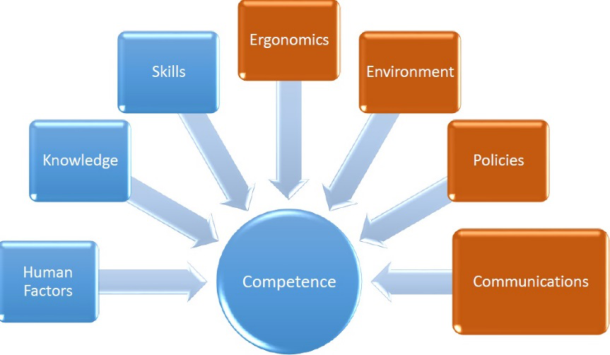
Figure 1 displays the components of competencies as depicted by Pye Tait firm (2014). Individual components expressed consist of skills related to an individual’s job, knowledge and behaviours such as risk awareness, perso- nal attributes and communication skills. As depicted in the chart, certain competency components are related to management, such as policies imple- mentation and effective communication, although they can be relevant to everyone in an organisation.
In delivering their essential services within the construction industry, Managers must master the specialised two facets of Project Management. These facets are described by Dinsmore and Cabanis-Brewin (2006) as the ‘art’ and ‘science’ of ‘project management. Only by combining the two areas of competence can efficient and effective management be delivered for con- struction projects. The art of project management includes trust, values, integrity, effective communication, sound decision making, staff develo- pment, sound business judgements, problem-solving, conflict management, flexibility, training, mentoring, consultations, good business judgements, and managing change and expectations. While the science of project management includes risk management, proper planning, resource estimation and manage- ment, status reporting, financial planning, and quality control (Dinsmore and Cabanis-Brewin, 2006). Hence competence in construction project manage- ment can be demonstrated in four dimensions knowledge, skills, personal traits, and experience (Anderson et al., 2006).
Pathirage, Amaratunga and Haigh (2008) explain that knowledge can be divided into personal knowledge, knowledge shared with others, practical, experiential, and theoretical knowledge. For all project managers, knowledge does not just entail planning and monitoring projects; they have to be kno- wledgeable in their specific field, engineering, construction, or marketing. They must put their legal, financial, strategic resources and technological expertise, as well as business acumen in their specific field, to good use. Project Management, especially in construction, requires specific analytic, accounting, and quality control knowledge to successfully complete projects (Gustafsson and Yadav, 2013).
As a professional practice of project managers, communication requires appropriate rules and tools to ensure that the information being conve- yed is as useful as possible. Effective communication skills are important
Core Competencies Required for Construction Project Success 325
Figure 1: Components of competencies (adapted from Pye Tait firm, 2014).
because information flow is an important activity that leads to project success (Anyanwu, 2013). All stakeholders must understand all information and instructions about the project. Human interaction can make or break a con- struction project if communication is ineffective (Goldsmith and Newton, 2011). Misunderstandings of conveyed information may often lead to qua- lity issues which is usually a strong part of project objectives. Hence lack of or even inadequacy in communication flow can lead to project failure (Schultz, 2012).
Furthermore, frequent miscommunication and inadequate knowledge can be huge sources of conflicts and problems in construction projects. The ability to solve problems is an essential aspect of project management (Anderson et al., 2006). However, When a problem cannot be solved, project stakeholders may have to engage in negotiations to reach an amicable agree- ment. Hence negotiation is another vital component of project management (Chebet, Rotich and Kurgat, 2015). Since an individual cannot complete a construction project, there is bound to be conflict. Teams of people from different backgrounds, beliefs, and skillsets must work together to meet the project’s quality standards while adhering to budget and schedule con- straints. However, conflicts will inevitably arise, jeopardising the projects’ success (Ogunbayo, 2013). Conflict resolution is a crucial function in project management.
Education and experience are well regarded in every industry for pro- ject managers, and the construction industry is no exception. Nkomo and Thwala (2016) described the construction industry as extremely busy with a complicated scope of works. Due to its complexity, project managers need to have the proper education and exeperience necessary to succes- sfully manage a construction project to completion and fulfil all its objectives (Buvik and Rolfsen, 2015).
Similarly, many personality traits are essential characteristics for pro- ject management personnel. Professionalism, enthusiasm, commitment and
326 Akinshipe
determination are characteristics that project managers should possess as they are supposed to be role models. Project managers are supposed to lead the whole project team. Ambitious and confident individuals are most likely to lead projects successfully as they can see decisions through and control arising circumstances (Gustaffson and Yadav, 2013).
According to Poskey (2006), success in a work environment depends highly on the capabilities of the human resources and their interpersonal relationships. Team members are not just chosen based on their qualifica- tions and experience; their “soft” skills, or “transversal competencies,” are also considered. Emotional intelligence and social management skills are also essential components of project management, especially in the con- struction industry. Construction projects’ complexity and multidisciplinary nature necessitate a high level of emotional intelligence and social skills for a project manager. Managing and satisfying all stakeholders expectations is not an easy task; hence a project manager needs the utmost emotional maturity (Anyanwu, 2013).
In all industries, one characteristic of professionals is to always act with professionalism. Campbell and Taylor (2008) see professionals as trustwor- thy, competent, respectful, considerate, dependable and committed. Further- more, professionalism often describes the workplace’s behaviour style, which is influenced by values and professional roles. Sirbegovic (2009) believes that practising professionalism involves punctuality, dressing appropriately, careful consideration of words uttered, offering assistance when required, refraining from gossip, staying positive, acknowledging mistakes, and always being fair to colleagues. Professionalism does not necessarily mean a project manager can successfully get the job done; however, it influences the ability to effectively and efficiently do the work, thereby enhancing project success.
When knowledge has been applied to practice over time, thereby enha- ncing an individual’s skills, experience is gained. Consequently, experience also increases knowledge and skill (Dinsmore and Cabanis-Brewin, 2006). The more valid experience a project manager possesses, the more efficiency is applied to managing the project.
RESEARCH DESIGN This study’s theoretical review has extensively discussed how a project mana- ger’s knowledge, skills, experience and personal traits can be beneficial or detrimental to the success of a construction project. This study investigates the core competencies necessary for successfully completing a construction project. This research was streamlined into a descriptive study, and thus, the survey method was deemed appropriate for collecting the primary data. The research adopted a quantitative model, and a five-point Likert scale structu- red questionnaire was designed and used as the medium of collecting primary data with the sole purpose of achieving the aim of the study. This research was conducted in the Gauteng Province of South Africa through a survey of construction professionals. Data collected and collated from the survey were deemed usable and formed the basis of data analysis for the study. To deter- mine the level of importance of each rated factor, the five-point scale from the
Core Competencies Required for Construction Project Success 327
Table 1. Management competencies required for construction project success.
questionnaire was converted into a Relative Importance Index (RII) for each of the rated factors. The collated data were tested to check its reliability with the aid of Cronbach’s alpha test. They returned a value of 0.980, indicating that the collected data set is very reliable and fit for use for this study.
FINDINGS AND DISCUSSION Background data collected for this study revealed that all participants are professionals within the construction industry, with most of them being pro- ject managers. Other participants are built environment professionals that have been engaged as project managers in the construction industry. Most of the participants possess between two and ten years of experience in the industry, while a few had above ten years of experience. The engagement sector amongst participants is evenly distributed between the public and pri- vate sectors, with a significant number of them working in both sectors. The slightly even distribution of the respondents speaks to the reliability of this research.
The extracted factors share a common link to effective and efficient pro- ject management. Although all projects are unique and all have challenges, effective management competencies can serve as a means to navigate through those inherent challenges. Results revealed that all the 22 core competencies addressed in this study are critical. The core compentencies can be clas- sified into two categories in a different vein. The first relates to personal
328 Akinshipe
traits and includes innovative thinking, problem-solving skills, dependabi- lity, emotional maturity and control, confidence, creative thinking, effective communication, flexibility, strong emotional intelligence, self-motivation, diplomacy, and time management skills. At the same time, the second cate- gory relates to managerial traits. It includes effective teamwork management, quality control, professionalism, effective mentoring skills, organisational skills, adaptability to changes, ability to manage stakeholders expectations, negotiation skills, conflict management, and sound decision making. Finally, the empirical and theoretical findings agree that effective project manage- ment skills are essential for all construction professionals and managerial competence is vital to project success.
CONCLUSION
Projects are characterised by four features: a group of people, an objective, limited time, finances, and uncertainty regarding whether the goals will be achieved. Effective project management skills are essential for all construction professionals. Hence the need to understand the basic project management competencies. Survey results were used to develop a relative importance index. Findings from the study revealed that innovative thinking, problem- solving skills, dependability, emotional maturity and control, confidence are vital traits required from project stakeholders to ensure successful completion of projects. The study classified the identified competencies into two cate- gories relating to personality traits and managerial traits. It was, therefore, concluded specific competencies must be inherent in project team members and management for a project to reach successful completion.
REFERENCES
Akinshipe, O. Aigbavboa, C. Thwala, W.D. Mutshaeni M. (2019) Premature project closure: the role of consultants and contractors In: Laryea, S. and Essah, E. (Eds) Procs West Africa Built Environment Research (WABER) Conference, 5–7 August 2019, Accra, Ghana, 808–817. Anderson, J. Huhn, M. Rivera, D. Susong, M. (2006) Phases of the construction
project. Klinger, M. and Susong, M (red.). Construction Project: Phases, People, Terms, Paperwork, Processes, 4–40; Chicago: American Bar Association. Anyanwu, C.I. (2013) The Role of Building Construction Project Team Members in Building Projects Delivery. Journal of Business and Management, 14(1), pp. 30–34. Buvik, M.P. Rolfsen, M. (2015) Prior ties and trust development in project teams–
A case study from the construction industry. International journal of project management, 33(7):1484–1494. Campbell, S.L. Taylor, D.D. (2008) Professionalism in the workplace. Chebet, W.T. Rotich, J.K. (2015) Negotiation skills: keys to business excellence in the 21 st century? European Journal of Research and Reflection in Management Sciences, 3(3). Dinsmore, P.C. and Cabanis-Brewin, J. (2006). The AMA handbook of project
management. AMACOM Division American Management Assosiation.
Core Competencies Required for Construction Project Success 329
Goldsmith, R. Newton, S. (2011) What do communication skills mean in the Construction discipline? Journal of Academic Language and Learning, 5(5), pp. A158–A168. Gustafsson, B. Yadav, B. (2013) Closing IT projects: A Swedish public sector
perspective. Havila, V. Medlin, C.J. Salmi, A. (2013) Project-ending competence in premature project closures. International journal of project management, 31(1):90–99. Nkomo, M.W. Thwala, D.W. (2016). Impotance of Effective Mentoring of Constru-
ction Graduates In The South African Construction Industry. ICSR 2016–SERBIA. Ogunbayo, O. (2013) Conflict management in Nigerian construction industry: project managers’ view. Journal of Emerging Trends in Economics and Management Sciences, 4(2), p. 140. Pathirage, C. Amaratunga D. Haigh, P.R. (2005) Knowledge management rese-
arch within the built environment: Research methodological perspectives. 5th International Postgraduate Conference in the Built and Human Environment. Salford, UK. Pye Tait Firm (2014) Competence in construction. Poskey, M. (2006) The Importance of Emotional Intelligence in the Workplace, Why It Matters More than Personality. Retrieved April, 17. Schultz, C.S. (2012) The role of problem solving in construction management
practices. In Proceedings of the 28th Annual ARCOM Conference. Sirbegovic, D. (2008) Professionalism in the Workplace. Vincent, L. (2008) Differentiating competence, capability and capacity. Innovating Perspectives, 16(3).
LISTED IN THE AHFE DIGITAL BOOKSTORE CATALOGUE
Explore the complete digital volume
Human Factors in Architecture, Sustainable Urban Planning and Infrastructure
Read this individual research paper free through the original publisher, or explore the full digital proceedings book.
ISBN 978-1-958651-34-6
Explore this ISBN in the AHFE Bookstore ↗Listed in the July 2026 bookstore catalogue; search by ISBN to confirm current availability · Digital book purchase optional