Marcela De Obaldia, Fabiola Cortes Chavez, Alberto Rossa-Sierra, Mariel Garcia-Hernandez (2022). The importance of the adobe brick for a sustainable architecture in Mexico. In: Human Factors in Architecture, Sustainable Urban Planning and Infrastructure. AHFE Open Access, vol. 58, pp. 79–84. https://doi.org/10.54941/ahfe1002336
1 Facultad de Ingeniería, Universidad Panamericana, Alvaro Portillo 49, 45010, Jalisco Mexico ↗
2 Universidad de Monterrey, Universidad de Monterrey, Av. Ignacio Morones Prieto 4500 Poniente, Col. Jesús M. Garza, San Pedro Garza García, 66238, Nuevo León México ↗
For many years, humans have being using the resources of the planet to create a more comfortable way of living without thinking the consequencues. Construction is considered to be one of the areas that generates great impact to the environment.Today, one of the biggest concerns is caring for the environment based on all the premises that sustainability recomends.Since humans became sedentary many great cities have been built with materials like adobe (soil and water) and today are still standing as a clear evidence of durability.In Mexico, adobe is a hardly used material that due to its composition and elaboration process is considered sustainable and should be considered important to analyze its past to propose how to bring the use of this material to the present needs
Sustainable development is a term created in 1987 by the United Nation’s commission in a document called “Our Common Future”. This document was created because the way humans have lived through the years, with the intentions of improving quality of life, have affected the balance and existe- nce of all other species and the resources that have allowed them for so many years. Now, these man’s actions are the main cause for environmental pol- lution. Pollution that happens in the air that one breath, the water that one drink and the earth from which one obtains food and a shelter to live.
Thus, sustainable development is defined as the “development that meets the needs of the present without compromising the ability of future generati- ons to meet their own needs.” (UNESCO, no date).
In order to achieve a sustainable development, one must consider not only the environment, but also society and economy, which all three toge- ther represent the pillars that will help measure the success of sustainable development. Therefore, it is important to understand each one of them.
1. The environmental pillar is when all human actions must be done taking in consideration the environmental preservation and the natural resources receive the least impact possible. 2. The social pillar is when all human actions must be done taking in con- sideration the society needs to achieve wellbeing and harmony: health, work, security, cultural identity, gender equality. 3. The economical pillar is when all human actions must be done taking in consideration that profit happen in equal ways to all the parts involved in the company, and could contribute at a larger scale to reach society wealth. (MENOM, no date) If Social and environmental pillars happen together it will create bearable circumstances, if social and economic pillars happen then it creates equita- ble circumstances and if environmental and economic sustainability happens then viable circumstances happen. Only if social, environmental and econo- mical pillars happen at once then sustainable circumstances happen. (Jagran Josh, 2019).
Every activity that humans develop represents at the same time an impact, big or small, to the environment because resources will always be needed, which makes important not only to know all these concepts but also to cre- ate awareness of the situation the world is actually living as society and the damage it is causing to the environment in order to be able to be part of the solution.
One of the sectors that is considered to generate the greatest environmental pollution is construction industry which is why it makes it an area of inte- rest to propose improvements that contribute, mainly, to the environment preservation. (Jannik, 2014).
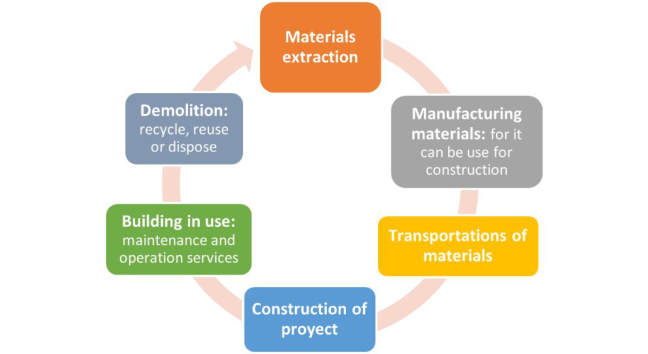
Environmental Impact of Construction Construction is the materialization of a building’s life cycle, that starts with the materials needed to build the project and it involves extraction, manufa- cturing and transportation of the materials. Then the construction process, operation of the building until reaching the demolition stage. (Figure 1).
In a greater or lesser degree, environmental pollution has been happe- ning at any of the building life cycle phases, making the construction sector responsible for more than 50% of polluting emissions in the world. (Arch- desk, 2021) This makes construction sector a very vast area of study to apply the concept of sustainable development an propose solutions. Accor- ding to the World Watch Institute, construction sector consumes 40% of the of the world’s raw stones, gravel and sand, and 20% of virgin wood per year. (Archdesk, 2021).
Actually, the most used material in construction is cement because it pre- sents attributes highly valued by today’s architecture design tendencies, like plasticity that allows to create any type of shape, texture and color, structural strength that allows diversity in forms, heights and gap between beams and durability that provides a clean and timeless image.
The Importance of the Adobe Brick for a Sustainable Architecture in Mexico 81
Figure 1: Graphic of building lifecycle.
Unfortunately, the cement elaboration process makes it a material that is part of the 50% of the pollution produced by construction sector. Therefore, is a material that does not accomplish sustainable development.
For this reason, a good contribution to sustainable development would be to consider solutions that propose the use of other types of materials. One way to find possible solutions is to considered what architect Michel Lewis once said “when it is claimed that the past was better than the present or that the current time overcomes to the past, there is a risk of being left out of progress. But if the lessons of yesteryear are taken up with creativity to transform them into sustainable ideas, then, it evolves.” (Real State, Market and Lifestyle, 2010) In other words, by taking a look in to the past and analyze how things were build one can find options of materials that are worth being rescued, like adobe bricks, and adapt them to present needs.
Adobe Brick Values Found Through History The use of adobe dates back to ancient times under different climates and cultural conditions. Evidence found show that different cultures settled in different parts of the world like Egyptians in Africa, Mesopotamians in Asia or Pre Hispanic in America had widely used adobe to build their cities. From simple houses to majestic temples or castles. (Referente, 2015) Specifically in Mexico, adobe has been used since the oldest evidence found belong to Olmec culture dated between 1200 and 900 B. C. and continued to be used and evolved until the colonial period with the Spaniards occupation. (Serrano, 2020). Like cement, adobe also presents the attribute of plasticity, which allows the use of different techniques to work this material being the most common one to shape adobe in bricks.
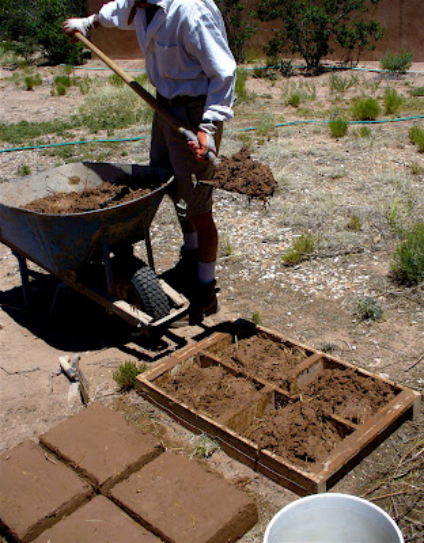
Traditionally speaking, the adobe brick is made from the soil found in the construction site that once is mix with water forms mud. Then the mud is molded and dried in the sun. (Figure 2) Sometimes natural fibers, like straw,
Figure 2: ARKIPLUS (n.d.). Molding adobe bricks [online]. Available at: https://www.ar kiplus.com/bloques-de-adobe/ (accessed 22 February 2022).
is added. Since bricks are made from the soil found in the site, the composition can vary but on average it’s been found that is 10 to 15% clay, 10 to 15% silt and 70 to 80% sand with 25 to 30% of water. (Diamil, 2015).
Its elaboration process emerges empirically according to the culture, the location, the resources had at hand and what it was needed to be built. In other words, it is an intuitive process that the knowledge of it happens from generation to generation as family job. Thus, there is very little documented information on the process despite it is as important as the materials used to make the brick. (Goyeneche, 2011).
No matter what technique is used to build with adobe, it will always pre- sent several qualities that later will be related to sustainable development: (Salas, 2012).
Thermal capacity because adobe brick works as a temperature regula- tor keep fresh inside with hot outside and keeping warm inside when cold outside.
Acoustic behavior because it works as a low sound transmission. Low cost because the materials required and abundant and easily obtained at any region so no special or long-distance transportation are required. Also, because its elaboration process does not require special machines it can be made by hand.
Self-construction because any one can learn how to make adobe bricks and there is no special equipment or machines required to do so.
The Importance of the Adobe Brick for a Sustainable Architecture in Mexico 83
Low impact material which will be discussed in detail as part of the conclusions of this article.
Having so many qualities in building with adobe bricks, one wonders why adobe bricks are no longer used and the main reason is that adobe bricks present a vulnerability to water and low structural strength which limits the possibility of tall or bis scale buildings. It is important to acknowledge this disadvantage in the attempt to rescue the use of adobe bricks it will be a subject of investigation that so far is not the intention of this article.
CONCLUSION
So far it has been mentioned the importance of sustainable development, the environmental impact of construction and the importance of adobe bricks as a building material. Relating the life cycle of a building with adobe bricks and the three pillars of sustainable development to show that adobe brick is a sustainable material worth of study to rescue from the past and to take in considerations for actual constructions.
In the extractions of raw materials was mentioned before that adobe bri- cks are made with clay, silt, sand and natural fibers. These are materials that can easily be obtained at any place one decides to build. Since these are abun- dant materials, there is no excessive exploitation of non-renewable resources. These actions help with the environment care.
In addition, being materials from the region makes it a low-cost mate- rial, which contributes to the economic pillar and can contribute to cultural identity and social pillar as well.
In manufacturing adobe bricks, it is only required the use of human force and renewable energies (sunlight) so no pollution is generated and again, it is economical sustainable because of its low-cost process. Also, it is a technique that can easily be learned, adopted an integrated by society.
No special transportation will be needed to provide neither raw mate- rial or adobe bricks to the construction site avoiding gas emissions, son the environment is being cared.
The use of adobe bricks in the process of construction does not affect sustainable development. Because no special adhesives nor special equipment or machinery is required to build with adobe. However, it is perhaps the lifecycle stage in which it will be necessary to apply more research to succes- sfully promote the evolutions of adobe bricks towards present and future architecture.
Once the building is operating the sustainable analysis is taking in con- siderations its thermal and sound qualities. The first one avoids the use of artificial climates like air conditioning or heating that produce emissions of greenhouse gases. Even though adobe maintenance it has to be done more often that other materials but still does not generate pollution and it is low- cost which it is economically accessible to any person and easily becomes part of cultural identity of the region.
Finally, the demolition of a building it is still is sustainable, since being a brick made with natural materials can be easily recycle or reuse without causing environmental pollution.
Despite all the advantages that adobe has given for so many years and through so many civilizations today is a material that is hardly used because with the appearance of new material like cement adobe bricks became an image of rustic and austere So far, the information gathered shows that adobe bricks fit 100% in the three pillars of sustainable development but its structural strength requires more attention in being researched in order to improve its resistance enough to achieve cutting-edge works in design and with resistance for low-rise buildings and thus prevail sustainable constructions for many years.
REFERENCES
Amazon Registrar, Inc. (2021). ARCHDESK [online]. Available from: https://archdesk.com/es/blog/como-afecta-la-construccion-al-medio-ambiente/ [accessed 16 February 2022] Djamil Benghida. (2015). Adobe Bricks: The Best Eco-Friendly Building Material.
Advanced Materials Research. Vol. 1105. 386-390. Available from: Scientific Net. [accessed 12 January 2021] Google LLC. (2011). Blogspot [online]. Available from: http://arqalexg.blogspot.co m/2011/10/el-adobe.html [accessed 12 December 2021] Google LLC. (2012). Blogspot [online]. Available from: http://arquetipounah.blogsp
ot.com/2012/05/el-adobe.html [accessed 12 December 2021] Inversiones Plataforma Networks Ltda. (2020). Archdaily [online]. Available from: https://www.archdaily.mx/mx/944575/adobe-el-material-reciclable-mas-s ostenible/ [accessed 15 December 2021] Jannik Giesekam, John Barrett, Peter Taylor, Anne Owen. (2014) The greenhouse
gas emissions and mitigation options for materials used in UK construction. Jour- nal Elsevier, Energy and Buildings. 78. 202-214. Available from: Science Direct. [accessed 12 January 2021] Juan Medina Karo. (2015) Referente [online]. Available from: https://referente.mx/@ Sarahi/arquitectura-de-tierra-riqueza-tradicion-sustentable-y-comunidad [acces- sed 10 January 2021] M ENOM, INC. eNom, LLC. (No date). My Waste [online]. Available from: https://meuresiduo.com/en/blog-en/understand-the-three-pillars-of-sustai nability/ [accessed 12 February 2022] M ENOM, INC. eNom, LLC. (2010). Real Estate, Market and Lifestyle [online].
Available from: https://realestatemarket.com.mx/articulos/materiales-de-la-indus tria/11295-construccion-con-adobe-en-siglo-xxi [accessed 11 February 2021] MMI Online Limited. (2019). Jagran Josh: Complete Career Guide for School, College and Job Finder [online]. Available from: https://www.jagranjosh.com/gen eral-knowledge/sustainable-development-background-definition-pillars-and-obj ectives-1446807134-1 [accessed 12 February 2022] Serrano Barquín, H. P., Ruiz Serrano, M., Zarza, M., Ruiz Serrano, E., Ser-
rano Barquín, C., & Estrada Olivella, R. (2020). El adobe. Su tradición sim- bólica y arquitectónica en el Estado de México. Ciudad de México: Ediciones y Gráficos Eón, SA de CV. Available from: Repositorio Institucional UAEM. [accessed 14 February 2022] U.N.E.S.C.O (No date). UNESCO [online]. Available from: https://en.u nesco.org/themes/education-sustainable-development/what-is-esd/sd#:~: text=Sustainable%20development%20is%20the%20overarching,to%20mee t%20their%20own%20needs.%E2%80%9D [accessed 14 February 2022]
LISTED IN THE AHFE DIGITAL BOOKSTORE CATALOGUE
Explore the complete digital volume
Human Factors in Architecture, Sustainable Urban Planning and Infrastructure
Read this individual research paper free through the original publisher, or explore the full digital proceedings book.
ISBN 978-1-958651-34-6
Explore this ISBN in the AHFE Bookstore ↗Listed in the July 2026 bookstore catalogue; search by ISBN to confirm current availability · Digital book purchase optional