Alberto Rossa-Sierra, Fabiola Cortes Chavez, Marcela De Obaldia, Mariel Garcia-Hernandez (2022). Food packaging design that help reduce consumer-generated waste. In: Ergonomics In Design. AHFE Open Access, vol. 47, pp. 241–247. https://doi.org/10.54941/ahfe1001942
Estimations affirm that by 2030 there will be 9 billion people on our planet, which makes the problem of food a priority issue. A large part of the food, especially in industrialized countries, is packaged, either fresh produce from the field (fruits and vegetables) or cooked products, many of them in the ready-to-take mode.The recent COVID-19 pandemic increased the consumption of food prepared for home delivery, causing more waste in municipal landfills. In countries like Spain, takeaway fast food services have increased during the pandemic by 83% compared to 2019, already representing 3% of the shopping basket, which indicates that spending on this appearance has doubled.The Starpack Competition organized by the Institute of Materials, Minerals, and Mines of England used this problem as a theme for its contest in 2021. The students of the "Molds and production in plastics" course of Engineering in Innovation and Design at Universidad Panamericana in Mexico participated in the contest, obtaining outstanding positions in the awards.This communication shows the results obtained. We explain six design projects, who received prizes in the contest. The projects include a container for take-out tacos, a dehydrator container for fruits and vegetables, a Multi-purpose container for foods such as salads, sushi, hamburgers, etc., a container for scones, and finally, a container for fresh potatoes.All the proposals presented were made with recycled or recyclable plastic materials, thinking about the circular economy, the possibility of being re-used, and the reduction to a minimum of waste and the manufacturing process. The intervention of the human factor was taken into account during the design process, considering the physical and psychological aspects in the design of the packaging projects.
Worldwide, the market for food delivery stood at €83 billion in 2016, before the COVID pandemic period. (Hirschberg, 2016). In the USA, for example, food prepared away from home accounted for over 50% of total food expen- diture in 2018. (Keeble, 2020). Some data confirm the growing worldwide trend of this sector with revenue that stands, in 2020, at US$136,431 m, of which US$70,741 m is attributable to the platform-to-consumer delivery segment; a value that should reach US$182,327 in 2024. (Galati, 2020).
During the quarantine period, online grocery shopping and food delivery increase while the store visits decrease. According to market research made by McKinsey and Company in October 2020, customers purchasing online in the “Food takeout and delivery” category has grown by 15–29% in the USA, Italy, and Japan. As of May 31, 16% of respondents in Germany and 19% in the UK stated that they had preferred restaurant delivery/takeaway online instead of offline shopping (Ahuja, 2021).
For example, during the pandemic, home sales of the Mexican restaurant operator Alsea, owner of brands in Mexico Starbucks, Domino’s Pizza, and Vips, grew 143% in 2020 compared to 2019 and accounted for more than 24% of total sales. According to reports, the delivery share of Alsea Mexico’s sales reached 24%, representing a growth of 42% in the third quarter, com- pared to the same period in 2019, but had an increase of 143% in comparison year to year. (Noguez, 2021).
The increase in home sales leads hand in hand to the increased use of con- tainers and containers for such deliveries. In most of these deliveries, the containers are made of plastic; it is estimated that 80% of these materials are plastics (Song, 2017). Which has a significant impact on sustainability. Although there are no detailed studies about the effect on the volume of con- tainers generated by the increase in sales, some authors have conducted local studies. For example, Beijing reports that the sale of food at home ordered online (Food delivery), produce 0.1185 kgs of solid waste and 0.68 kg CO2 eq/kg Global Warming Potential (GWP) from each order and that the manu- facturing and disposal of packaging, accounted for 45% and 50% of the total environmental impact, respectively (Li, 2020).
In line with this growth in the use of materials, the Starpack competition organized by the UK Institute for Materials, Minerals, and Mines used this growing problem as a theme for its competition in 2021. The theme proposed was the Packaging design to help reduce consumer food waste.
Students of the course of “Molds and production in plastics” of Enginee- ring in Innovation and Design (IID) of the Universidad Panamericana, Cam- pus Guadalajara in Mexico, participated in the contest, obtaining interesting results that the judges recognized as honorable mentions and winners.
DESIGN PROPOSALS Once the organization established the contest bases, an analysis of the pro- blems posed was made, developing the design proposals individually. Some students used the local food type (Tacos, for example). In contrast, others preferred to investigate fast food eating habits in the UK. The solutions pro- posed are very varied, which will be described together with the image of the developed packaging.
1. Dehydrating container
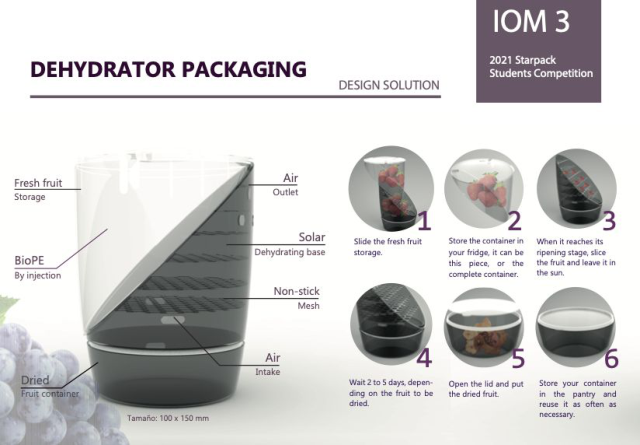
This container is manufactured in BioPE by injection molding. It consists of a container for fruits and vegetables, which is also able to contain said fruits and separate the container part to place it in the freezer. The rest of the con- tainer serves as a solar dryer to take advantage of all the fruit, especially when
Food Packaging Design that Reduce Consumer-Generated Waste 243
Figure 1: Dehydrator packaging proposal. Design: Ana Shopie Castillo, 2021.
it begins to lose its color or texture and avoid its waste. The dark container is left in the sun for 2 to 5 days, depending on the type of fruit or vegetable in question; it has small vents that allow moisture release. At the bottom is a container with a lid to store dehydrated fruit. This participation earned a silver prize in the competition. The jury commented on the proposal: Excel- lent presentation and graphics with a clear design and development process. The concept is somewhat over engineered as packaging solution (Figure 1).
2. Tacos to Go As you can well imagine, one of Mexico’s most significant food products is the “tacos”, which are always accompanied by supplements such as different sauces, onions, lemons, etc., which means that for this type of food, always used too many containers or bags for tacos and supplements.
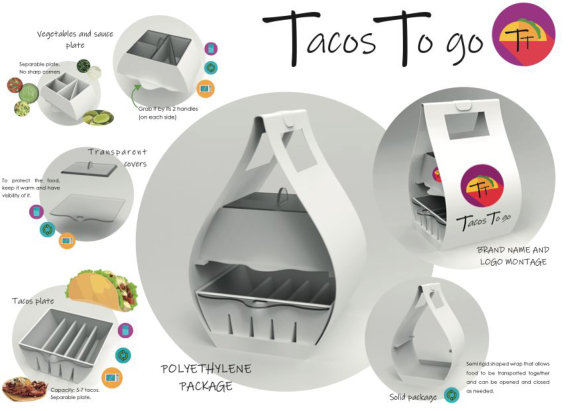
The student Brenda Rivero developed the proposal “Tacos to Go,” which consists of a reusable container of different spaces for a personal order of tacos (5 to 7 tacos) transported in a special tray with its respective lid. Addi- tionally, the container has a container developed to place the different types of salsa (up to 2 varieties) and the additional complements mentioned above. The containers are stored in a semi-rigid container that allows transport them together. Obviously, all containers can be washed to be reused. The jury issued the following comment: Excellent research and presentation with a very strong development process. Consider recyclability/end of life scenario and perhaps reducing the amount of packaging (Figure 2).
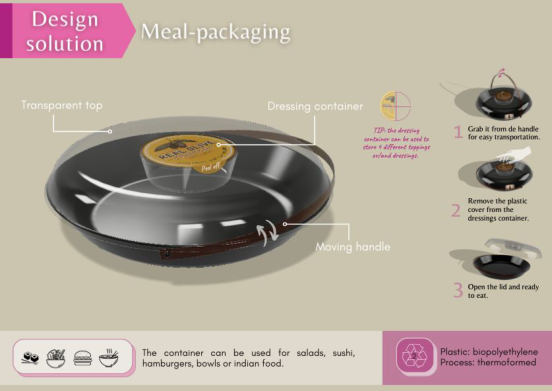
3. Generic meal packaging The design presented is a round container. It can be used to contain salads, sushi, hamburgers, or oriental food. It consists of a container formed by two parts, a bowl, and lid, manufactured in BioPE by thermoforming. The cover has a space in the center to place dressings or sauces. The container has a
Figure 2: Tacos to Go packaging proposal. Design: Brenda Rivero, 2021.Figure 3: Generic meal packaging. Design: Magaly Rentería 2021.
handle that allows its transportation. The judges opinion was: Well presented proposal with good market insights. The presentation is a little oversimpli- fied, and the concept is similar to existing solutions. This design proposal won an honorary mention (Figure 3).
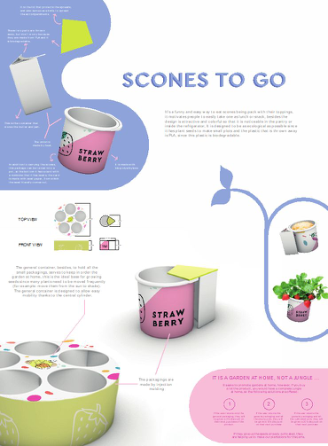
4. Scones to Go One of the proposals that were based on specific UK food is the one pre- sented below. Scones are individual round-shaped muffins, typical of UK cuisine, and originate from Scotland. It is a widespread food in breakfasts and lunches. The idea presented consists of a container made of PLA (poly- lactic acid), which is a bioplastic. Once fulfilled its function as a container, it
Food Packaging Design that Reduce Consumer-Generated Waste 245
Figure 4a: Scones to Go. Design: María Massú, 2021.Figure 4b: Plant-E. Design: Mariana Brun, 2021.
is transformed into a pot, as it is accompanied by seeds that can be grown to have a small garden at home. This proposal received the mention of highly commended (Figure 4a).
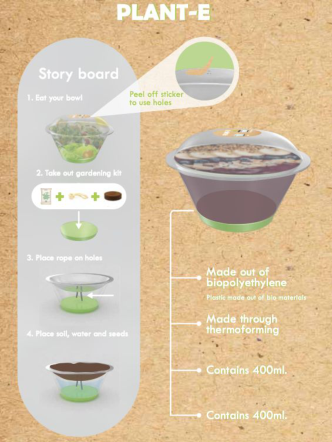
5. Plant-E The packaging consists of 3 pieces, which can be used to contain salads and other types of food. The container is made with BioPE by thermoforming. Once its function is finished, the lid is turned over and drilled to pass a small
Figure 5: Potato Shelf Life. Design: María José Aguilera, 2021.
rope to keep the soil moist placed on the cover, which will serve as a pot and create small gardens at home. The design proposal was highly commen- ded. The judges commented: Well presented with good research. It would have been interesting to see more of the design and development process (Figure 4b).
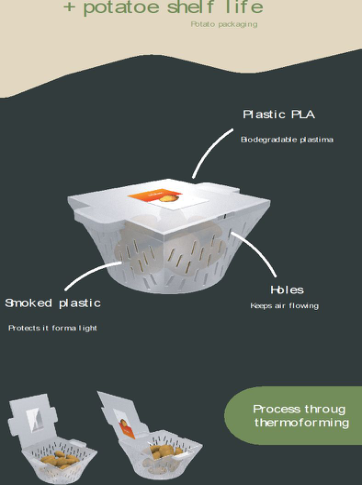
6. Potato Shelf Life The last proposal presented that earned an honorary motion is the design of a container for fresh potatoes. This container is manufactured in PLA (polylactic acid) by thermoforming. The package can contain up to a kg of potatoes; the color of the plastic container is smoked with the intention that the sun does not affect vegetables. It has holes for the vegetables to breathe and closes with the integrated lid to allow the storage of more containers. The comment of the judges is similar to the previous proposal: Well presented with good research. It would have been interesting to see more of the design and development process (Figure 5).
CONCLUSION
The proposals presented here are only a part of the designs made to attend the contest. Students attend to these challenges with great attention since, in addition to having design challenges similar to those they will encounter in professional life. They can make proposals from the point of view of sustai- nability, which is a topic of great interest to young students. As professionals of the design, to attend this type of problem and to be able to contribute some kind of solution from our profession is very enriching; the students partici- pate with great interest and facilitate the understanding of the contents of
Food Packaging Design that Reduce Consumer-Generated Waste 247
the subject that could be very technical and unattractive to them. We have been developing this exercise for six years. Due to the results obtained, we will continue to participate in this type of contest.
ACKNOWLEDGMENT
The authors would like to acknowledge the participating students for their enthusiastic participation in the contest. (Group “Molds and Plastic Pro- duction” 2021, Facultad de Ingeniería, Universidad Panamericana, Campus Guadalajara).
REFERENCES
Ahuja, K. (2021). Ordering in: The rapid evolution of food delivery. McKinsey & Company. Available at: https://www.mckinsey.com/industries/technology-media- and-telecommunications/our-insights/ordering-in-the-rapid-evolution-of-food- delivery (Accessed: 22 Feb 2022) Galati, A., Crescimanno, M., Vrontis, D. and Siggia, D. (2020), “Contribution to the
Sustainability Challenges of the Food-Delivery Sector: Finding from the Deliveroo Italy Case Study”, Sustainability, MDPI AG, Vol. 12 No. 17, p. 7045. Hirschberg, C. (2016). The changing market for food delivery. McKinsey & Company. Available at: https://www.mckinsey.com/industries/technology-media- and-telecommunications/our-insights/the-changing-market-for-food-delivery (Accessed: 22 Feb 2022) Noguez, R. (2021). Confinamiento impulsa 143% las ventas a domicilio de Alsea en
2020. Forbes México. Available at: https://www.forbes.com.mx/negocios-alsea- ventas-domicilio-2020/ (Accessed: 22 Feb 2022) Keeble, M., Adams, J., Sacks, G., Vanderlee, L., White, C.M., Hammond, D.
and Burgoine, T. (2020), “Use of Online Food Delivery Services to Order Food Prepared Away-From-Home and Associated Sociodemographic Characteristics: A Cross-Sectional, Multi-Country Analysis”, International Journal of Environ- mental Research and Public Health, MDPI AG, Vol. 17 No. 14, p. 5190. Leal, W., Voronova, V., Kloga, M., Paço, A., Minhas, A., Lange, A., Dias, C., Sivapalan, S. (2021), “COVID-19 and waste production in households: A trend analysis”, Science of The Total Environment, Elsevier, Vol. 777, 145997. Li, C., Mirosa, M. and Bremer, P. (2020), “Review of Online Food Delivery Platforms
and their Impacts on Sustainability”, Sustainability, MDPI AG, Vol. 12 No. 14, p. 5528. Song, G., Zhang, H., Duan, H., & Xu, M. (2018). Packaging waste from food delivery in China’s mega cities. Resources, Conservation and Recycling, Elsevier. Vol. 130, p. 226–227.
LISTED IN THE AHFE DIGITAL BOOKSTORE CATALOGUE
Explore the complete digital volume
Ergonomics In Design
Read this individual research paper free through the original publisher, or explore the full digital proceedings book.
ISBN 978-1-958651-23-0
Explore this ISBN in the AHFE Bookstore ↗Listed in the July 2026 bookstore catalogue; search by ISBN to confirm current availability · Digital book purchase optional