Fabiola Cortes-Chavez, Mariel Garcia-Hernandez, Elvia Luz Gonzalez Muñoz, Gabriela Duran-Aguilar, Alberto Rossa-Sierra (2026). Human-Centered Design: A Playful Tool for Teaching HCD in the Design Process. In: Human Interaction and Emerging Technologies (IHIET-FS 2026): Future Systems and Design Applications. AHFE Open Access, vol. 235, pp. 93–99. https://doi.org/10.54941/ahfe1007264
1 Universidad Panamericana, Facultad de Ingeniería, Álvaro del Portillo 49, Zapopan Jalisco, 45010, México ↗
2 Universidad de Monterrey, Av. Ignacio Morones Prieto 4500-Poniente, Zona Valle Poniente, 66238, San Pedro Garza García, Nuevo León, México ↗
3 Centro de Investigaciones en Ergonomía. Universidad de Guadalajara, Calzada Independencia Norte 5075, Huentitán El Bajo 44300, Guadalajara, Jalisco, México ↗
4 Universidad Panamericana, Facultad de Ingeniería, Jose María Escrivá de Balaguer 101 Villas Bonaterra, Aguascalientes, 20296, México ↗
Human-Centered Design (HCD) has become a key paradigm in contemporary product development, emphasizing empathy with users, contextual understanding, and evidence-based decision-making. Despite its relevance in professional design practice, integrating HCD principles effectively into design and engineering education remains challenging. Students frequently rely on intuition, aesthetic preferences, or assumptions rather than research-based reasoning when defining product characteristics.This paper presents a pedagogical methodology designed to strengthen the integration of Human-Centered Design principles within product design education through a gamified learning strategy. The proposed method introduces a coin-based questioning system implemented during the conceptual development phase of the design process, when students present prototypes derived from their design research.The methodology organizes structured critique sessions in which design teams present their proposals and justify design decisions using research evidence. Peer teams challenge these proposals through a structured questioning process consisting of contextual verification questions and a critical “coin question” designed to evaluate the coherence between research insights and design decisions.Inspired by Socratic questioning, the dynamic encourages students to identify inconsistencies in their reasoning and refine their design proposals iteratively. The methodology has been implemented for more than fifteen years in undergraduate courses in industrial design and product design engineering. Qualitative observations from classroom implementation indicate that the approach enhances students’ ability to justify design decisions, strengthens the connection between research insights and product characteristics, and promotes a deeper understanding of Human-Centered Design processes.
Human-Centered Design (HCD) is widely recognized as a framework that prioritizes user needs, contextual understanding, and iterative evaluation Received April 10, 2026; Revised April 30, 2026; Accepted May 16, 2026; Available online June 22, 2026
throughout the design process (Norman, 2013). International standards such as ISO 9241-210 define human-centered design as an approach that focuses on users and their requirements during the development of systems and products (ISO, 2019).
Despite its growing importance in professional design practice, integrating HCD principles into design education remains challenging. Students often conduct research activities in early design stages but struggle to translate research findings into concrete design decisions.
Previous research in design education indicates that students frequently rely on intuition or aesthetic preferences instead of grounding their design decisions in empirical research (Sanders & Stappers, 2008). This gap between research insights and design outcomes represents a persistent pedagogical challenge.
Experiential learning environments have been identified as effective strategies to address this issue. Learning approaches that involve reflection, experimentation, and collaborative dialogue can help students understand how research informs design decisions (Kolb, 1984).
In response to these challenges, this study introduces the Coin-Based Design Argumentation Method (CBDA), a gamified pedagogical framework developed to strengthen research-based reasoning during the conceptual stages of product design education.
HUMAN CENTERED DESIGN IN DESIGN EDUCATION Human-Centered Design emphasizes understanding users, contexts, and behaviors as key drivers of design decisions (Norman, 2013). Within design education, these principles are commonly introduced through research methods such as interviews, contextual observations, and user analysis.
However, translating research insights into concrete product characteristics remains difficult for many students. Studies in design pedagogy suggest that students often treat research activities and design development as separate phases rather than interconnected stages of the design process (Shehab et al., 2021). Collaborative critique sessions have therefore been recognized as valuable pedagogical tools for encouraging reflective thinking and strengthening design reasoning.
Gamification has also emerged as a strategy to increase motivation and engagement in learning environments. The integration of game mechanics in educational contexts has been shown to improve participation and enhance learning experiences (Deterding et al., 2011).
Research examining gamified learning in higher education suggests that these strategies can significantly improve engagement and support deeper learning processes (Zainuddin et al., 2020; Li et al., 2023).
PEDAGOGICAL FOUNDATIONS The methodology proposed in this study is grounded in three complementary educational principles: andragogy, gamification, and Socratic questioning.
Human-Centered Design: A Playful Tool for Teaching HCD in the Design Process 95 Andragogy
Adult learning theory proposes that learners benefit from educational environments that encourage autonomy, reflection, and experiential engagement (Knowles et al., 2015). Within design education, students bring previous experiences and knowledge that can be strengthened through collaborative learning activities.
Experiential learning theory further emphasizes that knowledge emerges through the transformation of experience into reflection and action (Kolb, 1984).
Gamification Gamification refers to the application of game-design elements in non-game contexts in order to increase motivation and engagement (Deterding et al., 2011). In educational settings, gamified strategies can encourage participation and foster collaborative learning environments.
Game-based learning approaches have also been shown to stimulate deeper cognitive engagement when students face complex problem-solving situations (Plass et al., 2015).
Socratic Questioning The questioning dynamic used in the CBDA methodology is inspired by Socratic dialogue. This pedagogical approach promotes critical thinking through structured questioning that encourages learners to examine assumptions and refine arguments (Mahoney & Harris-Reeves, 2019).
THE COIN-BASED DESIGN ARGUMENTATION METHOD (CBDA) The Coin-Based Design Argumentation Method (CBDA) is a gamified critique framework developed to evaluate the coherence between user research findings and design decisions during the conceptual stages of product development.
The method is implemented after students have conducted user research and developed early conceptual prototypes. At this stage, design teams present their design proposals and explain how research findings informed the characteristics of their proposed solutions.
The CBDA activity structures critique sessions through a sequence of stages that guide interaction between design teams and encourage evidence- based reasoning.
STRUCTURE OF THE GAME The game is organized through several stages that support collaborative critique and design reflection.
Presentation Stage Each design team presents its project and explains the research insights that informed the characteristics of the proposed product.
Observation Stage Students analyze the projects presented by other teams and identify potential inconsistencies between research findings and design decisions.
Questioning Stage The questioning process includes two contextual questions followed by a critical coin question designed to evaluate the coherence between research insights and product characteristics.
The contextual questions help verify previously presented information, while the coin question challenges the reasoning behind design decisions.
The rules governing the exchange of tokens during the activity are summarized in Table 1.
Table 1: Rules of the coin-based design argumentation method.
Table available in the original PDF paper.
Situation Outcome Strong question and weak answer Responding team loses one coin
Strong question and strong answer No coins exchanged Weak question Questioning team loses one coin
Response without evidence Responding team loses two coins Failure to respond within time Team loses one coin
The questioning sequence followed by students is structured according to three types of questions described in Table 2.
Table 2: Structure of a questioning turn.
Table available in the original PDF paper.
Situation Outcome Context Question 1 Confirm previously presented information
Context Question 2 Clarify research assumptions Coin Question Evaluate coherence between research insights and design decisions
RESEARCH METHOD This study follows a qualitative educational research approach based on the long-term implementation of the CBDA methodology in design education contexts.
Educational Context The methodology has been implemented in undergraduate courses in industrial design and product design engineering where students develop user-centered design projects.
Human-Centered Design: A Playful Tool for Teaching HCD in the Design Process 97 Participants
The method has been applied across multiple cohorts of undergraduate students for more than fifteen years of teaching practice.
Procedure The implementation of the CBDA methodology follows several stages that structure the critique activity within the design process.
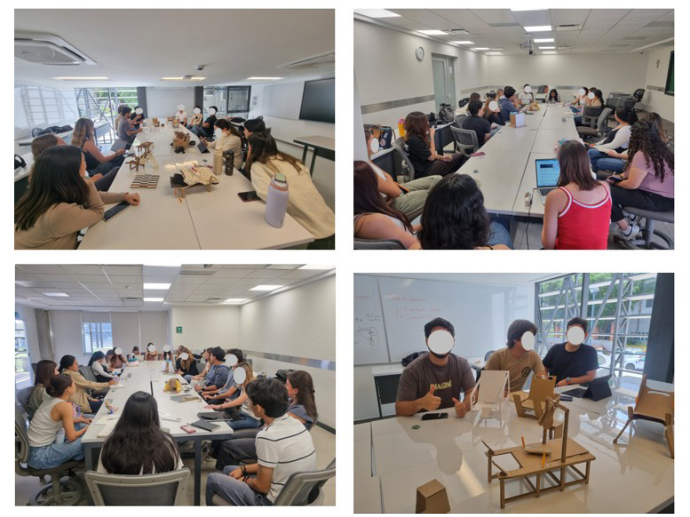
The CBDA methodology is implemented through collaborative critique sessions in which design teams present their prototypes and engage in structured questioning using the coin-based system. Figure 1 presents examples of classroom sessions where the methodology was applied during undergraduate design course.
Figure 1: Classroom implementation of the coin-based design argumentation method (CBDA). The images illustrate collaborative critique sessions where students present design prototypes and engage in structured questioning using the token-based system.
Introduction of the Game Before the critique session begins, the instructor introduces the CBDA methodology and explains the objective of the activity. Students are informed that the exercise aims to strengthen their ability to justify design decisions using research evidence and to critically analyze the relationship between research insights and product characteristics.
The instructor then explains the rules of the token-based system. Each design team receives three coins that represent a portion of the course evaluation. These tokens function as incentives that encourage students to formulate meaningful questions and defend their design decisions with research-based arguments.
Design Presentation Each team presents its project and explains the research findings that informed the proposed product characteristics.
Observation and Question Preparation Students analyze the projects presented by their peers and identify potential inconsistencies between research insights and design decisions.
Structured Questioning Game During the questioning rounds, teams formulate contextual questions followed by a coin question. Tokens are exchanged depending on the strength of the question and the quality of the response.
Reflection and Iterative Redesign After several questioning rounds, the activity concludes with a reflection stage. Teams analyze the feedback received and identify areas where their design decisions require revision. As a result, students revisit earlier stages of the design process to refine their concepts and improve the coherence between research insights and design outcomes.
LEARNING OUTCOMES The CBDA methodology encourages students to recognize the importance of supporting design decisions with research evidence rather than intuition.
Gamified critique environments increase engagement and participation while reinforcing research-based reasoning among students (Triantafyllou et al., 2019).
The main learning outcomes observed during the implementation of the methodology are summarized in Table 3.
Table 3: Observed learning outcomes.
Table available in the original PDF paper.
Learning Dimension Observed Outcome Research integration Stronger connection between research and design
Design argumentation Improved justification of design decisions Critical thinking Identification of inconsistencies
The CBDA methodology transforms traditional critique sessions into structured learning environments that promote evidence-based reasoning and collaborative reflection.
By combining gamification, structured questioning, and peer critique, the method encourages students to articulate design arguments supported by research evidence. This process helps students identify inconsistencies between research findings and product characteristics while fostering deeper understanding of the design process.
These findings align with previous research highlighting the value of experiential and collaborative learning environments within design education (Kolb, 1984).
CONCLUSION
Human-Centered Design requires designers to translate research insights into coherent product characteristics and meaningful design solutions.
The Coin-Based Design Argumentation Method offers a practical pedagogical framework that strengthens research-based reasoning through structured and gamified critique sessions. By encouraging students to justify design decisions using evidence and engage in collaborative questioning, the methodology promotes critical thinking and reflective design practices.
Future research may explore quantitative evaluation of learning outcomes associated with the methodology and examine its potential application in other educational contexts.
REFERENCES
Brown, T. (2008). Design thinking. Harvard Business Review, 86(6), 84–92. Deterding, S., Dixon, D., Khaled, R., & Nacke, L. (2011). From game design elements to gamefulness. Proceedings of the 15th International Academic MindTrek Conference, 9–15. ISO. (2019). ISO 9241-210: Human-centered design for interactive systems.
International Organization for Standardization. Kolb, D. A. (1984). Experiential learning: Experience as the source of learning and development. Prentice Hall. Knowles, M. S., Holton, E., & Swanson, R. (2015). The adult learner. Routledge. Li, M., Tsai, C., Tao, J., & Lorentz, C. (2023). Gamification in education: A systematic
review. Educational Research Review. Mahoney, B., & Harris-Reeves, B. (2019). Socratic questioning and critical thinking.
Thinking Skills and Creativity. Norman, D. (2013). The design of everyday things. Basic Books. Plass, J., Homer, B., & Kinzer, C. (2015). Foundations of game-based learning.
Educational Psychologist. Sanders, E., & Stappers, P. (2008). Co-creation and the new landscapes of design.
CoDesign. Shehab, S., Sharp, H., & Marshall, A. (2021). Measuring learning outcomes in human-centered design education. Design Research Society Proceedings. Triantafyllou, S., Timcenko, O., & Busk Kofoed, L. (2019). Gamification in
engineering education. European Journal of Engineering Education. Zainuddin, Z., Chu, S., Shujahat, M., & Perera, C. (2020). The impact of gamification on learning. Computers & Education.
LISTED IN THE AHFE DIGITAL BOOKSTORE CATALOGUE
Explore the complete digital volume
Human Interaction and Emerging Technologies (IHIET-FS 2026): Future Systems and Design Applications
Read this individual research paper free through the original publisher, or explore the full digital proceedings book.
ISBN 979-8-950676-11-6
Explore this ISBN in the AHFE Bookstore ↗Listed in the July 2026 bookstore catalogue; search by ISBN to confirm current availability · Digital book purchase optional