Industry 4.0 technologies have been disrupting the automotive industry for the past few years. The changes bring shift in the established paradigm and automotive sector has taken a leading role in implementing various elements of this revolution. Mar- gins from selling new vehicles are considered very low, so companies understand the importance of innovation and efficiency improvements. In our research, we explore the most relevant technologies connected to automation and Industry 4.0 in automotive industry with purpose to find deeper connections in obtained information. The aim of our research was also together with production managers and/or process managers to evaluate the level of components and technologies within the concept of Industry 4.0 and automation implemented in automotive manufacturing companies’ operations in Slovakia. Results point to high level of application of automation technologies within the automotive industry and to positive correlation between the level of implemen- tation of elements of advanced automation and the number of implemented base technologies within the key supporting technologies of Industry 4.0.
Nowadays, the major and radical changes are coming with 4th Industrial revolution, also known as Industry 4.0 (Ross and Maynard, 2021). The indicatives of Industry 4.0 aim to make factories more competitive, flexi- ble, connected, and collaborative (Lee et al., 2015). Manufacturing within Industry 4.0 can be seen from a new managerial perspective, in which fully automated manufacturing processes are based on artificial intelligence, Inter- net and networking technologies, through which machines communicate and create new machines without human participation (Alekseev et al., 2018). The essence of the concept of Industry 4.0 is the introduction of intelligent interconnected systems that implement self-regulatory production, where people, machines, equipment and products communicate with each other (Kovács and Kot, 2016). Industry 4.0 relies on implementation of new tech- nologies that are able to gather data in real time and to analyze it, providing useful information to the manufacturing system (Lee et al., 2015). Chan- ges coming with Industry 4.0 are showing new directions for establishing an
Implementation of Automation and Industry 4.0 Technologies 831
efficient and smart factory. With this movement, if companies do not invest in new technologies and improving their efficiency, they could be compromising their survival (Costa et al., 2017).
In the paper, we focus on the automotive sector as it has taken a central role in manufacturing and has been considered as a major source of the most important technological, but also organizational and managerial innovati- ons. In context of investments and implementation of technologies within Industry 4.0, the automotive sector has been a pioneer (Cassia and Ferrazzi, 2018). Automobile producers and component manufacturers are expected to achieve the highest productivity gains using Industry 4.0 technologies and innovations compared to other sectors (Rüssmann et al., 2015). Deloitte’s insights highlight automation, high-speed connectivity, machine learning and low-cost computing as current challenges and topical issues in Industry 4.0 concepts in this sector (Deloitte, 2021). Among the main conditions for the prosperity of today’s companies, it is recommended to digitize all processes and invest in the latest available technologies (Dutt et al., 2020).
In the first part of the paper, we summarize the most relevant technologies and components of Industry 4.0 used in automotive sector. Then, we pre- sent methodology and results of the research focused on implementation of components and technologies of Industry 4.0 and automation in automotive manufacturing companies in Slovak Republic. In the last part, we conclude the paper with our main findings.
TECHNOLOGIES WITHIN INDUSTRY 4.0 In the sense of Industry 4.0, we understand automation as a set of techno- logies that enable machine operations and operations within systems to be performed without significant human intervention. This is also the main dif- ference from manual work (Akogbe, 2015). Such system or device should have the following characteristics: sufficiently inform about the running/ope- rational mode of the device and warn of dangerous threats and the possibility of manual restriction, i.e. human intervention. Among such systems, we can include e.g. HMI panels (Human Machine Interface), SCADA visualizations (Supervisory Control and Data Acquisition), PLC programmable devices, industrial robots, autonomous logistics devices and others. These systems either execute something, back it up, or monitor it automatically. Individual production end devices can have different properties which help them either communicate with each other, be optimized/programmed or monitored. They can be controlled autonomously, or we can control them remotely (Bahrin et al., 2016). Robots have the key representation, because they are autono- mous, can be programmed and are also characterized by safety mechanisms. Such robots replace human work, e.g. on assembly lines or during welding work. These new innovative advancements turn the spotlight on automation and reveal new ways for growth and productivity advancement. Together Industry 4.0 and automation open new manufacturing possibilities in form of advanced automation. These two concepts can generate more reliable, con- sistent and efficient results in machinery and production facilities, while they also bring further enhancements and improvements to the manufacturing
832 Smolka and Papulová
processes that provide better outcomes than those obtained by operation of only basic automation elements.
In the context of Industry 4.0, several interrelated technologies are being discussed. Based on a study of the literature, we have identified dozens of essential technologies and concepts, however we selected only the most rele- vant. Therefore, for selection of specific technologies, we considered their practical applicability and realistic impact and importance for the automo- tive sector. Based on Frank et al. (2019) and other authors, Industry 4.0 technologies can be divided into two different groups that are determined by their primary purpose. The front-end technologies (e.g. smart manufa- cturing, smart factory, smart supply chain) refer to operational and market needs and have an end-application purpose for the companies’ value chain. The base technologies (Internet of things, cloud, big data and analytics) refer to technologies that serve and supply connectivity, intelligence, communica- tion and information sharing for front-end technologies (Frank et al., 2019). Later in our research, we will particularly focus on this second group, as Frank et al. (2019) call attention for further enhancement of its understan- ding since managers are more aware of smart manufacturing utilization and its functionalities than the technologies that enable it.
The Internet of Things (IoT) refers to the networking of everyday obje- cts that leads to a highly distributed network of devices that communicate with people as well as with other devices. These everyday objects can be equipped with identification, scanning, networking functions and options for further interconnection and processing. These features and capabilities will allow them to communicate with each other as well as with other devices and services over the Internet, thus enabling them to achieve certain useful goals. The basic concepts of IoT are not new. For years, technologies such as Radio-frequency Identification (RFID), sensors and sensor networks have been used in production. Direct communication between end devices (Mach- ine to machine, M2M) is also not a new concept, as it serves as the basis of the Internet, in which clients, servers and routers communicate with each other. IoT represents the development of the use of these existing technologies in terms of the number and types of devices, as well as the interconnection of these networks across the Internet (Whitmore et al., 2015). IoT was introdu- ced in the automotive industry only a few years ago but nowadays is already considered as necessary.
Cloud computing is a model that provides ubiquitous and convenient on- demand network access to a shared set of configurable computing resources (such as networks, servers, storage, applications, and services). This approach can be provided quickly, with minimal effort required and minimal intera- ction with the service provider (Mell and Grance, 2011). This technology is highly scalable, reduces business risks and provides easy access to infor- mation. Automotive vendors use cloud computing to reduce their operating costs. Thanks to better analytics within the company, they can maximize uptime, improve initial product quality and optimize machine productivity. They also know how to use the cloud to track their assets (such as expen- sive tools) throughout the value chain, potentially reducing taxes, optimizing
Implementation of Automation and Industry 4.0 Technologies 833
reuse, and eliminating them at the right time. Suppliers can equip critical pro- duction facilities with so-called peripheral equipment and aggregate the data obtained in the cloud, allowing them to predict future failures and perfor- mance anomalies (predictive maintenance). Vendors can also migrate legacy applications and technology jobs to the cloud to reduce operating costs and increase agility (Deloitte, 2021).
The term Big Data refers to large amounts of data resulting from the exi- stence of millions of systems currently connected to the network (IoT) and producing real-time data (Costa et al., 2017). It refers to the ability to store large quantities of data that are stored in so-called data warehouses and are processed at the same time. The reason for storing large databases on the actual sales of cars or vehicles can be used for various evaluations (statisti- cal reports) or the generation of graphs that will help the company to make better decisions. For example, based on appropriately selected data, suitable marketing strategy can be created for the end customer.
Another supporting tool in the context of Industry 4.0 is artificial intel- ligence. It is an intelligent machine behavior that can learn intelligently on its own, solve problems, predict various behavioral trends or possible thre- ats. Artificial intelligence includes various devices, machines or robots that are programmed by a person so that they can behave autonomously, i.e. by auto-regulation. A new trend for manufacturing companies is to implement algorithms in devices, which allow them to make right and optimal decisions automatically.
Based on communication between devices (M2M), devices can adjust their configuration, share the acquired knowledge or influence the behavior of another production plant in a completely different location (Lee et al., 2018).
Other technologies connected to Industry 4.0 include 3D printing (additive manufacturing), energy monitoring, process simulation and more.
METHODOLOGY
Research Goal, Sample, and Data Collection The aim of our research was also together with production managers and/or process managers to evaluate the level of components and technologies within the concept of Industry 4.0 and automation implemented in automotive manufacturing companies’ operations in Slovakia. We developed a hypoth- esis to confirm if there is correlation between the level of implementation of advanced automation elements and the number of implemented base technologies of Industry 4.0.
As the sample were chosen automotive companies based in Slovakia that focus on production and assembly of auto parts and automobile compo- nents. Our other criteria for a company to be selected were following: a company must be active with accessible contact information; a company must have achieved a last year’s revenue of at 1 mil € at the minimum. Our final list consisted of 266 companies (of which all of them were contacted) and was created by online business registers and other publications. Data- gathering was realized through questionnaire survey that went on for more
834 Smolka and Papulová
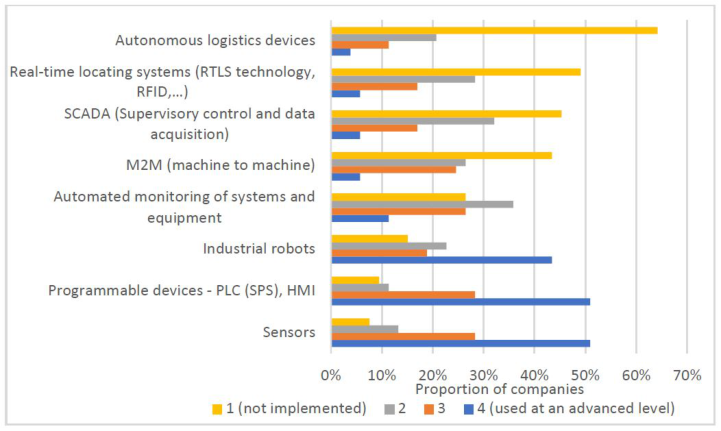
Figure 1: Level of implementation of automation elements in the production process. (Own processing according to the answers from the questionnaire survey) than 2 months (from mid-February to end of April 2021). Overall, we’ve obtained answers from almost 20% of respondents – 53 companies in total.
Conventional scientific methods were applied for evaluation and interpre- tation of results. Based on the acquired knowledge, we also formulated a hypothesis, which we tested statistically using the data obtained from the questionnaire survey. Descriptive and inferential statistics was used to explain findings from primary data and to verify assumptions, hypotheses, distribu- tions etc. The gathered data were examined in IBM SPSS Statistics (version 27.0) and Microsoft Excel.
RESULTS AND DISCUSSION
The Level of Advanced Automation The first area of our research was to examine the level of implementation of the elements of advanced automation, respectively of the individual compo- nents and technologies within the concept of industry 4.0 and automation. Respondents were asked to determine the level of use for individual compo- nents and technologies on a scale from 1 to 4 (Figure 1). Results are showing, that 79% of companies use sensors and programmable PLCs at more adva- nced levels (3 and 4). More advanced levels of use (3 and 4) can also be observed with industrial robots (52% of companies) and automated monito- ring of systems and equipment (37%). Approximately half of the companies do not use the following components and technologies at all: autonomous logistics facilities (64%), localization tools (49%) and SCADA (45%).
The Implementation of Key Supporting Technologies The second area of our search was specialized on implementation of key supporting technologies of Industry 4.0 (Figure 2).
Implementation of Automation and Industry 4.0 Technologies 835
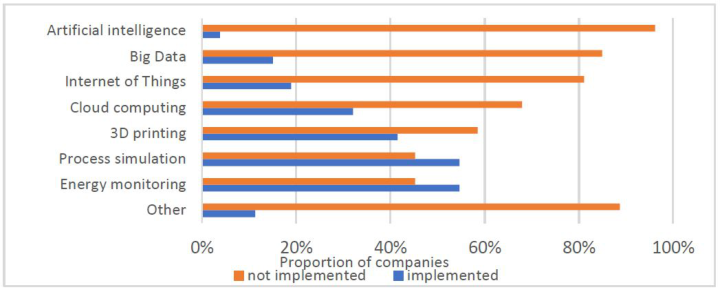
Figure 2: Level of implementation of components and technologies of automation and Industry 4.0. (Own processing according to the answers from the questionnaire survey)
All companies in our sample used at least one key supporting technology of Industry 4.0 and almost one half (43%) of companies used only one techno- logy. Less than a third of companies used two technologies (21%) and three technologies (19%). None of companies in the sample uses all of 7 mentioned technologies (Figure 2).
Testing the Hypothesis When establishing the research strategy, the following hypothesis was deve- loped based on deduction from the acquired knowledge:
H0: There is no correlation between the level of implementation of adva- nced automation elements and the number of implemented base technologies within the key supporting technologies of Industry 4.0.
H1: There is a positive correlation between the level of implementation of advanced automation elements and the number of implemented base technologies within the key supporting technologies of Industry 4.0.
The variable 1 “the level of implementation of advanced automation elements” was defined as a number of implemented components and tech- nologies within the concept of Industry 4.0 (these technologies and concepts were also presented on Figure 1, in total 8). The variable 2 “the number of implemented base technologies within the key supporting technologies of Industry 4.0”, in which the base technologies were defined as Internet of Things, cloud computing, big data (in total 3).
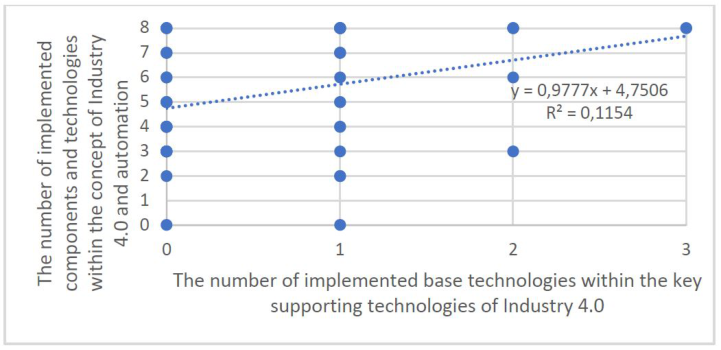
To identify the mutual relationship between two quantitative variables, we use a correlation diagram called a dot plot. After projecting the variable 1 “the number of implemented base technologies within the key supporting technologies of Industry 4.0” and variable 2 “the level of implementation of advanced automation elements”, we can observe a positive linear correlation (dependence) between the variables (Figure 3).
We decided to test the significance of the correlation between theses vari- ables using the Spearman correlation coefficient, as our data did not meet the requirements for using the Pearson correlation coefficient. Although the variable 1 shows a normal distribution, the variable 2 does not. Based on
836 Smolka and Papulová
Figure 3: The relationship between the number of implemented key supporting tech- nologies of Industry 4.0 and the number of implemented elements of advanced automation. (Own processing according to the statistical analysis of questionnaire survey answers).Table 1. Spearman correlation coefficient results (Own processing according to the statistical analysis of the questionnaire survey answers).
Table available in the original PDF paper.
Variable 1 Variable 2 Np Spearman’s corre- lation coefficient N rs p (2)
base technologies only 3
5 0,395 0,004
52
0,419 0,002 base technologies + artificial intelligence + energy monitoring all technologies 8 0,561 <0,001
Number of implemented key supporting technologies of Industry 4.0
The level of implementation of elements of advanced automation Legend: Np = number of key supporting technologies of Industry 4.0, N = number = number of enter- prises, rs = rho = value of Spearman’s correlation coefficient, p (2) (marked as “Sig. (2-tailed)” in SPSS = p-value (significance) of deviations of mean values between two groups
Spearman correlation coefficient (Table 1), we found a statistically signifi- cant positive correlation – a positive statistical dependence between the order of the values of these variables. Since rs > 0, we assume that it is a positive linear correlation. Since p (2) < 0.05, we assume that this is a statistically significant correlation. rs (52) = 0.419, p (2) = 0.002 => we can reject the hypothesis H0. For rs values, the following applies: −1 ≤rs ≤1. The closer the rs value is to 1 or −1, the stronger the linear correlation (relationship between variables 1 and 2).
We also tested the hypothesis H0 of non-existence of mutual correlation for extended variable 2 (base technologies + artificial intelligence + energy monitoring, in total 5) and in last case for all key supporting technologies (in total 8). In both of these cases, the values of the Spearman correlation coeffici- ent assume a statistically significant positive correlation (rs > 0, p (2) < 0.05). Interestingly, for the case of all supporting technologies the correlation is the
Implementation of Automation and Industry 4.0 Technologies 837
strongest (rs = 0.561), in comparison with case of base technologies only (rs = 0,419) and base technologies + artificial intelligence + energy moni- toring (rs = 0.395). We can conclude, based on the value of the Spearman correlation coefficient, that we can reject H0 and accept H1.
CONCLUSION
The implementation of automation in automotive industry is relatively high. Based on the results, majority (96%) of automotive companies in our sam- ple implement automation elements (60% of companies at a more advanced level). Mostly, companies use sensors and programmable PLC devices at more advanced levels, and industrial robots at high level of implementation. More than 60% of companies do not implement autonomous logistics equipment (location tools, SCADA systems and M2M technologies). Most elements of advanced automation are implemented at more advanced levels by only a very small number of enterprises. When implementing the key supporting techno- logies of Industry 4.0, energy monitoring and process simulation are the most popular, but despite this, only slightly more than 50% of companies imple- ment each of them. Cloud computing and 3D printing are implemented by around 30% of enterprises, while the Internet of Things, big data or artificial intelligence are used by less than 20% of enterprises. By verifying the hypoth- esis, we also found a positive correlation between the level of implementation of elements of advanced automation and the number of implemented base technologies within the key supporting technologies of Industry 4.0. We can conclude that application of Industry 4.0 key supporting technologies improves the possibilities to implement solutions of advanced automation. Implementation of such solutions should also call attention of managers, especially in the area of management of intellectual capital to focus on develo- pment of suitable business processes, knowledge and necessary skills needed for the implementation of new technologies.
ACKNOWLEDGMENT
This research was supported and funded by project VEGA 1/0773/20 titled Management of Intellectual Capital and Measuring of Innovativeness of Slovak Companies.
REFERENCES
Akogbe, Michael. (2015) Brief Overview of Automated Industrial Plant: A Review.
In: International Journal of Computer Trends and Technology (IJCTT), vol. 23 (3), Seventh Sense Research Group, ISSN 2231–2803. https://doi.org/10.14445/ 22312803/IJCTT-V23P127 Alekseev, Alexander et al. (2018) Financial Strategy of Development of Industry 4.0 in the Countries with Developing Economy. In: Revista ESPACIOS, vol. 39(12), Caracas, Venezuela: Revista ESPACIOS, ISSN 0798-1015. http://w.revistaespacio s.com/a18v39n12/a18v39n12p01.pdf Bahrin, M. Othman, M. Azli, N. Talib, M. (2016) Industry 4.0: Review on Indu-
strial Automation and Robotic. Journal Teknologi. pp. 137–143. https://doi.org/ 10.11113/jt.v78.9285
838 Smolka and Papulová
Cassia, Fabio. Ferrazzi, Matteo. (2018) The Economics of Cars. Newcastle upon Tyne, England, United Kingdom: Agenda Publishing, ISBN 978-1-911116-71-4. https://doi.org/10.2307/j.ctv5cg94w Costa, Cesar. Mendes, Cleiton. Osaki, Raphael. (2017) INDUSTRY 4.0 IN AUTO-
MATED PRODUCTION. Sao Paulo, Brazil: IFSP-Federal Institute of Sao Paulo. https://doi.org/10.13140/RG.2.2.30849.15204 Deloitte. (2021) Cloud computing in the automotive industry. London, United Kingdom: Deloitte. https://www2.deloitte.com/us/en/pages/consulting/articles/cloud -automotive-industry-value-chain.html Dutt, Debanjan. Wilson, Alexander. Natarajan, Vijay. Robinson, Ryan. (2020)
Steering into Industry 4.0 in the automotive sector: Taking advantage of uncer- tain times to align for future success. In: Industry 4.0 in automotive: Digi- tizing the end-to-end automotive value chain. USA: Deloitte Development, 2020. https://www2.deloitte.com/us/en/insights/industry/automotive/industry-4- 0-future-of-automotive-industry.html Frank, Alejandro Germán. Dalenogare, Lucas Santos. Ayala, Néstor Fabián. (2019) Industry 4.0 technologies: Implementation patterns in manufacturing companies. In: International Journal of Production Economics, Netherlands: Elsevier BV, vol. 210, pp. 15–26. ISSN 0925-5273. https://doi.org/10.1016/j.ijpe.2019.01.004 Kovács, Gy. Kot, Sebastian. (2016) New logistics and production trends as the effect
of global economy changes. In: Polish Journal of Management Studies, Czesto- chowa, Poland: Czestochowa University of Technology, vol 14 (2), pp. 115–126. ISSN 2081-7452. https://doi.org/10.17512/pjms.2016.14.2.11 Lee, Jay. Davari, Hossein. Singh, Jaskaran. Pandhare, Vibhor. (2018) Industrial Artificial Intelligence for industry 4.0-based manufacturing systems. In: Manu- facturing Letters, Netherlands: Elsevier BV, vol. 18, pp. 20–23. ISSN 2213–8463. https://doi.org/10.1016/j.mfglet.2018.09.002 Lee, Jay. Bagheri, Behrad. Kao, Hung-An. (2015) A Cyber-Physical Systems archi-
tecture for Industry 4.0-based manufacturing systems. In: Manufacturing Letters, Netherlands: Elsevier BV, vol. 3, pp. 18–23. ISSN 2213–8463. https://doi.org/10. 1016/j.mfglet.2014.12.001 Mell, Peter. Grance, Timothy. (2011) The NIST Definition of Cloud Computing.
Gaithersburg, USA: National Institute of Standards and Technology. https://nvlp ubs.nist.gov/nistpubs/Legacy/SP/nistspecialpublication800-145.pdf Ross, Philip. Maynard, Kasia. (2021) Towards a 4th industrial revolution. In: Intelligent Buildings International. United Kingdom: Taylor & Francis, Vol 13 (3). ISSN 1756–6932. https://doi.org/10.1080/17508975.2021.1873625 Rüssmann, Michael. Lorenz, Markus. Gerbert, Philipp. Waldner, Manuela. Engel,
Pascal. Harnisch, Michael. Justus, Jan. (2015) Industry 4.0: The Future of Productivity and Growth in Manufacturing Industries. Boston, Massachusetts, USA: Boston Consulting Group, https://www.bcg.com/publications/2015/engine ered_products_project_business_industry_4_future_productivity_growth_manuf acturing_industries Whitmore, Andrew. Agarwal, Anurag. Xu, Li. (2015) The Internet of Things—A survey of topics and trends. In: Information Systems Frontiers. Netherlands: Sprin- ger, vol. 17(2), pp. 261–262. ISSN 1572-9419. https://doi.org/10.1007/s10796- 014-9489-2
Read this individual research paper free through the original publisher, or explore the full digital proceedings book.
ISBN 978-1-958651-44-5
Explore this ISBN in the AHFE Bookstore ↗Listed in the July 2026 bookstore catalogue; search by ISBN to confirm current availability · Digital book purchase optional