Nur Hidayatullah, Achmad Nurmandi (2022). The success of E-Participation in Supporting the development of Smart Cities in Spain, Italy, United States and Germany. In: Human Interaction & Emerging Technologies (IHIET 2022): Artificial Intelligence & Future Applications. AHFE Open Access, vol. 68, pp. 781–788. https://doi.org/10.54941/ahfe1002806
This study aims to analyze the role of E-participation in supporting the success of smart city development. This research method uses qualitative research with a bibliometric analysis approach. Sources of research data obtained 218 documents from the Scopus database using the keywords "smart city" and "e-participation" with a span of 7 years from 2015 to 2022. The data analysis phase of this research used VOSviewer and NVivo12 Plus software to visualize the data. This study indicates that e-participation is essential in creating the successful implementation of smart cities. The implementation of e-participation in four countries has different participation strategies. Spain is increasing participation forms online communities and public participation platforms. Italy utilizes digital technology and involves volunteers in public participation. Germany, in increasing participation, develops digital participation platforms and implements practical participation projects. The United States applies a political approach and involves interest groups supported by digitization. Furthermore, increasing participation is supported by information and communication technology, services, and agile management are the main focus. Spain, management focuses on location data management, and service aspect focuses on service platforms, and technology focuses on blockchain technology. Italy, the service aspect focuses on open service, and the technology aspect focuses on open source technology. In the United States, the management aspect pays attention to location data management. Then, the technological aspect focuses on civil technology practices. Germany, management and service are not yet a top priority in this aspect. While the technology aspect only pays attention to the web technology sector. Based on these findings, Spain is a country that dominates various aspects. This means being a country that can be an example of e-participation development in realizing a smart city.
Smart city projects are getting more and more popular and widely spread all over the world. As we know that the growth of society in the city conti- nues to grow and increase, a challenge for the city to continue to support the
use of technology to create public service (Dameri, 2013). The main deter- minant of urban intelligence is the network-type activity that characterizes it in many aspects of city life (Gagliardi et al., 2017). Implementing smart city ideas requires a comprehensive city view and integration of many urban systems(Kauf, 2019). The standardization process also serves as a stepping stone for each city to outline its vision for a smart city strategy and build a complete smart city framework capable of linking all projects and activi- ties (Dameri and Rosenthal-sabroux, 2017). In this category, e-Participation in the development and transition of participation in a democratic and con- sultative community system mediated by information and communication technology (ICT), especially the internet (Sæbø, Rose and Skiftenes Flak, 2008). E-participation aims to support active citizens by using modern tech- nology, advancing access and availability of participation in the success of a just and efficient society and government (Sæbø, Rose and Skiftenes Flak, 2008). Therefore, the existence of e-Participation in a smart city is an effe- ctive solution to strengthen collaboration between the government and the community. Smart city development is an effective solution to improving the quality of life, supported by technology and information. Therefore, the rese- archer wants to focus on the four countries in terms of how the level of success of E-participation in supporting the development of smart cities in Spain, Italy, the United States, and Germany. We know that these four countries are countries that have dominated for the last 7 years, from 2015 to 2022. This is a very interesting and varied phenomenon to explore in more depth.
LITERATURE RIVIEW The smart city idea is critical since its development and expansion benefit both sides, most notably municipal management, and the community (Kauf, 2019). Smart city programs aim to improve urban performance by harnes- sing data, information, and information technology (IT) to provide more efficient services to residents, monitor and manage existing infrastructure, and foster cooperation among varied economic players (Marsal-Llacuna, Colomer-Llinàs and Meléndez-Frigola, 2015). A related new approach to urban services has been based on leveraging technology, including ICT, to help create what some call smart cities (Albino, Berardi and Dangelico, 2015). From a citizen’s point of view, involving the community in contribu- ting through public participation is a voluntary action that aims to generate social benefits, which is carried out in public participation without the need for a legislature to include individuals in political decision-making (Vogt, Förster and Kabst, 2014). Local governments worldwide are progressively deploying e-participation platforms to engage citizens in consultation and decision-making (Macintosh and Whyte, 2008). Understanding the elements that influence e-participation over time is critical to developing dissemination and promotion strategies that encourage individuals to continue to partici- pate (Naranjo-Zolotov et al., 2019). Participation is a term that refers to the degree to which other parties are directly involved in making choices on government activities. Examples include public consultations, public mee- tings, and focus groups. Surveys, advisory or citizen groups, referendums,
The Success of E-Participation in Supporting the Development of Smart Cities 783
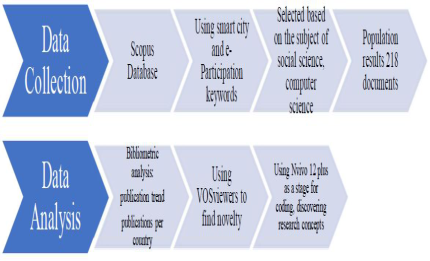
Figure 1: Stages of data identification and analysis.
initiatives, and business are all examples of these (Spil, Ton A.M, Robin Effing, 2017). According to (Gil-Garcia, Pardo and Nam, 2015), provides an in-depth examination of the components and features that comprise a smart city. This view consists of four perspectives: (1) technology and data, (2) government, (3) society, and (4) physical environment. Technology is seen as a perspective that contributes to them. One of the three components of the “Community” perspective is leaning toward the unique downtown envi- ronment of operations, emphasizing collaborative governance and the role of information and communication technologies in facilitating collaborative governance, participation, and engagement.
METHODS
This study uses a bibliometric analysis approach. At this stage, the resea- rcher obtained 218 articles about “smart cities” and “e-Participation” which were sourced from the Scopus database. Bibliometric analysis evaluates bibli- ographic data objectively and quantitatively which is useful for constructing knowledge in a particular topic area (Merigó, Gil-Lafuente and Yager, 2015). Based on past research, qualitative techniques are used to organize issues and themes and organize ideas (Dixon-Woods et al., 2006). This research consi- sts of several stages, namely the identification of articles and data analysis. In the next stage, mutually supportive and related articles are needed to produce in-depth research.
The first step is to identify the article that a researcher wants to find. Then, the article search process uses the Scopus database by entering the keywords “smart city” and “e-Participation”. After finding the total number of available articles, the researcher uses limits based on subject, number of documents, and applies a “limit to”application to limit the number of articles available. The second stage is the data analysis process using software that functions to analyze content, such as VOSviewers and Nvivo 12 plus. At this stage the purpose of using VOSviewers is to generate a concept, and research novelty related to the research topic. Meanwhile, using Nvivo 12 plus is to present visual data related to the topic, the relationship between concepts in a research.
784 Hidayatullah and Nurmandi
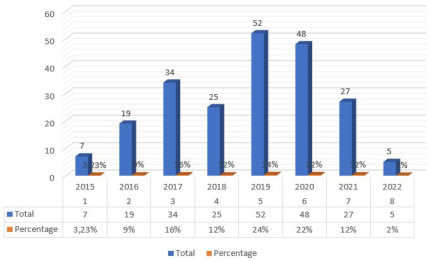
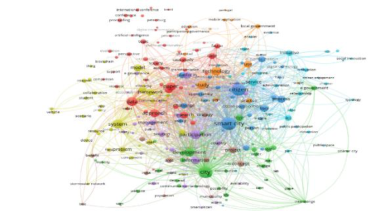
Figure 2: Scientific publication by year. Source: Scopus database.Figure 3: Network visualization co-occurance in E-participation smart city. Source: Processed by researchers using VOSviewer.
RESULTS
Trend in The Development of E-participation in Smart Cities Trend data shows that in research publications based on year to year, namely from 2015 to 2022. Researchers obtained data within the last 7 years. We know that the data shows that it fluctuates from year to year. However, the highest data is in 2019. While the lowest data is the number of publications in 2022. Furthermore, the growth of these publications can be seen in the following table.
Based on the table above related to e-participation in smart cities, it shows that the highest achievement was in Spain with 26 documents, Italy 22 docu- ments, United States 20 documents and Germany 18 documents. The table data is obtained from the Scopus database. Furthermore, the researcher chose the four countries that became the focus of his research.
Co-Occurance E-participation in Supporting Smart Cities The success of E-participation in supporting smart cities in Spain, Italy, Uni- ted States and Gemany is an effort by the state to achieve the goal of smart cities. VOSviewers software as a tool to display keyword relationships that can make it easier for researchers. So that later can find the novelty of the research process.
The picture is the result of the VosViewers software display related to network visualization E-participation in developing smart cities. Therefore,
The Success of E-Participation in Supporting the Development of Smart Cities 785
Table 1. Four highest countries E-participation smart city.
Table available in the original PDF paper.
Afiliation Author
Country Number of Document
Alcaide Muñoz, L
Spain 26 Universidad de Granada Rodríguez Bolívar, M.P Universidad Autónoma de Madrid Cantador,
Universidad Complutense de Madrid Coscia, C., Italy 22 Università degli Studi di Sassari
Bellavista, P.
Politecnico di Torino Niglia, F. The University of Manchester Cronemberger, F.
United States 20 State University of New York Albany Aal, K.
Georgia Institute of Technology
Altarawneh,
Argonne National Laboratory
Avgerou, A.
Germany 18 Heinrich-Heine- Universität Düsseldorf Aal, K.
Ministry of Housing and Urban Affairs National Library Board Afrooz, A.E
Source: Scopus Database
the researcher demonstrates that the focus and strategy in developing agile human resources is supported by participatory services from government, community, interest groups. So this can make an adaptive smart city. In this case, technology is an important part of the sustainability of smart cities.
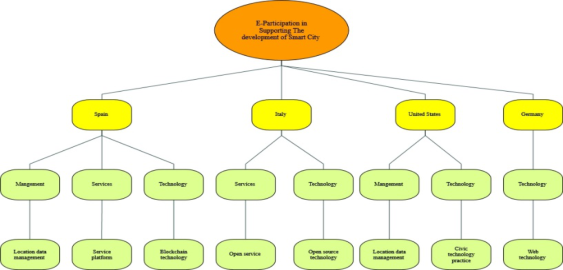
The Success of E-Participation Smart Cities Visualization of data using VOSviewer software, then the data is coded with NVivo 12 plus. The data obtained from each country found the main focus in the success of e-participation smart city from three important aspects, mana- gement, service and technology in Spain, Italy, United States and Germany. The following is an image that interprets the success of e-participation in smart cities.
Based on the picture above, related to the success of e-participation in deve- loping a smart city, it needs to be supported by strategic actions. In this study, each country has a different focus and strategy. Engagement is the main thing that can be done to create success for every country. Based on the concept of e- Participation is a form of involvement of citizens and other parties by utilizing technology, information and communication. In this context, the focus and strategy that can be used as a benchmark is the management, service sector and using technology as a tool to simplify and accelerate all activities. In this context, Spain has supporting variables, including management that pays
786 Hidayatullah and Nurmandi
Figure 4: Coding data with Nvivo 12 Plus. Source: Processed by researches using NVivo 12 plus.
attention to location data management which is useful for providing privacy for the location of the data. Meanwhile, the agile service sector applies the latest cellular technology, georeference and wiki concepts. This is influenced by technological advances related to smartphones and mobile internet (De Reuver, Stein and Hampe, 2013). Aspects of the country’s public services is to adopt web 2.0 technology. Increasing citizen participation is one way to change people’s perceptions in political and public dialogue (Bolívar, 2017). As for the technology sector, by adopting Distributed Ledger Technologies- DLTs or it can be said that Blockchain technology can change the channel of citizen participation and facilitate the transparency of public information (Benítez-Martínez, Hurtado-Torres and Romero- Frías, 2021).Based on the State of Italy, adequate technology and good service are the main priorities in supporting community involvement. For example, the services carried out are open services that aim to involve citizens and the government in a partici- patory manner (Gagliardi et al., 2017). Then, there is the use of open source technology to encourage e-participation in urban planning (De Filippi, Coscia and Guido, 2017). In the United States, the management sector focuses more on location data management which is used to provide location privacy for the data. While the technology sector uses civic technology practices to deve- lop smart cities by combining open civic data, collaborative civic technology to facilitate effective governance (David, McNutt and Justice, 2018). Fur- thermore, the German state is only in the technology sector by using web technology that utilizes HTML5 and WebGL to facilitate public participation in urban planning (Dambruch and Krämer, 2014).
CONCLUSION
This research is related to the success of e-participation in developing smart cities which is supported by several variables including management, agile services and adequate technology. Regarding the growth of e-participation publications from year to year, it fluctuates based on data from 2015 to 2022. On the other hand, with the development of technology, public involvement has become important in supporting smart cities. Each country has a diffe- rent perception in developing it, some are using online communities, forming
The Success of E-Participation in Supporting the Development of Smart Cities 787
volunteers, and so on. In the researcher’s perception that the success of e- participation is not only in the community, but it requires the synergy of the government, interest groups and supported by adequate technology. So that the smart city becomes realized and has implications for the community.
REFERENCES
Albino, V., Berardi, U. and Dangelico, R. M. (2015) ‘Smart cities: Definitions, dimensions, performance, and initiatives’, Journal of Urban Technology, 22(1), pp. 3–21. doi: 10.1080/10630732.2014.942092. Benítez-Martínez, F. L., Hurtado-Torres, M. V. and Romero-Frías, E. (2021) ‘A neural
blockchain for a tokenizable e-Participation model’, Neurocomputing, 423(xxxx), pp. 703–712. doi: 10.1016/j.neucom.2020.03.116. Bolívar, M. P. R. (2017) ‘Governance Models for the Delivery of Public Services Through the Web 2.0 Technologies: A Political View in Large Spa- nish Municipalities’, Social Science Computer Review, 35(2), pp. 203–225. doi: 10.1177/0894439315609919. Dambruch, J. and Krämer, M. (2014) ‘Leveraging public participation in urban
planning with 3D web technology’, Proceedings of the 19th International ACM Conference on 3D Web Technologies, Web3D 2014, pp. 117–124. doi: 10.1145/2628588.2628591. Dameri, R. P. (2013) ‘Searching for Smart City definition: a comprehensive proposal’, International Journal of Computers & Technology, 11(5), pp. 2544–2551. doi: 10.24297/ijct.v11i5.1142. Dameri, R. P. and Rosenthal-sabroux, C. (2017) ‘Smart City and Value Creation
Smart City and Value Creation Searching for a shared smart city idea’, (June 2014), pp. 1–12. doi: 10.1007/978-3-319-06160-3. David, N., McNutt, J. G. and Justice, J. B. (2018) ‘Smart cities, transparency, civic technology and reinventing government’, Public Administration and Information Technology. School of Public Policy and Administration, University of Delaware, Newark, DE 19720, United States: Springer, pp. 19–34. doi: 10.1007/978-3-319- 58577-2_2. De Filippi, F., Coscia, C. and Guido, R. (2017) ‘How technologies can enhance open
policy making and citizen-responsive urban planning: MiraMap - A governing tool for the Mirafiori sud district in Turin (Italy)’, International Journal of E- Planning Research, 6(1), pp. 23–42. doi: 10.4018/IJEPR.2017010102. De Reuver, M., Stein, S. and Hampe, J. F. (2013) ‘From eParticipation to mobile participation: Designing a service platform and business model for mobile parti- cipation’, Information Polity, 18(1), pp. 57–73. doi: 10.3233/IP-2012-0276. Dixon-Woods, M. et al. (2006) ‘How can systematic reviews incorporate quali-
tative research? A critical perspective’, Qualitative Research, 6(1), pp. 27–44. doi: 10.1177/1468794106058867. Gagliardi, D. et al. (2017) ‘Information and communication technologies and public participation: interactive maps and value added for citizens’, Government Information Quarterly, 34(1), pp. 153–166. doi: 10.1016/j.giq.2016.09.002. Gil-Garcia, J. R., Pardo, T. A. and Nam, T. (2015) ‘What makes a city smart? Iden-
tifying core components and proposing an integrative and comprehensive conce- ptualization’, Information Polity, 20(1), pp. 61–87. doi: 10.3233/IP-150354. Kauf, S. (2019) ‘Smart logistics as a basis for the development of the smart city’, Transportation Research Procedia, 39(2018), pp. 143–149. doi: 10.1016/j.trpro.2019.06.016.
788 Hidayatullah and Nurmandi
Macintosh, A. and Whyte, A. (2008) ‘Towards an evaluation framework for eParticipation’, Transforming Government: People, Process and Policy, 2(1), pp. 16–30. doi: 10.1108/17506160810862928. Marsal-Llacuna, M. L., Colomer-Llinàs, J. and Meléndez-Frigola, J. (2015) ‘Lessons
in urban monitoring taken from sustainable and livable cities to better address the Smart Cities initiative’, Technological Forecasting and Social Change, 90(PB), pp. 611–622. doi: 10.1016/j.techfore.2014.01.012. Merigó, J. M., Gil-Lafuente, A. M. and Yager, R. R. (2015) ‘An overview of fuzzy research with bibliometric indicators’, Applied Soft Computing Journal, 27, pp. 420–433. doi: 10.1016/j.asoc.2014.10.035. Naranjo-Zolotov, M. et al. (2019) ‘Continuous usage of e-participation: The role
of the sense of virtual community’, Government Information Quarterly, 36(3), pp. 536–545. doi: 10.1016/j.giq.2019.05.009. Spil, Ton A.M, Robin Effing, J. K. (2017) ‘Smart City Participation: Dream or Reality? A Comparison of Participatory Strategies from Hamburg, Berlin & Enschede’, (October), pp. 276–288. doi: 10.1007/978-3-319-68557-1. Sæbø, Ø., Rose, J. and Skiftenes Flak, L. (2008) ‘The shape of eParticipation: Chara-
cterizing an emerging research area’, Government Information Quarterly, 25(3), pp. 400–428. doi: 10.1016/j.giq.2007.04.007. Vogt, S., Förster, B. and Kabst, R. (2014) ‘Social Media and e-Participation’, International Journal of Public Administration in the Digital Age, 1(3), pp. 85–105. doi: 10.4018/ijpada.2014070105.
Read this individual research paper free through the original publisher, or explore the full digital proceedings book.
ISBN 978-1-958651-44-5
Explore this ISBN in the AHFE Bookstore ↗Listed in the July 2026 bookstore catalogue; search by ISBN to confirm current availability · Digital book purchase optional