Peihan Wen, Zhouhai Chen, Yuan Fu, Yujiao Shu (2026). The Development of Policy Analysis about Carbon Neutrality: A Bibliometric Review. In: Sustainable Built Environment. AHFE Open Access, vol. 225, pp. 94–105. https://doi.org/10.54941/ahfe1007902
Carbon neutrality has already become global vision, aiming at the low-carbon transition of society to avert catastrophic climate change. Responding to this objective, government, as the authority, needs to utilize policy instruments to steer low-carbon socioeconomic activity. Therefore, various policies are being formulated to build a comprehensive governance mechanism, followed by abundant policy research to explore various problems faced in the process of policymaking and implementation, such as how a policy works, how effective a policy is or what the breadth and depth of a relevant policy mix are. Although new research is emerging all the time, the current policy research about carbon neutrality are fragmented and context-dependent, and there lacks research to systematically review the holistic research situation in this domain. Thus, we presented an in-depth overview of the development of the policy research about carbon neutrality including its current status, research hotspots and frontiers through CiteSpace. Five problems were addressed in the review by analyzing 1,151 unique scientific articles from Web of Science: (1) What’s the spatial and temporal distribution situation of the 1,151 unique articles? (2) What’s the current dominating research theme in this research field? (3) Whether the research themes by Chinese authors in English and Chinese journals are distinct? (4) Which journals have grabbed the attention of many scholars? (5) What’s the research hotspots and frontiers of this field and what’s the current research direction?
Under the grim circumstance of climate warming, carbon neutrality has been put forward as an idealized and ambitious emission reduction strategy to make the realization of a net-carbon status (Sun et al., 2022). Given the challenge and hardship of attaining this goal, it’s urgent for government to come up with vigorous and effective policy design to ensure socioeconomic system’s development remains on a decarbonized trajectory (Chen & Lin, 2021). To reduce carbon emissions sufficiently, “carbon neutrality” policy necessarily considers multipath carbon reducing tools, which clearly include reduction in energy services demand, switching to renewable energy development, land management in a way that enhances carbon sinks (Yangka et al., 2019), etc. Research methods, such as model-based integrated analysis, should be applied to seek and test effective decarbonization policies (Duan et al., 2020).
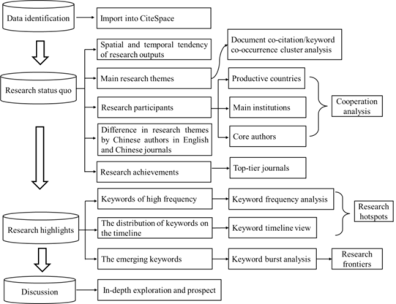
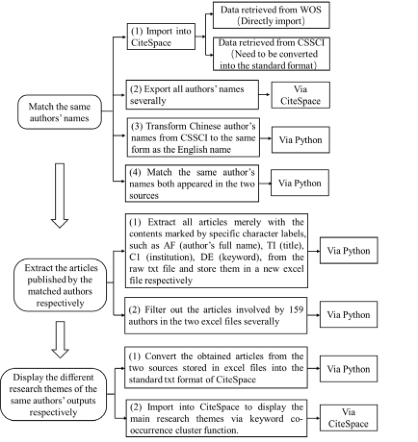
The Development of Policy Analysis About Carbon Neutrality: A Bibliometric Review 95 Moreover, since China came up with the “carbon neutrality” target, Chinese scholars were active about this policy analysis, with abundant scientific outputs both in English and Chinese journals. So, with the interest to explore the distinction of current research achievements in English and Chinese journals by Chinese authors, we compared their research themes. The brief description of all analytical steps is given in Figure 1.
Figure 1: The brief description of analytical steps.
METHOD FOR BIBLIOMETRIC ANALYSIS This bibliometric analysis was completed through two steps: data retrieval with appropriate identification strategy, domain mapping by CiteSpace with various knowledge maps displayed to analyze the development situation of “carbon neutrality” policy research.
We chose the core set of WOS, concretely the Science Citation Index Expanded database (SCIE) and the Social Sciences Citation Index database (SSCI), to retrieve literature data. In order to cover studies related to “carbon neutrality” policy analysis, the ultimate retrieval formula is confirmed to be TS = (“carbon emission * neutral*” OR “carbon neutral*” OR “net*zero emission” OR “nearly zero emission” OR “carbon offset” OR “low carbon” OR “carbon emission”) AND TI = (“policy”). In addition, the literature types we selected were merely articles and reviews.
CiteSpace is one of the most well-known instruments which is a Java- based software developed by Professor Chaomei Chen in early 2004 (Chen, 2004; Jiang & Ashworth, 2021). By means of CiteSpace, we finalized the domain visualization of “carbon neutrality” policy research through research status quo and research highlights.
RESEARCH STATUS QUO Giving all the data processed, then we firstly purposed to overview the status quo of “carbon neutrality” policy research. At first, we presented the
annual publication status and prominent participating countries in different phases. Secondly, we utilized CiteSpace to get a glimpse of the main research themes in “carbon neutrality” policy analysis. Thirdly, we explored whether the research themes by Chinese authors in English and Chinese journals are distinct. Lastly, we displayed several top-tier journals, so that scholars would search efficiently and obtain high-quality articles about “carbon neutrality” policy analysis.
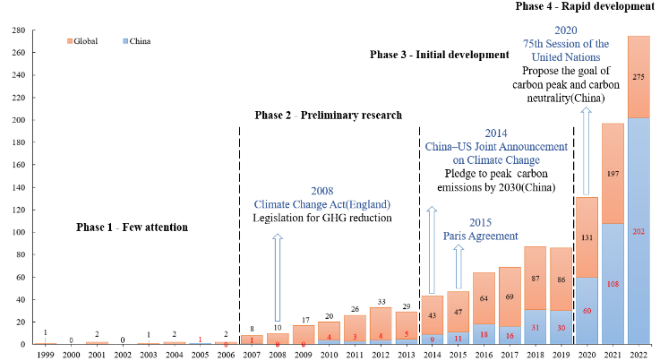
Spatial and Temporal Tendency As shown in Figure 2, a quickly rising trend in total as the years progressed, which suggests “carbon neutrality” policy analysis has appealed to more and more attention. In order to better identify the research evolution, we divide the timeline into four research stages: few attention (before 2007), preliminary research (2007–2013), initial development (2014–2019) and rapid development (2020–2022).
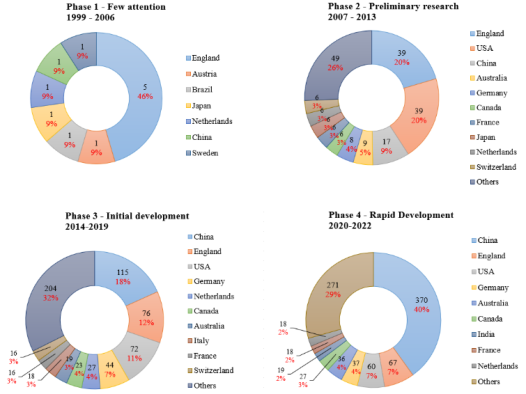
Figure 3 counts the country participation of publications in above four research stages severally. Prior to 2007, there were only nine publications, most from England, indicating that England has paid much earlier attention to carbon dioxide emissions. In Phase 2, England and America had the highest level of scholarly engagement, and then followed by China. In Phase 3, China made its first commitment to peak carbon emissions by 2030 at the China–US Joint Announcement on Climate Change (Wei et al., 2022). Furthermore, in the context of the 2015 Paris Agreement, China has emerged as a leading contributor, having initiated over a hundred outputs. In Phase 4, China proposed a “double carbon” target commitment. The subsequent influx of articles led China to lead the way in this phase, with a total of nearly 400 publications, accounting for about 40% of the global total amount. England and USA still remained respectably stable research enthusiasm.
Figure 2: Temporal trends in publications.Figure 3: Spatial distribution of publications in the four research stages.
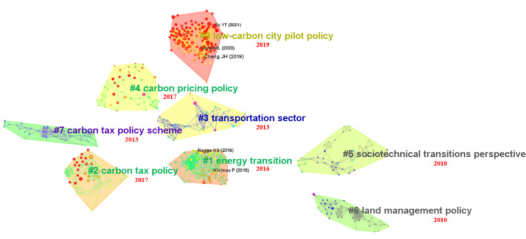
Main Research Themes An academic article usually quotes many references, reflecting the take-up relationship from previous research results. Existing research are necessarily based on the past, and keywords co-occurred frequently are correlative to each other and can be clustered to one theme. Thus, we operated document co-citation and keyword co-occurrence cluster function to obtain research themes of “carbon neutrality” policy analysis.
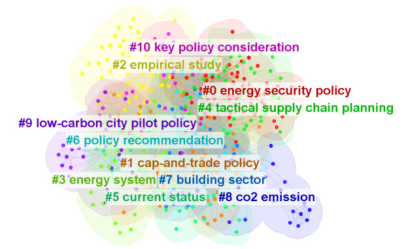
In this paper, the cluster function was employed to visualize the main research themes connected with “carbon neutrality” policy analysis. Document co-citation and keyword co-occurrence cluster network results are shown in Figure 4 and Figure 5.
The co-citation results of the documents show that the main research themes in the field of “carbon neutrality” policy research from early to recent times are “#0 low-carbon city pilot policy”, “#1 energy transition”, “#2 carbon tax policy” etc. It’s observed that cluster “#0 low-carbon city pilot policy” is the more recent research theme in this domain. In the research theme of “low- carbon city pilot policy”, it’s found that Chinese scholars have carried on the most of academic research and the ten most cited articles are all participated by Chinese scholars. The most three co-cited articles all adopt the difference- in-differences method to evaluate the effects of low-carbon city construction on green growth, ecological efficiency and carbon emission efficiency from the perspective of China respectively (Cheng et al., 2019; Song et al., 2020; Yu et al., 2021). Whereas, it’s reached that cluster “#0 energy security policy”, “#1 cap-and trade policy” and “#2 empirical study” are the more current topics in “carbon neutrality” policy research from Figure 5. In general, the analysis of “low-carbon city pilot policy”, “energy security policy” and “cap- and trade policy” are drawing more scholars’ attention recently. And current prime research method is empirical study to test the effect of certain policy.
Papers of the Same Chinese Authors In order to compare the difference of Chinese scholars’ research preference in Chinese and English journals, we also retrieved relevant publications in CSSCI (i.e., Chinese Social Sciences Citation Index). The detailed steps are shown in the Figure 6. First, we match the authors’ names and stored in txt file. Then, the data from both sources were imported to perform author cooperation analysis and exported all authors’ names severally. Since the authors’ names from CSSCI are Chinese, to match the same authors both published articles in English and Chinese journals automatically not manually, we transformed Chinese name to the same form as English name by Python. With the uniform name pattern, 159 authors in total were matched ultimately. Second, we primarily extracted all articles, only with the contents marked by specific character labels from each raw txt file and then stored them in each new excel file. Next, we filtered out the articles from both sources singly which were involved by the 159 authors by judging whether an article includes at least one author of the 159s or not in each excel file through Python code. Finally, in order to delve into the differences of research preference of the 159 authors’ outputs in Chinese and English journals, these articles filtered out from both sources were then converted into the standard analysis format of
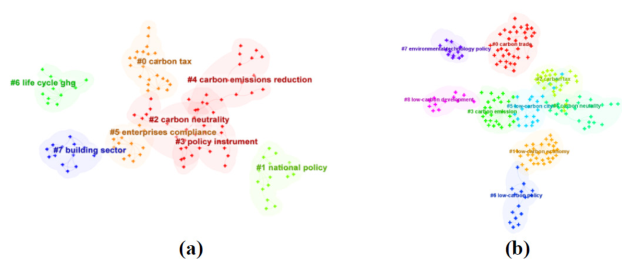
The Development of Policy Analysis About Carbon Neutrality: A Bibliometric Review 99 CiteSpace to display main research themes by keyword co-occurrence cluster function severally. The analysis results are shown in Figure 7a and Figure 7b.
From Figure 7a, the themes of publications in English journals are mainly about “carbon tax”, “national policy”, “carbon neutrality”, “policy instrument”, “carbon emissions reduction”, “enterprises compliance”, “life cycle ghg” and “building sector”. Whereas, the themes of publications in Chinese journals shown in Figure 7b are primarily about “carbon trade”, “low- carbon economy”, “carbon tax”, “carbon emission”, “carbon neutrality”, “low-carbon city”, “low-carbon policy”, “environmental technology policy” and “low-carbon development”. It’s concluded that research in Chinese journals are mostly about “low-carbon development”, systematically explore economy, technology and policy problem of low-carbon development, while research in English journals are more various and specific.
Figure 6: Detailed steps to explore the difference of Chinese scholars’ research preference in Chinese and English journals.Figure 7: The main research themes. (a) Data from WOS; (b) Data from CSSCI.
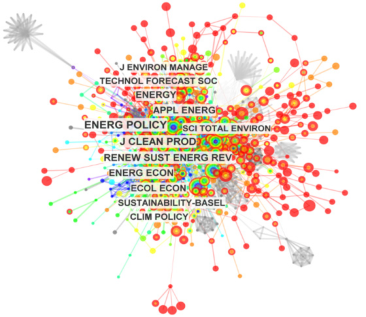
Research Achievements A large number of research achievements had been gathered in the field of “carbon neutrality” policy research. In order to obtain main journals that collected this field’s research results, we then used the journal co-citation network and burst function of CiteSpace to analyze the main sources of knowledge and emerging journals related to “carbon neutrality” policy research. As shown in Figure 8, a diverse range of journals contain “carbon neutrality” policy research. “Energy Policy”, “Journal of Cleaner Production”, “Renewable and Sustainable Energy Reviews”, “Energy Economics”, “Applied Energy” and “Energy”, with more than 400 frequencies, are the main knowledge source in this research field.
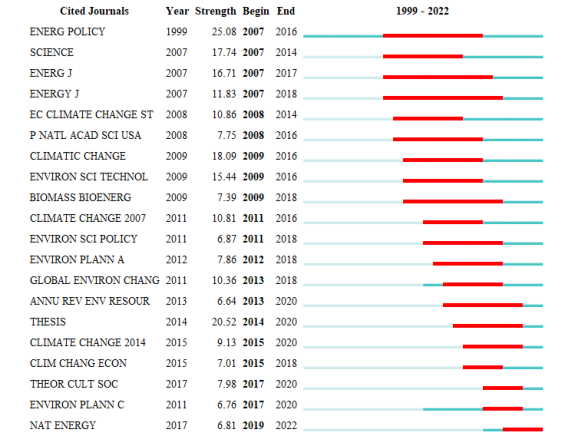
The strength and duration of the burst state are two important attributes of citation bursts. Figure 9 lists top 20 cited journals with the strongest citation burst (Red line segment represents the year of co-citation bursts). “Energy J” was not only the earliest journal with citation burst but also had lasted for the longest: 11 years. Besides, “Energy Policy”, “Science” and “Energ J” were the earliest journals with citation burst as well. Among them, “Energy Policy” had the strongest citation burst. In recent years, the journal “Nat Energy” has emerged, showing that relevant articles in the journal are worth paying attention to recently.
Figure 8: Journal co-citation network.Table 1: Top 10 most co-cited journals.
Table available in the original PDF paper.
Rank Counts Journal Year
1 834 Energy Policy 1999
2 587 Journal of Cleaner Production 2010
3 460 Renewable and Sustainable Energy Reviews 2007
4 438 Energy Economics 2008
5 421 Applied Energy 2010
6 419 Energy 2009
(Continued)
Table 1: Continued.
Table available in the original PDF paper.
Rank Counts Journal Year
7 332 Ecological Economics 2009
8 274 Sustainability -Basel 2017
2010
9 249 Technological Forecasting and Social Change
10 247 Climate policy 2007
Figure 9: Top 20 cited journals with the strongest citation bursts.
RESEARCH HIGHLIGHT After understanding the current state of “carbon neutrality” policy research, we were also interested in research hotspots and frontiers in this field. Based on the keyword co-occurrence function of CiteSpace, we tried to grasp research highlights and current research direction of “carbon neutrality” policy research.
Research Hotspots
Table 2 lists the top 10 most high-frequency keywords. “Impact”, “climate change”, “emission”, “renewable energy” are the research hotspots with higher counts. The research about energy and carbon emission has drawn more scholars’ concentration. Moreover, research in connection with Chinese situation has got high attention. And the popular research method is modeling. From Table 2, it’s concluded that high-frequency keywords focused on studies about “energy”, “climate change”, and “greenhouse gas impacts”
which emphasized the urgency to reduce carbon emissions and explored macroscopic energy and climate policy before 2010. Gradually, diverse and specific policy instruments were discussed. There were more empirical studies to estimate policy effect to find appropriate policy design.
Table 2: Top 10 most co-occurrence keywords.
Table available in the original PDF paper.
Rank Count Centrality Year Keyword 1 181 0.06 2011 impact
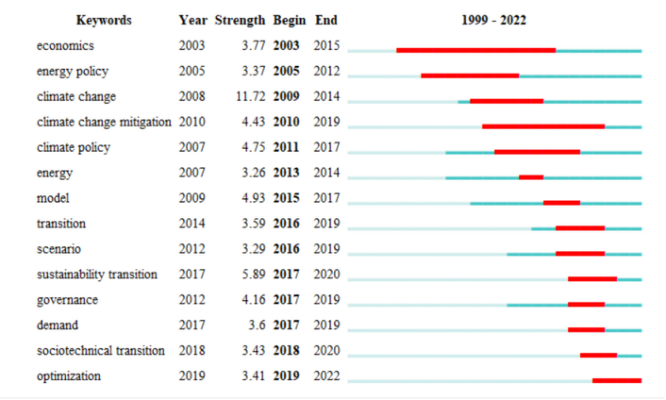
Research Frontiers From Figure 10, “Optimization” is the current research frontiers. The keywords, co-occurring with “optimization”, are “system”, “design”, “supply chain”, “model”, “reduction” and so on. We can focus on the policy analysis of optimization in these aspects. Under the new development mode, technological innovation will be principal driving force for the energy revolution and achieving carbon neutrality. How to organically link them with traditional energy systems to aid in the fundamental optimization of the energy structure via policies is an important issue deserving future investigation.
Figure 10: Keyword timeline view.
CONCLUSION
We proceeded in-depth review of 1,151 documents from WOS database about “carbon neutrality” policy research in the nearly 23 years and used CiteSpace to carry out intensive study on research status quo, hotspots and frontiers in this field.
From the above analysis, we acquired the following critical conclusions: (1) The number of publications increased in the general trend as the years progressed and more and more countries got to participate in the research field. England has so far maintained a strong research enthusiasm in this field from an early stage. It’s worth noting that since 2020 China’s outputs surged due to the pledge to the “double carbon” targets. (2) “Low-carbon city pilot policy” and “cap-and trade policy” are drawing more scholars’ attention recently. (3) 159 Chinese authors who have published articles in both Chinese and English journals are automatically identified via Python codes. It is observed that research in Chinese journals is mostly about low-carbon development, while research in English journals is more various and specific. (4) “Energy Policy”, “Journal of Cleaner Production”, “Renewable and Sustainable Energy Reviews”, “Energy Economics”, “Applied Energy” and “Energy”, with more than 400 frequencies, are the main knowledge sources in this research domain. (5) How to organically link advanced technologies with traditional energy systems to aid in the fundamental optimization of the energy structure through relevant policies is an important issue deserving future investigation in the domain of “carbon neutrality” policy research.
ACKNOWLEDGMENT
The authors would like to acknowledge National Social Science Foundation of China (grant No. 23BSH029) and the Fundamental Research Funds for the Central Universities, China (grant No. 2024CDJSKJJ20) for the financial support.
REFERENCES
Chen, C. (2004) Searching for intellectual turning points: Progressive knowledge domain visualization. Proceedings of the National Academy of Sciences, 101(Suppl. 1), pp. 5303–5310. https://doi.org/10.1073/pnas.0307513100 Chen, C. (2006) CiteSpace II: Detecting and visualizing emerging trends and transient
patterns in scientific literature. Journal of the American Society for Information Science and Technology, 57(3), pp. 359–377. https://doi.org/10.1002/asi.20317 Chen, X. and Lin, B. (2021) Towards carbon neutrality by implementing carbon emissions trading scheme: Policy evaluation in China. Energy Policy, 157, 112510. https://doi.org/10.1016/j.enpol.2021.112510 Cheng, J., Yi, J., Dai, S. and Xiong, Y. (2019) Can low-carbon city construction
facilitate green growth? Evidence from China’s pilot low-carbon city initiative. Journal of Cleaner Production, 231, pp. 1158–1170. https://doi.org/10.1016/j. jclepro.2019.05.327 Del Rio, D.D.F., Sovacool, B.K., Foley, A.M., Griffiths, S., Bazilian, M., Kim, J. and Rooney, D. (2022) Decarbonizing the ceramics industry: A systematic and critical review of policy options, developments and sociotechnical systems. Renewable and Sustainable Energy Reviews, 157, 112081. https://doi.org/10.1016/j.rser.2022.112081
Del Rio, D.D.F., Sovacool, B.K., Griffiths, S., Bazilian, M., Kim, J., Foley, A.M. and Rooney, D. (2022) Decarbonizing the pulp and paper industry: A critical and systematic review of sociotechnical developments and policy options. Renewable and Sustainable Energy Reviews, 167, 112706. https://doi.org/10.1016/j. rser.2022.112706 Duan, H., Rogelj, J., Veysey, J. and Wang, S. (2020) Modeling deep decarbonization:
Robust energy policy and climate action. Applied Energy, 262, 114517. https:// doi.org/10.1016/j.apenergy.2020.114517 Griffiths, S., Sovacool, B.K., Kim, J., Bazilian, M. and Uratani, J.M. (2022) Decarbonizing the oil refining industry: A systematic review of sociotechnical systems, technological innovations, and policy options. Energy Research and Social Science, 89, 102542. https://doi.org/10.1016/j.erss.2022.102542 Jiang, K. and Ashworth, P. (2021) The development of carbon capture utilization
and storage (CCUS) research in China: A bibliometric perspective. Renewable and Sustainable Energy Reviews, 138, 110521. https://doi.org/10.1016/j. rser.2020.110521 Kainuma, M., Matsuoka, Y., Morita, T. and Hibino, G. (1999) Development of an end-use model for analyzing policy options to reduce greenhouse gas emissions. IEEE Transactions on Systems, Man and Cybernetics, Part C: Applications and Reviews, 29(3), pp. 317–324. https://doi.org/10.1109/5326.777068 Rogelj, J., den Elzen, M., Höhne, N., Fransen, T., Fekete, H., Winkler, H., Schaeffer,
R.S., Ha, F., Riahi, K. and Meinshausen, M. (2016) Paris Agreement climate proposals need a boost to keep warming well below 2°C. Nature, 534(7609), pp. 631–639. https://doi.org/10.1038/nature18307 Rogge, K.S. and Duetschke, E. (2018) What makes them believe in the low-carbon energy transition? Exploring corporate perceptions of the credibility of climate policy mixes. Environmental Science and Policy, 87, pp. 74–84. https://doi. org/10.1016/j.envsci.2018.05.009 Shen, L., Lin, F. and Cheng, T.C.E. (2022) Low-carbon transition models of high
carbon supply chains under the mixed carbon cap-and-trade and carbon tax policy in the carbon neutrality era. International Journal of Environmental Research and Public Health, 19(18), 11150. https://doi.org/10.3390/ijerph191811150 Singh, V.K., Singh, P., Karmakar, M., Leta, J. and Mayr, P. (2021) The journal coverage of Web of Science, Scopus and Dimensions: A comparative analysis. Scientometrics, 126(6), pp. 5113–5142. https://doi.org/10.1007/s11192-021- 03948-5 Song, M., Zhao, X. and Shang, Y. (2020) The impact of low-carbon city construction
on ecological efficiency: Empirical evidence from quasi-natural experiments. Resources, Conservation and Recycling, 157, 104777. https://doi.org/10.1016/j. resconrec.2020.104777 Sun, Z., Ma, Z., Ma, M., Cai, W., Xiang, X., Zhang, S., Chen, M. and Chen, L.
(2022) Carbon peak and carbon neutrality in the building sector: A bibliometric review. Buildings, 12(2), 128. https://doi.org/10.3390/buildings12020128 Wei, Y.-M., Chen, K., Kang, J.-N., Chen, W., Zhang, X. and Wang, X.-Y. (2022) Policy and management of carbon peaking and carbon neutrality: A literature review. Engineering, 14, pp. 52–63. https://doi.org/10.1016/j.eng.2021.12.018 Yang, L. and Lin, B. (2016) Carbon dioxide emission in China’s power industry:
Evidence and policy implications. Renewable and Sustainable Energy Reviews, 60, pp. 258–267. https://doi.org/10.1016/j.rser.2016.01.058
The Development of Policy Analysis About Carbon Neutrality: A Bibliometric Review 105 Yangka, D., Rauland, V. and Newman, P. (2019) Carbon neutral policy in action:
The case of Bhutan. Climate Policy, 19(6), pp. 672–687. https://doi.org/10.1080/ 14693062.2018.1551187 Yu, Y. and Zhang, N. (2021) Low-carbon city pilot and carbon emission efficiency: Quasi-experimental evidence from China. Energy Economics, 96, 105125. https:// doi.org/10.1016/j.eneco.2021.105125 Zhao, X., Zuo, J., Wu, G. and Huang, C. (2019) A bibliometric review of green
building research 2000–2016. Architectural Science Review, 62(1), pp. 74–88. https://doi.org/10.1080/00038628.2018.1485548
LISTED IN THE AHFE DIGITAL BOOKSTORE CATALOGUE
Explore the complete digital volume
Sustainable Built Environment
Read this individual research paper free through the original publisher, or explore the full digital proceedings book.
ISBN 979-8-950676-01-7
Explore this ISBN in the AHFE Bookstore ↗Listed in the July 2026 bookstore catalogue; search by ISBN to confirm current availability · Digital book purchase optional