Nana Akua Gyadu-asiedu, Clinton Aigbavboa, Simon Ofori Ametepey, John Aliu (2025). Advancing Construction Innovation: Bibliometric Insights into Large Language Models in the Construction Industry. In: Sustainable Construction in the Era of the Fourth Industrial Revolution. AHFE Open Access, vol. 187, pp. 65–75. https://doi.org/10.54941/ahfe1006561
Large Language Models (LLMs) have revolutionised industries worldwide, and the construction industry is no exception. LLMs enhance digital solutions for construction design and management. It further promotes stakeholder collaborations and assists decision-making by processing large datasets and evaluating embedded systems in modular designs. This study explores the impact of LLMs in the construction industry through a bibliometric analysis of 24 documents retrieved using the Elsevier Scopus database with keywords “Large,” AND “Language,” AND “Models,” AND “Construction,” AND “Industry” spanning from 2000 to 2024. Using the VOSviewer software, the research maps the bibliometric relationships among these documents to uncover key themes, trends, and research gaps in the application of LLMs in the construction industry. The analysis identifies four clusters with emerging themes: Digital solutions for construction design and management, Systems engineering and modular solutions for sustainable development, AI-driven language processing in construction modelling, and Automated information processing and compliance in large datasets. The findings also reveal significant gaps in research. Despite the evident potential of LLMs in streamlining construction industry processes, there is a significant research gap in addressing the customisation and domain-specific adaptation of LLMs to meet the specific requirements of the construction industry task. Existing studies primarily focus on generic applications of LLMs, such as information retrieval and data processing, but lack exploration into their tailored integration for complex tasks like regulatory compliance, modular construction optimisation, and sustainable development resilience. Furthermore, geographic limitations with the United States of America and China leading in research in existing literature highlight a lack of studies focused on developing countries, where the industry is rapidly growing but struggles with adopting digital innovations like LLMs. While the study provides valuable insights, it is limited by the relatively small dataset of 24 documents and the use of the Scopus search database and criteria. Future research could expand the dataset by including broader keywords or alternative databases and examine deeper into cross-regional comparisons. Notwithstanding these limitations, the study significantly contributes to the growing body of knowledge in understanding the integration of LLMs in the construction industry and provides a foundation for further exploration.
Large Language Models (LLMs) have revolutionized industries worldwide, including construction. LLMs are a subset of Natural Language Processing (NLP) models equipped with advanced machine learning capabilities. While NLP serves as the overarching discipline focused on language-related computational tasks, LLMs are specific models within this field that achieve advanced language processing capabilities, pushing the boundaries of what is possible in automated language understanding and generation (Balasubramaniam et al., 2024). They utilize machine learning algorithms to analyze and process vast amounts of pre-existing data, such as text, code, videos, and audio to generate new and meaningful content. As a key aspect of Generative Artificial Intelligence (GenAI) within the machine learning field, LLMs have the potential to redefine innovation and productivity. By leveraging advancements in NLP, LLMs are trained on massive datasets, enabling them to analyze big data with significantly higher accuracy compared to traditional NLP methods (Akhtar, 2024). LLMs like GPT-3.5 and GPT-4.0 are transforming construction processes by leveraging advanced natural language processing for tasks such as project planning, safety management, and knowledge sharing. Applications include extracting structured data from construction documents, project scheduling, and real- time monitoring, reducing errors and improving efficiency (Xue et al., 2022; Yi et al., 2024; Hassan and Le, 2022). They also enhance risk mitigation by analyzing site data like quality control and safety inspections (Chen et al., 2024). Studies highlight their potential to improve workplace safety through hazard identification, streamlined communication, and decision support, while automating repetitive tasks and enabling data-driven decision-making (Charalampidou et al., 2024; Cruz Castro et al., 2024).
This study uses a bibliometric analysis to explore the depth and scope of LLM applications in the Construction Industry and their impact on innovation, productivity, and sustainability. Also, explore research done over the years, and future opportunities, employing the Elsevier Scopus as the primary database. What distinguishes this study is its use of a bibliometric approach to identify gaps and opportunities in the existing body of knowledge. The findings provide a strong theoretical foundation for further research and practical applications in the construction industry. The structure of the paper is as follows: the next section presents a comprehensive review of the relevant literature, followed by a description of the research methodology employed. The fourth section details the bibliometric analysis conducted using the VOS viewer text-mining software. Finally, the paper concludes with a discussion of the key findings.
LITERATURE REVIEW-LLMS IN CONSTRUCTION INDUSTRY The emergence of Large Language Models (LLMs) has marked a paradigm shift in leveraging Artificial Intelligence (AI) in construction project implementation processes. LLMs, such as GPT-4, utilize deep learning techniques to process, understand, and generate human-like language. Their applications span diverse tasks, from text summarization and question
Advancing Construction Innovation: Bibliometric Insights into LLMs 67
answering to complex decision-making processes. In construction, LLMs address long-standing challenges, including inefficiencies in communication, project delays, and safety risks, by automating documentation, enabling real- time collaboration, and improving knowledge management. As a result, these tools not only enhance operational efficiency but also ensure firms to meet the growing demand for innovation in the built environment (Charalampidou et al., 2024; Ghimire et al., 2024; Prieto et al., 2023).
LLMs are increasingly used in construction processes for safety management, project planning, and data analysis. For instance, in safety management, LLMs assist in hazard identification and mitigation by analyzing large volumes of project data and providing actionable insights. This capability has been particularly significant in addressing workplace safety challenges, where human errors often have catastrophic consequences. Furthermore, LLMs aid in automating project documentation and streamlining workflows, such as generating contracts, updating progress reports, and creating detailed technical specifications. These applications reduce administrative burdens and improve accuracy in data-intensive processes (Cruz Castro et al., 2024; Lee et al., 2024).
One significant advantage of LLMs in construction is their capacity for adaptive learning and scalability. LLMs can analyze and interpret evolving project requirements, ensuring dynamic adaptability to changes in scope or regulations. This scalability is critical in large-scale construction projects, where compliance and stakeholder alignment are essential. Moreover, the ability of LLMs to process unstructured data, such as site inspection reports and maintenance logs, allows construction firms to derive actionable insights and optimize resource allocation (Ghimire et al., 2024; Saka et al., 2024). In addition to improving operational efficiencies, LLMs promote sustainability in construction practices. By integrating predictive models, LLMs can optimize material usage, reduce waste, and enhance energy efficiency in project designs. It can further advance material design through Knowledge- Driven Design (KDD) adoption and design of sustainable building concrete. LLMs can leverage a variety of expert-designed tools, including web and literature searches, specialized molecular and reaction utilities, and even the operation of laboratory hardware, thereby enhancing performance in chemistry-related tasks (Völker et al., 2024). These outcomes align with global sustainability goals and enable firms to contribute positively to environmental conservation while meeting industry demands for green construction practices (Regona et al., 2024). Furthermore, the role of LLMs in promoting knowledge sharing and capacity building within construction teams ensures that firms remain competitive and innovative (Prieto et al., 2023). The underpinning theory of Artificial Intelligence (AI) innovative tools in the built environment lies in computational intelligence and machine learning principles (Mhlanga, 2023). These tools, including LLMs, depend on algorithms that learn patterns from vast datasets, enabling predictive analytics, automated reasoning, and decision support (Holzmann and Lechiara, 2022). The integration of AI in construction is rooted in the diffusion of innovation theory, which posits that technological
advancements drive productivity, reduce costs, and foster competitive advantage (Mariani et al., 2023; Wang et al., 2023). In the built environment, these tools support sustainable practices, enhance resource management, and improve stakeholder engagement by aligning technological capabilities with project objectives.
LLMs in the construction industry are transforming traditional workflows, driving efficiency, innovation, and sustainability. As AI technologies continue to evolve, the adoption of LLMs will likely expand, creating new opportunities to address complex challenges in the built environment.
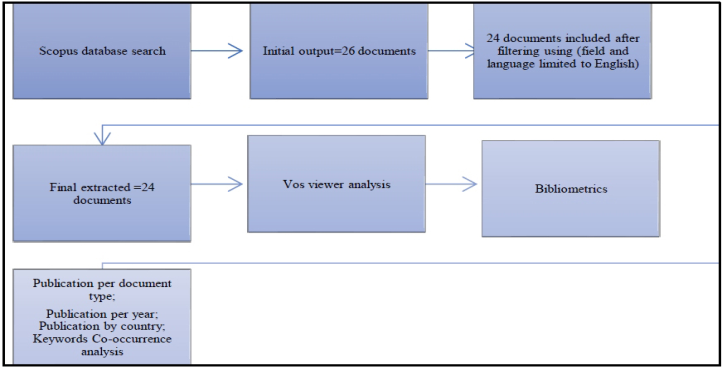
RESEARCH METHODOLOGY This study employed a bibliometric approach to identify and map core knowledge domains and research trends in the field of large language models (LLMs) in the construction industry. Using the Scopus database, renowned for its extensive and reliable literature coverage (Aliu and Aigbavboa, 2023), a retrieval schema combining “large,” “language,” “models,” “construction,” and “industry”was applied to titles, abstracts, and keywords for publications from 2000 to 2024. The search yielded 24 English-language documents after filtering. VOS viewer software was utilized to analyze bibliometric networks, focusing on publication types, geographical distribution, temporal trends, and keyword co-occurrence. A keyword co-occurrence map was generated, followed by cluster analysis, to visualize the structural and physical aspects of research within this domain. This structured methodology provided a systematic and comprehensive exploration of the literature, uncovering key trends, gaps, and knowledge domains in LLM applications in the construction industry. Figure 1 outlines the research methodology employed.
Figure 1: Research methodology employed source: researcher’s construct, 2025.
Advancing Construction Innovation: Bibliometric Insights into LLMs 69
BIBLIOMETRIC ANALYSIS AND DISCUSSION Yearly Publications and Documents by Type
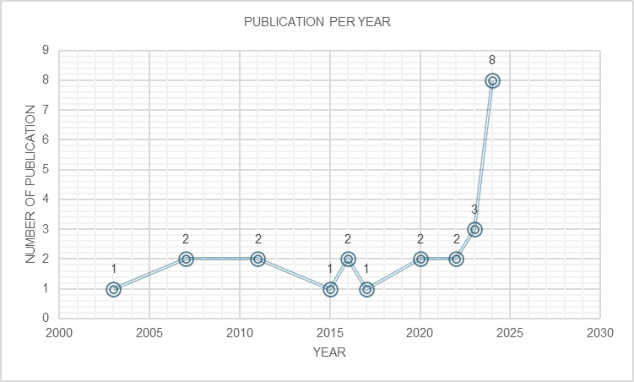
The analysis included 24 documents: 9 journal articles, 11 conference papers, 3 review papers, and 1 book chapter. The lower number of journal articles likely reflects the stringent peer-review process, while the higher count of conference papers may result from their quicker publication timelines and alignment with relevant conference themes. Figure 2 highlights the distribution of publications over the years (2000–2024). From 2000 to 2015, the number of publications remained relatively low and stable, fluctuating between 1 and 2 publications annually. The output briefly dropped to 1 publication in 2014 and 2016. Between 2017–2022, there was a slight upward trend starting in 2017, with 2 publications in most years and a peak of 3 in 2022. Then in 2024, there is a dramatic spike in publications observed in 2024, reaching 8 publications, which is the highest in the period analyzed. This suggests that in 2024 major developments and increased research were seen due to LLMs like GPT-4 and its successors having reached unprecedented levels of sophistication, making them highly applicable to niche industries like construction. Post-pandemic challenges also accelerated the integration of digital solutions in the industry. This led to the recognition and application of LLMs in Construction processes such as Automating project schedules, enhancing stakeholder collaborations and predictive modelling for risk management (Aghimien et al., 2021; Hassan and Le, 2022; Yi et al., 2024; You et al., 2023; Yuan et al., 2024).
Figure 2: Publications per year.
Publication Per Country This section presents the global distribution of publications on LLMs in construction research, highlighting the number of documents and citations by
country. Using a VOS viewer with a minimum threshold of one publication per country, the analysis identified 13 countries contributing research outputs. The United States of America (USA) leads in publication volume (9 publications, 52 citations) but has a lower impact per paper, while the UK (4 publications, 76 citations), UAE (1 publication, 60 citations), and Canada (1 publication, 55 citations) demonstrate high research quality and influence despite smaller publication numbers. China performs well in both volume and total impact (6 publications, 75 citations) following second after the USA. These patterns suggest varying research priorities: the USA and China focus on broader exploration, while the UAE, Canada, and the UK emphasize quality and innovation. Publications from the UAE, Canada, and the UK have received a high number of citations, indicated their significant impact and suggesting that these studies are widely referenced in the context of LLM applications within the construction industry. It could also be attributed to the high-impact journals in which the papers are published (Elsevier and Multidisciplinary Digital Publishing Institute “MDPI”) (Amyot and Eberlein, 2003; Chen et al., 2024; Prieto et al., 2023). The other countries all had one publication: Indonesia and Taiwan (22 cites), Hong Kong and South Africa (12 cites), and Germany (1 cite).
The top 5 countries with the most citations are illustrated in Table 1.
Table 1: Publication per country (top 5 countries).
Table available in the original PDF paper.
Country Documents Citations United States of America 9 52 China 6 75 United Kingdom 4 76 United Arab Emirates 1 60 Canada 1 55
Source: Researcher’s construct, 2025 Analysis of Co-Occurring Keywords
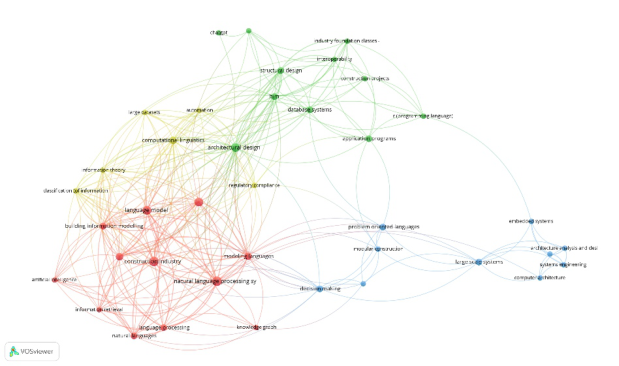
Using Scopus data retrieved and the VOS viewer text-mining tool, a visualization map was created to analyze keyword co-occurrence and research topic networks. This analysis identified research trends and thematic clusters related to the impact of LLMs in the construction industry. The keyword similarity indicates the rate of co-occurrence, and the analysis identified four significant keyword clusters. A network was created from 319 keywords, of which 39 met the threshold of at least two keyword co-occurrences. This is visualized in the network map presented in Figure 3.
Cluster 1: AI-Driven Language Processing in Construction Modelling (Red Cluster). The first cluster has keywords such as Building Information Modelling (BIM), Language Models, Language Processing, Natural Language Processing, Information Retrieval, Modelling Languages, and Construction Industry. The integration of LLMs into construction modelling processes, such as Building Information Modelling (BIM), enhances the ability to process and retrieve complex information. LLMs enable efficient
Advancing Construction Innovation: Bibliometric Insights into LLMs 71
natural language processing, allowing stakeholders to query and analyze construction data, generate reports, and communicate project requirements seamlessly. These tools also facilitate the integration of knowledge graphs and information retrieval systems, improving the interoperability and accuracy of construction models (Chen et al., 2024; Fard and Touran, 2011; Lin et al., 2022; Zheng and Fischer, 2023). Cluster 2: Digital Solutions for Construction Design and Management (Green Cluster). This cluster comprises keywords such as Programming languages, ChatGPT, Database systems, Project management, Architectural designs, Structural designs, Interoperability, Construction projects, Industry Foundation Classes (IFC), and Application programs. LLMs significantly enhance digital solutions for construction design and management as revealed in several studies. By leveraging programming languages and database systems, LLMs support activities such as generating design alternatives, streamlining project management workflows, and facilitating collaboration through tools like ChatGPT. Their ability to ensure interoperability between Industry Foundation Classes (IFC) and other systems is crucial for effective integration across architectural design, structural engineering, and construction project management (Fard and Touran, 2011; Hu et al., 2016; Prieto et al., 2023; You et al., 2023). Cluster 3: Systems Engineering and Modular Solutions for Sustainable Development (Blue cluster). The keywords in the third cluster include Architectural Analysis and Design Language (AADL), Avionics, Computer Architecture, Embedded systems, Large-scale systems, Modular Construction, Systems engineering, Problem-oriented languages, and Decision-making. In the context of systems engineering and modular construction, LLMs assist in decision-making by processing large datasets and evaluating embedded systems in modular designs. They aid in sustainable development by optimizing resource use and predicting the long-term impact of architectural and engineering choices. Additionally, LLMs enhance large- scale systems analysis, enabling effective problem-solving in sustainable construction initiatives (Gullaksen, 2020; Lewis, 2007; Schwenk, 2017). Cluster 4: Automated Information Processing and Compliance in Large Datasets (Yellow cluster). This cluster comprises keywords, Automation, Computational Linguistics, Classification of information, Large datasets, Information theory, and Regulatory compliance. LLMs improve automation and classification processes in construction, particularly in managing large datasets and ensuring regulatory compliance. Their computational linguistic capabilities support real-time decision-making by analyzing compliance standards and automating documentation. By integrating information theory with advanced language processing, LLMs reduce manual errors and enhance the accuracy of regulatory checks and project documentation (Aghimien et al., 2021; Chen et al., 2024; Deligiannis et al., 2008; Gullaksen, 2020; Hassan and Le, 2022; Lin et al., 2022; Saparamadu et al., 2024).
Figure 3: Network visualization map source: Vos viewer software 1.6.19.
CONCLUSION
The study findings revealed the publication activity was relatively consistent with low output until 2022, followed by a sharp increase in 2024; countries with fewer publications, such as the UAE and Canada, are producing highly impactful research, while the USA and China have higher volumes but relatively lower per-paper influence. Overall, North America (USA and Canada) dominates in terms of total publications (10 documents combined) but shows contrasting trends; Asia (China, UAE) also demonstrates strong research contributions, with China leading in volume and the UAE making a significant contribution with one highly impactful paper. The UK balances both quality and quantity, producing fewer papers than the USA or China but achieving the highest total citation count. South Africa was the only African country represented in the publications, with a single study that garnered twelve citations, highlighting its relevance and impact. While LLMs show great potential for streamlining construction processes, research is lacking on their customization for industry-specific tasks, such as regulatory compliance, modular construction optimization, and sustainable development. Existing studies focus on generic applications but neglect tailored integration with construction tools like BIM and IFC. This would ensure seamless integration across architectural, engineering, and project management domains. Bridging this gap could maximize LLMs’ transformative impact on construction workflows and the industry globally.
REFERENCES
Aghimien, E. I., Aghimien, L. M., Petinrin, O. O., Aghimien, D. O., (2021). Highperformance computing for computational modelling in built environment-related studies – a scientometric review. JEDT 19, 1138–1157. https://doi.org/10.1108/ JEDT-07-2020-0294
Advancing Construction Innovation: Bibliometric Insights into LLMs 73
Akhtar, Z. B., (2024). Unveiling the evolution of generative AI (GAI): A comprehensive and investigative analysis toward LLM models (2021–2024) and beyond. Journal of Electrical Systems and Inf Technol 11, 22. https://doi.org/ 10.1186/s43067-024-00145-1 Aliu, J., Aigbavboa, C., (2023). Reviewing the trends of construction education research in the last decade: A bibliometric analysis. International Journal of Construction Management 23, 1571–1580. https://doi.org/10.1080/ 15623599.2021.1985777 Amyot, D., Eberlein, A., (2003). [No title found]. Telecommunication Systems 24, 61–94. https://doi.org/10.1023/A:1025890110119 Balasubramaniam, S., Kadry, S., Prasanth, A., Kumar Dhanaraj, R. (Eds.),
(2024). Generative AI And LLMs: Natural Language Processing and Generative Adversarial Networks, in: Generative AI and LLMs. De Gruyter, p. V–VI. https://doi.org/10.1515/9783111425078-202 Charalampidou, S., Zeleskidis, A., Dokas, I. M., (2024). Hazard analysis in the era of AI: Assessing the usefulness of ChatGPT4 in STPA hazard analysis. Safety Science 178, 106608. https://doi.org/10.1016/j.ssci.2024.106608 Chen, N., Lin, X., Jiang, H., An, Y., (2024). Automated Building Information
Modeling Compliance Check through a Large Language Model Combined with Deep Learning and Ontology. Buildings 14, 1983. https://doi.org/10.3390/ buildings14071983 Cruz Castro, L. M., Castelblanco, G., Antonenko, P. D., (2024). LLM-based System for Technical Writing Real-time Review in Urban Construction and Technology, in: Proceedings of 60th Annual Associated Schoolsof Construction International Conferenc. Presented at the Proceedings of 60th Annual Associated Schools of Construction International Conference, EPiC Series, Auburn, Alabam, pp. 130–120. https://doi.org/10.29007/d9j3 Deligiannis, V., Manesis, S., Lygeros, J., (2008). Global automata: A new
approach on modelling industrial systems. IJISE 3, 383. https://doi.org/10.1504/ IJISE.2008.017551 Fard, J. B., Touran, A., (2011). Construction Smart Forms: An Application of Information Technology to Reduce Waste by Increasing Interoperability, in: Modern Methods and Advances in Structural Engineering and Construction (ISEC-6). Presented at the Modern Methods and Advances in Structural Engineering and Construction, Research Publishing Services, pp. 209–214. https:// doi.org/10.3850/978-981-08-7920-4_S1-C06-cd Ghimire, P., Kim, K., Acharya, M., (2024). Opportunities and Challenges of
Generative AI in Construction Industry: Focusing on Adoption of Text-Based Models. Buildings 14, 220. https://doi.org/10.3390/buildings14010220 Gullaksen, J., (2020). Software Application Based on Subsea Engineering Design Codes, in: Volume 1: Offshore Technology. Presented at the ASME 2020 39th International Conference on Ocean, Offshore and Arctic Engineering, American Society of Mechanical Engineers, Virtual, Online, p. V001T01A016. https:// doi.org/10.1115/OMAE2020-18063 Hassan, F. U., Le, T., (2022). Automated Prioritization of Requirements to
Support Risk-Based Construction Inspection of Highway Projects Using LSTM Neural Network, in: Construction Research Congress 2022. Presented at the Construction Research Congress 2022, American Society of Civil Engineers, Arlington, Virginia, pp. 1270–1277. https://doi.org/10.1061/ 9780784483961.133
Holzmann, V., Lechiara, M., (2022). Artificial Intelligence in Construction Projects: An Explorative Study of Professionals’ Expectations. EJBMR 7, 151–162. https:// doi.org/10.24018/ejbmr.2022.7.3.1432 Hu, Z.-Z., Zhang, X.-Y., Wang, H.-W., Kassem, M., (2016). Improving interoperability between architectural and structural design models: An industry foundation classes-based approach with web-based tools. Automation in Construction 66, 29–42. https://doi.org/10.1016/j.autcon.2016.02.001 Lee, J., Ahn, S., Kim, Daeho, Kim, Dongkyun, (2024). Performance comparison of retrieval-augmented generation and fine-tuned large language models for construction safety management knowledge retrieval. Automation in Construction 168, 105846. https://doi.org/10.1016/j.autcon.2024.105846 Lewis, B., (2007). System Engineering Approaches for Performance Critical Avionics
Embedded Computer Systems Using the Architecture Analysis and Design Language., in: In Annual Forum Proceedings - AHS International, 3. Presented at the Annual Forum Proceedings - AHS International, American Helicopter Society Incorporrated, Alabama, United States, p. 1679. Lin, T.-H., Huang, Y.-H., Putranto, A., (2022). Intelligent question and answer system for building information modeling and artificial intelligence of things based on the bidirectional encoder representations from transformers model. Automation in Construction 142, 104483. https://doi.org/10.1016/ j.autcon.2022.104483 Mariani, M. M., Machado, I., Magrelli, V., Dwivedi, Y. K., (2023). Artificial intelligence in innovation research: A systematic review, conceptual framework, and future research directions. Technovation122, 102623. https://doi.org/ 10.1016/j.technovation.2022.102623 Mhlanga, D., (2023). The Fundamental Concepts and Principles That Underpin
Artificial Intelligence and Machine Learning, in: Responsible Industry 4.0: A Framework for Human-Centered Artificial Intelligence. Routledge, London. https://doi.org/10.4324/9781003393382 Prieto, S. A., Mengiste, E. T., García De Soto, B., (2023). Investigating the Use of ChatGPT for the Scheduling of Construction Projects. Buildings 13, 857. https:// doi.org/10.3390/buildings13040857 Regona, M., Yigitcanlar, T., Hon, C., Teo, M., (2024). Artificial intelligence and
sustainable development goals: Systematic literature review of the construction industry. Sustainable Cities and Society 108, 105499. https://doi.org/10.1016/ j.scs.2024.105499 Saka, A., Taiwo, R., Saka, N., Salami, B. A., Ajayi, S., Akande, K., Kazemi, H., (2024). GPT models in construction industry: Opportunities, limitations, and a use case validation. Developments in the Built Environment 17, 100300. https:// doi.org/10.1016/j.dibe.2023.100300 Saparamadu, P. V. I. N., Jayasena, H. S., Eranga, B. A. I., (2024). Blueprint for a
natural language processing powered nexus for regulatory and legal landscape in construction, in: 12th World Construction Symposium - 2024. Presented at the World Construction Symposium - 2024, Department of Building Economics, pp. 306–317. https://doi.org/10.31705/WCS.2024.24 Schwenk, A., (2017). CEMPL: A new domain-specific language for rapid modeling of cross-energy systems, in: 2017 International Energy and Sustainability Conference (IESC). Presented at the 2017 International Energy and Sustainability Conference (IESC), IEEE, Farmingdale, NY, pp. 1–6. https://doi.org/10.1109/ IESC.2017.8167478
Advancing Construction Innovation: Bibliometric Insights into LLMs 75
Völker, C., Rug, T., Jablonka, K. M., Kruschwitz, S., (2024). LLMs can Design Sustainable Concrete – a Systematic Benchmark. https://doi.org/10.21203/rs.3.rs- 3913272/v1 Wang, Y., Hong, D., Huang, J., (2023). A Diffusion of Innovation Perspective
for Digital Transformation on Education. Procedia Computer Science 225, 2439–2448. https://doi.org/10.1016/j.procs.2023.10.235 Xue, X., Hou, Y., Zhang, J., (2022). Automated Construction Contract Summarization Using Natural Language Processing and Deep Learning. Presented at the 39th International Symposium on Automation and Robotics in Construction. https://doi.org/10.22260/ISARC2022/0063 Yi, M., Ceglinski, K., Ashok, P., Behounek, M., White, S., Peroyea, T., Thetford, T., (2024). Applications of Large Language Models in Well Construction Planning and Real-Time Operation, in: IADC/SPE International Drilling Conference and Exhibition. Presented at the IADC/SPE International Drilling Conference and Exhibition, SPE, Galveston, Texas, USA, p. D021S014R003. https://doi.org/ 10.2118/217700-MS You, H., Ye, Y., Zhou, T., Zhu, Q., Du, J., (2023). Robot-Enabled Construction
Assembly with Automated Sequence Planning Based on ChatGPT: RoboGPT. Buildings 13, 1772. https://doi.org/10.3390/buildings13071772 Yuan, C., Li, L., Su, X., Du, R., (2024). Construction Risk Assessment of Tunnel Crossing Goaf Based on Analytic Hierarchy Process-Extension Theory Model. Energy Science & Engineering ese3.1983. https://doi.org/10.1002/ese3.1983 Zheng, J., Fischer, M., (2023). Dynamic prompt-based virtual assistant framework
for BIM information search. Automation in Construction 155, 105067. https:// doi.org/10.1016/j.autcon.2023.105067
LISTED IN THE AHFE DIGITAL BOOKSTORE CATALOGUE
Explore the complete digital volume
Sustainable Construction in the Era of the Fourth Industrial Revolution
Read this individual research paper free through the original publisher, or explore the full digital proceedings book.
ISBN 978-1-964867-63-2
Explore this ISBN in the AHFE Bookstore ↗Listed in the July 2026 bookstore catalogue; search by ISBN to confirm current availability · Digital book purchase optional