Mohamed Suliman Gardee, Faith Dowelani (2025). Factors Influencing Student Housing Preferences: An Analysis of Communes and PBSAs in Johannesburg. In: Sustainable Construction in the Era of the Fourth Industrial Revolution. AHFE Open Access, vol. 187, pp. 47–56. https://doi.org/10.54941/ahfe1006559
Housing for students constitutes a prominent part of urban real estate markets, which is especially true in areas where a university with a large student population is located. Student accommodation demand has increased due to the National Student Financial Aid Scheme (NSFAS)'s transition from loans to grants, which were allocated as a result of higher university admission rates. The students at the University of Johannesburg campus in APK primarily reside in communes in Brixton or the purpose-built student accommodation (PBSAs) in Auckland Park. The PBSAs are superior; nevertheless, many students prefer to live in the communes. This study endeavoured to analyse the elemental factors of student housing preferences. The research employed a quantitative survey that was carried out among the students staying in communes and PBSAs and focused on the issues of preferences and satisfaction. A Preference Instrument: SAPI Dimension formed the structure of the survey. The findings were that high preference rates were mainly related to the affordability, social environments, and proximity to informal transport networks that communes offered. Key facilities consisted of moderate-sized houses, unlimited Wi-Fi, and shared spaces. PBSAs are recognised for superior security, contemporary facilities like gyms and study areas, and visual attractiveness. The findings further indicated that communal living arrangements in communes cultivate an environment of bonding and social communication, particularly during collective activities, such as cooking. The results suggest that property managers should recognise these choices to enable the high occupancy ratio in rental properties. A subsequent investigation would be helpful in understanding information asymmetries and probable differential pricing strategies.
Student accommodation has become a growing asset class for many investors (JLL, 2016). The surge in investment and demand for this asset class has sparked a search for ways to improve investment yields and increase exposure to this class (IFC, 2020; Jones & Blakey, 2020). As the market for student accommodation is a relatively new asset class (Jones & Blakey, 2020; Newell & Manaf, 2017), investors are looking for ways to increase occupancy and yield (JLL, 2016). Student accommodation alternatives differ based on each institution’s historical context and unique architectural characteristics (Sage,
Smith & Hubbard, 2012; Martin & Allen, 2009). Student accommodation includes on-campus residences and off-campus private accommodation, referred to as Purpose-built student housing (PBSA) and Communes (Kinton et al., 2018).
In South Africa, the National Student Financial Aid Scheme (NSFAS) funds the accommodation for needy students (NSFAS, n.d.), requiring developers to be NSFAS-accredited and adhere to the Minimum Norms and Standards for Student Housing at Public Universities (Department of Higher Education and Training, 2015). Despite these minimum norms and standards for student accommodation, the quality of off-campus private accommodation varies greatly (Mudau, 2017). Landlords aim to offer cost-effective amenities to attract students, and understanding their accommodation preferences and values is crucial for increasing occupancy. The study examined the preferences of NSFAS-funded students in the vicinity of the University of Johannesburg (UJ) Kingsway campus, particularly focused on their choice between commune and purpose-built student accommodation.
COMMUNES A commune, as defined in the Residential Commune Policy August 2009 (COJ, 2009:8), is “a dwelling house where the habitable rooms are rented out for an extended period to unrelated persons who share the communal facilities such as the kitchen, lounge and or dining room as well as bathroom”. Garmendia et al. (2012) assert that the evolution of communes is propelled by property owners who swiftly transform existing homes to satisfy the demand for student accommodation. Ike et al. (2017) suggests that students residing in communes often compromise on quality standards such as prevention of dampness, poor quality of lighting and unsuitable maintenance arrangements. Students viewed communes as quieter, with fewer rules and restrictions and the freedom to have more visitors (Gregory & Rogerson, 2019b).
As observed by the author, a typical commune would comprise a small to medium house that has been renovated or converted for use as a student accommodation property. A typical commune is located on a 495 square metre stand, with street front dimensions of 15–18 meters wide and 25–28 meters deep. This stand would then contain a three-bedroomed home. They are generally further away from the University than PBSAs. The houses will feature unlimited Wi-Fi, larger bedrooms with shared kitchens, and a more homely atmosphere. The surrounding neighbourhoods are urban or suburban, and the neighbourhoods are generally not very clean. The communes are located in low to medium-density neighbourhoods in Joburg, not designated for high density, often containing numerous converted houses (JDA, 2018).
PURPOSE-BUILT STUDENT ACCOMMODATION Purpose-built student Accommodation (PBSA) refers to private sector- constructed accommodation units designed specifically for students
Factors Influencing Student Housing Preferences: An Analysis of Communes and PBSAs 49
(Ince, 2019). PBSA functions as an alternative housing model that integrates living, studying, and socialising for university students (JLL, 2019; Pina, 2021). PBSAs are student accommodation developments with a minimum of 20 beds, marketed and operated near the university. (International Finance Corporation, 2020). Growthpoint, a listed REIT, defined PBSA as “ housing specifically built for university students by private developers “and that they are different from traditional student housing as they are designed and built specifically for university students (Growthpoint Properties, 2021:2). PBSAs provide a furnished bedroom with a bed, desk, chair, wardrobe, desk lamp, bookshelf, and bin. Some PBSAs feature communal kitchens on each floor, accommodating 10–20 bedrooms and communal bathrooms. other PBSAs consist of four-bedroom apartment units with shared kitchens and bathrooms, each occupied by four occupants. Some have dedicated study areas, computer labs, gyms and games rooms, and on-site convenience stores.
STUDENT PREFERENCES Although students’ preferences and their satisfaction with accommodations are related, satisfaction is a function of how well expectations and reality are balanced (Thomsen, 2007). Aghimien et al. (2019) assessed student satisfaction based on physical and social aspects. The study found that private institution students were more satisfied with the social and management characteristics than with the property’s physical characteristics. In contrast, Song (2016) discovered that architecture enhances joy, indicating that a favourable physical environment influences occupants’ emotions and that well-designed buildings contribute to student happiness. According to Ribera et al. (2017), a sense of belonging is crucial for students, and both the living environment and the individuals with whom the student resides influence their sense of belonging on campus. Additionally, Adewumni et al. (2011) discovered that maintenance was a crucial performance area for students in a post-occupancy evaluation of 29 performance criteria.
Edwards (2019) found that (i) Most students wanted convenience, low-cost accommodation, privacy and safety, accommodation within walking distance of the campus, and not sharing showers and bathrooms with other genders. The four most important attributes were unlimited Wi-Fi, a 24-hour computer laboratory, 24-hour on-site security and an on-site convenience store. In addition, Ross and Rassool (2019) and Gopal and Van Niekerk (2018) show safety as an important criterion and preference. The aforementioned research offers a useful overview of the complexity of student preferences and the challenges associated with making assumptions about what students’ desire. Two key studies highlighted students’ preferences in accommodation choice. The study on the Relative importance of Student Accommodation Quality in Higher Education (Nimako & Bondinuba, 2013), as well as the development and validation of the Student Accommodation Preferences Instrument (Khozaei, Hassan & Razak, 2011b). The study by Nimako and Bondinuba (2013) predicated that quality is measured along five metrics, which are:
50 Gardee and Dowelani
Core facility quality relates to the most basic reason for student renting. It covers the bedroom, toilet, and bathrooms, which are the basic qualities first considered.
Enabling facility quality - these facilities are necessary for sound accommodation. These include utilities, security, rules and regulations.
Supporting facility quality - these are value-added facilities like a common room or entertainment, library and so on. These are attractive but not the most important criteria for renting.
Cost - this is what a student would have to pay for the services above and
Overall quality - overall quality combines the above four criteria.
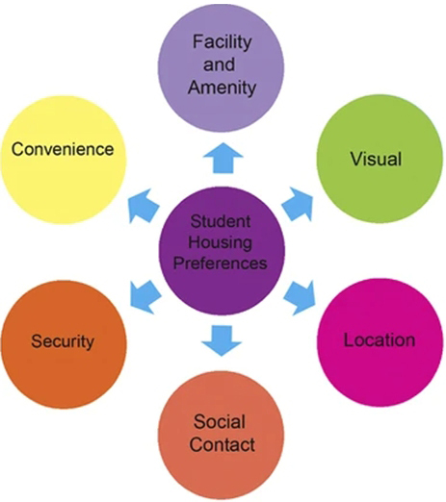
The study by Khozaei et al. (2011b) developed the Student Accommodation Preferences Instrument (SAPI). The distillation of 64 criteria plus six demographic factors resulted in six main dimensions. These are as follows: 1. Facility and amenity, 2. Convenience, 3. Security, 4. Social contact, 5. Location and 6. Visual. Figure 1 is derived from the study and is a visual depiction of the above:
Figure 1: Dimensions of SAPI (Khozaei et al., 2011b).
METHODOLOGY
The study utilized a mixed-method approach. The questionnaire to assess students’ preferences in off-campus residences between communes and PBSAs was developed using the minimum norms and standards for student housing and Khozaei et al. (2011a) dimensions for student accommodation.
Factors Influencing Student Housing Preferences: An Analysis of Communes and PBSAs 51
The questionnaire includes thirteen multiple-choice questions and one qualitative question. The data was analysed using a table, graphs, and tables to display percentages of and the number of responses. Using a deliberate non-probability sampling technique, 124 students from PBSAs and communes participated in the research.
FINDINGS Facilities and Amenities
Table 1 illustrates the choices of residents under the theme facilities and amenities. Both types favour medium-sized properties, but PBSA has a higher proportion of large properties. In terms of the type of kitchens that were preferred, shared communal kitchens are more common than individual kitchens for communes. For PBSA, the spread is almost equal 31.72% for individual kitchens in rooms/units and 34.15% for shared communal kitchens. This indicates a community-oriented living arrangement, though it may also reflect cost-effectiveness in building design. Uncapped WiFi is strongly preferred (83.61% communes and 73.17% PBSA). This reflects the essential nature of internet access for modern student life and academic work.
Table 1: Facilities and amenities.
Table available in the original PDF paper.
Property Type
Instruction to respondent: Please choose which option is most important in your choice of staying in the current accommodation.
Question 6 Type of Kitchens? Question 10 WiFi?
Question 5 Size of Property?
Capped Un capped
Large Medium Small Individual Kitchen in Room/Unit
Visual Visual elements were measured by questions relating to the type of building, neighbourhood, and the look and feel of communes and PBSA accommodations. In terms of the type of building, there was a slight preference towards old, homely houses that were renovated. Under the look and feel theme, commune residents ranked the homely suburban type highly. While PBSA residents ranked many students and a social vibe highly. The findings are presented in Table 2 and Table 3.
52 Gardee and Dowelani
Table 2: The rankings for look and feel preferences.
Table available in the original PDF paper.
Commune PBSA
1. Homely suburban house type building: 37.70%
1. Many students and a social vibe: 46.34% 2. Modern architecturally designed buildings: 34.43%
2. Modern architecturally designed buildings: 34.15% 3. Limited number of housemates, intimate feel: 18.03%
3. Gym and other amenities on site: 17.07% 4. Many students and a social vibe: 6.56% 4. Homely suburban house-type building: 2.44% 5. Gym and other amenities on site: 3.28% 5. Limited number of housemates, intimate feel: 0.00%
Table 3: Summary of visual theme.
Table available in the original PDF paper.
Theme Look and Feel Neighbourhood Type of Building Frequency Highly ranked Frequency Highly Frequency Highly ranked ranked Type of Building
38 Renovated 27
23 Urban neighbourhood
Commune Homely suburban house type building
19 Renovated 12
19 Suburban with trees lining the street
PBSA Many students and a social vibe
Location and Convenience Location was tested in terms of a preference for distance to the University versus proximity to shopping centres or entertainment. 62.30% of commune respondents and 70.73% of PBSA respondents chose to be near the University as a preference, while 22.94% of commune respondents and 26.83% of PBSA respondents were satisfied with being more than 800 metres from the University.
Table 4: Location of accommodation.
Table available in the original PDF paper.
Type of Property
Near to University
Near to Entertainment
Near to Shopping Centre
More Than 800m From University Commune 62,30% 11,48% 3,28% 22,94% PBSA 70,73% 2,44% 0,00% 26,83%
Security As per Table 4, the study found that 32.79% and 51.22% of the commune and PBSA, respectively, preferred full Security – Property with CCTV AND Electric Fence AND 24-hour Guard AND Armed Response, while
Factors Influencing Student Housing Preferences: An Analysis of Communes and PBSAs 53
19.67% and 14.63% were satisfied with one security element and 24% and 17.07 of respondents required at least two security elements. Full security (CCTV + Electric Fence + 24-hour Guard + Armed Response) is overwhelmingly preferred. This demonstrates that security is a top priority for student accommodation, with students favouring comprehensive security measures.
Table 5: Security.
Table available in the original PDF paper.
Type of Property
No Security Elements
One Security Element - Property With CCTV OR Electric Fence OR a 24-Hour Guard OR Armed Response
Full Security - Property With CCTV AND Electric Fence AND 24-Hour Guard AND Armed Response
Three Security Elements - Property With CCTV AND Electric Fence AND Either a 24-Hour Guard OR Armed Response
Two Security Elements - Property With CCTV AND Either Electric Fence OR a 24-Hour Guard OR Armed Response
SUMMARY OF FINDINGS In communes and PBSAs, students prefer medium-sized properties over larger ones. For kitchens, there is a strong preference for shared communal spaces, especially older, homely kitchens where students can cook together with roommates. Uncapped Wi-Fi is a must in both types of accommodation. When it comes to bedrooms, students in communes prefer large or small rooms with shared bathrooms, while PBSA residents strongly prefer smaller rooms, with many opting for a chill area or en-suite. In terms of visual preferences, communes residents lean towards older, homely buildings, though renovated properties are acceptable, with a preference for a homely suburban feel. PBSA residents prefer high-rise, renovated buildings with a social, student-focused vibe. Location-wise, both groups prioritise proximity to the University, though PBSA residents also value being near a suburban neighbourhood with tree-lined streets. Both groups require security features, but PBSA residents demand a higher level of security with CCTV, electric fencing, and 24-hour guards or armed response. The findings clearly show that both commune residents and PBSA residents preferred social spaces through communal kitchens and social environments. Table 6 below presents a summary of the amenities valued along each theme for communes versus PBSAs.
54 Gardee and Dowelani
Table 6: Summary of amenities valued by theme for communes and PBSAs.
Table available in the original PDF paper.
Theme Communes PBSA Medium-sized property
Medium-sized property instead of
Facilities and Amenities instead of large. Shared communal homely older kitchens with the ability to cook with roommates. Uncapped Wi-Fi. Large or small bedroom with a shared bathroom.
High-Rise Renovated building.
large, slight preference. Shared kitchen either being large or smaller and modern. One-third of respondents wanted an individual kitchen. Uncapped Wi-Fi. Smaller bedroom with either a common chill area or an en-suite, otherwise a large bedroom. Visual Preference towards old Many students and a social vibe.
and homely but renovated is also tolerated. Homely suburban house-type building with a social aspect.
Suburban neighbourhood with trees
Location Near to University. Near to University. Convenience Urban neighbourhood.
lining the street.
Preference towards a less suburban quiet neighbourhood.
More security elements are
Security Security elements required
required. At least three security elements, such as CCTV, electric fence, 24-hour guard, or armed response, are required.
at least two security elements in terms of CCV, electric fence, 24-hour guard or armed response.
CONCLUSION
This study analysed the factors influencing student housing preferences between communes and PBSAs in Johannesburg. The study suggests that PBSA developers should consider medium-sized property types to create designs that appeal to end users, as they are preferred. While the PBSA and Commune products are differentiated, both types reveal a desire for full security. This indicates that developers should prioritize security in developing student accommodations, whether a PBSA or a commune. Students prioritize convenience and social aspects of living together, leading to a preference for chill areas and communal spaces in new developments. Additionally, most students value proximity to the University and uncapped Wi-Fi. Overall, there seems to be a demand for elements from both types of housing, and developers should take cognisance of the various elements which can be used from each housing type to provide a product that satisfies the end users.
Factors Influencing Student Housing Preferences: An Analysis of Communes and PBSAs 55
REFERENCES
Adewunmi, Y., Omirin, M., Famuyiwa, F. & Farinloye, O. 2011. Post-occupancy evaluation of postgraduate hostel facilities. Facilities, 29(3/4): pp. 149–168. Aghimien, D., Aigbavboa, C., Adama, J. & Thwala, W. 2019. Students’ housing
satisfaction in private higher institutions. Proceedings of the Tenth International Structural Engineering and Construction Conference, Chicago, Illinois, United States, May 20–25, 2019. City of Johannesburg (COJ). 2009. Commune Policy: Development Planning and Urban Management. COJ. [Online] Available from: https:// mra.ilovemelville.co.za/wp-content/uploads/2016/11/commune_policy09.pdf [Accessed: 2024-02-10]. City of Johannesburg (COJ). 2016. Municipal Planning By-Law, 2016. COJ. [Online] Available from: https://joburg.org.za/documents_/ Documents/By-Laws/Final%20%20JHB%20Municipal%20Planning%20By- law%20June%202016.pdf [Accessed: 2024-02-10]. Department of Higher Education and Training (DHET). 2015. Higher Education Act (101/1997): Policy on the Minimum Norms and Standards for Student Housing at Public Universities. DHET. [Online] Available from: https://www.greengazette.co.za/notices/higher-education-act-101-1997-the- policy-on-the-minimum-norms-and-standards-for-student-housing-at-public- universities_20150929-GGR-39238-00897.pdf. Edwards, S. 2019. Student preferences for accommodation at a Cape Town University: An application of the stated preference approach. Master’s thesis, Cape Town: Cape Peninsula University of Technology. Garmendia, M., Coronado, J. M. and Ureña, J. M., 2012. University students
sharing flats: When studentification becomes vertical. Urban Studies, 49(12), pp. 2651–2668. Gregory, J. J. & Rogerson, J. M. R. 2019. Studentification and commodification of student lifestyle in Braamfontein, Johannesburg. Urbani Izziv, Supplement, 30: pp. 178–193. Growthpoint Properties. 2021. Purpose-built Student Accommodation (PBSA) Growthpoint/Investec Showcase. [Online] Available from: https:// growthpoint.co.za/wp-content/uploads/2021/11/2.-Student-accommodation- GRT_Investec-Showcase-10.11.2021.pdf [Accessed: 2023-09-30]. Gopal, N. & Van Niekerk, C. 2018. Safety in student residences matters! South
African Journal of Higher Education, 32(3): pp 172–188. Ike, N., Baldwin, C. & Lathouras, A. 2017. Optimising tertiary student accommodation within university neighbourhoods. Articulo-Journal of Urban Research. Ince, T. 2019. An overview of private purpose-built student accommodation. Milan: Politenico Milano. International Finance Corporation (IFC). 2020. Market Assessment: The Student Housing Landscape in South Africa. IFC, April 28. [Online] Available from: https://www.ifc.org/en/insights-reports/2021/market-assessment- the-student-housing-landscape-in-south-africa. JDA. 2018. Empire Perth Development Corridor: Strategic Framework. [Online]
Available from: http://dx.doi.org/ [Accessed: 2023-10-02]. Jones Lang Lasalle (JLL). 2016. Student Housing: A New Asset Class in Sub-Saharan Africa. JLL, August 2016. [Online]. Available from: https://propertywheel.co.za/ wp-content/uploads/2016/08/Student-housing-a-new-asset-class-in-SSA-August- 2016.pdf. JLL. 2019. Portugal Student Housing. Lisbon: Lasalle, J. L.
56 Gardee and Dowelani
Jones, S. & Blakey, M. 2020. Student Accommodation: The Facts. Higher Education Policy Institute (HEPI). [Online] Available from: https://www.hepi.ac.uk/wp- content/uploads/2020/08/HEPI-Student-Accommodation-Report-FINAL.pdf. Kinton, C., Smith, D. P., Harrison, J. & Culora, A. 2018. New frontiers of
studentification: The commodification of student housing as a driver of urban change. The Geographical Journal, 184(3), pp. 242–254. Khozaei, F., Hassan, A. S. & Ramayah, T. 2011a. The students’ degree of preference for residence hall facilities and amenities, study of a developing country. African Journal of Business Management, 5(17): 7335–7341. Khozaei, F., Hassan, A. S. & Razak, N. A. 2011b. Development and validation of
the student accommodation preferences instrument (SAPI). Journal of Building Appraisal, 6(3-4): pp. 299–313. Martin, J. and Allen, M., 2009. Students in my backyard: Housing at the campus edge and other emerging trends in residential development. Planning for Higher Education, 37(2), p. 34. Mudau, T. 2017. An exploration of the challenges faced by students residing
off-campus in rural universities in South Africa. Gender and Behaviour, 15(4), pp. 10568–10580. National Student Financial Aid Scheme (NSFAS). (n.d.) Our Mission. NSFAS [Online] Available from: https://www.nsfas.org.za/content/mission.html. Newell, G. & Manaf, Z. 2017. Education As An Asset Class. Western Sydney University: Penrith, NSW, Australia. [Online] Available from: https://www.researchgate.net/profile/Jufri-Marzuki/ publication/332464536_Institutional_investor_attitudes_to_technology- enhanced_university_vertical_campuses_in_the_digital_era/links/ 5cb7b4a3a6fdcc1d499c4e40/Institutional-investor-attitudes-to-technology- enhanced-university-vertical-campuses-in-the-digital-era.pdf. Nimako, S. G. & Bondinuba, F. K. 2013. Relative Importance of Student Accommodation Quality in Higher Education. Current Research Journal of Social Sciences, 5(4): pp. 134–142. Pina, G. 2021. Purpose-Built Student Accommodation (PBSA): The new reality of
student housing in Lisbon. Lisbon: Universidade Catolica Portuguesa. Ribera, A. K., Miller, A. L. & Dumford, A. D. 2017. Sense of peer belonging and institutional acceptance in the first-year: The role of high-impact practices. Journal of College Student Development, 58(4): pp. 545–563. Ross, E. & Rasool, S. 2019. ‘You go to campus with fear and come back with fear’:
University students’ experiences of crime. South African Crime Quarterly, 68(1): pp. 7–20. Sage, J., Smith, D. & Hubbard, P. 2012. The Diverse Geographies of Studentification: Living Alongside People Not Like Us. Housing Studies, 27(8): pp. 1057–1078. Song, Y. 2016. A dormitory could be more joyful: Student housing. Master’s thesis,
Auckland, New Zealand: Unitec Institute of Technology. Thomsen, J. 2007. Home Experiences in Student Housing: About Institutional Character and Temporary Homes. Journal of Youth Studies, 10(5): pp. 577–596. University of Johannesburg (UJ). 2024. Privately Owned Student Accommodation
(POSA) Information. UJ. [Online] Available from: https://www.uj.ac.za/ admission-aid/privately-owned-student-accommodation-posa-information/.
LISTED IN THE AHFE DIGITAL BOOKSTORE CATALOGUE
Explore the complete digital volume
Sustainable Construction in the Era of the Fourth Industrial Revolution
Read this individual research paper free through the original publisher, or explore the full digital proceedings book.
ISBN 978-1-964867-63-2
Explore this ISBN in the AHFE Bookstore ↗Listed in the July 2026 bookstore catalogue; search by ISBN to confirm current availability · Digital book purchase optional