Danie Hoffman, Faith Dowelani, Benita Zulch (2023). A Changing Demographic - Profiling South African Female Quantity Surveyors. In: Human Factors in Management and Leadership. AHFE Open Access, vol. 92, pp. 18–28. https://doi.org/10.54941/ahfe1003730
The growth and prosperity of a profession such as the discipline of quantity surveyors in South Africa are often linked to accurate self-knowledge and integrating that knowledge into future strategies and planning. When the make-up of such a professional discipline is stable, this management process is relatively simple and can rely on previous and existing self-knowledge. However, a young democracy and developing country like South Africa often presents additional challenges. Strategies that rely on knowledge of what the compo-sition of the profession was 5 to 10 years ago may be found wanting today. Successful progress and effective succession planning will require professional disciplines and organ-isations serving these professions to keep up to date with changes in the environment, including the make-up or composition of the profession. The recent COVID-19 pandemic has disrupted many industries and professions alike. However, the pandemic also provided the need for self-reflection and the time and space to perform such contemplation. The South African Association of Quantity Surveyors (ASAQS), assisted by the University of Pretoria, analysed the profile of its members dur-ing this period through a comprehensive questionnaire. A total of 626 valid responses were received from respondents, representing approximately 14% of registered QS's in South Africa.The data from these questionnaires indicate that significant changes are occurring in the profile of the ASAQS membership. These changes are apparent in the age and racial make-up of the current membership. The study also finds the gender of ASAQS members to be an important profiling attribute to describe the changing face of South African quan-tity surveyors. The South African quantity surveying profession of the past consisted mostly of male members of European descent. This study will describe the growing num-ber of female quantity surveyors in South Africa by referring to their age, race, locational spread, academic qualifications, nationality, registration status with the Council of South African Quantity Surveyors, and length of the current employment term. This analysis will provide a reasonably detailed description of the female quantity surveyors in South Afri-ca.The above information will be of value to the Association of South African Quantity Surveyors, the management of quantity surveying firms and institutions such as universi-ties that offer accredited academic programmes to train quantity surveyors. The findings can also be shared with quantity surveying organisations across international borders to compare against their membership profiles.
A Changing Demographic - Profiling South African Female Quantity Surveyors 19
INTRODUCTION
The modern world is characterised by rapid and constant change. Organisati- ons and institutions must be geared to adapt to this change (Campbell, 2021). Berman, Quinn and Paavlo (2012) proposed that managers prioritise inte- rventions to develop their organisation’s abilities to adapt to constant change. Iyengar, Durham and Katz (2016) supported a rapid adaptive change model, while Bordeleau and Felden (2019) favour change management through a structured management approach.
South Africa’s first democratic election in 1994 introduced a period of continuous and substantial change that impacted all facets of South Afri- can society. This change also included the construction industry and the quantity surveying profession. Quantity surveyors (QS’s) are the financial consultants of the construction industry, advising on cost and contractual aspects of construction projects. The South African quantity surveying (QS) profession is well-established in the construction industry but still needs to be well-informed about its members and their needs and challenges. Only well- grounded self-knowledge can be integrated into successful future strategies and planning for the profession.
Effective managing a professional discipline with a stable profile is rela- tively straightforward and can often rely on previous and existing self- knowledge. Indications from the industry are, however, that the profile of the quantity surveying profession is changing quite rapidly. Bowen, Cattell, Distiller and Michell (2007, 2008) confirmed that the number of female quantity surveyors is increasing significantly. Data from tertiary instituti- ons confirms that more females are also entering the profession than before. Female students registering for quantity surveying at the University of Preto- ria (UP) has increased from 35,9% of the cohorts for the period of 2010–2015 to 42,3% for the period 2016 – 2021 (University of Pretoria, n.d.).
FEMALE QUANTITY SURVEYORS The construction industry is typically a male-dominated industry and pre- sents a significant challenge for equal opportunities for females (Amaratunga & Haigh, 2007). In the context of South Africa, Haupt (2009) describes the industry as one of the most untransformed sectors, as the industry is still dominated by white male management and very few females holding top managerial positions in Quantity surveying (Ellison, 2001). Furthermore, female quantity surveyors in South Africa perceived the profession to be dominated by male attitudes, especially concerning the provision of mater- nity leave and flexible working hours (Bowen, Cattell, Michell, and Distiller, 2008). Despite the male dominance, the industry has shown a significant increase in female representation in the workplace and institutions of higher learning in recent decades. According to Jaafar, Puteri Yazrin, Nuruddin, and Jalali (2014), the increase in the number of females entering the construction indu- stry is due to organisational changes in worksite settings and other economic reasons. Although there is an increase in the number of females entering the workplace, there is a challenge of females leaving the industry in their early
thirties and firms are faced with the issue of retention of female labour within the industry (Bowen, Cattell, Michell, and Distiller, 2008).
Since the industry is male-dominated and is viewed as a highly gendered activity, it is hard for females to survive when exhibiting the qualities com- monly associated with females (Amaratunga & Haigh, 2007). Females are seen as emotional, fragile and sensitive. They have their own negotiation style and definition of their professional identities (Powell, Bagilhole, & Dainty, 2009), whereas successful management is based on masculine traits. Many barriers exist to female participation in the industry, despite their commitment, readiness and willingness to adapt to the working environ- ment. According to the literature, the following barriers contribute to females leaving the industry earlier than expected:
Marital commitments (Dainty and Lingard, 2006),
Gender discrimination (Smith 2004),
Lack of awareness about the quantity surveying profession (Balogun, 2006, Smith, 2004),
Work environment and remuneration discrimination (Bentley & Adam- son, 2003),
Organisational barriers to promoting female quantity surveyors (Ellison, 2001), and
Lack of interest on the part of females in Quantity Surveying due to the limited number of females in higher managerial levels in practice (Ojo and Adeyinka, 2011).
In their study, Jaafar, Jalali and Sini (2016) found that marital commi- tment was the highest-ranked reason for employers to recruit more males than females; employers believed that marital commitment affects the level of job commitment expected from married females due to the home front challenges they faced. Historically and culturally, the primary duties of a female are to be nurturers of the family, and their sole dedication must be to look after their husbands and children. The traditional family structure in South Africa – which focuses on females being family caretakers, contributes to hindrances that shorten the professional working life of females in quan- tity surveying. The conflict between work and family obligations that many professionals experience is more acute for women than men (Amaratunga et al., 2007). According to Ginsburg (2012), generally, men are more willing to work longer hours, take financial risks and relocate to remote areas. This can be attributed to the fact that most men do not have social responsibilities that women are expected to perform, for instance, taking care of the children and other family responsibilities.
Working women reported that the daily challenge of being a wage earner and family caretaker left them feeling stressed, tired, unsupported, unackno- wledged, and with sufficient time for their families (Malone, 1998). From their study, Gyllesten & Palmer (2005) observed that females are particu- larly likely to suffer from role overload and that career-family conflict is one of the primary sources of stress for working females. as family responsibilities increase, females tend to reduce their involvement at work and lean towards
A Changing Demographic - Profiling South African Female Quantity Surveyors 21
jobs or roles that are less stressful, striking a balance between family life and work.
The barriers females face in the construction industry contribute to a low representation of females in middle and top management. As a result, there is a low number of women in management who can act as role models or mentors to younger women aspiring to take a similar career path.
THE MERIT FOR THE STUDY This study aims to compile the profile of female QS’s to assist the ASAQS in gaining more comprehensive insight into the changing profile of South African QS’s. Previous research (Bowen, Cattell, Distiller and Michell, 2007, 2008) found that the number of female quantity surveyors is increasing. The number of first-year female students registering for quantity surveying at UP has increased by almost 18% from the period of 2010 – 2015 to the period 2016 – 2021 (University of Pretoria, n.d.). The ASAQS need accu- rate information about this changing profile of its members. This study’s profile of South African female QS’s will include describing their numbers, age, location, race, sex, qualifications, SACQSP registration, and ASAQS membership.
METHODOLOGY
The data for the study originated from a questionnaire distributed by the ASAQS to all South African QS’s on their database. The ASAQS requires updated knowledge of the current profile of its members, including attributes such as age, location, race, sex, qualifications, SACQSP registration, and ASAQS membership. The UP assisted the ASAQS in compiling the research instrument and analysing the data.
The UP lecturers participating in the study have many years of indu- stry experience and have or are serving on the board and committees of the ASAQS. This background gave them the necessary context to link the ASAQS’s requirements with compiling the questionnaire. The questionnaire’s content and the detail of the options available to respondents allowed for providing meaningful data for the study.
The questionnaire, compiled on Survey Monkey, was forwarded ele- ctronically to all QS’s on the database. A total of 626 QS’s responded, representing approximately 14% of registered QS’s in South Africa. The que- stionnaire focused on various aspects to describe South African QS’s. These aspects include age, gender, race, contact details, qualification levels, employ- ment status, SACQSP registration status and ASAQS membership. A signed agreement between the ASAQS and UP secured the above study data.
The data from the questionnaires was captured in Excel and analysed by making use of a detailed Pivot table. The study used the data and statistical analysis tools forming part of the Excel software. The Pivot Table was desi- gned to allow the study access to each of the desired profile facets of female QS’s.
FINDINGS The questionnaire data analyses enabled the study to draw a comprehen- sive profile of South African female QS’s. The most pertinent findings are discussed in the following sections.
Female QS Numbers
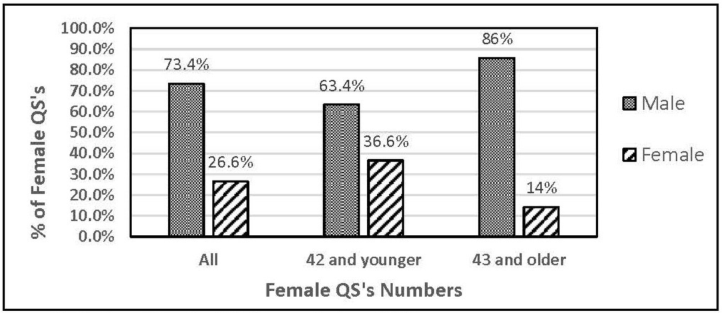
Figure 1 confirmed that female QS’s make up 26.6% of all quantity surveyors. A significant insight was comparing the different gender profiles of older and younger QS’s. Amongst QS’s younger than 43 years, 36.6% are females, while only 14% of QS’s older than 42 years are female. This finding confirms that more young females are entering the QS profession. Based on these findings, the ASAQS should consider including the specific needs of female QS’s more formally in their membership structure.
Age
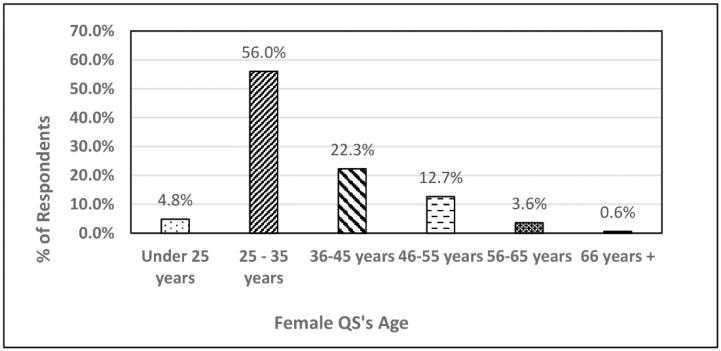
Figure 2 confirmed that most South African female QS’s are relatively young – 60.8% are not older than 35 years, while more than 83% are younger than 46 years.
Race and Age
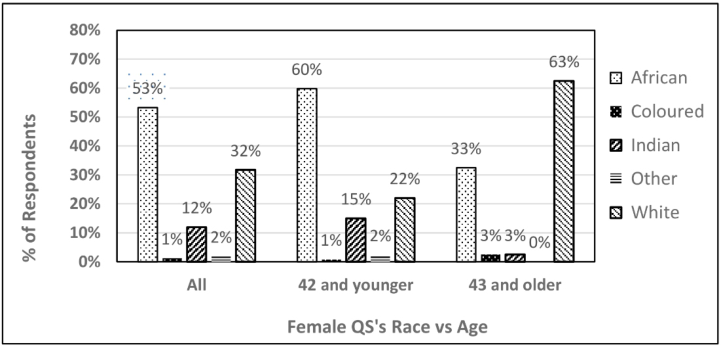
Figure 3 confirms that age reveals a significant change in the gender profile of female QS’s. Amongst female QS’s of 43 years and older white females make- up 63%, with African females at 33% and Indian females at 3%. However, amongst female QS’s younger than 43 years, Africans increased to 60% and Indians to 15% while whites reduced to 22%.
Employment Industry
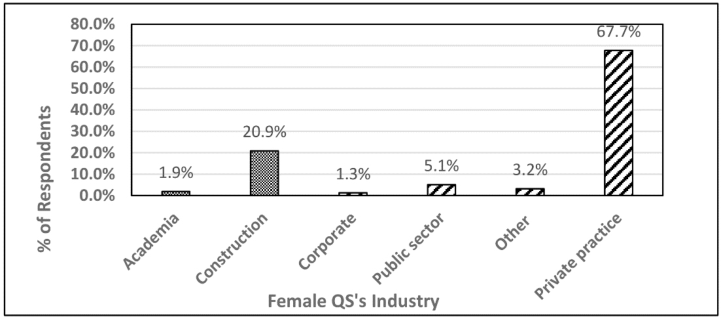
Figure 4 details the industry in which female QS’s are employed. The majority of 67.7% are employed as QS’s in consulting firms, with 20.9% employed as construction QS’s and 5.1% employed in the public sector.
Figure 1: Number of female QS’s (source: authors, 2023).
A Changing Demographic - Profiling South African Female Quantity Surveyors 23
Figure 2: Age of female QS’s (source: authors, 2023).Figure 3: Gender and race of female QS’s (source: authors, 2023).Figure 4: Employment industry of female QS’s (source: authors, 2023).
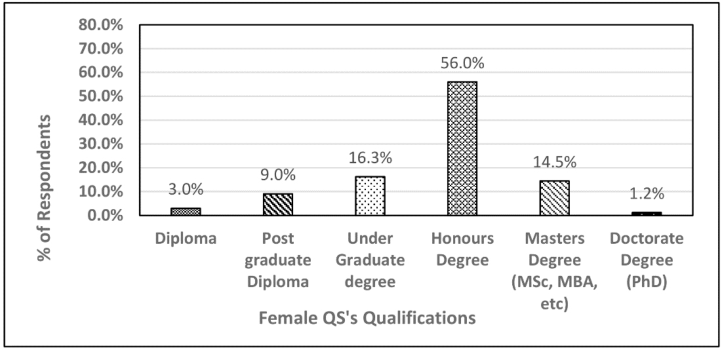
Qualification Level All the female QS’s in the study have tertiary qualifications (see Figure 5). The majority of 56.0% of female QS’s achieved an Honours degree, with a further 16.3% who have B-degrees. A total of 12.0% have diplomas or post- graduate diplomas, while 14.5% have achieved Master’s degrees, and only 1.2% have a PhD.
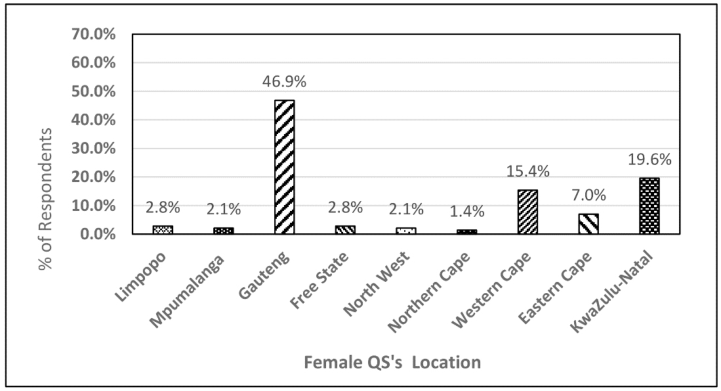
Location The majority of female QS’s in the study resides in the three provinces with the largest economies. A total of 81.9% of female QS’s are from Gauteng (46.9%), KwaZulu-Natal (19.6%) or the Western Cape (15.4%), respectively (see Figure 6).
Figure 5: Qualifications of female QS’s (source: authors, 2023).Figure 6: Location of QS’s (source: authors, 2023).
A Changing Demographic - Profiling South African Female Quantity Surveyors 25
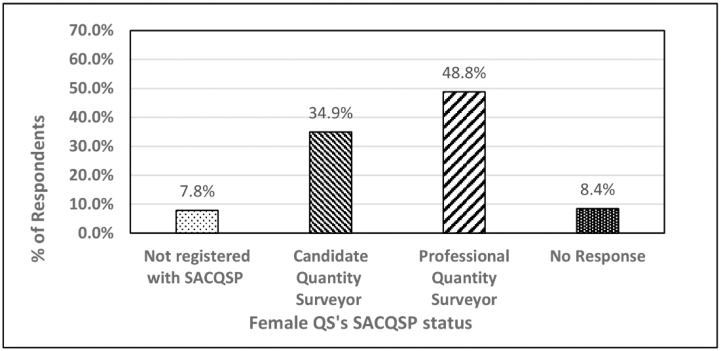
SACQSP Registration The study found that 83.7% of female QS’s are registered with the SACQSP. Of these registered QS’s, 48.8% have registered QS (PrQS) status, while 34.9% are registered as candidate QS’s. Figure 7 confirms that only 7.8% of female QS’s have responded that they are not registered with the SACQSP.
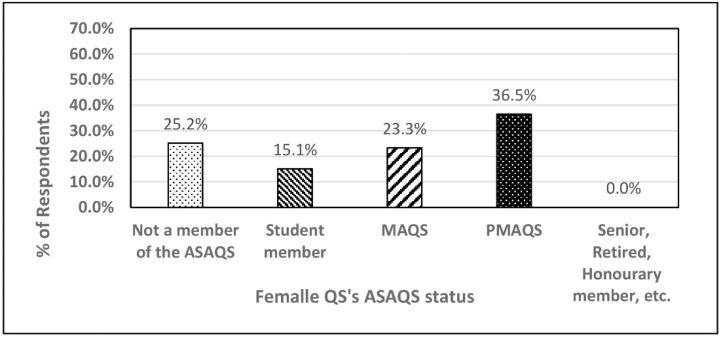
ASAQS Membership The study found that 25.2% of female QS’s are not ASAQS members. Figure 8, however, confirms that 74.9% of female QS’s are currently ASAQS members, with 36.5% being practising members (PMAQS) of the ASAQS.
Figure 7: SACQSP status of female QS’s (source: author, 2023).Figure 8: ASAQS membership of female QS’s (source: authors, 2023).
CONCLUSION
The study made some important findings for the ASAQS and the QS profession to take note of.
The first finding is that the number of female QS’s is increasing significan- tly, with 26.6% of all QS’s and 36.6% of QS’s younger than 43 years being of the female gender. The ASAQS is therefore advised to consider gender-specific needs that female QS’s may have.
The second finding is that female QS’s are relatively young, with more than 83% younger than 46 years. Most female QS’s, therefore, have many years of economic activity left to contribute to the QS profession. The fact that only 16.9% of female QS’s are older than 45 years, can possibly have two interpretations. The first conclusion may be that two or three decades ago a much smaller number of females entered the profession, which resulted in the low number of more senior female QS’s today. The second conclusion may be that female QS’s, due to their different roles in society and their family lives, often do not have such long and extended professional careers as their male colleagues.
The racial profile of QS’s is also changing dramatically. The study compa- res the race of female QS’s within two age groups – ‘younger’ versus ‘equal to or older’ than 43 years. The number of African and Indian female QS’s younger than 43 years is rising sharply to 60% and 15%, respectively, from 33% and 3% compared to female QS’s of 43 years and older. However, the number of white female QS’s has decreased from 63% for older QS’s to 22% for younger QS’s.
The majority of female QS’s (67.7%) are working in the private sector for consultancy firms and are well educated, with 72.3% of them with a Bachelors or Honours degree.
81.9% of female QS’s are already located in the country’s major economic hubs. No relocation of female QS’s is required if the ASAQS’s future strate- gies may target areas of major economic activity currently unattended or not serviced by QS’s.
The sixth finding is that as many as 83.7% of female QS’s are registered with the SACQSP, with 48.8% registered QS’s (PrQS). Only 7.8% of female QS’s are not registered with the SACQSP.
The seventh and last finding is that 25.2% of female QS’s are not ASAQS members, with 74.9% being members and 36.5% being practising members (PMAQS) of the ASAQS. This strong support of the ASAQS from a growing sector of the profession indicates that the ASAQS is well advised to focus on the needs and challenges experienced by female QS’s.
RECOMMENDATIONS The above findings suggest that the ASAQS must keep being informed of the changing profile of QS’s. The number of female QS’s is growing, and their specific needs or challenges will become more critical. The ASAQS must ensure that its future strategies accommodate these identified changes.
The ASAQS is serving the needs and interests of the QS profession very well and has done so for many decades. However, younger female QS’s needs
A Changing Demographic - Profiling South African Female Quantity Surveyors 27
and interests may differ from the older QS’s of the past, and the ASAQS should inform themselves in this regard. With more female managers acting as mentors/role models, they can assist in making the industry more appealing to younger females through various initiatives.
The changing profile of QS’s also suggests that this study is repeated every 2nd or 3rd year to keep the profession and the ASAQS informed of trends and changes amongst QS’s. New, updated and accurate information about the profession and its members will be essential components of the change management plans of the ASAQS to keep the organisation focused on the current and future needs of the profession.
ACKNOWLEDGMENT
The authors would like to acknowledge the support of the ASAQS in distributing the questionnaire and providing access to the questionnaire data.
REFERENCES
Amaratunga R and Haigh R, (2007). Construction Industry and Women: A review of barriers, England: University of Salford. Balogun M. (2006): The Experiences and Expectations of Female Undergraduates in
Construction Education, Unpublished B. Sc Project Dissertation, Department of Building, Obafemi Awolowo University, Ile-Ife. Bentley J and R Adamson, (2003). Gender differences in the careers of academic Scientists and Engineers, New York: National Science Foundation. Berman, R., Quinn, C., Paavola, J. (2012). The role of institutions in the tran-
sformation of coping capacity to sustainable adaptive capacity. Environmental Development, Volume 2, April 2012, Pages 86–100. Elsevier. https://doi.org/10. 1016/j.envdev.2012.03.017 Bordeleau, F and Felden, C. (2019). Digitally transforming organisations: a Review of Change Models of industry 4.0. Proceedings of the 27th European Conference on Information Systems (ECIS), Stockholm & Uppsala, Sweden, June 8-14, 2019. ISBN 978-1-7336325-0-8 Research Papers. https://aisel.aisnet.org/ecis2019_rp /49 Bowen, P, Cattell K, Distiller, G and Michell, K. (2007). Job satisfaction of South Afri-
can quantity surveyors: a racial analysis. Journal of Contemporary Management, Volume 4, pages 86–115. Bowen, P., Cattell, K., Michell, K. and Distiller, G., (2008). Job satisfaction of South African quantity surveyors: is salary a significant factor? Journal of Contemporary Management, 5(1), pp. 13–38. Campbell, J. L. (2021). Institutional Change and Globalisation. Princeton University
Press. Dainty, A. R. J. and Lingard, H., (2006). Indirect Discrimination in Construction Organizations and the Impact on Women’s Careers. Journal of Management in Engineering, 22(3). Ellison, L. (2001). Senior management in chartered surveying: where are the women?
Women in Management Review, 16(6), pp. 264–278. Ginsburg J, 2012. Proceedings of the 2012 Joint International Conference on Human-Centered Computer Environments. New York, ACM, NY.
Gyllesten, K and Palmer, S, (2005). Can coaching reduce workplace stress? A quasi-experimental study. International Journal of Evidence Based Coaching and Mentoring, 3(2), pp. 75–85. Haupt F, (2009). The debt counselling process-closing the loopholes in the national
credit act 34 of 2005, Johannesburg: South African Legal Information Institute. Iyengar, S., Durham, J. and Katz, A. (2016) What strategies are used by institutional entrepreneurs to build adaptive capacity in non-profit organisations? A rapid rea- list review. In 2nd International Conference on Realist Evaluation and Synthesis: Advancing Principles, 2 – 6 October 2016. Jaafar, M., Puteri Yazrin, M. Y., Nuruddin, A. R., & Jalali, A. (2014). How women
quantity surveyors perceive job satisfaction and turnover intention. International Journal of business and technopreneurship, 4(1), 1–19. Jaafar, M., Jalali, A. and Sini, N. M., (2016). Assessing the duties and competencies of female quantity surveyors. Asian Social Science, 12(1), p. 129. Malone K, 1998. Geographies of exclusion: young people’s perceptions and use of
public space. Family Matters, 49(13), pp. 20–26. Ojo, G. K. and Adeyinka, F. B., (2011). Female in quantity surveying profession in Nigeria: a critical review. Issues in the Built Environment of Nigeria, Obafemi Awolowo University Press, Ile-Ife. Powell, A., Bagilhole, B., & Dainty, A. (2009). How women engineers do and undo
gender: consequences for gender equality. Gender, Work & Organisation, 16(4), 411–428. http://dx.doi.org/10.1111/j.1468-0432.2008.00406.x Smith W., (2004) Women in Construction; Construction Economist, The Journal of the Canadian Institute of Quantity Surveyors 14(1). University of Pretoria, No date. Department of Construction Economics. SACQSP
Annual Reports, 2010 – 2021. Unpublished Council reports, Pretoria, South Africa.
LISTED IN THE AHFE DIGITAL BOOKSTORE CATALOGUE
Explore the complete digital volume
Human Factors in Management and Leadership
Read this individual research paper free through the original publisher, or explore the full digital proceedings book.
ISBN 978-1-958651-68-1
Explore this ISBN in the AHFE Bookstore ↗Listed in the July 2026 bookstore catalogue; search by ISBN to confirm current availability · Digital book purchase optional