Danie Hoffman, Derick Booyens, Karl Trusler (2023). Comparing the Profile of South African Quantity Surveyors with Construction Quantity Surveyors. In: Human Factors in Architecture, Sustainable Urban Planning and Infrastructure. AHFE Open Access, vol. 89, pp. 65–75. https://doi.org/10.54941/ahfe1003681
Organisations and professions need adaption skills to survive and prosper in a world of change. As a new democracy, South Africa is experiencing significant change. Organisations such as the Association of South African Quantity Surveyors (ASAQS) must also adapt. The ASAQS is a voluntary association formed to serve the professional needs of Quantity surveyors (QS’s). QS’s offer financial consultancy services to the construction industry. The ASAQS has been considering adding a new membership category for construction quantity surveyors (CQS) since a recent study has shown that more than 17% of QS’s are employed by contractors and do not work as professional consultants. South African CQS’s do not have a professional organisation to serve their interests. A new CQS membership category will address that need, strengthen the ASAQS membership base and expand the ASAQS’s influence in the construction industry. To secure updated information about the profile of QS’s, a questionnaire from the ASAQS, assisted by the University of Pretoria (UP), was recently circulated to all QS’s nationally. In a previous study, the data was used to compile a profile of CQSs to assist the ASAQS’s consideration of a CQS membership category. The profile of CQS’s confirmed them to be relatively young (almost 55% are not older than 35 years), 83% are located in provinces with major urban economic hubs, 63% are African, but less than 10% are from Coloured, Indian or other racial groups. All CQS’s have tertiary qualifications, only 25% of CQS’s are not registered with the South African Council for the Quantity Surveying Profession (SACQSP), but 34% are not ASAQS members. To further assist the ASAQS in considering this new membership category, this study will compare the profile of CQS’s to the profile of consulting QS’s. The findings of this study will assist the ASAQS to more clearly understand the specific nature and traits of CQS’s. Recent and detailed information proposed by this study will help guide the ASAQS’s decision on CQS membership.
Global economies are characterised by the only constant of change (Camp- bell, 2021). To cope with constant change, organisations and institutions have to develop their adaptive capacity to progress and ultimately survive
(Berman, Quinn and Paavola, 2012). This change forces organisations and institutions to be agile and geared to adapt constantly to these changes. Bor- deleau and Felden (2019) argued that a structured approach needs to be adopted to support this constant change management. Research by Iyen- gar, Durham and Katz (2016) supported a rapid adaptive change model accordingly.
The South African construction industry and its stakeholders participating in industry, form part of the effects of these changes globally. In South Africa, the quantity surveying (QS) profession is one of the established construction industry stakeholders that need to adapt to change. The profession needs to be well informed about its members’ needs and challenges but moreover, how the industry influences these needs and challenges.
As the financial consultants of the construction industry, QS’s advise on cost and contractual matters of construction projects. QS’s must comply with the ASAQS’s strict code of professional to ensure that they fulfill their duties and responsibilities professionally (ASAQS, 2022a). In addition, QS’s must also have full regard for the public’s interest, which is of key importance in this profession (Maritz and Siglé, 2010). Professional QS’s must also uphold the dignity and reputation of the QS profession (SACQSP, 2022).
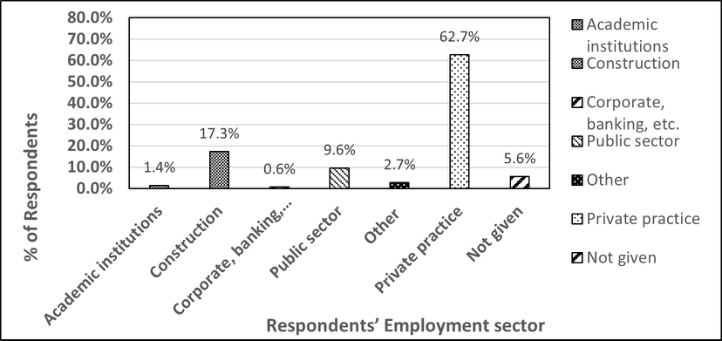
Although the majority of QS graduates are employed by QS consultancy firms, many South African construction companies also employ QS’s (see section Figure 1). When employed by construction companies, QS gradua- tes often find the construction company environment, and being involved with the physical execution phases of projects, more satisfying and they pre- fer to remain within that environment. Many CQS’s choose not to register as professional quantity surveyors with the South African Council for the Quantity Surveying Profession (SACQSP, 2021). A QS employed by a con- struction company, does not need to register professionally (SACQSP, 2021) or be recognized by the ASAQS (ASAQS, 2022a) resulting in many CQS’s never becoming members of the ASAQS (Towey, 2012).
It is therefore important to ask the question whether the SACQSP and the ASAQS should not consider creating a registration category for CQS’s. This study has evaluated and described this issue by listing the different cha- racteristics of CQS’s and comparing that with the characteristics of other QS’s. A detailed profile of a CQS, based upon what industry requires from such a person, will assist the SACQSP and the ASAQS when considering the professional status or possible registration category of CQS’s in South Africa.
SOUTH AFRICAN CQS’S Navigating to South African recruitment agencies online such as www.pnet.co.za and using key search terms such as “construction quantity surveyor”, results in an astonishing 676 results. This is a a strong indication of the need by construction companies to employ CQS’s (PNet, 2023).
The potential value gained by construction companies when employing QS’s are:
Estimate and calculate construction costs at tendering stage;
Comparing the Profile of South African Quantity Surveyors 67
Calculate the potential financial implication of variations ordered;
Do cost planning to determine the value of money of the proposed project;
Advise the construction company’s management team during the tende- ring process on tendering procedures by interpreting the tender documents prepared by the project client’s QS;
Negotiate with and procure material, suppliers and specialist sub- contractors not only during the tendering but also during the construction stages in terms of the contract conditions;
Do project cost control during the construction or execution stage;
Reduce construction defects and re-working during the execution stage;
Meeting regulatory, contractual and legal;
Determine the value of variations and settling the final account;
Source and create new client opportunities towards future;
To set a benchmark to retain existing clients’.
(Chamikara, Perera and Rodrigo, 2020; Ashworth, Hogg and Higgs, 2013; Cartlidge, 2018; Nkado and Meyer, 2001).
Various skills and traits are required by both the QS as well as the CQS. Skills required include bBeing talented and skilled in mathematics, interpre- ting figures and geometry; being a problem-solver with logical reasoning; Being focused and concentrated, whether on the construction site or the office; Being adequately literate with the ability to communication. Traits that are required include working systematically and orderly; being a reliable team member; competency based on a sound knowledge of construction pro- cesses and a solid understanding of project management principles; enjoying the construction industry and wanting to learn more about new techniques as they become available (Towey, 2012; Cartlidge, 2018; Nkado and Meyer, 2001). By adding CQS’s to their management teams, construction companies can therefore be seen as “diversifying” the services they offer by adding the value of having the CQS on board. Mintzberg et al. (2009) and Grant (2005) argue that diversification of firms such as construction firms, stems from the company’s corporate strategy, taking into consideration different business strategies that enhance the corporate performance and development.
THE MERIT FOR THE STUDY The ASAQS is considering adding a membership category for CQS’s. This extended membership category will add to the potential membership of the organisation and will can extend the impact and sphere of influence of the ASAQS. CQS’s will, at the same time be receiving the comprehensive professi- onal support and representation that the ASAQS currently offers to practicing QS’s. Currently neither the SACQSP nor the ASAQS have categories to for- mally accommodate and recognise CQS’s (SACQSP, 2022; ASAQS, 2022b). By contrast the world’s largest institution of construction industry professi- onals in the world the Royal Institution of Chartered Surveyors (RICS) in the UK, does offer membership categories to QS’s who are not practicing as professional consultants (PrQS’s) such as CQS’s (RICS, 2022).
In a previous study (Hoffman, Booyens, Trusler, 2022) detailed the profile of South African CQS’s. This follow-up study compares the previous study’s profile of CQS’s with that of other QS’s. The study findings aims to provide the ASAQS with more comprehensive insight and understanding of South African QS’s employed by the construction industry and will also inform the ASAQS on the possible differences between CQS’s and the characteri- stics of the current ASAQS members. The study’s profile of South African QS’s and CQS’s includes details on their numbers, age, gender, location, race, qualifications, SACQSP registration, and ASAQS membership.
METHODOLOGY
The source of the study data was an ASAQS questionnaire distributed to all South African QS’s on their database to acquire updated knowledge of the current profile of its members. The profile included attributes of age, location, race, sex, qualifications, SACQSP registration, and ASAQS membership. The UP assisted the ASAQS in compiling the questionnaire and analysing the data. The participating UP lecturers’ many years of industry experience combined with serving on the board and committees of the ASAQS provided the study with the necessary context linking the ASAQS’s requirements with the questi- onnaire’s content. This research collaboration enabled the study to provide meaningful data. The Survey Monkey questionnaire was forwarded electro- nically to all QS’s on the database. 626 QS’s (or 14% of registered QS’s in South Africa) responded. The questionnaire focused on various aspects to describe South African QS’s. A signed agreement between the ASAQS and UP confirmed the research collaboration and secured the above study data.
The questionnaires’ was captured in Excel and analysed by means of a detailed Pivot table. The study used the data and statistical analysis tools forming part of the Excel software. The Pivot Table’s design allowed the study access to each of the desired profile facets of QS’s and CQS’s.
FINDINGS Construction QS numbers
CQS’s are the second largest group amongst the responding QS’s with 17,3% employed by construction companies (see Figure 1). Based on this finding, the ASAQS should more seriously consider formally including membership for CQS’s Age and Numbers
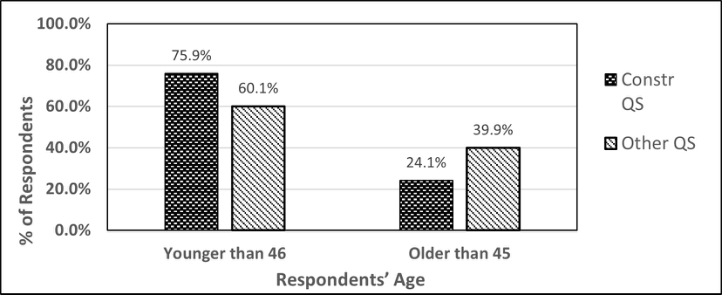
South African CQS’s are relatively young. A total of 75,9% of CQS’s are younger than 46 years compared to 60.1% of other QS’s. Only 24,12% of CQS’s are older than 45 years (see Figure 2).
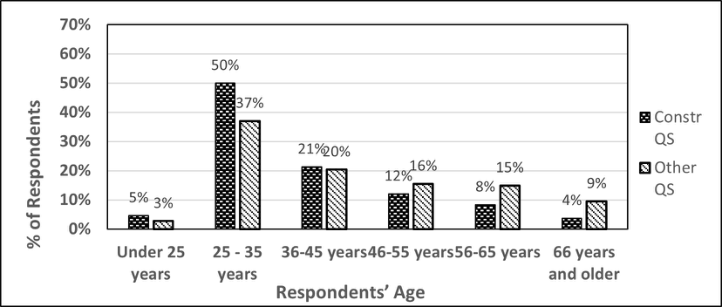
The spread of CQS’s across the sequential age groups declines much qui- cker than the spread for other QS’s. Figure 3 details that a total of 55% of CQS’s are younger than 36 years with only 4% being older than 65 years. The respective numbers for other QS’s are 40% and declining to 9%.
Comparing the Profile of South African Quantity Surveyors 69
Figure 1: Employment sector of CQS’s (source: authors, 2023).Figure 2: Age of CQS’s (source: authors, 2023.)Figure 3: Age categories of QS’s (source: authors, 2023).
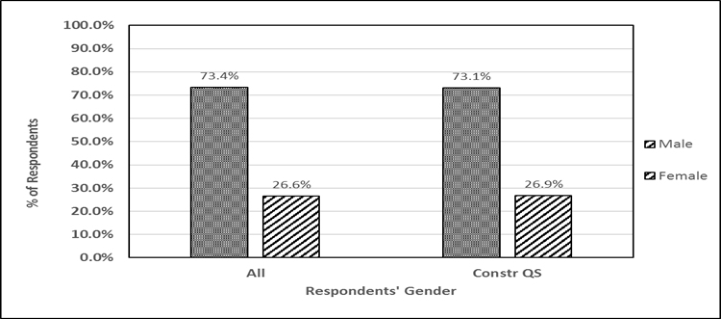
Gender The gender makeup of CQS’s Figure 4 closely resembles that of all QS’s (see Figure 4). Male QS’s make up a total of 73,1% of CQS’s compared to 73,4% of all QS’s. Female QS’s form 26,9% of CQS’s compared to 26,6% of all QS’s. The construction industry was able to attract equal numbers of female qualified QS’s compared to those employed by QS consultancy firms
Location
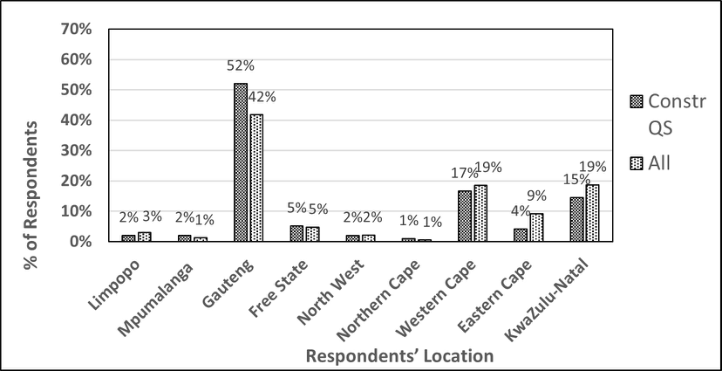
Figure 5 compared the spread of CQS’s vs QS’s amongst the country’s nine provinces. The largest concentrations of both groups occur in the areas of major economic development where most of the construction activities are likely to occur. 84% Of CQS’s are located in the three provinces of Gauteng
Figure 4: Gender of CQS’s (source: authors, 2023).Figure 5: Location of CQS’s (source: authors, 2023).
Comparing the Profile of South African Quantity Surveyors 71
(52%), the Western Cape (17%) and Kwazulu-Natal (15%). The correspon- ding numbers for all QS’s total to 80%, made up of Gauteng (42%), the Western Cape (19%) and Kwazulu-Natal (19%).
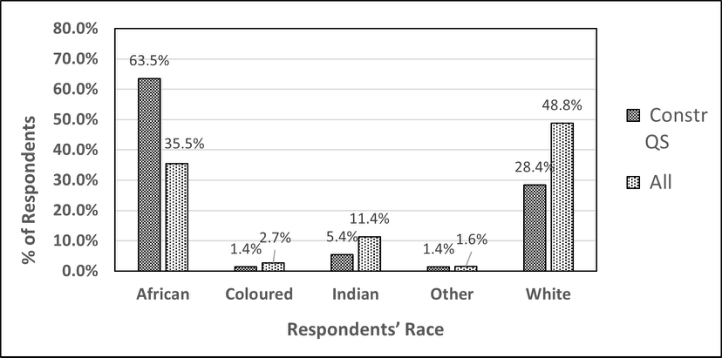
Race Analysing the racial demographic of the respondents reveals distinct diffe- rences between CQS’s and QS’s. Figure 6 details that African QS’s make up 63,5% of CQS’s but only 35,5% of all QS’s. Of all QS’s 48,8% are white compared to only 28,4% being African.
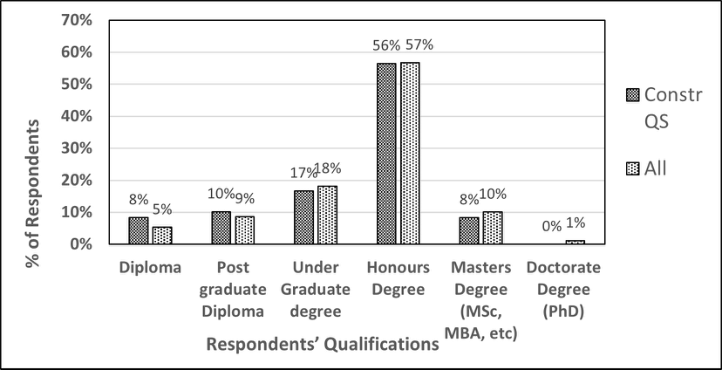
Qualification Level All the respondents have tertiary qualifications (see Figure 7). The majority of 56% (CQS’s) and 57% (All) have Honours degree qualifications, with a
further 17% (CQS’s) and 18% (All) who have B-degrees. A total of 18% (CQS’s) and 14% (All) have diplomas or post-graduate diplomas, while 8% (CQS’s) and 10% (All) have achieved Master’s degrees.
The above finding confirms very little difference between the qualification levels of CQS’s and All QS’s in South Africa. The finding therefore supports the argument for creating an ASAQS membership category for CQS’s.
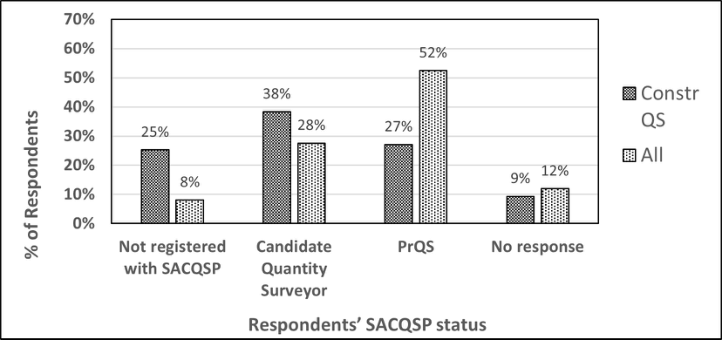
SACQSP Registration The study found that a large portion of 65% CQS’s are registered with the SACQSP compared to 80% of All QS’s (see Figure 8). As CQS’s do not need to be registered, a relatively low number of 27% of CQS’s achieved registration (PrQS) status, comparted to 52% for All QS’s. A relatively large portion of 38% of CQS’s are registered as Candidate QS’s compared to 27% of All QS’s. This may indicate a tendency for younger CQS’s to aspire to PrQS status.
ASAQS Membership
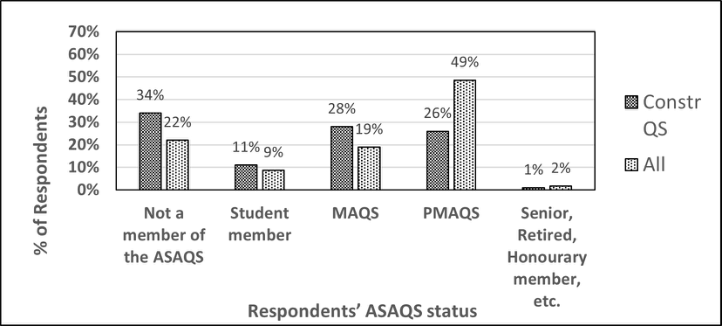
Figure 9 confirms that 66% of CQS’s are ASAQS members even though the ASAQS does not currently have a specific membership category for CQS’s.
Comparing the Profile of South African Quantity Surveyors 73
For all QS’s this number increases to 79%. Only 26,0% of CQS’s are, how- ever practicing members (PMAQS) of the ASAQS compared to 49% for all QS’s.
CONCLUSION
The study made some important findings that the QS profession and specifi- cally the ASAQS should note.
The first finding is that at 17,3% of all QS’s, CQS’s are the second- largest grouping by employment, and supported the ASAQS’s consideration to consider including CQS’s in their membership category.
The second finding is that a larger percentage of CQS’s falls within the younger age categories that other CQS’s. 55% Of CQS’s are younger than 36 years. However, a concern is that only 12% of CQS’s are older than 55 years and CQS’s seems to have a shorter industry lifespan compared to QS’s. The QS profession needs older and more experienced members to lead the profession and mentor younger members.
Thirdly, the study identified that an equal proportion of female QS’s are employed as CQS’s compared to those employed by QS consultancy firms.
The study’s fourth finding is that similar to all QS’s, CQS’s are also located in the country’s provinces of major economic significance. Future strate- gies which the ASAQS may consider for targeting areas of economic activity previously unattended or not serviced by QS’s, will not require significant relocation of CQS’s.
In the fifth instance, the study confirms that the majority of 63,5% of CQS’s are of African descent. For all QS’s this number drops to 35,5%. Of concern is that only 8,2% of CQS’s are from the Coloured, Indian or Other race groups compared to 15,7% for all QS’s. The ASAQS may consi- der a dedicated marketing and communication campaign to ensure a strong and viable supply of future QS’s from these sections of the South African population demographic.
The next finding is that CQS’s achieved a similar high level of tertiary qua- lification as was found for all QS’s. A total of 73% of CQS’s have academic degrees (Bachelors and Honours) compared to 75% for all QS’s. Following the example of the RICS, the ASAQS may do well to consider membership and registration categories catering specifically for CQS’s.
Another finding is that as many as 65% of CQS’s are registered with the SACQSP, but only 27% are registered QS’s (PrQS). A CQS registration cate- gory may suit these QS’s better since they are not performing actual PrQS functions in their day-to-day activities. 25% Of CQS’s are not registered with the SACQSP.
The last finding is that 34% of CQS’s are not ASAQS members and that only 26% of CQS’s are practising members (PMAQS) of the ASAQS. A new and dedicated CQS membership category by the ASAQS may be considered better to suit the needs and challenges of CQS’s.
RECOMMENDATIONS The findings of this study supported by the findings of the previously men- tioned 2022 study support the recommendation that the ASAQS continues to explore the profile and needs of CQS’s and a membership category for CQS’s in more detail. The ASAQS is well informed as to what consulting QS’s require from the organisation. However, CQS’s needs and interests may be quite different, and the ASAQS should inform themselves in this regard. A Pr(CQS) registration category with a specific set of criteria may be introdu- ced by the ASAQS with inputs from other industry stakeholders, especially construction companies.
The study’s findings confirmed that the profession finds itself in a period of rapid change that may well continue in the short to medium term. Therefore the suggestion is made that this study should be repeated every 2nd or 3rd year to keep the profession and the ASAQS informed of trends and changes amongst QS’s. New, updated and accurate information about the profession and its members will be essential components of change management plans for the ASAQS to keep the organisation focused on the current and future needs of the profession.
ACKNOWLEDGMENT
The authors would like to acknowledge the support of the ASAQS in distributing the questionnaire and providing access to the questionnaire data.
REFERENCES
ASAQS. 2022a. What is a Quantity surveyor? [Online] Available from https://www.asaqs.co.za/page/what_is_QS (Accessed on 26 May 2022. ASAQS. 2022b. Membership categories. [Online] Available from https://www.asaqs.
co.za/page/membership-categories. Accessed on 3 June 2022. Ashworth, A., Hogg, K., and Higgs, C. 2013. Wills’s practice and procedure for the quantity surveyor. 13th ed. Oxford: Blackwell Publishing. Berman, R., Quinn, C., Paavola, J. (2012). The role of institutions in the tran-
sformation of coping capacity to sustainable adaptive capacity. Environmental Development, Volume 2, April 2012, Pages 86–100. Elsevier. https://doi.org/10. 1016/j.envdev.2012.03.017. Bordeleau, F and Felden, C. (2019). Digitally transforming organisations: a Review of Change Models of industry 4.0. Proceedings of the 27th European Conference on Information Systems (ECIS), Stockholm & Uppsala, Sweden, June 8-14, 2019. ISBN 978-1-7336325-0-8 Research Papers. https://aisel.aisnet.org/ecis2019_rp /49 Campbell, J. L. 2021. Institutional Change and Globalization. Princeton University
Press. Cartlidge, D. 2018. New aspects of quantity surveying practice 4th Edition. Routledge, Francis & Taylor Group, New York. Chamikara, P. B. S., Perera, B. A. K. S., and Rodrigo, M. N. R. 2020. Competencies
of the quantity surveyor in performing for sustainable construction. International Journal of Construction Management, Volume 20, Issue 3. Grant, R. M. (2005), Contemporary Strategy Analysis, 5th ed., Blackwell Publishing, London.
Comparing the Profile of South African Quantity Surveyors 75
Hoffman, D. J., Booyens, D. E., and Trusler. K. 2022. Agents for Change – Profiling South African Construction Quantity Surveyors. In: Nagar, K. N., Jat, D. S., Mishra, K. M. and Joshi, A. eds. Intelligent Sustainable Systems. Lecture notes on Networks and Systems Vol 578. Singapore: Springer Nature, pp. 541–552. Iyengar, S., Durham, J. and Katz, A. (2016) What strategies are used by institutional
entrepreneurs to build adaptive capacity in non-profit organisations? A rapid rea- list review. In 2nd International Conference on Realist Evaluation and Synthesis: Advancing Principles, 2 – 6 October 2016. Maritz, M. J., & Sigle, H. M. (2010). Quantity surveying practice in South Africa.
Pretoria: Construction Economics Associates (Pty) Ltd. Mintzberg, H., Ahlstrand, B. and Lampel, J. (2009), Strategy Safari Your Complete Guide Through the Wilds of Strategic Management, Prentice-Hall, London. Nkado, R., and Meyer, T. 2001. Competencies of professional quantity surveyors: a
South African perspective. Construction Management and Economics. 19(5):481– 491. PNet [Online] Available from https://www.pnet.co.za/jobs/construction-quantity-su rveyor?rsearch=1. Accessed 24 January 2023. RICS. 2022. Sector pathways. [Online] Available from https://www.rics.org/en-
za/surveying-profession/join-rics/sector-pathways/ Accessed on 3 June 2022. SACQSP. 2021. Annual Report: April 2020 – March 2021. South Africa: South African Council for the Quantity Surveying Profession. SACQSP. 2022. Select your registration category. [Online] Available from https://ww
w.sacqsp.org.za/general/register_member_type.asp? Accessed on 3 June 2022. Towey, D. 2012. Construction Quantity Surveying: A practical guide for the contractor’s quantity surveyor. Wiley & Sons, Proquest.
LISTED IN THE AHFE DIGITAL BOOKSTORE CATALOGUE
Explore the complete digital volume
Human Factors in Architecture, Sustainable Urban Planning and Infrastructure
Read this individual research paper free through the original publisher, or explore the full digital proceedings book.
ISBN 978-1-958651-65-0
Explore this ISBN in the AHFE Bookstore ↗Listed in the July 2026 bookstore catalogue; search by ISBN to confirm current availability · Digital book purchase optional