Emmanuel Ayorinde, Jeffrey Mahachi, Clinton Aigbavboa, Ntebo Ncogbo (2023). Financing Power Infrastructure in a Developing Economy: An Exploratory Factor Analysis Approach. In: Human Factors in Architecture, Sustainable Urban Planning and Infrastructure. AHFE Open Access, vol. 89, pp. 106–117. https://doi.org/10.54941/ahfe1003685
Power infrastructure development plays a fundamental role in nations building and economic growth, and it influences both developed and developing countries. This study assesses the mode of financing power infrastructure in a developing economy. Adopting a quantitative approach, data was retrieved through the use of questionnaire. The target population of the study were professionals saddled in the affairs of implementing policies on power infrastructure. Mean Item Score and Factor analysis served as the methods of data analysis. The study revealed that the most effective ways of financing power infrastructure are public-private partnership; also revealed from the factor analysis is three major constructs that serves as the major ways of financing power projects which are development mechanisms, public-private sources, and foreign financing mechanisms. Conclusively, the study outlined that the weight and strength required to develop power infrastructure effectively is enormous in nature, it is therefore imperative that government institutions find a lasting and effective solution to the problem of power infrastructure financing. Ultimately this will help improve economic profile and social development of a developing economy. This study contributes to the power infrastructure and social development of developing economies. This will help improve electricity security in developing economy since financing power infrastructure effectively is one of the major problem facing development in Africa.
Lack of adequate financing of power infrastructure, both in the developed and developing countries, has the ability of setting nations back economically (Kumari and Sharma, 2017). Therefore, the lack of quick returns on power infrastructure investment, high cost of power infrastructure investment, nega- tive influence of politics, lack of maintenance of power facilities and lack of adequate private sector investment in the Nigeria power industry have led to the poor state of power investment in the country (Ayorinde et al.,
Financing Power Infrastructure in a Developing Economy 107
2018). The investment in infrastructure development is the highest in emer- ging and developing countries, especially the ones with the highest growth, such as India and China in particular. These two nations, together with Bra- zil, South Africa, and Russia, make up the so-called BRICS, which in 2012 produced one-quarter of the world’s gross domestic product (GDP) (Wilson and Purushothaman, 2003). According (Pearson, 2013), infrastructure fina- ncing cannot be funded solely by government’s conventional means which is annual budgeting. Therefore, it is the responsibilities of the government to provide infrastructure facilities, both social and physical infrastructure, to its citizens such as education, health, roads, power, transportation, and water facilities. These provisions will improve the life of the citizens and the country’s economy at large (Alm, 2020).
(Dalkman, 2014), explained that one of the three ways infrastructure can be financed effectively is by helping municipalities obtain the adequate capi- tal they need to finance infrastructure efficiently and in a coordinated way through creating a platform for private finance, which reduces spending by the government while at the same time promoting sustainable econo- mic growth. (Emenike, 2016), also outlined four steps by means of which infrastructure can be financed effectively, namely positive partnering betw- een public and private investors, focusing on private and projects delivered by local government, admission to relevant financial institutions, effective mul- ticity partnership. There is a need for governments to combine with other factors to realise efficient financing mechanisms for infrastructure projects: the private sector and civil society should be included in these factors. The public-private partnership, which is inclusive of both the central government and private sector, plays a significant role in the provision of infrastructure projects (Dalkman, 2014).
Alm (Alm, 2020), further indicates that the collaboration between the public and private sector which is known as a public-private partnership, is effective in the provision and construction of several infrastructure proje- cts. This collaboration can fund infrastructure projects without adding to the fiscal burden of the government. (Annez, 2006), on the other hand, emph- asized that the private-public partnerships have not done enough to fund infrastructure projects as expected. Instead, the little funding available has to be mobilized for practical, political and personal reasons, due to corruption.
(Enright and Newton, 2004), indicate that private sector participation in infrastructure development is not limited to the provision of funding for infrastructure only: it also consists of the distribution of built structure and provision of infrastructure services. This is cheaper when carried out by the private sector and more effective than government when the government finances the same number of projects. Hence, governments need to amend policies to drive private sector participation in infrastructure projects. The involvement of the private sector is well positioned and has the strength economically in the delivery of services, especially when the gains and cost savings exceed the financing amount associated with public financing. The two methods that are required to provide infrastructure through the private sector are public-private partnerships and the privatization of public facilities (Economics, 2016). In view of the glaring challenges of power infrastructure
financing in developing countries, this study aims at assessing the various methods in financing power infrastructure with a view to proffering soluti- ons and abating the long term issues plaguing the power infrastructure and its negative effect on the socio-economic stand of developing countries.
Overview of Power Infrastructure Financing Sub-Saharan Africa is in the middle of a deep crisis in terms of power infra- structure i.e. the supply of electricity. This is because of the insufficient, undependable and expensive nature of power infrastructure. This ineffici- ent power supply has crippled the economic development of the region: the region as a whole has the lowest connection to the power grid. The 48 countries are the sub-Saharan Africa region generate 88 gigawatts (GW) of electricity which is less than a single country such as Spain. For the past three decades there has been little improvement in the development of power infra- structure in the region which has set the region back in terms of economic development compared to the rest of the world (Zhang, 2005). (Banerjee et al., 2008), highlighted that less than 45 per cent of the countries in Africa could achieve global access to power supply by 2030. This is due to the fact that fewer than three out of every ten people in sub-Saharan Africa compa- red to more than half of South Asia and over 90 per cent of East Asia have access to an electricity supply. Power infrastructure in sub-Saharan Africa is very undependable; it is widely known that about 15 per cent of the installed power infrastructure facilities are not in use, mainly owing to maintenance or aging issues (Eberhard et al., 2011). The average monthly consumption per capita in the region is 40 kWh and only 10 kWh if South Africa is remo- ved. This is in contrast with the 100 kWh monthly for developing countries and 1000 kWh monthly for developed countries (Eberhard et al., 2011). South Africa alone generates 60 per cent of the region’s electricity supply, with 40 GW (850 W per individual) which contrasts sharply to the rest of the region. Nigeria is the second largest generator in the region with 4 GW (which is 28 W per individual). This shows the failure of electricity per capi- tal consumption in the region when compared to other regions of the world, both the developing and developed world (Eberhard and Shkaratan, 2012).
The importance of the supply of electricity, socio-economic growth and technological advancement in a nation is evident and cannot be over- emph- asised (Sambo, 2008). (Kaseke and Hosking, 2013), stated that in the Organisation for Economic Co-operation and Development (OECD), volu- mes of reports for “infrastructure to 2030”showed the global need for power infrastructure development. They also noted that this task would run beyond the capabilities of just the central government, and there was a need for private investors to become involved for effective financing of power infra- structure projects for community growth and expansion. (Strickland, 2013) also noted that there is a need to explore alternative source in the financing of power infrastructure projects, due to restraints in the budget which have resulted in a reduction in the traditional financing source of a country. (Merk et al., 2012) also highlighted that several OECD countries have minimized the spending of public resources on public facilities in an attempt to reduce
Financing Power Infrastructure in a Developing Economy 109
public debts, which have left the floor open for collaborations with private investors for the efficient financing of power infrastructure projects. The glo- bal access to electricity supply initiatives launched by the United Nations Secretary-General Banki Moon in 2012 to achieve global access to electricity requires adequate funding and technological investment which will exceed the historic standards. Sub-Saharan Africa (SSA) generates 30.5 per cent of electricity, and the reforms in policies have not been adequately implemented and these have cast doubt on whether Sub-Saharan Africa (SSA) will be able to achieve the mandate of the United nations for global access to electricity and sustainable energy by the year 2030 (Chirambo, 2016).
Ways to Finance Power Infrastructure Since infrastructure can no longer be financed conveniently from the public coffers, there is a need to source for new ways and methods of financing infra- structure projects without relying totally on annual budgeting. The studies by (OECD, 2005) and (Stevens and Schieb, 2007) revealed that the following are the major sources of power infrastructural financing.
Public-private partnerships These have been identified to reduce constru- ction cost, lower operating cost and ensure fast delivery of power infrastru- cture. Also, is the collaboration between the public and private investors with the aim of financing power infrastructure (Stevens and Schieb, 2007). Pension funds This is a promising source of financing power infrastructure facilities because of the large base of financing strength. The enormous assets, and the super league of shareholders involved ensure a long-term and stable returns for investments, making it a suitable source of financing power infrastructure. Pension funds in recent times have moved from a weak form to more stable equity offer for financing infrastructure (OECD, 2005). User charges These are monthly charges on services rendered the revenue of which is turn used in financing the infrastructure e.g. water charges, electricity charges, tolls on expressway are used as a mechanism in financing energy utilities (Stevens and Schieb, 2007). Earmarked taxes These can also mean license fee charges which involve the usage of taxes raised from a specific sector of the economy in financing a particular class of infrastructure.
According to Enright and Newton (Enright and Newton, 2004) Private sector finance have shown that the presence of the private sector in power infrastructure financing is relatively low since most of the cities depend lar- gely on public capital. The lack of involvement of private investment is due to the equity risk involved in the financing of power projects. Therefore, reliable policies and models need to be fully explored to increase private sector participation. This includes different parties such as households, mul- tinational corporations, direct investors and financial institutions such as banks and pension funds to be involved. Unlike public funding, private fun- ding is profit oriented, thus governments need to develop policies that can be fair to the private sector. The governments need to establish and imple- ment policies that can reduce risks that are associated with private financing (Inderst, 2013). Land use This funding means has been used in the financing of infrastructure facilities since the 1980s; it provides capital in the form of
leasing land use rights and charging land use fees in financing power pro- jects. (Cohen et al., 2012), clearly demonstrate that land transfer fees as a funding mechanism have had an annual average growth rate of 54.3 per cent in the past ten years. International aid is given as capital by the World Bank in the financing of power infrastructure projects in the developing coun- tries. Also they are in the form of grants given to a country in developing its power infrastructure sector (Inderst, 2013). Sales of state-owned assets of national assets in recent times has, however, been used by the govern- ment to finance energy utilities and other infrastructure projects for economic growth and benefits (Enright and Newton, 2004). Insurance companies fina- nce power infrastructure projects through, pension funds, offers long-term capital investment and stable returns to investors (Saussier et al., 2009). Par- tial earmarked taxes resources are obtained from heavy goods vehicle fees, value added taxes, excise duties and are channelled into power infrastru- cture development (Saussier et al., 2009). Tax increment financing is a type of mechanism is used to encourage the development of an area in need of impro- vement. This is given as grants by the central government in the revitalization of power infrastructure facilities (Pearson, 2013). Development charges are charges paid by land developers, whose funds in turn are used in the develo- pment of infrastructure in the same region, i.e real estate developers should be made to pay for the infrastructure required to connect their development to the existing infrastructure (Pallant, 2011).
Value capture taxes captures the value of profits of real estate develo- pers due to new infrastructure development nearby or power utilities and diverts these to public finance which is used in financing public infrastructure (Saussier et al., 2009). Green bonds are a means of attracting private fina- nce to green infrastructure projects like renewable energy. They are issued by the European Investment Bank (EIB) and the Asian Development Bank (ADB) for financing power utilities. Also, these are funds obtained because of low greenhouse gas emissions (GHG), as a mechanism in financing power infrastructure (Steven and Schieb, 2007). Public sector Budgeting or diver- sification of the state-owned resources are appropriate in the financing of power infrastructure development and form a traditional means of financing infrastructure in most developing countries (Steven and Schieb, 2007). Grants are funding given in the form of aid by the International Monetary Fund or World Bank in the financing of infrastructure in developing countries (Saus- sier et al., 2009). Higher density building rights is the selling of additional building rights, i.e. additional floors or space on the top of an existing buil- ding, as a means to raise finance for infrastructure development (Pallant, 2011). Utility fees these encourages the conservation of resources and reduce waste for the purpose of financing infrastructure (Saussier et al., 2009).
RESEARCH METHODOLOGY The study adopted a quantitative research approach with the motive of ach- ieving the aim the set out objective, which is ascertaining the effective ways to finance power infrastructure in Nigeria. Questionnaire was the instrument used in the process of data collection; this was developed from a wide review
Financing Power Infrastructure in a Developing Economy 111
of the literature. The target population of the study are practicing power infrastructure professionals in the power sector of Nigeria that are engaged in the implementation of policies in the power sector.
A total of one hundred and fifty (150) questionnaires were distributed using purposive sampling technique, and one hundred and thirty-two (132) were received, this represents a response rate of 88%. The validity and reli- ability of the research instrument was ascertained with the use of Cronbach alpha test, and gave a result of 0.618.
DATA ANALYSIS Two descriptive statistics were carried out, which are in the form of mean item score and factor analysis. The ranking of the variables was done with mean item score, likewise factor analysis was carried out to outline the variables measuring same underlying effects (Ahadzie et al., 2008).
Mean Item Score The mean ranking of the variables presented depicts the individual views reached on by the respondents (Ledwaba, 2012). The result for the test is shown in the table below. The mean table represented below also include the standard deviation of the variables. Table 1: Effective ways to finance power infrastructure in the Nigerian economy.
Factor Analysis Exploratory factor analysis (EFA) is one of the two types of factor analysis (FA) and is often deployed during the initial stage of research by research- ers in order to collate information about the interrelationships within a set of variables (Schwartz et al., 2014). The EFA of the results were obtained
Table 1. Effective ways to finance power infrastructure.
Table available in the original PDF paper.
Rank (R)
Effective ways to finance power infrastructure in Nigeria
Mean (x) Standard deviation (σX) Public-private partnership 4.75 0.530 1 Private finance 4.64 0.702 2 Development banks 4.41 0.741 3 Foreign direct investment 4.32 0.557 4 International financial institutions 4.28 0.832 5 Africa Development Bank 4.15 0.756 6 Pension funds 4.06 1.329 7 Green bonds 4.05 0.873 8 Equity financing 3.90 0.770 9 Public finance (government budget) 3.86 0.997 10 Commercial bank loans 3.69 1.230 11 Insurance company 3.54 1.112 12 Nigerian Bank of Industry 3.54 1.002 13 Inter-government transfer 3.34 1.245 14 Land valuation taxation 3.22 1.154 15
to confirm the validity and reliability of the effective ways to finance power infrastructure in Nigeria, with the highest likelihood with an eigen value of more than one, together with the varimax rotation EFA was used specifi- cally for this study. SPSS software version 21.0 was used to conduct the EFA for this research. The descriptive results show the rankings of all the factors from the first to last according to the variables, with the table representing the individual variables’ mean score as well as the standard deviation of the variables.
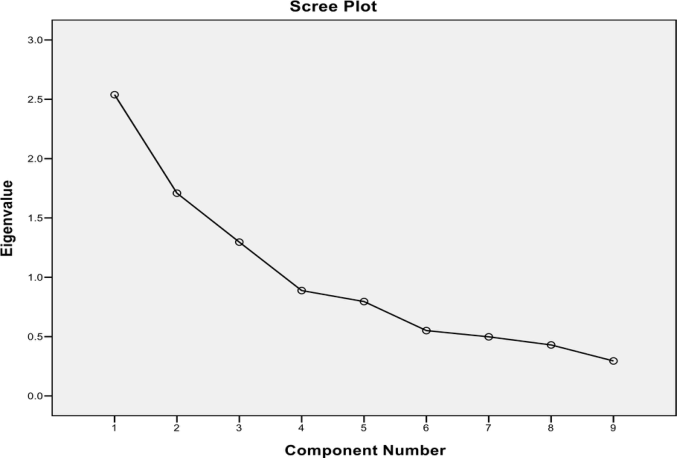
Factor analysis is important in breaking down numbers of large varia- bles and breaking them into more simple clusters for better interpretations (Schwartz et al., 2014). Table 3-6 and Fig. 1 below shows (Table 3) Kaizer- Meyer-Olkin (KMO),the measure of sampling adequacy attained a high score of 0.618. (Table 4) The Bartlett test of sphericity also was important; this suggest that the matrix of population is not an identical matrix. Also, the Cronbach alpha which measures internal consistency is 0.618, therefore it suggests that the reliability of the instrument used by the researcher in the research is quite good.
The data was subjected to principal component analysis (PCA) using vari- max rotation. Also, the eigenvalue was at a conventional high value of 1, as represented in Table 4, with three (3) factors and eigenvalue that exceed 1 were extracted. The Catell’s scree plot represented in Fig. 1 also shows the
Table 2. KMO and Bartlett’s test.
Table available in the original PDF paper.
Kaiser-Meyer measure of sampling adequacy .618 Bartlett’s test of sphericity Approx. chi-square 251.918 Df 36 Sig. .000
Table 3. Rotated factor matrix.
Table available in the original PDF paper.
Factors
1 2 3
.745
African Development Bank (ADB) .867 Development banks .845 Green bonds .712 Commercial bank loans .815 Private finance .800 Public-private partnership .608 International financial institutions e.g. World Bank Equity financing .714 Foreign direct investment .601 Extraction method: Principal component analysis. Rotation method: Varimax with Kaiser Normalization.a a. Rotation converged in 4 iterations
Financing Power Infrastructure in a Developing Economy 113
%
Variance Cumulative
% Total % of
Variance Cumulative
% Total % of
Variance Cumulative
Total % of
Table 4. Total variance explained.
Table available in the original PDF paper.
Factors Initial eigenvalues Extraction sums of squared loadings Rotated sums of squared loadings
extracted factors by indicating the break in the plot where eigenvalues levelled off. The following are the variance values for each of the extracted factors: factor 1 (28.206%), factor 2 (18.985%) and finally, factor 3 (14.403%). The values are shown in Table 5. The final statistics of the extracted factors and PCA account for approximately 62 per cent of the overall cumulative variance.
The principal axis factoring used showed that three (3) were present with eigenvalues greater than 1 as represented in (table 5) above. Owing to the careful observation of the inherent connections among each of the variables under each factor, the following assessments were made: Factor 1 was descri- bed as loan mechanisms; factor 2 was described as public private sources and finally, factor 3 was termed foreign financing mechanisms. The terms used in describing these factors were obtained as a result of closely observing the variables within each of the factors. The two factors extracted and their constituent indicators are explained below, together with a comprehensive description of how the two factor sections were described.
Discussion of Result Factor 1: Development Mechanisms As shown in table 4 above, the three (3) extracted as the effective ways to finance power infrastructure were as follows: for factor 1 was African Development Bank (86.7%), development banks (84.5%), and green bonds (71.2%). The numbers in parentheses showcase the individual factor loa- dings. The definitions of these variables are also explained in Table 2. This cluster accounted for 28.206 per cent of the variance. These findings are in line with the study of (Schwartz et al., 2014); (Dalkman, 2014) outlined that power infrastructure financing can be effectively financed using innovative means of financing other than the tradition means of financing.
Financing Power Infrastructure in a Developing Economy 115
Factor 2: Public-Private Sources As shown in Table 4 above, the three (3) extracted as the effective ways to finance power infrastructure were as follows: for factor 2, commercial bank loans (81.5%), private finance (80.0%), and public-private partnersh- ips (60.8%). The numbers in the parentheses indicate the individual loadings. The definitions of these variables are explained in Table 2 above. This cluster accounted for 18.985 per cent of the variance.
Factor 3: Foreign Financing Mechanisms As shown in Table 4 above, the three (3) extracted as the effective ways to finance power infrastructure were as follows: for factor 3, international fina- ncial institutions e.g World Bank (74.5%), equity financing (71.4%), and foreign direct investment (60.1%). The numbers in the parentheses show the individual loadings. The definitions of these variables are explained in Table 2 above. This cluster accounted for 14.403 per cent of the variance.
Implication of Findings The findings are in line with the study of (Schwartz et al., 2014) and (Dalkman, 2014) where the authors outlined that power infrastructure fina- ncing can be effectively financed using innovative means of financing other than the tradition means of financing. Public-private partnership, private finance, development banks, foreign direct investment, and international financial institutions e.g. World Bank were listed as effective ways to finance power infrastructure in Nigeria. Is it therefore important for Nigeria to adopt these mechanisms of power infrastructure financing for a more improved power development in the country.
From the findings, the theoretical reviews conform to the empirical fin- dings. It can be deduced from the study that public-private financing was seen by the respondents as the most effective way to finance power infra- structure in Nigeria. Likewise, foreign direct investment, private finance, and development among many others can effectively finance power infrastructure in Nigeria. By adopting these mechanisms and findings of this study power infrastructure in Nigeria will be financed effectively for better, greater and more sustainable energy development in Nigeria. When power infrastructure is effectively financed it will lead to development, both in the economy and the living standards of the citizens.
CONCLUSION
Results from the literature review established that effective ways to finance power infrastructure in Nigeria are by public finance i.e. government budget, private finance, and foreign direct investment. However, literature has further shown that other mechanisms such as utility fees and development banks can be used to finance power infrastructure in Nigeria effectively.
Results from the findings of the secondary data i.e. the questionnaire survey indicate that there are eight main mechanisms that be used to finance
power infrastructure in Nigeria effectively. These are public-private par- tnerships, private finance, development banks, foreign direct investment, international financial institutions, the African Development Bank, pension funds and green bonds. It can be said conclusively that this research objective for this study has been answered.
REFERENCES
Ahadzie, D. K., Proverbs, D. G., & Olomolaiye, P. O. (2008). Critical success criteria for mass house building projects in developing countries. International Journal of project management, 26(6), 675–687. Alm, J. (2010). Municipal Finance of Urban Infrastructure: Knowns and Unknowns.
Wolfensohn Center for Development at Brookings. Annez, P. C. (2006). Urban Infrastructure Finance from Private Operators: What have we learned from recent experience? The World Bank. Ayorinde, E., Aigbavboa, C., & Ntebo, N. (2018, July). A Theoretical Assessment of
the Challenges Facing Power Infrastructure Development in Low-Income Coun- tries in Sub-Sahara Africa. In International Conference on Applied Human Factors and Ergonomics (pp. 551–563). Springer, Cham. Banerjee, S., Wodon, Q., Diallo, A., Pushak, T., Uddin, E., Tsimpo, C., & Foster, V.
(2008). Access, affordability, and alternatives: Modern infrastructure services in Africa. Chirambo, D. (2016). Addressing the renewable energy-financing gap in Africa to promote universal energy access integrated renewable energy financing in Malawi. Renewable and Sustainable Energy Reviews, pp. 62793–803. Cohen, I., Freiling, T. & Robinson, E. (2012). The economic impact and financing
of infrastructure spending. Dalkmann, H. (2014). 3 Promising pathways to financial sustainable cities. Available online at: https://www.wri.org/blog/2014/12/3-promising-pathways-finance-s ustainable-cities. Eberhard, A. & Shkaratan, M. (2012). Powering Africa: Meeting the financing and
reform challenges. Energy Policy, 429–18. Eberhard, A., Rosnes, O., Shkaratan, M., Vennemo, H., Foster, V. & Garmendia, C. (2011). Africa’s power infrastructure: Investment. Integration, efficiency. Washington DC: World Bank. Economics, T. (2016). South Africa: Economic indicators. Emenike, D. (2016). A qualitative case study of Nigeria electric power outage and its
economic consequence. Enright, M. J. & Newton, J. (2004). Tourism destination competitiveness: A quantitative approach. Tourism Management, 25(6): 777–788. Inderst, G. (2013). Private infrastructure finance and investment in Europe. Kaseke, N. & Hosking, S. G. (2013). Sub-Saharan Africa electricity supply ina-
dequacy: Implications. Eastern Africa Social Science Research Reviews, 29(2): 113–132. Kumari, A. and Sharma, A. K., 2017. Infrastructure financing and development: A bibliometric review. International Journal of Critical Infrastructure Protection, 16, pp. 49–65. Ledwaba, M. J. (2012). Informal settlements and organisations in post-apartheid
South Africa. Merk, O., Saussier, S., Staropoli, C., Slack, E. & Kim, J. (2012). Financing green urban infrastructure.
Financing Power Infrastructure in a Developing Economy 117
Organisation for Economic Co-operation and Development (OECD). (2005). Financial market trends. No. 89 Supplement, November, pp. 21–22, Paris: OECD. Pallant, J. (2011). Multivariate analysis of variance. SPSS survival manual. Allen &
Unwin. Pallant, J. (2010). SPSS survival manual: A step by step guide to data analysis using SPSS. Maidenhead. England: McGraw-Hill Education. Pearson, M. (2013). Financing infrastructure through innovative strategies in Africa.
Great Insight, pp. 22–3. Sambo, A. (2008). Matching electricity supply with demand in Nigeria. International Association for Energy Economics, pp. 432–36. Saussier, S., Staropoli, C. & Yvrande-Billon, A. (2009). Public–private agreements,
institutions, and competition: When economic theory meets facts. Review of Industrial Organization, 35(1): 1–18. Schwartz, J. Z., Ruiz-Nuñez, F. & Chelsky, J. (2014). Closing the infrastructure finance gap: Addressing risk. Financial Flows Infrastructure Financing, 141. Stevens, B. & Schieb, P. (2007). Infrastructure to 2030: Main findings and policy
recommendations. Infrastructure to 2030, 19. Strickland, T. (2013). Financing urban development and infrastructure in Chicago.
CURDS, Newcastle University, Newcastle upon Tyne. The case of Bethlehem, Tshwane (Mini dissertation). Available online at: http://hdl.handle.net/10210/532. [Accessed 27 February 2022]. Wilson, D. & Purushothaman, R. (2003). Dreaming with BRICs: The path to 2050.
Global Economics Paper, (99):1. Zhang, X. (2005). Critical success factors for public–private partnerships in infrastructure development. Journal of Construction Engineering and Management, 131(1): 3–14.
LISTED IN THE AHFE DIGITAL BOOKSTORE CATALOGUE
Explore the complete digital volume
Human Factors in Architecture, Sustainable Urban Planning and Infrastructure
Read this individual research paper free through the original publisher, or explore the full digital proceedings book.
ISBN 978-1-958651-65-0
Explore this ISBN in the AHFE Bookstore ↗Listed in the July 2026 bookstore catalogue; search by ISBN to confirm current availability · Digital book purchase optional