Matthew Ikuabe, Clinton Aigbavboa, Ayodeji Oke (2023). Principal Component Analysis of Factors Affecting Construction Project Transaction Costs in Developing Economies. In: Sustainable Construction in the Era of the Fourth Industrial Revolution. AHFE Open Access, vol. 107, pp. 121–129. https://doi.org/10.54941/ahfe1003099
The delivery of any construction project is the outcome of economic exchange, usually involving multiple actors. This economic exchange is attributed to costs other than the traditional cost elements of project delivery and is referred to as transaction costs. Optimizing construction transaction costs is a vital constituent in the deliberations of project success, especially from the project client’s perspective. On this basis, this study evaluates the factors affecting construction project transaction costs in the Nigerian construction industry. A questionnaire survey was used in collecting data from the target respondents, while the retrieved data was analyzed with exploratory factor analysis. Findings showed that four constructs critically influence transaction cost in construction project delivery: the client’s behavioral traits, project characteristics, managerial skills, and contractor's behavioral traits. The study’s findings make theoretical contributions to the literature on improving construction project delivery by unraveling the influential factors to transaction costs.
The systemic complexities associated with the delivery of construction proje- cts with respect to project realization are targeted at the attainment of clients’ demands using the dynamism of technical competencies and innovative skills of the project executor (Oh and Choi, 2020). The delivery of construction projects is characterized by the demand for significant financial expense from inception till completion. Therefore, the proper management of financial resources during construction project execution is vital as it serves as one of the cardinal mandates of project success (Ikuabe and Oke, 2020). Conven- tionally, construction contractors are obligated with the responsibility of executing projects which necessitates putting a price for the delivery. This price, as viewed by the contractor, is translated to cost from the client’s perspective (Hillebrandt and Hughes, 2000).
In any production process, such as in construction, there are associated costs other than production costs usually incurred. These costs are termed
transaction costs (Ikuabe et al., 2020). In the transaction costs economics theory (TCE), a transaction is executed when a service or good is transfer- red through an interface that is technologically distinct (Williamson, 2010). The costs related to transforming inputs into outputs are known as produ- ction costs, while the costs associated with the economic exchange are known as transaction costs. For construction projects, transaction costs include but are not limited to the preparation of bidding documents, setting up a con- tract, contract administration, handling deviations from contract conditions, legal costs, the cost of extracting and processing information, etc. (Li et al., 2014). Since construction cost is a vital parameter in determining project performance (Oke, 2022), it becomes imperative to assess the factors influ- encing construction project transaction costs. On this premise, this study presents the outcome of evaluating the factors influential to construction project transaction costs in project delivery.
LITERATURE REVIEW
According to Casson (2013), transaction costs are financial expenditures lin- ked with an economic exchange, distinct from the exchanged product and competitive price. Also, transaction costs can be seen as costs associated with the market exchange, enforcing agreements, and negotiating contra- cts (Nirvikar, 2008). For construction projects, economic exchange is usually administered over a long period of time and attributed to a significant degree of complexity and uncertainty while being unable to ascertain contingency (Kardes et al., 2013) fully. Therefore, transaction costs incurred over this stretch of time are influenced by several factors. According to Ozorhon et al. (2010), project owner’s timely payment of works eliminates doubtfulness, therefore leading to fewer calls for claims by the contractor and consequently reducing the likelihood of legal disputes. Also, projects prone to incomplete designs or poorly defined scope increase the susceptibility to post-contract changes, thereby affecting the transaction costs of the project (Cardens et al., 2017). Furthermore, based on the organizational efficiency of the contra- cting organization, the capacity to maximize outlined outputs would present a good flow of project delivery. While also, the contractor’s exhibition of a good relationship with subcontractors would induce a good general per- formance by the contractor (Manu et al., 2015), hence reducing transaction costs.
Claims made by contractors are presented for recompense or relief during project execution. This can be harmoniously settled between parties to the contract; however, some can degenerate into unwanted disputes (Assaf et al., 2019), consequently leading to a rise in transaction costs. Moreover, the type of leadership portrayed during project execution plays a significant role in the project’s performance. De Meyer (2010) affirmed that good leaders exhibit inspiring project vision and form a cordial alliance among project team mem- bers by synergizing team goals and cooperative actions, which in turn leads to a reduction in transaction costs. Furthermore, the quality of decisions reached during project execution impacts transaction costs. Also, efficient communi- cation among team members leaves no avenue for uncertainty among project
Principal Component Analysis of Factors Affecting Construction Project Transaction Costs 123
team members with respect to goals and responsibilities, consequently redu- cing transaction costs (Silva et al., 2008). Furthermore, the portrayal of conflicts during project execution leads to unwarranted claims and, at other times, disputes which have a negative bearing on project management effi- ciency, thereby negatively affecting transaction costs (Wang and Wu, 2020). With respect to project attributes, the project’s complexity leads to uncer- tainty in the transaction environment, consequently influencing procurement costs (Farajian, 2010).
RESEARCH METHODOLOGY The study aims to evaluate the factors influencing the transaction costs expended in construction project delivery. By employing a quantitative resea- rch design, the study employed a questionnaire survey that elicited responses from the target respondents. Tan (2011) stated that the questionnaire helps in facilitating the gathering of responses from a large pool of respondents while it also gives room for objectivity and quantifiability in research. These attributes informed the choice of the questionnaire in gathering data from the study’s respondents. Construction professionals made up the target respon- dents of the study, and these include architects, quantity surveyors, builders, and engineers. Convenience sampling was employed for the study due to time constraints and budget considerations. A total of three hundred and thirty- seven questionnaires were administered, while two hundred and sixty-four were received and deemed appropriate for analysis. To establish the reliabi- lity and validity of the questionnaire, the study used Cronbach’s alpha test, which gave an alpha value of 0.789. This affirms the good reliability of the questionnaire as the alpha value is beyond the threshold of 0.6 and has an affi- nity towards 1.00 (Tavakol and Dennick, 2011). The method of data analysis used for the study is exploratory factor analysis (EFA), while principal com- ponent analysis was used as the method of extraction as used by Ikuabe et al. (2022). Jollife (2002) noted that the method aids in the conversion of varia- bles that are comparably related and attributed with inherent characteristics that are linear correlated and presents constructs that are given in variance with respect to the initial variable.
RESULT AND DISCUSSION
Exploratory Factor Analysis In trying to establish constructs made of variables with comparable underl- ying dimensions, EFA was employed by the study as the method of data analysis. This gave to the presentation of variables with similar features in the form of clusters, hence leading to the reduction of variables by leading to a better-understood and simpler framework. Firstly, the assessment of the suitability of the dataset for the proposed analysis was carried out using appropriate methods. The result of the inter-item correlation gave coeffici- ents above 0.3, hence deemed appropriate as stipulated by Phelan and Wren (2007). Also, the Kaiser-Meyer-Olkin (KMO) measure of sampling adequacy and Bartlett’s test of sphericity were used in appraising the factorability of
Table 1. KMO and Bartlett’s test.
Table available in the original PDF paper.
Kaiser-Meyer-Olkin Measure of Sampling Adequacy 0.911 Bartlett’s Test of Sphericity Approx. Chi-Square 1488.372 Df 136 Sig. 0.000
the dataset of the study. Bartlett’s test of sphericity ought to be significant (p < 0.05) to be passed suitable for factor analysis, as recommended by Pal- lant (2005). The result shows that Bartlett’s test of sphericity is significant, with a p-value of 0.000. Also, the KMO should be above the threshold of 0.6 to consider the suitability of factor analysis as employed by previous studies (Aghimien et al., 2020; Ikuabe et al., 2021). The result given shows that the KMO gave a value of 0.911. These result, in conjunction with the reliability test, which gave an alpha value of 0.789 using Cronbach’s alpha test, gives credence to the suitability of the study’s dataset for EFA.
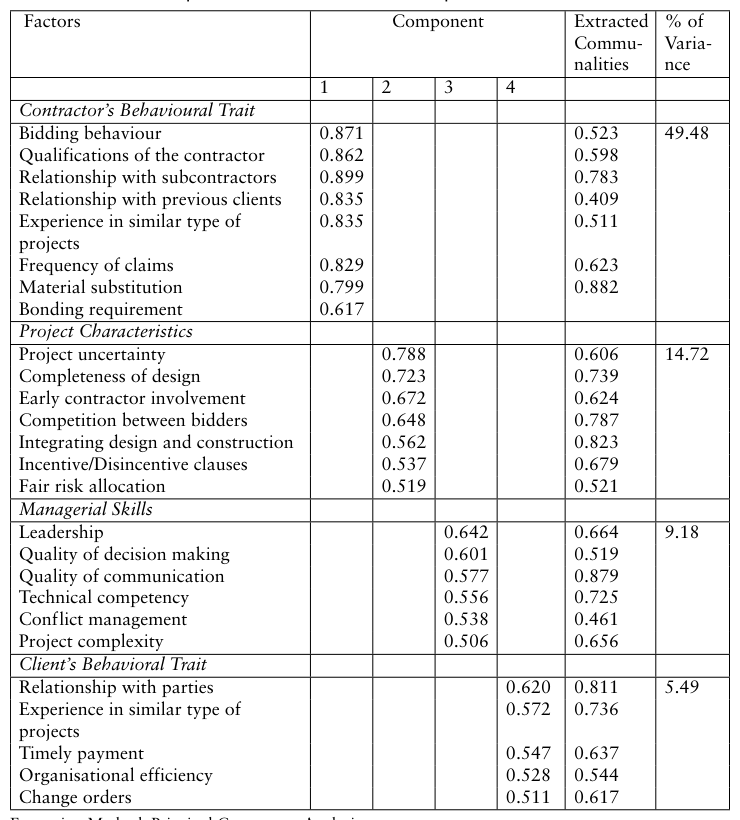
Table 2 outlines the outcome of the rotated component matrix and extra- cted communalities of the EFA of the study. Using the principal compo- nent analysis (PCA) extraction method applying the varimax rotation, the variables converged in seven iterations. The result presents four compo- nents having eigenvalue ≥1.00 while the total cumulative variance given is 78.87%. The first component is characterized by eight variables with factor loadings ranging from 0.871 to 0.617, while it accounts for 49.48% of the variance explained, and it is labelled as contractor’s behavioral trait. The second component is made up of seven variables with factor loadings ran- ging from 0.788 to 0.519, while it accounts for 14.72% of the variance given and is labelled as project characteristics. The third component has six varia- bles with factor loading ranging from 0.642 to 0.506, while it accounts for 9.18% of the variance explained, and it is labelled as managerial skills. The last component has five variables with factor loading ranging from 0.620 to 0.511, while it accounts for 5.49% of the variance explained, and it is labelled as client’s behavioral trait. The labels given to the components are informed by their intrinsic characteristics and the related attributes among the clustered variables.
DISCUSSION OF FINDINGS Contractor’s Behavioral Trait
The first construct has eight factor loadings which are bidding behaviour, qualifications of the contractor, relationship with subcontractors, experie- nce in similar type of projects, frequency of claims, material substitution, and bonding requirement. This construct refers to contractor’s attitudinal disposition during the course of the project execution. This finding is in tan- dem with Li et al., (2014), which established that contractor’s behaviour has a huge effect on the transaction costs of any construction project. A con- tractor’s experience from a similar project in time past and the relationship established with sub-contractors affect transaction cost. Also, the compete- nce of the contractor and the frequency at which claims are brought up are
Principal Component Analysis of Factors Affecting Construction Project Transaction Costs 125
Table 2. Rotated component matrix and variance explained.
Extraction Method: Principal Component Analysis a.4 components extracted influential. Kale and Arditi (2001) noted that a good relationship with a sub- contractor would enhance the delivery of the main contractor. Consequently, bringing about optimization of transaction costs. Li et al., (2013) emphasized that the choice of competent contractors would affirmatively bring about a reduction in transaction costs in construction projects.
Project Characteristics The second construct has seven factor loadings which are project uncertainty, completeness of design, early contractor involvement, competition between bidders, integrating design and construction, incentive/disincentive clauses, and fair risk allocation. The construct highlights the influence of the pro- ject’s attributes on the transaction costs. This is in consonance with the study of Farajian (2010), who noted that projects with complex characteristics and
uncertainties are more susceptible to experiencing higher transaction costs. This identifies with the fact that the lesser complexities and uncertainties of a construction project, the higher the probability of arriving at lower tran- saction costs. Also, projects prone to incomplete designs or poorly defined scope increase the susceptibility to post-contract changes, thereby affecting the transaction costs of the project (Cardens et al., 2017).
Managerial Skills The third construct has six factor loadings, namely leadership, quality of decision-making, quality of communication, technical competency, and conflict management. The construct outlays the managerial skills and dexte- rity exhibited during the course of the construction project execution. The managerial skills and competence shown during project execution have a significant influence on project performance. Areas of competence such as Leadership, communication, technical abilities, and dispute management make up this construct. Li et al., (2014) noted that there is a positive cor- relation between project management efficiency and transaction costs in construction projects. While also affirming that optimizing project mana- gement would reduce transaction costs. Moreover, the portrayal of conflicts during project execution leads to unwarranted claims and, at other times, disputes which have a negative bearing on project management efficiency, thereby negatively affecting transaction costs (Wang and Wu, 2020).
Client’s Behavioral Trait The five extracted factors loaded into the fourth construct are relationship with parties, experience in a similar type of projects, timely payment, organi- sational efficiency, and change orders. This construct refers to the attitudinal disposition of the client or owner of the project. This is corroborated by Li et al., (2014), who asserted that owner’s attitude has a virile impact on transaction costs in construction projects. Client’s responsibilities to any construction project, such as payment of monies due to the contractor and ascertaining works carried out (albeit through commissioned consultants), influence transaction costs in any project. Equally, the rate of issuing change orders during the course of administering any construction impacts tran- saction costs (Khalifa and Mahamid, 2019). Furthermore, Kululanga and McCaffer (2001) buttressed that clients’ experience from similar projects in time past would aid organization learning effectively, and if lessons gotten are well harnessed for future projects, would bring about stability in the owner’s behaviour. This would ultimately affect transaction costs positively.
CONCLUSION
The study assessed the influencing factors to transaction costs in construction project delivery. To ascertain these factors, a detailed review of the literature was conducted and informed the basis for formulating the research instru- ment. The formulated questionnaire was presented to the target respondents of the study, who gave their opinions on the significance of the identified factors. The retrieved data were subjected to analysis using EFA adopting the
Principal Component Analysis of Factors Affecting Construction Project Transaction Costs 127
principal component analysis extraction technique. The result indicated four constructs influential to transaction costs in construct contract execution. These are contractor’s behavioral traits, project characteristics, managerial skills, and client’s behavioral traits. Based on these findings, to achieve optimized transaction costs during construction contract execution, a har- monious working relationship should be established among economic actors in a contract. This would help abate the occurrence of claims, disputes, or litigations which all have a significant bearing on transaction costs in constru- ction contract execution. Furthermore, the selection process of contractors should be of utmost priority by the clients and their representatives. To a considerable extent, the type of contractor chosen for a construction project significantly influences the transaction costs of projects. Adequate attention should be paid to the contractor’s qualifications, the relationship established with previous clients, and the experience in similar projects. Moreover, the early involvement of the contractor would help synergize the working rela- tionship with other stakeholders of the construction project and, therefore, aid in optimising transaction costs.
REFERENCES
Aghimien, D. O., Aigbavboa, C. O., Meno, T., Ikuabe, M. O. (2021). Unravelling the risks of construction digitalisation in developing countries, CONSTRUCTION INNOVATION Volume 21 No. 3, pp. 456–475. https://doi.org/10.1108/CI-02- 2020-0026 Assaf, S., Hassanain, M., Abdallah, A., Sayed, A. Alshahrani, A. (2019). Sognificant
causes of claims and disputes in construction projects in Saudi Arabia, BUILT ENVIRONMENT PROJECT AND ASSET MANAGEMENT Volume 9 No. 5, pp. 597–615. Cardens, I., Voordijk, H. Dewulf, G. (2017). Beyond theory: Towards a probabilistic causation model to support project governance in infrastructure projects, INTER- NATIONAL JOURNAL OF PROJECT MANAGEMENT Volume 35 No. 3, pp. 432–450. Casson, M. C. (2013). Transaction costs and the theory of the multinational enter-
prise. In New theories of the multinational enterprise (RLE international business) Routledge. De Meyer, A. (2010). Collaborative leadership: New perspectives in leadership development, Working Paper, Cambridge Judge Business School, University of Cambridge, Cambridge, UK. Farajian, M. (2010). Transaction cost estimation model for us infrastructure public
private partnerships, M. Sc. thesis, University of Maryland, College Park, MD. Hillebrandt, P., Hughes, W. (2000). What are the costs of procurement and who bears them? Proceeding of 2nd International Conference. on Construction in Develo- ping Countries, Botswana National Construction Industry Council and Univ. of Botswana, Gaborone, Botswana. Ikuabe, M., Aghimien, D., Aigbavboa, C., Oke, A., Ngaj, Y. (2021) “Barriers to the
adoption of zero-carbon emissions in buildings: The South African narrative”, In: R. J. Howlett, J. R. Littlewood and L. C. Jain (eds), Emerging Research in Sustai- nable Energy and Buildings for a Low-Carbon Future, Advances in Sustainability Science and Technology, Springer, pp. 135–148. https://doi.org/10.1007/978-981- 15-8775-7_9
Ikuabe, M., Oke, A. and Aigbavboa, C. (2020). Impact of contractors’ opportunism on construction project transaction costs: Construction professionals’ perception, JOURNAL OF FINANCIAL MANAGEMENT OF PROPERTY AND CON- STRUCTION Volume 25 No. 1, pp. 125–141. https://doi.org/10.1108/JFMPC- 04-2019-0040 Ikuabe, M., Aigbavboa, C., Anumba, C., Oke, A., Aghimien, L. (2022). Confir-
matory factor analysis of performance measurement indicators determining the uptake of CPS for facilities management, BUILDINGS Volume 12 No. 4, 466. https://doi.org/10.3390/buildings12040466 Ikuabe, M. O., Oke, A. E. (2020) “Construction Transaction Costs in a Developing Economy: The Nigerian Construction Perspective”, In: Aigbavboa, C., Thwala, W. (eds) The Construction Industry in the Fourth Industrial Revolution. CIDB 2019. Springer, Cham. pp. 56–61. https://doi.org/10.1007/978-3-030-26528-1_6 Jollife, I. T. (2002). Principal Component Analysis. 2nd Ed. New York Springer
Publishing. Kale, S., Arditi, D. (2001). General contractors’ relationships with subcontractors: A strategic asset, CONSTRUCTION MANAGEMENT AND ECONOMICS Volume 19 No. 5, pp. 541–549. Kardes, I., Ozturk, A., Cavusgil, T. and Cavusgil, E. (2013). Managing global
megaprojects: Complexity and risk management, INTERNATIONAL BUSINESS REVIEW Volume 22 No. 6, pp. 905–917. Khalifa, W. Mahamid, I. (2019). Causes of change orders in construction projects, ENGINEERING, TECHNOLOGY & APPLIED SCIENCE RESEARCH Volume 9 No. 6, pp. 4956–4961. Kululanga, G. K., McCaffer, R. (2001). Measuring knowledge management for
construction organizations, ENGINEERING, CONSTRUCTION AND ARCH- ITECTURAL MANAGEMENT Volume 8 No. 56, pp. 346–354. Li, H., Arditi, D., Wang, Z. (2013). Factors that affect transaction costs in construction projects, JOURNAL OF CONSTRUCTION ENGINEERING AND MANAGEMENT Volume 139 No. 1, pp. 60–68. Li, H., Arditi, D., Wang, Z. (2014). Transaction costs incurred by constru-
ction owners, ENGINEERING, CONSTRUCTION AND ARCHITECTURAL MANAGEMENT Volume 21 No. 4, pp. 444–458. Manu, E., Ankrah, N., Chinyio, E. Proverbs, D. (2015). Trust influencing factors in main contractor and subcontractor relationships during projects, INTER- NATIONAL JOURNAL OF PROJECT MANAGEMENT Volume 33 No. 7, pp. 1495–1508. Nirvikar, S. (2008). Transaction costs, information technology and develo- pment, INDIAN GROWTH AND DEVELOPMENT REVIEW Volume 1 No. 2, pp. 212–236. Oh, M., Choi, S. (2020). The competence of project team members and success
factors with open innovation, JOURNAL OF OPEN INNOVATION: TECHNO- LOGY, MARKET, AND COMPLEXITY Volume 6 No. 3, 51. https://doi.org/10. 3390/joitmc6030051 Oke, A. (2022). Budget: A Measure of Project Success. Measures of Sustainable Construction Projects Performance, Emerald Publishing Limited, Bingley, pp. 99–105. Ozorhon, B., Arditi, D., Dikmen, I., Birgonul, M. T. (2010). The performance of inter-
national joint ventures in construction, JOURNAL OF MANAGEMENT AND ENGINEERING Volume 26 No. 4, pp. 209–222.
Principal Component Analysis of Factors Affecting Construction Project Transaction Costs 129
Phelan, C., Wren, J. (2007). Exploring Reliability in Academic Assessment. Retrieved from https://chfasoa.uni.edu/reliabilityandvalidity.htm [Accessed 5 September 2022]. Silva, D. H., Ratnadiwakara, D. (2008). Using ICT to reduce transaction costs in
agriculture through better communication: A case study from Sri Lanka. Working Paper, LIRNEasia, Colombo, Sri Lanka. Tan, P. (2011). Towards a culturally sensitive and deeper understanding of “rote learning” and memorization of adult learners. Journal of Studies in International Education, 15(2), pp. 124–145. Tavakol, M., Dennick, R. (2011). Making sense of Cronbach’s Alpha, INTERNATI-
ONAL JOURNAL OF MEDICAL EDUCATION Volume 2, pp. 53–55. Wang, N. and Wu, G. (2020). A Systematic Approach to Effective Conflict Management for Program, SAGE OPEN Volume 10 No. 1. https://doi.org/10.1177/ 2158244019899055 Williamson, O. E. (2010). Transaction Cost Economics: The Natural Progression,
AMERICAN ECONOMIC REVIEW, Volume 100 No. 3, pp. 673–690.
LISTED IN THE AHFE DIGITAL BOOKSTORE CATALOGUE
Explore the complete digital volume
Sustainable Construction in the Era of the Fourth Industrial Revolution
Read this individual research paper free through the original publisher, or explore the full digital proceedings book.
ISBN 978-1-958651-83-4
Explore this ISBN in the AHFE Bookstore ↗Listed in the July 2026 bookstore catalogue; search by ISBN to confirm current availability · Digital book purchase optional