Emmanuel Ayorinde, Jeffrey Mahachi, Clinton Aigbavboa, Ntebo Ncogbo (2023). An Assessment of The Effects of Legislation Policies on Energy Infrastructure Financing in Developing Countries. In: Human Factors in Architecture, Sustainable Urban Planning and Infrastructure. AHFE Open Access, vol. 89, pp. 96–105. https://doi.org/10.54941/ahfe1003684
Energy development is one of the most germane factors for regional and national development. There is great need for institutional support to aid the development of energy infrastructure in the region. The purpose of this research is to determine the effects of legislation policies in the development of energy infrastructure financing in Nigeria. Data was collected through the aid of questionnaires from respondents using purposive sampling technique. Methods of data analysis deployed for the study are Mean Item Score and Factor Analysis. Views from the study showed that the most significant factor having effect on legislation on energy infrastructure development is policy instability; also the result of the factor analysis showcased two major constructs that formed the effects of legislation policies in the financing of energy infrastructure in the Nigerian economy and these are energy development policies and lack of quality legislation. Conclusion, the study noted that with the underdevelopment in the energy infrastructure sector in Nigeria, there is need for effective policies that will limit the risk of investments in the energy infrastructure sector. This will facilitate great investment by private investors in the sector. This research contributes to energy infrastructure financing in Nigeria, economic growth of Nigeria, which will also boost the number of investments made in the energy sector both in Nigeria and the entire continent.
Infrastructure development plays a significant role in every nation’s quest for economic development. It is therefore very necessary for both developed and developing countries to invest in infrastructure development (Kumari and Sharma, 2017). Infrastructure is classified into two main divisions, namely social infrastructure which consists of health systems and education, while physical infrastructure consists of roads, transportation, water facilities, and
An Assessment of the Effects of Legislation Policies on Energy Infrastructure 97
power which form the focus of this study. Infrastructure finance projects are different from manufacturing projects because of the higher risk involved in the process of financing infrastructure. According to (Mor and Sehrawat, 2006) and (Smith et al., 2009), The greater risk that characterizes infra- structure finance makes it different from manufacturing (Esty, 2004). This is due to the large sum of capital invested, and the longer duration of time involved in the completion of an infrastructural project; for example, the shortest duration that is required for the completion of an energy facility is five years. This is due to demand uncertainties, environmental surprises, tech- nological obsolescence, government policies and the politics involved (Smith et al., 2009). The maturity period for infrastructure involves a minimum of five years and a maximum of 40 years, which can be seen in the design life of infrastructure projects and their period of completion (Khan, 2013). Though it may take long to complete, the lifespan of the infrastructure pro- jects lasts longer. An example is the lifespan of a hydroelectric energy facility, which can last up to a period of 100 years or more and takes five years to construct (Mor and Sehrawat). Infrastructure projects usually cost a huge amount of money; this is one of the challenges of infrastructure financing (Merna and Njiru, 2002). The amount required to construct a kilometre of road can cost about 1 million dollars and could amount to about 200 million dollars in total (Mor and Sehrawat, 2006). Since the revenue of infrastructure projects are subject to the rate of inflation, returns needs to be measured in “real terms” (Thobani, 1999). Due to the effect that higher pricing can have on the economy and investments, the annual returns and demand could be close to zero but cannot remain negative for a longer period of time, as can be said in the case of manufacturing goods (Smith et al., 2009). The cost of construction of any infrastructure projects is quite expen- sive; therefore, before engaging in an investment relating to infrastructure, the risk associated must be considered and analysed carefully (Matsukawa and Habeck., 2007). Willing investors have been uncertain about investing in infrastructure projects due to different risks associated: if the risk is known and analysed, there will be reduced rate in investment by investors (Grimsey and Lewis, 2002).
The infrastructure risk is classified into in three categories: financial market risk due to market failures; risk involved in the completion of infra- structure projects and also risk associated arising from policy regulations and public pressure. These risks are grouped as commercial risk, force majeure risk, capital risk, country and environmental risk and others (Chapman and Ward, 2003; Kumari and Sharma, 2017).
With the established importance of legislative policies on the delivery of energy infrastructure financing, this study is geared towards assessing the effects of these policies on the financing of energy infrastructure in Nigeria. This is executed with a view to proposing insightful recommen- dations that would abate the daunting challenges faced by energy infra- structure financing and its glaring effects on the economy of the country. The other sections of the paper are the review of extant literature, rese- arch methodology, presentation and discussion of results, conclusion, and recommendations.
Policy Effects on Power Infrastructure Financing The volatile political environment accounts for the poor rate of infrastructure development in some regions of the world, mostly in developing countries. The political instability of some these countries can also account for the lack of financing infrastructure due to the lack of confidence in the political environment by the private investors. The realizations of stable political envi- ronment can boost the financing of infrastructure in the developing world to a great extent (Ehlers, 2014). There are indications of a lack of funding nee- ded to tackle infrastructural responsibilities of the government and the rate of decline of international sources due to the political nature of the developing world. This is due to the fact that it was seen as a mainly public mono- poly service which has derailed the sector for far too long (Noam, 1999). Most countries in the world have ditched this system of seeing infrastructure development as a government monopoly: it was in 1997 that the whole of sub-Saharan Africa began the process of infrastructure appraisal to suit the current trend of infrastructure financing (Obaidullah and Wilson, 1999). It can be said authoritatively that infrastructure development has deteriorated because of low revenue collections, widespread collusion, and unproductive strategic methods by the government (Ehlers, 2014). For effective infrastru- cture financing to occur there must be a favourable political atmosphere that can encourage private investors to invest in infrastructure. If communication can be taken as an example, the privatisation of the telecommunication sector for 1994 to 1998 released the sum of US$ 95bn worldwide whereas Africa as a continent received just US$ 1.7bn and more than 50 per cent of that fee was directed to South Africa (Ehlers, 2014).
Improvement in funding infrastructure is necessary, but not enough. Therefore, joint collaboration is needed to oust the political challenges that are facing the financing and operations of infrastructure development. Based on the global shift towards the development of infrastructure and the bene- fits that infrastructure development means to the whole world, it is time for the developing countries’ policy makers to produce a design or a plan to deregulate the infrastructure sector in other to encourage healthy competi- tion among private investors. This can be seen in the World Bank sectional reforms in the infrastructure investments in the developing countries (Mansell and When, 1998). Taking an example from the case study of this resea- rch, which is Nigeria, owing to the non-availability of a local manufacturing industry, it has become virtually impossible for the country to manufacture spare parts locally. The National Agency for Science and Engineering Infra- structure (NASENI) was established and the Ajaokuta Steel Rolling Mill (OASRM) was commissioned to help with the manufacturing of electrical tools. This has been found to be an impossible task because there is no policy in place that regulates the manufacturing of machines and their components and the government has not moved to start a franchise with the manufactu- rers of these machines, thereby crippling that sector. The same can be said of infrastructure development (Awosope, 2015).
System support for the sake of energy infrastructure development is a necessity for energy development in a region or country. For a successful
An Assessment of the Effects of Legislation Policies on Energy Infrastructure 99
energy infrastructure development to take place it is necessary for favoura- ble policies to be in place because policies affect infrastructure development negatively or positively (OECD, 2009). Non-involvement of government in the investment of energy infrastructure investment will result in low or no investment by private investors.
Private investors’ decisions to participate in the development of energy infrastructure in a region is directly proportional to the decision and stance of the government of the country on the policies regarding the investment in the sectors. It is therefore important for government to ensure that the legal framework is in place and policies are favourable, as well as backing the investments of the private investors. This will encourage private investors to invest in the sector, since there are effective and workable policies backing their investment in the region (Inderst, 2013).
The energy policies of a country’s are debatable and subject to change. It is therefore required that there should be a general agreement among the political parties in the country on the energy policies as regards a stable stance on the policy framework in the country. This will eliminate the risk involved in the change of policies and also allows legislation on a favourable and long- term policy framework that will encourage private investors in investing in the energy infrastructure sector (1OECD, 2009).
With the increased awareness of reducing the greenhouse gas emission (GHG) by the United Nations in the OECD countries, they are calling for renewable sources on energy infrastructure development as a way of curbing the GHG (World bank, 2012). It is therefore required of the government to enact favourable policies as a means of offering extra financial incentives in the investment on renewable sources by the private investors (OECD, 2016). This will encourage private participation in the sector, directly boosting the level of power infrastructure development in the region.
Favourable policy framework alone has been insufficient in eliminating risks in the investment in the energy infrastructure development sector, and in the investment in the energy sector. In this case government needs to assist the private sector, either by direct financing or indirect financing to encourage the participation of the private sector in energy development (Mansell and When, 1998). Public-private partnerships (PPPs) should be considered by the govern- ment in the construction of the new energy projects in the region. Policies that favour private sector participation models (likened to PPPs) must be enacted. This will bring about foreign investments in the country in the form of build- own-operate (BOO) or the build-own-operate transfer (BOOT) programmes. This is the process whereby the foreign investors build energy facilities in the country, operate it in the country and sell back to the government of the coun- try under a supervised contract. This will increase the development of energy infrastructure in the region (Eberhard, 2011).
RESEARCH METHODOLOGY The study is aimed at evaluating the impacts of legislation policies on energy infrastructure financing. Utilising a deductive approach, the study was hin- ged on a post-positivism philosophical view aided by quantitative data from
professionals in the energy sector in Nigeria. Data was collected with the use of questionnaire survey. The questionnaire was developed from an extensive review of the literature on the legislation polices geared towards financing of energy infrastructure. The target population for the study were practi- cing energy infrastructure professionals in the power sector of Nigeria, while the sample size was arrived at using the formula given by (Yamane, 1967). Overall, a total number of one hundred and fifty (150) questionnaires were randomly distributed, while one hundred and thirty-two (132) were recei- ved and deemed appropriate for analysis, thus representing an 88% response rate and used for the analysis of the research findings. The question posed to the respondents elicited their perception of the effect of legislative policies on energy infrastructure financing in the Nigerian economy. These effects were presented to the respondents for rating using a Likert scale which were stron- gly agree = 5, agree = 4, neutral = 3, disagree = 4, and strongly disagree = 5. The methods of data analysis employed for the study are Cronbach’s alpha, mean item score (MIS), exploratory factor analysis (EFA). Cronbach’s alpha was used in ascertaining the reliability and validity of the research instrument. A value of 0.814 was given from the analysis which indicates a good relia- bility and validity of the research instrument (Tavakol and Dennick, 2011). Also, using SPSS version 27 the identified effects of impacts of legislation poli- cies on energy infrastructure financing were subjected to analysis and ranked using MIS. Furthermore, the study employed EFA in evaluating the unidi- mensionality of the identified effects as adopted by (Ikhuabe et al., 2020), (Ahadzie et al., 2012).
Mean Item Score
Table 1 shows the ranking of the result of the ranked impacts of legislation policies on energy infrastructure financing. The results indicates that the most ranked effects are policy stability with mean score of 4.39, completion uncer- tainties with 4.22, cost uncertainties with 4.18, and reduces corrupt practices in the power sector with 4.14. While the least ranked effects are lack of tech- nological advancements with a mean score of 2.14, tight power generation plan with 2.20, and lack of support from government with 2.21.
Exploratory Factor Analysis Exploratory factor analysis (EFA) is useful in reducing numbers of large vari- ables and breaking them into more simple clusters for better understanding (Merk et al., 2012). Table 2 shows Kaizer-Meyer-Olkin (KMO) measure of sampling adequacy and the Bartlett test of sphericity which determines the factorability of the dataset. The result shows a KMO value of 0.828, which satisfies the threshold of 0.6 used in previous studies while the value of the Bartlett’s test of sphericity was given as 868.096 at a p-value of 0.000, this indicating that it is significant (Pallant, 2011). The results from the KMO and Bartlett’s test gives credence to the factorability of the dataset for conducting EFA.
The data was regulated with principal component analysis (with varimax rotation). The eigen values has a high value of more than 1. As represented in
An Assessment of the Effects of Legislation Policies on Energy Infrastructure 101
Table 1. Effects of legislation policies in the financing of energy infrastructure development.
Table available in the original PDF paper.
Rank Effects Mean Standard Deviation
4.11 1.123 6
Policy instability 4.39 0.638 1 Completion uncertainties 4.22 0.850 2 Cost uncertainties 4.18 0.845 3 Reduces corrupt practices in the energy sector 4.14 1.049 4 Increases investors’ confidence 4.13 1.087 5 Viable long-term policy framework to sustain energy infrastructure development in the country
4.10 1.003 7
Improves rural electrification development through effective legislation
4.07 1.071 8
Encourages private sector investors through favorable policies
3.81 1.230 9
Favourable policies to support funding from government Low tariffs of electrification 3.81 1.192 10 Timeframe of revenue support 3.78 1.100 11 Effective legislation for a viable maintenance culture 3.48 1.188 12 Lack of profitable projects 2.26 1.501 13 Lack of support from government 2.21 1.309 14 Tight power generation plan 2.20 1.234 15 Lack of technological advancements 2.14 1.332 16
Table 2. KMO and Bartlett’s test.
Table available in the original PDF paper.
.828
Kaiser-Meyer measure of sampling adequacy Bartlett’s test of sphericity Approx. chi-square 868.096 Df 45 Sig. .000
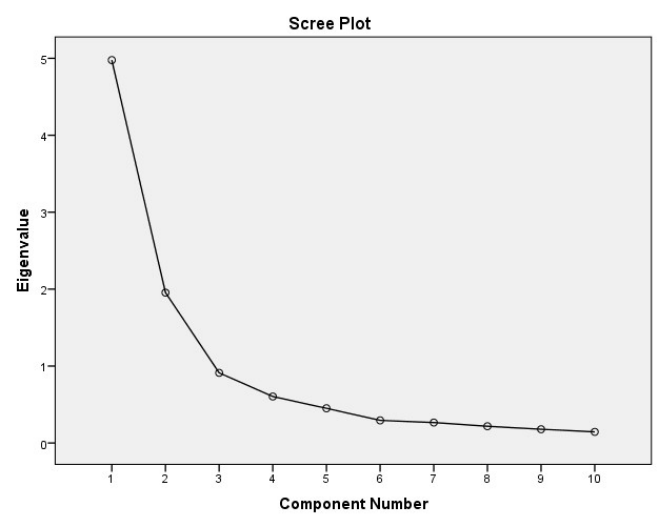
Table 3, the factor loading extracted was six components with the eigenvalue more than 1 and 0.5 (also see Fig. 1 scree plot). For the total variance (see Table 4), as explained by each component extracted; component 1 (49,770), component 2 (15,547). Therefore, the result from the principal component analysis (PCA) and the factors extracted amounted to 65,317% of the total cumulative variance.
The principal axis factoring used showed that two (2) were present with eigenvalues greater than 1 as represented in (Table 4) above. Owing to the careful observation of the inherent connections among each of the variables under each factor, the following assessments were made: Factor 1 was descri- bed as energy development policies and factor 2 was described as lack of quality legislation. The terms used in describing these factors were obtained as a result of closely observing the variable within each of the factors. The two factors extracted and their constituents’ indicators are explained below, together with a comprehensive description of how the two-factor sections were descibed.
Table 3. Rotated factor matrix.
Table available in the original PDF paper.
Label Effects Component
1 2
.887
EFF1 Encourages private sector investors through favourable policies
.869
EFF2 Improves rural electrification development through effective legislation
.837
EFF3 Increases investors’ confidence .864 EFF4 Viable log-term policy framework to sustain energy infrastructure development in the country EFF5 Low tariffs of electrification .755 EFF6 Time frame of revenue support .715 EFF7 Favourable policies to support funding from government .605 EFF8 Lack of profitable projects .866 EFF9 Lack of technological advancement .851 EFF10 Effective legislation for a viable maintenance culture .718
Figure 1: Scree plot for factor analysis.
Discussion of Result Factor 1: Energy Development Policies As shown in Table 3 above, the two (2) were extracted as the effects of legis- lations on energy infrastructure development. For factor 1 were ‘encourage private sector investors through favourable policies’ (88.7%), ‘improves rural electrification development through effective legislation’ (86.9%), ‘increases investors confidence’ (86.4%), ‘viable long-term policy framework to sustain energy infrastructure development in the country’ (83.7%), ‘low tariffs of
An Assessment of the Effects of Legislation Policies on Energy Infrastructure 103
Table 4. Total variance explained.
Table available in the original PDF paper.
Factors Initial eigenvalues Extraction sums of squared loadings
electrification’ (75.5%), ‘timeframe of revenue support’ (71.5%) and ‘favou- rable policies to support funding from government’ (60.5%). The numbers in the parentheses show the individual factor loadings. The definitions of these variables are also explained in Table 2. This cluster accounted for 49.770 per cent of the variance.
Factor 2: Lack of Quality Legislation As shown in Table 3 above, the two (2) were extracted as the effects of legislations on energy infrastructure development. For factor 2 was ‘lack of profitable projects’ (86.6%), ‘lack of technological advancements’ (85.1%), and ‘effective legislation for a viable maintenance culture’ (71.8%). The num- bers in the parentheses show the individual loadings. The definitions of these variables are also explained in Table 2 above. This cluster accounted for 19.547 per cent of the variance.
Implication of Findings The findings of this study reveals the effects of legislation policies on energy development in Nigeria. ‘Policy instability’ was ranked highest. This shows that policy instability has significant effects on the development of energy infrastructure in Nigeria, and it has to do with inconsistent and unfavou- rable policies that can jeopardise energy infrastructure development quite significantly. From the findings, it was also revealed increases in investors’ confidence has greatly contributed to the development of energy infrastru- cture in Nigeria. This is due to the fact that if there is a well framed legislation in the energy infrastructure sector it will boost investors’ confidence, both local and internationally, in developing the sector. It is therefore important for the following effects as revealed by this study to be tackled with immedi- ate effect to enable energy infrastructure projects to flourish in the Nigerian environment, for a better and more sustainable growth of lives and economy.
CONCLUSION
Results from the literature review established the following as the effects of legislation policies on energy infrastructure financing in Nigeria: effective long-term policies to sustain the development of energy infrastructure, policy instability, and tight power generation plans. However, literature has further shown other effects legislation has on the financing of energy infrastructure in Nigeria. These are increases in investors’ confidence, among others.
Results from the findings of the secondary data i.e. questionnaire survey indicate that there are eight main effects legislation policies have on the financing of energy infrastructure in Nigeria. These are: policy instability, completion uncertainties, cost uncertainties, reduction of corrupt practices in the sector, increase in investors’ confidence, viable long-term policy frame- work to sustain energy infrastructure development in the county, improved rural electrification development through effective legislation and private sector investors encouraged through favourable policies. Conclusively, it can be said that the research objectives for this study have been answered.
RECOMMENDATION Also, it is advised that government must adopt sustainable policies of fina- ncing energy infrastructure assessed from this study, as this will position developing countries for a better investment on infrastructure, development on the economy and improvement on the lives of the citizens.
ACKNOWLEDGMENT
I would like to express my special thanks and gratitude to National Research Foundation (NRF) South Africa for the grant allocated to me to be able to carry out this research project without much distractions.
REFERENCES
Ahadzie, D. K., Proverbs, D. G., & Olomolaiye, P. O. (2008). Critical success criteria for mass house building projects in developing countries. International Journal of project management, 26(6), 675–687. Awosope, C. (2015). Nigeria electricity industry: Issues, challenges and solutions.
Public Lecture Series 3(2). Ota, Ogun State, Nigeria: Covenant University Press. Chapman, C. & Ward, S. (2003). Project risk management: Processes, techniques, and insights. Wiley. Eberhard, A. (2011). The future of South African coal: Market, investment and policy
challenges. Program on Energy and Sustainable Development, 1–44. Ehlers, T. (2014). Understanding the challenges for infrastructure finance. Esty, B. C. (2004). Modern project finance: A casebook. John Wiley & Sons Incorporated. Grimsey, D. & Lewis, M. K. (2002). Evaluating the risks of public private partner-
ships for infrastructure projects. International Journal of Project Management, 20(2): 107–118. Ikuabe, M., Oke, A. and Aigbavboa, C. (2020), “Evaluating the influencing factors responsible for construction contractors’ opportunism in a developing economy”, African Journal of Science, Technology, Innovation and Development, Vol. 13 No. 3, pp. 387–393.
An Assessment of the Effects of Legislation Policies on Energy Infrastructure 105
Inderst, G. (2013). Private infrastructure finance and investment in Europe. Khan, A. M. (2013). Risk factors in toll road life cycle analysis. Transport metrica A: Transport Science, 9(5): 408–428. Kumari, A. and Sharma, A. K., 2017. Infrastructure financing and development: A
bibliometric review. International Journal of Critical Infrastructure Protection, 16, pp. 49–65. Mansell, R. & Wehn, U. (1998). Knowledge societies: Information technology for sustainable development. United Nations Publications. Matsukawa, T. & Habeck, O. (2007). Review of risk mitigation instruments for
infrastructure financing and recent trends and developments. Washington, DC: World Bank. Merk, O., Saussier, S., Staropoli, C., Slack, E. & Kim, J. (2012). Financing green urban infrastructure. Merna, T. & Njiru, C. (2002). Financing infrastructure projects Thomas telford. Mor, N. & Sehrawat, S. (2006). Sources of infrastructure finance. Noam, E. M. (1999). Telecommunications in Africa. Oxford University Press on
Demand. Obaidullah, M. & Wilson, R. J. (1999). International Conference on Islamic Economics organized by IIUM and IRTI, Kuala Lumpur, August. Conference proceedings of the. Organisation for Economic Co-operation and Development (OECD) (2009). OECD
territorial reviews. Paris: OECD. Organisation for Economic Co-operation, Development, (OECD). (2016), Infrastructure investment (indicator). doi: 10.1787/b06ce3ad-en [Accessed on 16 October 2016]. Organisation of Economic Co-operation and Development, (OECD) 2014. Indian
infrastructure report. Available online at: http://www.keepeek.com/Digital- AssetManagement/oecd/economics/oecd-economic-survey-2014_eco-surveys- ind-2014en#page81. Pallant, J. (2011). Multivariate analysis of variance. SPSS survival manual. Allen & Unwin. Pallant, J. (2010). SPSS survival manual: A step by step guide to data analysis using SPSS. Maidenhead. England: McGraw-Hill Education. Smith, N. J., Merna, T. & Jobling, P. (2009). Managing risk: In construction projects
John Wiley & Sons. Tavakol, M., and Dennick, R. (2011), “Making sense of Cronbach’s Alpha”, International Journal of Medical Education, Vol. 2, pp. 53–55. Thobani, M. (1999). Private infrastructure, public risk. Finance and Development,
36(1):50. World Bank. (2012). Best practices in public-private partnerships financing in Latin America: The role of subsidy mechanisms. Washington, DC. World Bank. Xth conference held in Y. SEE: A. O. TUNDE for format. Yamane T. (1967), “Statistics: An Introductory Analysis”, 2nd Ed. New York:
Harper and Row.
LISTED IN THE AHFE DIGITAL BOOKSTORE CATALOGUE
Explore the complete digital volume
Human Factors in Architecture, Sustainable Urban Planning and Infrastructure
Read this individual research paper free through the original publisher, or explore the full digital proceedings book.
ISBN 978-1-958651-65-0
Explore this ISBN in the AHFE Bookstore ↗Listed in the July 2026 bookstore catalogue; search by ISBN to confirm current availability · Digital book purchase optional