Progress Kamonere, Faith Dowelani (2026). Collaborative Governance for Urban Regeneration: Mapping the contributions of Real Estate Professionals, Local Authorities, and Investors in Harare's CBD Renewal. In: Human Factors in Architecture, Sustainable Urban Planning and Infrastructure. AHFE Open Access, vol. 229, pp. 30–40. https://doi.org/10.54941/ahfe1007951
Publisher statistics will load when you open Metrics.
AHFE OPEN ACCESS OPEN ACCESS CONFERENCE PROCEEDINGS PAPER
Collaborative Governance for Urban Regeneration: Mapping the contributions of Real Estate Professionals, Local Authorities, and Investors in Harare's CBD Renewal
Sustainable inner-city regeneration is a complex process that requires the collaboration of various stakeholders, including real estate industry practitioners. This study aimed to determine the contribution of real estate professionals in the quest for sustainable inner-city regeneration in Harare's Central Business District (CBD). A mixed-methods approach was employed, involving a survey of 131 respondents and interviews with key stakeholders. The findings revealed that real estate professionals, including property managers, investors, brokers, and valuers, play a crucial role in driving and benefiting from regeneration efforts. Their expertise spans across planning and analysis, advocacy and policy reform, project management and risk mitigation, property valuation and financial modelling, community engagement and social inclusion, capacity building and training, and enabling public-private partnerships. The study found that the involvement of real estate experts enhances property values, triggers economic activity, and promotes the diversification of property development. The engagement of real estate professionals also brings widespread sectoral benefits, including improved housing value, increased investor confidence, stimulated demand for green building materials, enhanced urban aesthetics, increased diversification of property development types, and improved public health and environmental outcomes. The study concludes that harnessing the potential of real estate practitioners and other stakeholders is essential for moving Harare toward a resilient, inclusive, and sustainable urban future.
Urban centres across Africa face growing inner-city decline, marked by deteriorating infrastructure, declining property values, reduced investment, and worsening socio-economic conditions (Turok & McGranahan, 2013; UN-Habitat, 2020). Once the economic cores of cities, Central Business Districts (CBDs) have been affected by informalisation, reshaping urban landscapes amid capital flight, obsolete buildings, and governance failures. In African cities, these issues are compounded by limited municipal resources, regulatory inefficiencies, and macroeconomic instability, resulting in cycles
Collaborative Governance for Urban Regeneration: Mapping the Contributions 31 of urban decay (Chirisa & Matamanda, 2021; Matamanda et al., 2020). Harare CBD faces the above-mentioned challenges. The CBD contains ageing high-rise office buildings suffering from underinvestment and declining functionality (Muchoza, 2018). Signs of decay include abandoned buildings, unreliable utilities, traffic congestion, failures in waste management, and high vacancy rates (Chigumira et al., 2021; ZIMSTAT, 2022). The conversion of commercial buildings to low-yield uses has reduced property values and weakened Harare’s investment appeal (Tibaijuka, 2015).
Inner-city regeneration is a key urban policy and development strategy addressing global urban decay. The literature shows that sustainable building upgrades and green redevelopment can yield economic benefits. Revitalised properties often enjoy higher rental premiums, occupancy rates, and ROI, especially with improvements in energy efficiency, aesthetics, and accessibility (Fuerst et al., 2017; Eichholtz et al., 2010). In Africa, green-certified or refurbished commercial buildings can command 5% to 12% rental premiums, while broader initiatives may yield 10% to 25% improvements in ROI (Chikozho & Mlambo, 2021; Fuerst et al., 2017). These findings position sustainable regeneration as both an urban development imperative and a viable investment strategy. Despite these opportunities, the implementation of sustainable inner-city regeneration in cities such as Harare remains constrained by multiple, interlinked challenges. High upfront costs associated with green retrofitting, coupled with limited financial incentives and restricted access to long-term credit, further discourage private sector investment (Boamah & Gyimah, 2020; UN-Habitat, 2020). These constraints highlight the growing need for collaborative governance frameworks that extend beyond property- led redevelopment to incorporate inclusive, coordinated, and institutionally supported approaches.
Empirical evidence on real estate practitioners’ contributions and their interaction with authorities and investors in Harare CBD remains limited. Studies have focused on physical decay, governance failures, and socio-economic challenges, with less attention to how stakeholders shape regeneration outcomes and investment decisions (Chigudu, 2021; Gambe, 2019). This gap is critical as Zimbabwe’s urban property market seeks to align with global sustainability standards amid constrained public sector capacity. This paper examines sustainable inner-city regeneration in Harare’s CBD, focusing on stakeholder collaboration and the roles of real estate professionals in driving regeneration. Through a mixed-methods approach, the study will contribute to African urban regeneration literature and provide insights into real estate professionals’ contributions to sustainable inner-city regeneration in Harare’s CBD. This addresses a gap in evidence on these stakeholders’ roles in an African city facing urban decline and limited public- sector capacity.
Towards Collaborative Governance in Inner-City Regeneration Contemporary urban regeneration theory emphasises the need for collaborative governance arrangements that integrate the roles of government, local authorities, property owners, investors, and professional
32 Kamonere and Dowelani intermediaries such as real estate practitioners (Ansell & Gash, 2008; Emerson et al., 2012). Within this framework, real estate professionals, including property managers, valuers, developers, brokers, and investors, play a critical intermediary role by translating policy objectives into financially viable projects, mobilising investment capital, managing risk, and aligning market demand with sustainability goals (Ali et al., 2020; Wilkinson & Sayce, 2015). The literature emphasises that the effectiveness of regeneration initiatives largely depends on the quality of governance arrangements, institutional capacity, and the alignment of public and private sector incentives (Ansell & Gash, 2008; UN-Habitat, 2020). Fragmented and siloed approaches have been shown to yield limited, unsustainable outcomes, particularly in complex urban environments characterised by multiple competing interests. In the context of Harare’s CBD, the literature underscores the importance of coordinated stakeholder engagement, transparent decision-making, and shared responsibility for urban outcomes. Aligning policy objectives with market mechanisms and community needs is essential for achieving sustainable inner-city regeneration that delivers environmental, social, and economic benefits (Matamanda et al., 2021; UN-Habitat, 2020).
Role of Government, Local Authorities, Property Owners, Real Estate Professionals and Investors in Sustainable Inner-City Regeneration Real estate professionals, that is, valuers, property managers, estate agents, developers, and urban planners, are important parties that enable sustainable inner-city regeneration. Their skills span policy frameworks, investor demands, tenants’ needs, and environmental imperatives. Real Estate professionals bring valuable market knowledge, particularly in property market conditions, vacancy rates, rental rates, and development opportunities. These practitioners work with municipalities to balance land optimisation with social equity concerns, aiming for shared and inclusive regeneration sensitive to local contexts (Turok & Scheba, 2018). Additionally, Practitioners can influence zoning laws, land tenure legislation, tax relief, and building codes that sustainably deliver on regeneration efforts (Chigumira et al., 2021). In the Harare context, experts can assist in building on the limited potential of abandoned CBD buildings by prescribing adaptive reuse and retrofitting strategies for high-performing assets. However, they have not been adequately utilised in the past; they have been sidelined due to regulations, limited training, and low salaries.
National Government National governments shape the regulatory, fiscal, and institutional environment for inner-city regeneration through urban development policies, land tenure systems, tax incentives, and sustainability regulations. The central government establishes enabling conditions for investment and redevelopment (Turok & Scheba, 2018). In developing countries, weak policy coherence and inconsistent implementation constrain successful regeneration
Collaborative Governance for Urban Regeneration: Mapping the Contributions 33 (Boamah & Gyimah, 2020). In Zimbabwe, government influence over urban land markets, building regulations, and macroeconomic policy affects the feasibility of inner-city investment. Studies show that unstable macroeconomic conditions, unclear land tenure, and limited fiscal incentives have reduced investor appetite for the redevelopment of Harare’s CBD (Chigumira et al., 2021; Matamanda et al., 2020). Targeted government interventions, such as tax rebates for green retrofitting, streamlined approval processes, and access to concessional finance, are catalysts for sustainable regeneration (UN-Habitat, 2020).
Local Government Local authorities are central to operationalising inner-city regeneration through planning control, infrastructure, and service delivery. Municipal governments manage zoning, approvals, infrastructure, and public safety, all of which affect property values (Douglas et al., 2019). The literature highlights weak municipal capacity as a major impediment to CBD regeneration. Chronic underfunding and governance inefficiencies have led to unreliable utilities, deteriorating roads, and poor waste management (Matamanda et al., 2020; ZIMSTAT, 2022). These conditions discourage property refurbishment. Scholars argue that strengthening municipal governance and adopting participatory planning are essential for reversing urban decline (Chirisa & Matamanda, 2021). Local authorities facilitate PPPs for financing inner-city regeneration. Effective municipal leadership can align public objectives with private investment interests and ensure sustainability (Boamah & Gyimah, 2020).
Property Owners and Landlords Property owners are primary agents in inner-city regeneration, as their investment decisions directly shape the physical condition and functional performance of the building stock. The literature indicates that proactive landlords who invest in building maintenance, retrofitting, and adaptive reuse can significantly enhance rental yields, occupancy rates, and asset values (Eichholtz et al., 2019; Sayce et al., 2017). However, in declining inner cities such as Harare’s CBD, many property owners adopt a passive or survivalist approach, characterised by minimal maintenance and short- term income extraction. This behaviour is often attributed to low rental returns, high vacancy rates, lack of access to finance, and uncertainty about policy direction (Chigudu, 2021; Gambe, 2019). As a result, buildings continue to deteriorate, reinforcing cycles of disinvestment and urban decay. The literature suggests that incentivising property owners through fiscal support, technical assistance, and regulatory certainty can encourage reinvestment in ageing building stock. Sustainable retrofitting, mixed-use conversion, and energy efficiency upgrades are identified as viable strategies for restoring property competitiveness in inner-city markets (Fuerst et al., 2017).
Private investors are essential to scaling up inner-city regeneration, particularly in contexts where public resources are limited. Institutional investors, property developers, and real estate funds provide the capital required for refurbishment, redevelopment, and infrastructure upgrades (Ali et al., 2020). Investment decisions are typically driven by risk- return considerations, location quality, regulatory stability, and market demand. In Harare’s CBD, investor participation has been constrained by macroeconomic volatility, currency instability, and weak governance structures (Boamah & Gyimah, 2020). Nonetheless, evidence suggests that where sustainable regeneration initiatives are successfully implemented— such as green retrofitting and public realm improvements—investor confidence improves, leading to increased property values and enhanced returns on investment (Chikozho & Mlambo, 2021). The literature also highlights investors’ growing interest in environmentally sustainable and socially responsible real estate assets. Green buildings and revitalised urban districts are increasingly viewed as lower-risk, future-proof investments due to reduced operating costs, regulatory compliance, and improved tenant retention (Fuerst et al., 2017; Deloitte, 2024).
METHODOLOGY
This study used a mixed-methods approach, combining quantitative and qualitative methods. To complement the qualitative survey data, semi- structured interviews were conducted with selected participants. Survey data and stakeholder interviews enabled methodological triangulation, enhancing validity. The study focused on Harare’s CBD, Zimbabwe’s main commercial hub. The target population included key stakeholders: real estate practitioners, property owners, investors, building occupants, and local authority officials. The quantitative component comprised survey data from 131 respondents, drawn from a sample of 150 individuals with property development knowledge, selected through stratified random sampling. To gather qualitative data, interviews were conducted with 12 key stakeholders, including senior real estate professionals and institutional representatives. The interviews provided insights into governance challenges, investment constraints, and stakeholder roles. Quantitative data were analysed using descriptive statistics to assess respondents’ agreement regarding real estate practitioners’ roles. Qualitative data was analysed using thematic analysis through ATLAS.ti to identify patterns, contextualising the survey results. The study followed ethical guidelines. Participation was voluntary with informed consent. Confidentiality was maintained through anonymisation, and data was used for academic purposes only. By combining quantitative and qualitative data, this study validates a pragmatic perspective and a mixed- method strategy. The statistical outcomes were bolstered by stakeholder narratives that underscored the importance of strategic stakeholders in sustainable inner-city regeneration.
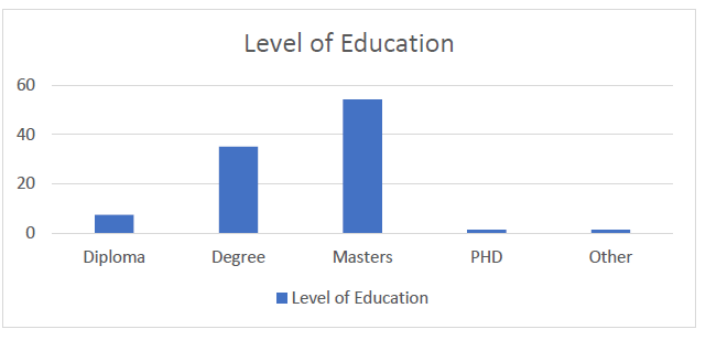
FINDINGS The highest education levels of the respondents are shown in Figure 1. 54.2% of the respondents have a master’s degree, while 35.1% have a bachelor’s degree. A small proportion, 1.5%, have gone on to attain a PhD.
Figure 1: Level of education of the respondents.
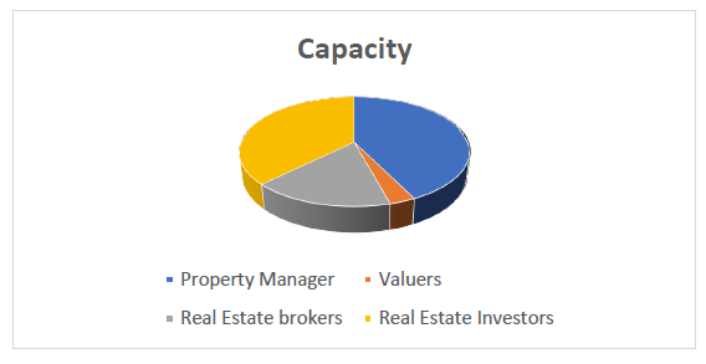
The professional capacities of respondents are depicted in Figure 2. Nearly half (47%) of respondents were property managers, followed by 35% estate investors, 16% brokers, and 2% valuers. This distribution illustrates the diversity of the real estate sector in Harare CBD.
Figure 2: Capacity of respondents.
Table 1 presents an overview of the key themes from the interview respondents. The table highlights the contributions of real estate professionals and stakeholders, as well as the positive outcomes associated with their collaborative efforts.
Table 1: Themes and sub-themes from Interview responses.
Table available in the original PDF paper.
General Themes Sub-Themes Responses Roles Role of Real Estate Practitioners in Inner-City Regeneration
Participants confirmed that Real estate practitioners contribute through market analysis, highest and best use assessments, valuation modelling, and feasibility studies that guide redevelopment decisions. Their technical expertise enables the identification of adaptive reuse opportunities for functionally obsolete buildings, thereby improving asset performance while reducing the environmental costs associated with demolition and reconstruction.
Role of Local Authorities and Government
Municipal institutions, particularly the City of Harare, are responsible for planning approvals, zoning regulations, infrastructure provision, and service delivery—factors that directly influence property values and investment viability.
The national government plays a complementary role by establishing policy and fiscal frameworks that either incentivise or discourage sustainable redevelopment.
Role of Property Owners and Investors
Practitioners assist property owners in improving asset competitiveness through refurbishment strategies, rental restructuring, and repositioning of buildings for mixed-use or green-certified purposes.
Benefits Increased property values, heightened economic activity, diversification of property development types, and the rehabilitation and reuse of disused buildings.
Their technical expertise enables the identification of adaptive reuse opportunities for functionally obsolete buildings, thereby improving asset performance while reducing the environmental costs associated with demolition and reconstruction.
The study found that practitioners assist property owners in improving asset competitiveness through refurbishment strategies, rental restructuring, and repositioning of buildings for mixed-use or green- certified purposes. These interventions contribute to improved occupancy rates, enhanced rental yields, and increased capital values.
Sustainable regeneration initiatives increase investor confidence by reducing operational risks, stabilising cash flows, and enhancing long-term returns.
Local authorities benefit from practitioner expertise in project appraisal, procurement, and monitoring, while investors gain clarity and certainty regarding regulatory requirements and project feasibility.
Table 2 shows that 87.78% agreed that the benefit of real estate professionals involved in regeneration diversifies property development types (mean = 4.26). 85.50% confirmed that their involvement increased economic activity (mean = 4.24), while 88.55% acknowledged that their involvement benefits the rehabilitation and reuse of disused industrial buildings (mean = 4.18) and 83.97% agreed that it boosts property values (mean = 4.12).
Table 2: The contribution of real estate professionals in the quest for sustainable inner-city regeneration and the benefits accrued by the sector.
Table available in the original PDF paper.
Statement
Disagree (%)
Neutral (%)
Agree (%)
Mean Std. Dev.
Strongly Disagree (%)
Strongly Agree (%)
1.53 4.58 9.92 52.67 31.30 4.12 0.84
Increased real estate values in surrounding areas.
3.82 4.58 6.11 38.17 47.33 4.24 1.03
It leads to heightened economic activity.
3.82 3.05 5.34 44.27 43.51 4.26 0.93
Increased diversification of property development types.
1.53 7.63 2.29 51.15 37.40 4.18 0.90
Rehabilitation and reuse of formerly disused industrial buildings.
Source: Author
DISCUSSION
This study aimed to examine collaborative governance for inner-city regeneration by analysing the contributions of real estate professionals, local authorities, government institutions, property owners, and investors in the urban regeneration of Harare’s Central Business District (CBD). The study demonstrated that urban renewal in developing or economically constrained African cities requires a multi-actor engagement that is coordinated rather than isolated, property-led interventions, as it is fundamentally a governance challenge. Real estate practitioners play a strategic liaison role within collaborative governance frameworks, mediating between public policy objectives and private investment needs. Their contributions extend beyond
38 Kamonere and Dowelani traditional agency roles to incorporate advocacy for regulatory changes, financial modelling, property valuation, development feasibility analysis, risk mitigation and project management. Real estate professionals facilitate public-private partnerships, community engagement, and sustainability standards for building refurbishment and redevelopment projects. The study shows that professional involvement improves property values, enhances investor confidence, promotes economic activity, and fosters diversification into mixed-use and green developments within the CBD.
This study highlights the critical roles of local authorities and national government in enabling sustainable regeneration. The municipality’s role is evident in planning control, infrastructure provision, service delivery, and regulatory enforcement, which shape the viability of inner-city investment. Constraints undermining regeneration efforts in Harare included weak institutional capacity, outdated planning frameworks, and inconsistent service delivery, all of which, despite professional expertise and private capital, were notable barriers. National policy frameworks, particularly fiscal incentives, land tenure security, and green building regulation, were found to be critical determinants of investor confidence and commitment to inner-city redevelopment. Property owners and investors emerge as both beneficiaries and drivers of regeneration, yet their participation remains constrained by low rental yields, high costs, macroeconomic volatility, and regulatory uncertainty. The findings show that where sustainable regeneration initiatives have professional guidance and enabling governance conditions, operational risks decline, returns increase, and investor confidence improves. This emphasises the importance of coordinated governance aligned with public objectives and private-sector risk–return considerations. This aligns with Fuerst et al. (2017), who demonstrate that sustainable building upgrades are associated with superior investment performance and reduced risk.
87.78% agree that real estate professionals contribute to diversifying property development types, indicating that their expertise broadens the scope and variety of development. This diversification encourages innovation in urban redevelopment, enabling mixed-use projects that address community needs. Additionally, 85.50% confirm that their involvement boosts economic activity, suggesting that regeneration efforts stimulate local economies through job creation, commerce, and new investments, which are crucial for urban growth. The highest agreement, 88.55%, acknowledges their role in rehabilitating disused industrial buildings (mean = 4.18), highlighting their contribution to sustainable development through adaptive reuse and heritage preservation. Furthermore, 83.97% agree that real estate professionals enhance property values, indicating their expertise increases market confidence and asset appreciation, benefiting owners and investors.
Overall, these findings collectively demonstrate that real estate professionals play a crucial, multifaceted role in regeneration projects, driving diversification, economic vitality, sustainable reuse, and value enhancement. Their involvement appears integral to successful property development outcomes in regeneration contexts. At a broader scale, the study demonstrates that collaborative regeneration generates significant sectoral spillovers beyond the property market. These include real estate products
Collaborative Governance for Urban Regeneration: Mapping the Contributions 39 supply, enhanced urban aesthetics, revitalised public spaces, increased demand for green construction materials, improved public health outcomes, and greater environmental resilience. Such outcomes reinforce the argument that sustainable inner-city regeneration is not merely a real estate strategy but a comprehensive urban development approach with wide-ranging socio- economic and environmental benefits.
CONCLUSION
In conclusion, the study confirms that sustainable regeneration of Harare’s CBD depends on involving real estate professionals within transparent, inclusive, and well-coordinated governance frameworks that actively involve government, local authorities, property owners, and investors. Strengthening institutional capacity, offering incentives for sustainable investment, ensuring up-to-date regulatory frameworks, and genuinely promoting public/private collaboration are fundamental to breaking cycles of disinvestment and urban decay. By providing empirically grounded insights from an African city context, this study contributes to urban governance and property literature and offers practical guidance for policymakers, practitioners, and investors seeking to advance resilient, inclusive, and sustainable inner-city regeneration.
REFERENCES
Ali, Z., Smith, A. and Pitt, M. (2020) ‘Real estate professionals and sustainable urban regeneration’, Journal of Property Investment & Finance, 38(3), pp. 223–239. Ansell, C. and Gash, A. (2008) ‘Collaborative governance in theory and practice’,
Journal of Public Administration Research and Theory, 18(4), pp. 543–571. Boamah, N.A. and Gyimah, C. (2020) ‘Public–private partnerships and sustainable urban redevelopment in Africa’, Cities, 96, 102440. Chigudu, A. (2021) Urban governance and sustainability in Zimbabwe. Harare:
Weaver Press. Chigumira, G., Muchadenyika, D. and Chitaka, T. (2021) ‘Urban decay and governance failures in Harare CBD’, Urban Forum, 32(2), pp. 179–196. Chikozho, C. and Mlambo, T. (2021) ‘Green retrofitting and property performance
in Harare CBD’, Journal of African Real Estate Research, 6(1), pp. 45–63. Chirisa, I. and Matamanda, A.R. (2021) ‘Urban resilience and governance challenges in Zimbabwean cities’, Development Southern Africa, 38(4), pp. 567–583. Douglas, I., Griffiths, J. and Jones, T. (2019) ‘Urban regeneration and sustainability’,
Sustainable Cities and Society, 44, pp. 408–419. Eichholtz, P., Kok, N. and Quigley, J.M. (2010) ‘Doing well by doing good? Green office buildings’, American Economic Review, 100(5), pp. 2492–2509. Eichholtz, P., Kok, N. and Yönder, E. (2019) ‘Environmental performance and commercial
property investment’, Journal of Portfolio Management, 45(3), pp. 94–105. Emerson, K., Nabatchi, T. and Balogh, S. (2012) ‘An integrative framework for collaborative governance’, Journal of Public Administration Research and Theory, 22(1), pp. 1–29. Fuerst, F., Sayce, S. and Parsa, A. (2017) ‘Green buildings and rental premiums’,
Journal of Property Investment & Finance, 35(3), pp. 241–256. Gambe, T.R. (2019) ‘Urban decay and land-use change in Zimbabwean cities’, Journal of Urban Affairs, 41(5), pp. 672–689.
40 Kamonere and Dowelani Matamanda, A.R., Chirisa, I., Mbedzi, R. and Bandauko, E. (2020) ‘Urban decline
and property market dynamics in Harare CBD’, Land Use Policy, 92, 104456. Matamanda, A.R., Nel, V. and Chirisa, I. (2021) ‘Political economy of urban development in Zimbabwe’, Journal of Southern African Studies, 47(2), pp. 321–338. Muchoza, E. (2018) Urban transformation in Harare. Harare: Zimbabwe Open
University Press. Sayce, S., Ellison, L. and Parsa, A. (2017) Sustainability appraisal in commercial property. 2nd edn. London: Routledge. Tibaijuka, A. (2015) Africa’s urban challenges. Nairobi: UN-Habitat. Turok, I. and McGranahan, G. (2013) ‘Urbanisation and economic growth’, World
Development, 50, pp. 80–97. Turok, I. and Scheba, A. (2018) ‘Urbanisation and inclusive growth in Africa’, Cities, 78, pp. 40–50. UN-Habitat (2020) World cities report: The value of sustainable urbanisation.
Nairobi: United Nations Human Settlements Programme. Wilkinson, S. and Sayce, S. (2015) ‘Property professionals and sustainability’, Property Management, 33(5), pp. 409–425. ZIMSTAT (2022) Zimbabwe population and housing census report. Harare:
Zimbabwe National Statistics Agency.
LISTED IN THE AHFE DIGITAL BOOKSTORE CATALOGUE
Explore the complete digital volume
Human Factors in Architecture, Sustainable Urban Planning and Infrastructure
Read this individual research paper free through the original publisher, or explore the full digital proceedings book.
ISBN 979-8-950676-05-5
Explore this ISBN in the AHFE Bookstore ↗Listed in the July 2026 bookstore catalogue; search by ISBN to confirm current availability · Digital book purchase optional