Orwa Alward Zaidan Khalaf, Noor Habib, Yasemin Nielsen, Ashraf Al Ashram (2025). 'Effective use of fly ash as a binder in concrete pavement: A case study of U.A.E. airport. In: Sustainable Construction in the Era of the Fourth Industrial Revolution. AHFE Open Access, vol. 187, pp. 1–12. https://doi.org/10.54941/ahfe1006555
Concrete pavements are essential for modern airport infrastructure's strength, longevity, and load capacity. A precise relationship between laboratory and field strength is essential to guarantee structural integrity. Thorough testing is necessary to verify real-world performance, even with standardized mix design standards. Although fly ash-modified concrete has been well recognized for its increased sustainability and durability, laboratory and in-situ strength variations make it challenging to predict real-world performance. In this work, laboratory performance tests were used to compare and assess the performance of fly ash-modified concrete mixtures and field cores produced in the lab and the field for use in an airport pavement application in the United Arab Emirates (U.A.E). This study employed an experimental approach, including 15% fly ash replacement levels under varied curing conditions, to assess their influence on strength development. Specimens underwent controlled laboratory testing, and core samples from the actual pavement site were tested to compare the laboratory test results with the field data. The field core compressive strength results showed a steady increase in strength with time, varying from 27MPa at 7 days to 41MPa at 90 days. This confirms that fly ash improves strength and durability over the long term, and curing greatly impacts early-age strength. Also, the visual inspection verified the lack of defects, while rebound hammer testing further confirmed the pavement's consistency and dependability, confirming the efficiency of the mix design and construction process. Thus, incorporating fly ash as a cement substitute in concrete pavement production satisfies field strength and durability requirements with minimal discrepancies and helps achieve U.A.E sustainability goals by lowering conventional cement-based concrete's carbon footprint in the construction industry.
Modern transportation infrastructure, notably airports, and aprons, relies significantly on concrete pavements due to their greater strength, longevity, and ability to handle heavy loads (Maltinti et al., 2024). As the aviation
industry grows, there is a greater need for ecologically sustainable infrastructure solutions that are consistent with worldwide initiatives to minimize carbon footprints and increase resource efficiency (Shah et al., 2021; Etukudoh et al., 2024). The growing volume of air traffic and the related increase in aircraft size demand the building of high-performance airport runways that can endure significant operational pressures while assuring long-term serviceability (Zimar et al., 2022). Because they offer the structural support required to handle the enormous weight and operational requirements of contemporary aircraft, concrete pavements are essential parts of airport infrastructure (Tamagusko, 2020; Wi¸eckowski and Sznurawa, 2017). However, serious environmental issues are related to the traditional production of Portland cement, a crucial binder in concrete, such as unnecessary carbon dioxide emissions and resource depletion (Li et al., 2022). To improve sustainability without sacrificing performance, scientists and researchers are investigating the use of sustainable waste material as a substitute for cement (Shukla et al., 2023; Debbarma et al., 2020). Furthermore, with the current shift to sustainability in airport construction, the use of various supplemental cementitious materials (SCMs), such as bottom ash, rich hush ash, and fly ash, as a partial substitute for conventional Portland cement, has been prompted by the growing need for economical and environmentally friendly building materials (Sun et al., 2018).
A key factor in evaluating the structural performance of concrete is its compressive and flexural strength, especially in pavement applications where durability and load-bearing capability are crucial (Alterary and Marei, 2021). Although laboratory mix designs frequently show encouraging outcomes, there is a discernible difference between strength measured in the lab and performance in the field. To close this gap and guarantee the dependability of fly ash-modified concrete in real-world applications, a methodical strategy to correlate laboratory and field compressive strength is required. Numerous loading and environmental factors affect the long-term performance of concrete pavements, particularly in airport infrastructure. Usually, laboratory specimens are made in a controlled environment using the best possible curing, compaction, and testing techniques. Conversely, field conditions bring in variables, including temperature swings, irregular curing, differences in compaction, and material interactions unique to a given location, all of which might impact the concrete’s actual compressive strength. These differences may result in unclear strength forecasts, which may affect service life expectations and safety considerations in pavement design. Thus, this study aims to bridge this gap by comparing the compressive and flexural strengths of fly ash-modified concrete measured in a laboratory setting with the strength recorded in the field. To determine a reliable association between laboratory and field outcomes, the study evaluates the optimal content of fly ash (15%) replacement under different curing days.
Paving Methodology The concrete with 15% fly ash cement replacement was paved at an airport in the United Arab Emirates during the hot climatic conditions. The concrete
Effective Use of Fly Ash as a Binder in Concrete Pavement: A Case Study of U.A.E Airport 3
paving procedure was completed with sophisticated slip-form equipment to guarantee compliance. Throughout the pavement building process, the planned joint locations were preserved. Each concrete panel that made up the apron was precisely positioned to accommodate the load and movement of the aircraft.
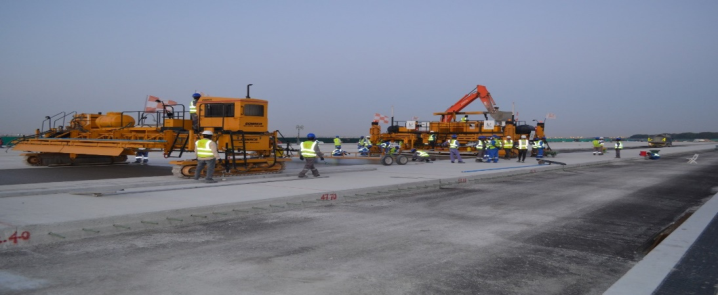
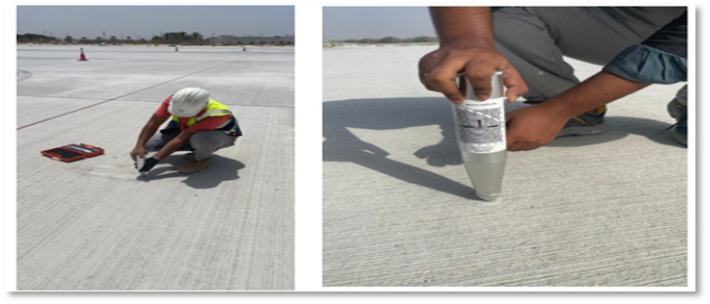
Using the Leica 3D Survey System and the slip-form paver equipment ensured a continuous uniform finish of the Apron. The texture and curing machine increased skid resistance and longevity, as shown in Figure 1. Field testing included a comprehensive suite of procedures performed at 7, 28, 42, 56, and 90 days, such as cube and cylinder compressive strength tests, beam flexural strength tests, pavement core sample compressive strength tests, rebound hammer tests, and site visual inspections performed in collaboration with the project consultant. These tests collectively offered a complete insight into the concrete’s strength and durability throughout time, guaranteeing that the pavement met the necessary performance standards. Figure 2 shows the field-testing methods for Rebound hammer testing for surface strength assessment and core sampling for in-situ compressive strength measurement.
Figure 1: Paving of apron with slipform paver.Figure 2: Rebound hammer test.
MATERIALS
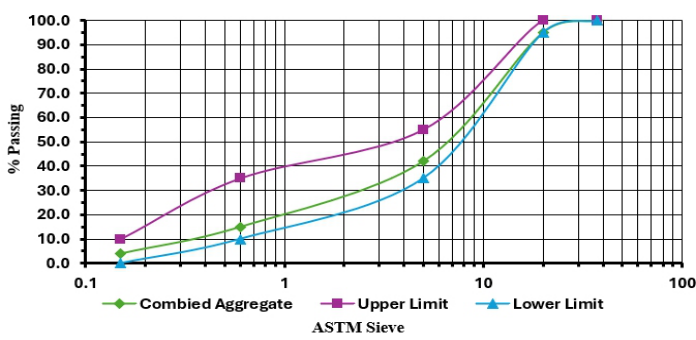
In the study, For the cementitious materials Type 1 Ordinary Portland Cement (OPC), which complies with ASTM C150 standards, was utilized, and Class F fly ash was added in amounts of 15% as a supplement to OPC, which served as the primary binder. The fine aggregate was natural sand with a specific gravity of 2.65. The intended combined aggregate gradation has been attained by using four nominal sizes of coarse aggregates. The combined aggregate gradation is shown in Figure 3. The four sizes are crushed gravel of sizes 5 mm with a specific gravity of 2.55 ,10 mm with a specific gravity of 2.69, 20mm with a specific gravity of 2.70, and 37.5 mm with a specific gravity of 2.73. potable water was added to the mix. Also, a superplasticizer was used to improve workability.
Figure 3: Combine aggregate gradation.
METHODS
The strength of concrete pavement was evaluated in this study using standardized laboratory and field testing. The compressive strength of standard cubes and cylinders also flexural strength of standard beams was measured at 7, 28, 42, 56, and 90 days at 23
C in curing tanks using a Universal Testing Machine (UTM). Concrete samples of 150 × 300 mm specimens were used to measure the cylinder’s compressive strength following ASTM C39/C39M. Concrete sample of 150 x 150 x 150 mm specimens were used to measure the cube’s compressive strength following BS 1881:P116:1983. The flexural strength of 100mm by 100mm by 500mm beams was ascertained using ASTM C78/C78M, while test field core samples were subjected to ASTM C42/C42M for in-situ strength. The field concrete pavement construction followed the approved project approach, including a slip-form paver and texturing and curing equipment linked to the Leica 3D Survey System. Similarly, the rebound hammer testing was carried out as stipulated by ASTM C805/C805M to have a non-destructive assessment of surface strength and homogeneity. Similarly, a project consultant visually
Effective Use of Fly Ash as a Binder in Concrete Pavement: A Case Study of U.A.E Airport 5
inspected the site and recorded joint problems, cracks, and other defects. Working with a team of pavement specialists, a field inspection was carried out per established protocols, such as the Roads Performance Monitoring Systems Guide and Pavement Design Manual (Department of Municipal Affairs and Transport, Abu Dhabi, UAE), the Pavement Surface Evaluation and Rating Manual (PASER) (FAA-USA), the Distress Identification Manual for the Long-Term Pavement Performance Program (FHWA-USA), A Guide to Concrete Road Pavements (British Cementitious Paving Association.
RESULTS AND DISCUSSION
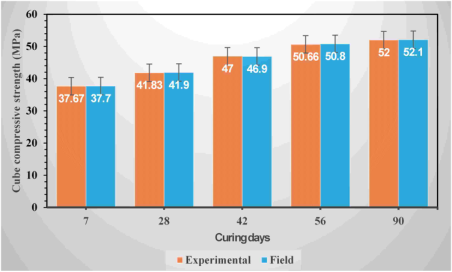
Testing on Collected Samples of Concrete While Paving Cube Compressive Strength In this study, the cube compressive strength for all the curing days showed a significant correlation between the experimental and field results. It was observed that as the curing days increase, the compressive strength also increases, as shown in Figure 4. This can be attributed to the fly ash ability in the concrete mixture to improve the concrete strength (Supit and Shaikh, 2015). The results showed that the field and experimental values were 37.7 MPa and 37.67 MPa, respectively, at 7 days and were almost the same. However, in the 28 days, the values showed a little increase to 41.83 MPa (experimental) and 41.9 MPa (field), indicating a consistent increase in strength due to the pozzolanic effect of the fly ash. Furthermore, at 42 days, the compressive strength increased to 47 MPa (experimental) and 46.9 MPa (field), and then 50.66 MPa and 50.8 MPa at 56 days as the curing process extended. Lastly, at 90 days, the highest compressive strength was observed to be 52 MPa (experimental) and 52.1 MPa (field), confirming the dependability of the concrete mixes developed and cast in laboratories in practical settings. The small variations reveal how well the concrete mix design tested in the lab was transferred to field settings and show the significance of quality control and optimal-designed mixes in ensuring long-lasting concrete pavements.
Figure 4: Compressive strength for cubes (MPa).
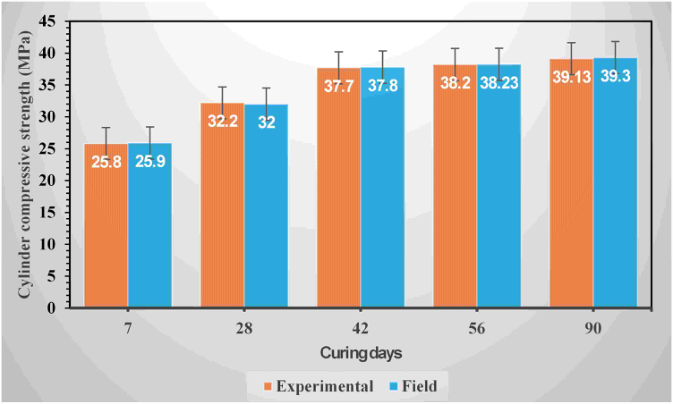
Cylinder Compressive Strength For cylinder compressive strength, the laboratory mix design’s dependability in practical applications was also confirmed by conducting tests between experimental and field results. The cylinder compressive strength is shown in Figure 5, and as expected, the concrete samples show a constant improvement in compressive strength with increased curing durations. This improvement is related to the continuing hydration process, which is responsible for the strength gain of the material over time (Herath et al., 2020). Fly ash improves reactivity with Ca(OH)2, increasing compressive strength (Sun et al., 2018). The results show consistent early strength development by the virtually similar compressive strength values of the experimental (25.8 MPa) and field (25.9 MPa) results at 7 days. Also, as the curing days increased to 28 days, the compressive strength reflected in the readings increased to 32.2 MPa (experimental) and 32.0 MPa (field). Strength increased steadily but gradually, reaching 37.7 MPa and 37.8 MPa at 42 days, 38.2 MPa (experimental), and 38.23 MPa (field) at 56 days. The highest values were measured at 90 days, 39.13 MPa for the experimental and 39.3 MPa for the field, were almost the same, supporting the mix’s long-term stability, a continuation of the hydration process, and formation of the gel- like structure of calcium silicate or calcium hydrate, which slowly eliminates the air voids in concrete as reflected by strength gain. The small differences seen at every testing age fall within tolerable bounds, confirming that the mix created in the lab works well in the field.
Figure 5: Compressive strength for cylinders.
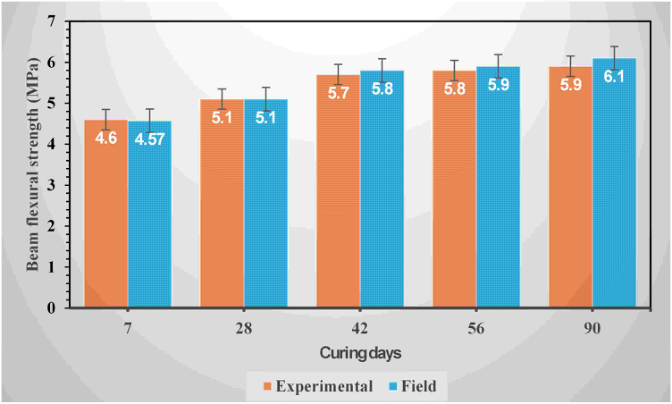
Flexural Strength The results of beam flexural strength of both field and experimental studies of the fly ash-modified concrete are shown in Figure 6, and it was observed
Effective Use of Fly Ash as a Binder in Concrete Pavement: A Case Study of U.A.E Airport 7
that as the curing days increased, the flexural strength also increased. This can be attributed to the fly ash’s ability to effectively fill the pore structures of the concrete, resulting in a denser and more resilient mix (Supit and Shaikh, 2015). Furthermore, the high pozzolanic reactivity of fly ash aids in the utilization of surplus Portlandite created during cement hydration (Zhai et al., 2021). The tests show that the experimental and field data in 7 days showed consistent early-age strength growth, nearly matching each other at 4.6 MPa and 4.57 MPa, respectively. The strength increases in the flexural capacity as hydration progress was reflected in the experimental and field results, which were observed by 28 days had reached 5.1 MPa. Also, it was observed that the strength steadily increased with further curing; laboratory values reached 5.7 MPa at 42 days and 5.8 MPa at 56 days, while field values, at 5.8 MPa and 5.9 MPa, closely followed. Lastly, the maximum flexural strengths were observed at 90 days with values of 5.9 MPa (experimental) and 6.0 MPa (field), demonstrating that the concrete design mix that was optimized in the lab was able to sustain its performance in the field. Based on the study outcomes, it can be comprehended that the proposed design mix shows outstanding durability and load-bearing capacity throughout time, as evidenced by the consistent and negligible discrepancies between experimental and field results.
Figure 6: Flexural strength for beams (MPa).
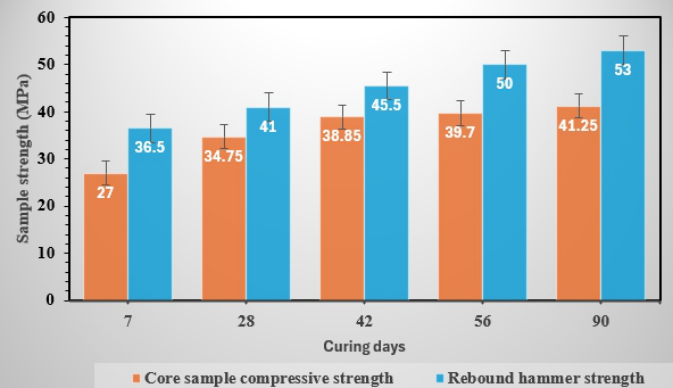
Field Testing After Paving Rebound Hammer Test The rebound hammer test, a non-destructive test, was conducted on paved concrete to evaluate the pavement mix’s dependability. Figure 7 shows the rebound hammer test and a linear trend was observed, indicating that the hydration process and the pozzolanic reaction are continuing efficiently, improving the casted concrete pavement’s overall strength and surface
hardness. The observed behavior is due to the pozzolanic interaction of fly ash (SiO2) and calcium hydroxide (Golewski, 2023). This reaction increases calcium silicate hydrate and re-crystallized calcium carbonate, which may lower porosity in the hardened cement matrix and densify the interfacial transition zone (ITZ) between cement paste and fly ash particles. Furthermore, the increased pozzolanic reaction produced by fly ash fortifies and deepens the ITZ between the mineral aggregates (Golewski, 2022). Based on the study outcome, a steady increase in strength was observed progressively and steadily, reaching 36.5 MPa at 7 days, 41 MPa at 28 days, 45.5 MPa at 42 days, 50 MPa at 56 days, and 53 MPa at 90 days.
Figure 7: Rebound hammer test values.
Core Test Destructive testing techniques are generally expensive, time-consuming, and intrinsically intrusive, and are usually used to assess the compressive strength of concrete. Core extraction from existing concrete structures is frequently used to perform in situ strength assessments, which are then followed by laboratory testing (Ivanchev, 2022). In order to verify the contractor’s workmanship and provide vital information on the as-built condition of concrete pavements, coring is a crucial component of quality assessment and control (Vancura et al., 2013). Thus, in this study, the strength of the concrete pavement was further confirmed by the results of the cored sample’s compressive strength collected from paved concrete. It was observed that the fly ash-modified concrete shows increased compressive strength with prolonged curing, attributed to ongoing hydration product formation that strengthened and densified the concrete matrix, enhancing its strength and durability (Murali et al., 2021). As evaluated in situ, the pavement mix’s consistent strength gain demonstrates that it maintains its load-bearing capacity, which indicates the effectiveness of the developed laboratory
Effective Use of Fly Ash as a Binder in Concrete Pavement: A Case Study of U.A.E Airport 9
concrete mix under real-world service circumstances. It was observed that the field core samples showed a steady increase in strength with time as the average compressive strength at 7 days was recorded to be 27 MPa which increases to 34.75 MPa at 28 days, 38.85 MPa at 42 days, 39.7 MPa at 56 days, and the highest strength was observed at 90days to be 41.25 MPa. This outcome is especially crucial for the pavement’s long-term performance since it validates that the mix design is strong enough to tolerate air traffic loads and environmental exposure (Raj and Rao, 2023). Furthermore, testing core samples not only makes evaluating strength easier but also acts as a diagnostic tool to determine the integrity of the concrete (Gómez et al., 2024). Compressive strength testing can guarantee the pavement infrastructure’s long-term serviceability and durability by identifying potential microcracking and other structural flaws (Li et al., 2017).
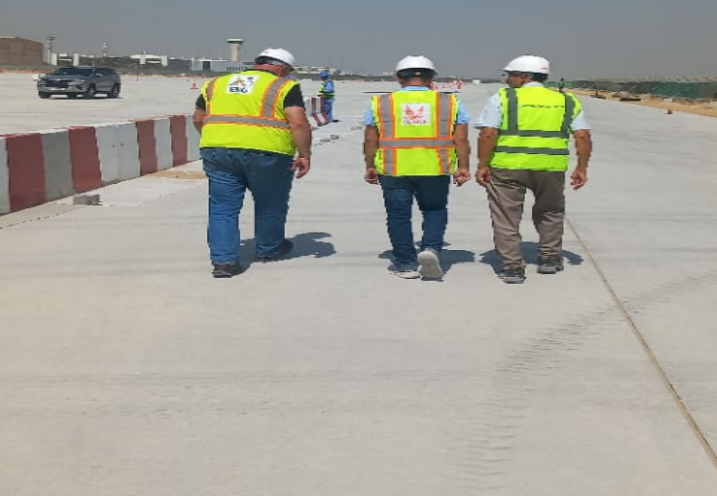
Visual Inspection Visual inspection is one of the most adaptable and user-friendly approaches to evaluating the condition of concrete airport pavement and identifying the cause of clear and early distress on the concrete. In this study, a visual examination was performed by experts, as shown in Figure 8 in the field to evaluate the surface conditions of the field pavement. The pavement was found to be defect-free during the examination, with no obvious surface imperfections, joint failures, or cracks. Also, the professionals and experts checked the quality and structural soundness of the concrete pavement, as observed by the lack of visible defects. Furthermore, they observed a homogeneous surface polish and well-formed joints, implying that the best standards were followed throughout the construction process, assuring satisfactory strength and resilience to environmental stresses. Observing the homogenous surface results in the lack of usual defects like scaling and shrinkage cracks due to appropriate finishing and curing processes. The outcome of the study shows that the visual assessment supports the findings of the laboratory and field tests, emphasizing how well the mix design and construction procedure produce high-quality and durable fly ash-modified concrete pavement.
Table 1: Pavement visual inspection tracker.
Table available in the original PDF paper.
S. No. Description Date Observation Remarks Satisfied 1 Casting date 10-May-24 Visually inspected and free surface imperfections, joint failures, or cracks.
Satisfied 2 Inspection (1) 17-May-24 Visually inspected and free surface imperfections, joint failures, or cracks.
Satisfied 3 Inspection (2) 07-June-24 Visually inspected and free surface imperfections, joint failures, or cracks.
Satisfied 4 Inspection (3) 21-June-24 Visually inspected and free surface imperfections, joint failures, or cracks.
Satisfied 5 Inspection (4) 05-July-24 Visually inspected and free surface imperfections, joint failures, or cracks.
Satisfied 6 Inspection (5) 08-Aug-24 Visually inspected and free surface imperfections, joint failures, or cracks.
Figure 8: Visual inspection by a team of experts.
CONCLUSION
This study demonstrates that incorporating fly ash as a cement substitute in concrete pavement production can improve sustainability by lowering conventional cement-based concrete’s carbon footprint while increasing the concrete’s strength.
Also, the study shows a strong correlation between concrete mixes created in laboratories and field performance testing before and after paving the concrete, guaranteeing long-lasting and structurally sound airport pavements. Also, it was observed that there were little discrepancies between laboratory and field results in compressive and flexural strength results, which confirmed steady strength development due to hydration and pozzolanic reaction of the fly ash. Furthermore, visual inspection verified the lack of defects, while rebound hammer testing further confirmed the pavement’s consistency and dependability, confirming the efficiency of the mix design and construction process.
ACKNOWLEDGMENT
The authors would like to acknowledge the support of the Al NISR Roads and Building Contracting for facilitating this case study and the field pavement at an operational airport in the UAE.
REFERENCES
Alterary, S. S. & Marei, N. H. 2021. Fly ash properties, characterization, and applications: A review. Journal of King Saud University-Science, 33, 101536.
Effective Use of Fly Ash as a Binder in Concrete Pavement: A Case Study of U.A.E Airport 11
Debbarma, S., Selvam, M. & SINGH, S. 2020. Can flexible pavements’ waste (RAP) be utilized in cement concrete pavements?–A critical review. Construction and Building Materials, 259, 120417. Etukudoh, E. A., Adefemi, A., Ilojianya, V. I., Umoh, A. A., Ibekwe, K. I. &
Nwokediegwu, Z. Q. S. 2024. A Review of sustainable transportation solutions: Innovations, challenges, and future directions. World Journal of Advanced Research and Reviews, 21, 1440–1452. Golewski, G. L. 2022. The role of pozzolanic activity of siliceous fly ash in the formation of the structure of sustainable cementitious composites. Sustainable Chemistry, 3, 520–534. Golewski, G. L. 2023. The effect of the addition of coal fly ash (CFA) on the control
of water movement within the structure of the concrete. Materials, 16, 5218. GÓMez, N., Villar, J., Sánchez, J. D. L. C., PazmiÑO, J., Vergara, F., Rodriguez, J.
& Mudarra, M. Comparative Analysis of the Accuracy of NDTs in Determining Concrete Strength. 2024 9th International Engineering, Sciences and Technology Conference (IESTEC), 2024. IEEE, 449–454. Herath, C., Gunasekara, C., Law, D. W. & Setunge, S. 2020. Performance of high volume fly ash concrete incorporating additives: A systematic literature review. Construction and Building Materials, 258, 120606. Ivanchev, I. 2022. Investigation with non-destructive and destructive methods for
assessment of concrete compressive strength. Applied Sciences, 12, 12172. Li, H., Harvey, J., Asselanis, J., Zhou, J., Guada, I., Kannekanti, V. & Wu, R.
2017. Results from Visual Inspection and Laboratory Testing for ASR in Existing Concrete Cores from Bridges and Pavements in California. Li, Y., Wu, B. & Wang, R. 2022. Critical review and gap analysis on the use of highvolume fly ash as a substitute constituent in concrete. Construction and Building Materials, 341, 127889. Maltinti, F., Flore, M., Pigozzi, F. & Coni, M. 2024. Optimizing Airport Runway
Capacity and Sustainability through the Introduction of Rapid Exit Taxiways: A Case Study. Sustainability, 16, 5359. Murali, M., Mohammed, B. S., Abdulkadir, I., Liew, M. & Alaloul, W. S. 2021.
Utilization of crumb rubber and high-volume fly ash in concrete for environmental sustainability: RSM-based modeling and optimization. Materials, 14, 3322. Raj, B. S. & Rao, M. K. Flexural Performance of Sustainable Fly Ash Based Concrete Beams. IOP Conference Series: Earth and Environmental Science, 2023. IOP Publishing, 012021. Shah, K. J., Pan, S.-Y., Lee, I., Kim, H., You, Z., Zheng, J.-M. & Chiang, P.-C. 2021.
Green transportation for sustainability: Review of current barriers, strategies, and innovative technologies. Journal of Cleaner Production, 326, 129392. Shukla, B. K., Gupta, A., Gowda, S. & Srivastav, Y. 2023. Constructing a greener future: A comprehensive review on the sustainable use of fly ash in the construction industry and beyond. Materials Today: Proceedings. Sun, Q., Zhu, H., Li, H., Zhu, H. & Gao, M. 2018. Application of response surface
methodology in the optimization of fly ash geopolymer concrete. Revista Romana de Materiale, 48, 45–52. Supit, S. W. M. & Shaikh, F. U. A. 2015. Durability properties of high volume fly ash concrete containing nano-silica. Materials and structures, 48, 2431–2445. Tamagusko, T. B. 2020. Airport pavement design. Vancura, M., Khazanovich, L. & Barnes, R. 2013. Concrete pavement thickness
variation assessment with cores and nondestructive testing measurements. Transportation Research Record, 2347, 61–68.
Wi¸eckowski, A. & Sznurawa, A. Structural aspects of airfield runways with concrete pavements. Contemporary Challenges of Transport Systems and Traffic Engineering: 13th Scientific and Technical Conference “Transport Systems. Theory and Practice 2016” Katowice, Poland, September 19–21, 2016 Selected Papers, 2017. Springer, 39–52. Zhai, H.-X., Tang, Y.-Z., Chen, S.-H., Chen, H.-H., Cheng, B.-Q., Cai, X. & Wei,
Y.-H. 2021. Experimental research on durability of fly ash pavement concrete and mix proportion optimization. Advances in Materials Science and Engineering, 2021, 1–11. Zimar, Z., Robert, D., Zhou, A., Giustozzi, F., Setunge, S. & Kodikara, J. 2022.
Application of coal fly ash in pavement subgrade stabilisation: A review. Journal of Environmental Management, 312, 114926.
LISTED IN THE AHFE DIGITAL BOOKSTORE CATALOGUE
Explore the complete digital volume
Sustainable Construction in the Era of the Fourth Industrial Revolution
Read this individual research paper free through the original publisher, or explore the full digital proceedings book.
ISBN 978-1-964867-63-2
Explore this ISBN in the AHFE Bookstore ↗Listed in the July 2026 bookstore catalogue; search by ISBN to confirm current availability · Digital book purchase optional