Nana Akua Gyadu-asiedu, Clinton Aigbavboa, Lerato Millicent Aghimien, Simon Ofori Ametepey (2026). Climate Adaptation Projects for Resilient Cities and Social Value: A Scientometric Review. In: Sustainable Built Environment. AHFE Open Access, vol. 225, pp. 50–60. https://doi.org/10.54941/ahfe1007898
The risks associated with climate change are escalating in communities, and the benefits of adaptation projects are often assessed by focusing primarily on the technical gains of increased resilience, with comparatively less attention to the social value they create for those communities. This study reviews academic evidence on how climate change adaptation projects implemented in the urban built environment translate these strategies into two outcomes: the city’s resilience and social value, through the lens of the delivery of urban planning and construction projects. The scientometric analysis was carried out on 58 peer-reviewed documents identified from the Web of Science (n=51) and the Scopus database (n=7), with relevance to English-language publications. The results of the keyword co-occurrence analysis using the VOSviewer tool, with a minimum of five occurrences and 22 keywords, clustered into four distinct themes: Policy Frameworks, Urban Resilience, Risk Management, and Planning Governance. The results of the study suggest a highly interconnected body of knowledge networked around the keywords of climate change, adaptation, cities, and resilience, representing a dynamic shift from a traditional framework of risk and vulnerability to a more contemporary approach that focuses on the roles of policy, planning, governance, and sustainability. It is also interesting to recognise the limited appearance of social value as a high-frequency keyword. The paper contributes a cluster delivery logic that links strategy, project selection, design needs, coordination, and implementation management to outcomes of resilience and social value. The discussion of implications suggests the need to integrate a criterion of social value into appraisal, procurement, and review processes, and to develop African evidence through African-led evaluations and context-related delivery research.
Climate change presents growing risks to urban centers globally, including more severe flooding, heatwaves, and extended droughts. Cities aggregate populations, economic assets, and critical infrastructure, making adaptation essential to protect human lives and economic stability (Carter et al., 2015). Lately, both researchers and practitioners have come to appreciate that urban Received February 5, 2026; Revised April 10, 2026; Accepted April 30, 2026; Available online July 20, 2026
Climate Adaptation Projects for Resilient Cities and Social Value: A Scientometric Review 51 initiatives designed for climate resilience can mitigate physical hazards while also fostering social benefits within communities (Jenewein & Hummel, 2022). Strategies for climate adaptation and resilient buildings, such as flood protection systems, buildings designed for heat resilience, storm water infrastructure and green urban infrastructure, provide additional advantages that improve living standards, social equity, and job prospects for city dwellers (Jabareen, 2013). Social value can be defined in this sense as “the positive outcomes a community derives in social, economic, and environmental terms, which includes reduced vulnerability, improved access, equity, or well- being resulting directly from a climate-adaptive strategy or project.” This definition fits with the broader understanding of social value in the built environment as a net positive impact on society beyond financial returns of a project or activity (Gyadu-Asiedu, Aigbavboa & Ametepey, 2024; Raiden, Loosemore, King & Gorse, 2018). Climate adaptation initiatives that are effective build community resilience alongside equity and inclusion, such as by safeguarding disadvantaged neighborhoods, expanding essential service access, and establishing green areas that promote well-being. Embedding these measures within urban development frameworks thus offers dual advantages for climate preparedness and social progress (Georgiadou & Fitton, 2026; Walker et al., 2024). Effective urban planning and construction projects are well-positioned to deliver social value through climate adaptation initiatives. Planning what gets built, where and how has significant societal implications. Therefore, it is important to ensure that these initiatives are pursued as a public good that prioritizes marginalized groups over quick engineering fixes (Xu et al., 2025; Anguelovski et al., 2016). The concept of a resilient city is now also understood to extend beyond the physical strength of cities to climate change, to the ability of cities to support human well-being and social justice under stress (Gretter et al., 2024). Thus, a truly resilient form of urban development integrates climate change adaptation with sustainable development, creating social value. A scientometric review approach is adopted, given the multidisciplinary nature of this research, which covers urban planning, environmental engineering, public policy, and development studies. It aims to map the knowledge landscape. (Leydesdorff & Milojević, 2015). The paper presents a scientometric analysis of the scholarly literature on climate adaptation projects for resilient cities and their social value implications. By analyzing a curated set of publications from Web of Science and Scopus using the Vosviewer software version 1.6.19. The aim was to identify the main research themes, influential publications and authors, and how the focus of this research has evolved over time. This study is the first scientometric paper to map climate adaptation research to resilient urban cities and social value in the built environment.
RESEARCH METHODOLOGY This study conducted a scientometric review to map the intellectual structure and thematic focus of research on climate adaptation projects for resilient cities and social value. Scientometric methods were used to quantify and visualise patterns in the literature, including most relevant authors and conceptual
linkages among keywords, thereby supporting the identification of dominant clusters and evolving research fronts (Olawumi & Chan, 2018). A structured bibliographic search was carried out in Scopus and Web of Science using the following Boolean string: (“climate adaptation” OR “urban adaptation” OR “adaptation strateg*” OR “climate resilient” OR “urban resilience” OR “resilient cit*”) AND (“urban planning” OR “spatial planning” OR “built environment” OR “urban infrastructure” OR “urban development”) AND (“infrastructure project*” OR “construction project*” OR “project delivery” OR “construction management” OR “project management”) AND (“social value” OR “social impact” OR “public value” OR equity OR wellbeing OR “co benefit*”) AND (procurement OR invest* OR financ* OR governance OR “stakeholder engagement”). Some keywords were truncated (*) to allow the search for the root of a word and automatically include all its possible endings. It broadens the search results by capturing multiple word forms without typing each variation. The initial Scopus search returned 11 records, which were refined to 7 after limiting results to English-language publications and relevant subject areas; records were exported in CSV format. The Web of Science search returned 100 records, which were refined to 51 using the same criteria and exported to Excel. Refinement across both databases used consistent inclusion criteria: English-language peer-reviewed outputs (articles and conference papers) and research areas aligned with the study scope, including urban studies, environmental sciences, geography, development studies, engineering, construction and building technology, architecture, water resources, and business/economics. No publication year range was set; the final corpus spans 2008–2025. The two datasets were merged and screened for overlap, yielding 58 relevant documents. Analysis and visualisation were conducted in VOSviewer version 1.6.19, using keyword co-occurrence mapping to identify knowledge structures and thematic clusters.
SCIENTOMETRIC ANALYSIS AND RESULTS The final dataset includes 58 journal articles published between 2008 and 2025, with a total of 4,495 citations. The number of publications on urban climate adaptation has been rising over the last decade, which indicates the rising interest in the field of urban resilience. It is also important to note that the articles included in the dataset are extremely interdisciplinary, as they are published in dozens of different journals and written by authors from different disciplines (planning, environmental science, engineering, economics, among others). After examining the dataset, the average number of citations per article is approximately 77, although the distribution of citations is not even, a few key articles have many citations, which shows their great impact on the development of this area. The number of documents on urban climate adaptation and resilient cities from 2008 to 2025 is presented in Table 1.
The literature is concentrated in the last five years. From the dataset, 2021–2025 reports 33 out of 58 documents (56.9%), with the highest output in 2022 (8 papers, 13.8%), followed by 2025 (7 papers, 12.1%). This pattern indicates and affirms recent research attention on climate adaptation projects linked to urban resilience and social value (Georgiadou & Fitton, 2026).
Table 1: Year distribution for the 58 documents.
Table available in the original PDF paper.
Year Documents (n) Share of Dataset (%)
2008 1 1.7
2012 2 3.4
2013 1 1.7
2014 1 1.7
2015 5 8.6
2016 6 10.3
2017 2 3.4
2019 3 5.2
2020 4 6.9
2021 6 10.3
2022 8 13.8
2023 6 10.3
2024 6 10.3
2025 7 12.1
Total 58 100.0
Most Cited Journals and Authors The analysis identified the leading journals and authors in this research domain by citation impact. Table 2 presents the top ten journals in which these 58 documents appeared, ranked by the total citations of those articles.
Table 2: Top 10 most cited journals.
Table available in the original PDF paper.
Rank Journal Name Total Citations 1st Cities 925
2nd Journal of Planning Education and Research 652 3rd Climate and Development 561
4th Progress in Planning 521 5th Ecosystem Services 384
6th Science of the Total Environment 290 7th Land Use Policy 266
8th Environmental Science & Policy 152 9th Habitat International 141
10th Journal of Environmental Planning and Management 140 The journal “Cities” from the table has been highly cited papers (in total 925 citations). For instance, Jabareen (2013) was published in this journal, on resilient city planning (639 citations as shown in Table 2). Other influential papers have also been published on urban adaptation strategies, and Cities is the highest-impact journal for the search results. The next is the “Journal of Planning Education and Research,” ranked second (652 citations),
mainly due to an influential 2016 paper on equity in climate adaptation planning. Other relevant and impactful journals, albeit with fewer citations, include Climate and Development (561 citations), for instance, the climate adaptation framework by (Tyler & Moench 2012), Progress in Planning (521 citations), also, the comprehensive review of urban adaptation capacity by (Carter et al., 2015), and Ecosystem Services (384 citations), publishing papers with the interest in nature-based solutions for urban resilience (McPhearson, Andersson, Elmqvist & Frantzeskaki, 2015). Other relevant publication sources from the dataset results included policy-focused journals on environment and urban issues, such as Science of the Total Environment, Land Use Policy, Environmental Science & Policy, among other journals, which rank among the top ten. Construction-related publications are represented but do not form a major part of the top-cited sources. This reflects a practice-related gap. Climate adaptation and resilience in urban areas are well established in planning and policy-related publications, whereas construction delivery methods that can embed social value, such as procurement, delivery Key Performance Indicators, and benefits realization during the construction and early operational stages, are less prominent in the citation environment. Table 3 presents the top 10 most-cited authors in the dataset, based on the total number of citations to their papers.
Table 3: Most cited authors.
Table available in the original PDF paper.
Rank Author Name Total Citations 1st Stephen Tyler 643
2nd Yosef Jabareen 639 3rd Marcus Moench 561
4th Isabelle Anguelovski 536 5th Linda Shi 536
6th Eric Chu 536 7th Daniel Gallagher 536
8th Kian Goh 536 9th Zachary Lamb 536
10th Kara Reeve 536
Stephen Tyler leads with 643 citations, largely due to his co-authoring of several influential papers (including the 2012 article on resilience framework and the 2016 paper on urban resilience indicators) (Tyler et al., 2016; Tyler & Moench, 2012). Second is Yosef Jabareen with 639 citations, mainly attributed to his 2013 paper conceptualizing the resilient city. Marcus Moench ranks third with 561 citations, largely due to his co-authoring with Stephen Tyler and others on the resilience framework and its related papers. The remaining 8 authors are next with 536 citations each, who were co-authors of a highly cited paper that examined the equity implications of urban adaptation planning (Anguelovski et al., 2016). These include Isabelle Anguelovski and Linda Shi, who have made significant contributions to the
Climate Adaptation Projects for Resilient Cities and Social Value: A Scientometric Review 55 literature on climate justice and adaptation. In their work, they highlight the implications of urban adaptation planning for exacerbating and mitigating social equity. The presence of these authors in the top ten reinforces the significance of conceptual frameworks and equity-oriented critiques in the literature.
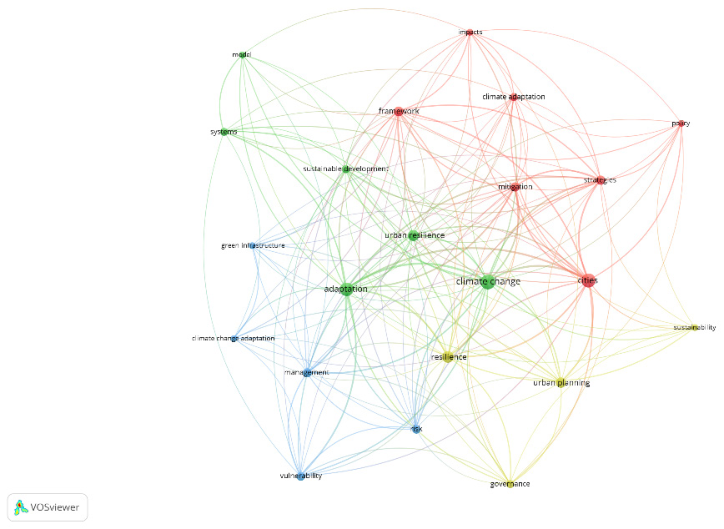
Keyword Co-Occurrence Network Analysis Mapping the co-occurrence of author-provided keywords reveals four distinct thematic clusters (Figure 1). Each cluster represents a nexus of frequently co-occurring concepts, suggesting a coherent research theme. From 370 extracted keywords, a minimum occurrence threshold of 5 yielded 22 keywords for mapping. The co-occurrence network is compact and highly connected, with climate change, adaptation, cities, resilience, and urban resilience acting as bridging terms across all clusters. The size of each node reflects the keyword’s frequency, and the thickness of links indicates the strength of co-occurrence between keywords. This network illustrates the field’s conceptual structure, with closely linked terms forming thematic clusters. Figure 1 presents the network visualization.
Figure 1: Keyword network visualization map.
Cluster1-Policy Frameworks (red): Keywords in this cluster include cities, climate adaptation, framework, impacts, mitigation, policy, and strategies. This theme focuses on the integration of climate adaptation in urban policy and planning systems, which is often researched simultaneously with mitigation. The use of the terms “adaptation” and “mitigation” together implies that
there is an integrated urban climate agenda that considers resilience and mitigation strategies simultaneously (Jenewein & Hummel, 2022). This recurring theme also reflects research that focuses on the development of strategic plans, policies, or institutional frameworks that address climate impacts (Van De Ven et al., 2016). This cluster reveals the various frameworks that promote climate resilience in cities. Cluster 2-Urban Resilience (green): This cluster includes keywords such as adaptation, climate change, model, sustainable development, and urban resilience. This cluster represents the underlying theories of urban climate resilience research. Indeed, many of the highly cited articles in this cluster introduce frameworks/models of thinking about what makes an urban area resilient in the face of climate change (Jabareen, 2013). For example, conceptual frameworks such as the ‘Climate Resilience Framework’ developed by Tyler and Moench (2012) incorporate systems thinking in assisting practitioners in operationalizing urban resilience in urban planning processes (Tyler & Moench, 2012). Likewise, Jabareen (2013) developed a ‘Resilient City Planning Framework’ that addresses “what cities and their communities should do” to become resilient in the future, acknowledging the “complexity and uncertainty of the future” (Jabareen, 2013). The appearance of ‘sustainable development’ as another keyword in this cluster underlines the fact that this cluster connects urban resilience with broader issues of sustainable development by conceptualizing adaptation in the context of sustainable urban development. Cluster 3-Risk Management (blue): Key terms in this cluster are climate change adaptation, management, risks, vulnerability, and green infrastructure. This cluster highlights research on climate change adaptation, risk management, vulnerability assessment, and green infrastructure, mostly in urban areas. It reveals practical applications, such as impact assessment, risk reduction, flood defense, early warning systems, and resilient design, which are aimed at reducing social and systemic vulnerabilities related to extreme weather events. Green infrastructure provides co-benefits, which again emphasize an operational approach to building adaptive capacity (Carter et al., 2015). Cluster 4-Planning Governance (yellow): This cluster features keywords like governance, resilience, sustainability, and urban planning. This cluster grounds climate adaptation in planning institutions and governance structures. Urban planning and governance are closely linked to resilience, suggesting that the relevant literature views planning systems as mechanisms for delivering resilience outcomes. This cluster also reveals research that links to social value because the governance and planning systems manage participation, the sharing of benefits, and the recognition of the vulnerable. The recent literature in the subject of adaptation planning prioritizes justice and equity as key evaluation criteria in urban adaptation planning. This is consistent with the ‘social value through projects’ theme when applied to the evaluation and procurement of projects (Georgiadou & Fitton, 2026; Cannon, Chu, Natekal & Waaland, 2023). This cluster examines how cities manage themselves to successfully implement adaptation and resilience in a sustainable manner.
The key finding is that social value is not represented in the 22 high- frequency keywords, although these concepts are represented through
Climate Adaptation Projects for Resilient Cities and Social Value: A Scientometric Review 57 sustainability, governance, vulnerability, and impacts. This implies that the discourse on climate adaptation in cities is primarily focused on resilience and sustainability, while the discourse on construction and infrastructure, which has developed the concept of social value through procurement, social procurement, and measurement, is weakly integrated with the discourse on climate adaptation. Evidence from the construction research discourse reveals an increasing body of research on social value and social procurement, but this is often undertaken in parallel with, rather than integrated with, research on climate adaptation (Suchowerska, Loosemore, Coen & Alkilani, 2025; Lou et al., 2023; Fujiwara et al., 2022).
DISCUSSION AND RESEARCH GAPS The cluster pattern shows that research and practice can improve the chain of delivery that connects adaptation strategies to resilience and social value by aligning four elements across the project life cycle. First, risk and vulnerability assessments should inform project scoping and optioning, as well as technical design. Second, planning and governance tools should express resilience outcomes as project appraisal criteria and portfolio decisions, which in turn influence procurement and contracting. Third, delivery-oriented tools should help transform policy agendas into measurable outcomes, such as benefits realization plans, stakeholder commitments, and monitoring systems that track distributional outcomes together with resilience outcomes. This is in line with the AR6 focus on enabling conditions for adaptation in cities and infrastructure (Intergovernmental Panel On Climate Change (Ipcc) 2023).
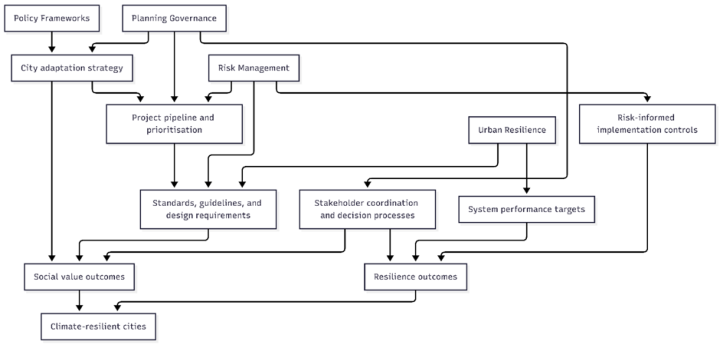
The overall thematic trajectory of the field can be understood as a movement from analysis to action, as well as from climate-centric to people- centric research. While early studies focused on what cities need to do to adapt (example, identify risks, enhance adaptive capacity), recent studies investigate how cities can do so through policy and governance, and who benefits or is at risk (Okamoto & Doyon, 2024). Figure 2 presents a conceptual framework that translates the four cluster themes into a deliver logic for climate adaptation projects.
Figure 2: Conceptual diagram.
Policy Frameworks and Planning Governance influences the city’s adaptation strategy and the circumstances under which decisions are made, for example, the process for selecting and prioritising projects. Risk Management can be leveraged for project screening and risk-informed implementation controls, while Urban Resilience provides performance targets for system performance and defines the meaning of ‘success’ for infrastructure and services under climate stress. All these inputs are brought together through three interfaces for implementation, namely, the project pipeline and prioritisation process, the process for setting standards and design requirements, and the process for coordinating stakeholders and making decisions. The process influences two outcome streams: resilience outcomes and social value outcomes, which define the path towards climate-resilient cities. A project like the sea wall, for example, could, in one sense, be considered successful if the flooding is stopped, but the broader view might ask questions about the jobs created during the project, the amenities included for the public, the neighborhoods that the project protects, and the extent to which the public was engaged in the process. For governments and institutions, the aspiration should be for multifunctional adaptation projects that not only protect vulnerable cities from the impacts of climate change but also improve lives.
While the literature on climate change adaptation in cities has expanded, there remain gaps in research. Resilience and sustainability are still viewed as parallel objectives, not integrated, without recognizing the joint pursuit of sustainability and resilience in cities (Chelleri, Schuetze & Salvati, 2015). There is a need to explore local and indigenous knowledge, especially in Africa, as well as the relationship between adaptation and social value creation (which extends beyond implicit notions of sustainability). There is a scarcity of evaluative tools that link adaptation, equity, well-being, and recognitional justice (Walker et al., 2024). Finally, the evidence skews toward the Global North and megacities, neglecting vulnerable cities in Africa and South Asia that are experiencing rapid growth.
CONCLUSION AND FUTURE RESEARCH This scientometric review has revealed the landscape of research on climate adaptation projects for resilient cities and their capacity to generate social value. The analysis identified four major thematic clusters, namely, Policy Frameworks, Urban Resilience, Risk Management, and Planning Governance. These research themes capture the multi-dimensional efforts required to develop climate-proof cities in a just and sustainable manner. It further highlights that early literature (from 2008) focused on foundational concepts of climate change adaptation, risk, and vulnerability, and recent works (post 2020) suggest a maturation of the research, moving from conceptual and risk analysis toward integration and action in city governance. For engineers and construction professionals, incorporate the “social value requirements” component into project briefs, with specific commitments such as local employment levels, apprenticeships, local sourcing where possible, and community safety provisions during construction. Break down resilience into performance requirements such as design return periods, redundancy,
Climate Adaptation Projects for Resilient Cities and Social Value: A Scientometric Review 59 recoverability, and maintainability, and directly link these to service outcomes for at-risk areas. Local knowledge should be treated as field data to assess flood routes, heat-stress hotspots, and asset failure history. Embed social value into land use and infrastructure sequencing by prioritising risk reduction and service access as explicit spatial goals. Use planning tools to safeguard adaptation investments, like drainage corridors, floodplain restrictions, and heat-sensitive urban design. Policy makers should formulate adaptation strategies into a pipeline with clear selection criteria, mandating each project concept note to prove a risk case, benefit of resilience, and social value case in sequence. Use procurement as a lever, applying social procurement guidance to ensure that public expenditure creates deliberate social value beyond the asset. Future studies should develop techniques to measure and monitor the social value outcomes of adaptation interventions, creating an evidence base to inform policy and investment decisions. Researchers must investigate alternative governance models to enable communities to take charge, especially in rapidly urbanizing cities in the Global South.
REFERENCES
Anguelovski, I., Shi, L., Chu, E., Gallagher, D., Goh, K., Lamb, Z., Reeve, K. and Teicher, H. (2016). Equity impacts of urban land use planning for climate adaptation: Critical perspectives from the Global North and South. Journal of Planning Education and Research. 36(3):333–348. doi. org/10.1177/0739456X16645166. Cannon, C., Chu, E., Natekal, A. and Waaland, G. (2023). Translating and embedding
equity-thinking into climate adaptation: An analysis of US cities. Regional Environmental Change. 23(1):30. doi.org/10.1007/s10113-023-02025-2. Carter, J.G., Cavan, G., Connelly, A., Guy, S., Handley, J. and Kazmierczak, A.
(2015). Climate change and the city: Building capacity for urban adaptation. Progress in Planning. 95:1–66. doi.org/10.1016/j.progress.2013.08.001. Chelleri, L., Schuetze, T. and Salvati, L. (2015). Integrating resilience with urban sustainability in neglected neighborhoods: Challenges and opportunities of transitioning to decentralized water management in Mexico City. Habitat International. 48:122–130. doi.org/10.1016/j.habitatint.2015.03.016. Fujiwara, D., Dass, D., King, E., Vriend, M., Houston, R. and Keohane, K. (2022).
A framework for measuring social value in infrastructure and built environment projects: An industry perspective. Proceedings of the Institution of Civil Engineers - Engineering Sustainability. 175(4):175–185. doi.org/10.1680/jensu.21.00029. Georgiadou, M.C. and Fitton, S.L. (2026). Delivering the UN Sustainable Development Goals through inclusive stakeholder engagement: The case of flood alleviation schemes in England. Sustainable Development. 34(S1):1184– 1196. doi.org/10.1002/sd.70237. Gretter, A., Nikologianni, A., Betta, A., Lugli, L., Laiti, L. and Barbiero, R. (2024).
A multi-approach and collaborative pathway towards designing climate strategies: The case of Trentino, a mountainous region in Italy. Sustainability. 16(10):4198. doi.org/10.3390/su16104198. Gyadu-Asiedu, N.A.A., Aigbavboa, C. and Ametepey, S.O. (2024). Social value trends in construction research: A bibliometric review of the past decade. Sustainability. 16(12):4983. doi.org/10.3390/su16124983.
Intergovernmental Panel on Climate Change (IPCC). (2023). Climate Change 2022: Impacts, Adaptation and Vulnerability: Working Group II Contribution to the Sixth Assessment Report of the Intergovernmental Panel on Climate Change. 1st edn. Cambridge: Cambridge University Press. doi.org/10.1017/9781009325844. Jabareen, Y. (2013). Planning the resilient city: Concepts and strategies for
coping with climate change and environmental risk. Cities. 31:220–229. doi. org/10.1016/j.cities.2012.05.004. Jenewein, O. and Hummel, M.A. (2022). Co-creating climate adaptation pathways in coastal cities: A practical guide for engaged scholars and urban designers. Sustainability. 14(23):16046. doi.org/10.3390/su142316046. Leydesdorff, L. and Milojević, S. (2015). Scientometrics. In: International
Encyclopedia of the Social & Behavioral Sciences. Elsevier. pp. 322–327. doi. org/10.1016/B978-0-08-097086-8.85030-8. Lou, C.X., Natoli, R., Goodwin, D., Bok, B., Zhao, F. and Zhang, P. (2023). A systematic literature review of research on social procurement in the construction and infrastructure sector: Barriers, enablers, and strategies. Sustainability. 15(17):12964. doi.org/10.3390/su151712964. McPhearson, T., Andersson, E., Elmqvist, T. and Frantzeskaki, N. (2015). Resilience
of and through urban ecosystem services. Ecosystem Services. 12:152–156. doi. org/10.1016/j.ecoser.2014.07.012. Okamoto, T. and Doyon, A. (2024). Equity and justice in urban coastal adaptation planning: new evaluation framework. Buildings and Cities. 5(1):101–116. doi. org/10.5334/bc.377. Olawumi, T.O. and Chan, D.W.M. (2018). A scientometric review of global research
on sustainability and sustainable development. Journal of Cleaner Production. 183:231–250. doi.org/10.1016/j.jclepro.2018.02.162. Raiden, A., Loosemore, M., King, A. and Gorse, C. (2018). Social Value in Construction. 1st edn. London: Routledge. doi.org/10.1201/9781315100807. Suchowerska, R., Loosemore, M., Coen, A. and Alkilani, S. (2025). Caring
beyond compliance: How social procurement professionals reshape relational norms in construction projects. International Journal of Project Management. 43(8):102783. doi.org/10.1016/j.ijproman.2025.102783. Tyler, S. and Moench, M. (2012). A framework for urban climate resilience. Climate and Development. 4(4):311–326. doi.org/10.1080/17565529.2012.745389. Tyler, S., Nugraha, E., Nguyen, H.K., Nguyen, N.V., Sari, A.D., Thinpanga, P., Tran,
T.T. and Verma, S.S. (2016). Indicators of urban climate resilience: A contextual approach. Environmental Science & Policy. 66:420–426. doi.org/10.1016/j. envsci.2016.08.004. Van de Ven, F.H.M., Snep, R.P.H., Koole, S., Brolsma, R., Van der Brugge, R., Spijker, J. and Vergroesen, T. (2016). Adaptation planning support toolbox: Measurable performance information based tools for co-creation of resilient, ecosystem-based urban plans with urban designers, decision-makers and stakeholders. Environmental Science & Policy. 66:427–436. doi.org/10.1016/j. envsci.2016.06.010. Walker, S.E., Smith, E.A., Bennett, N., Bannister, E., Narayana, A., Nuckols, T.,
Pineda Velez, K., Wrigley, J., et al. (2024). Defining and conceptualizing equity and justice in climate adaptation. Global Environmental Change. 87:102885. doi.org/10.1016/j.gloenvcha.2024.102885. Xu, Y., Willis, S., Dallmann, A., Cai, H., Hu, L., Zou, L., Zhai, W., He, C., et al.
(2025). Urban climate adaptation and resilience (U-CARE) in Texas: Insights from interdisciplinary perspectives. Applied Spatial Analysis and Policy. 18(2):53. doi.org/10.1007/s12061-025-09655-5.
LISTED IN THE AHFE DIGITAL BOOKSTORE CATALOGUE
Explore the complete digital volume
Sustainable Built Environment
Read this individual research paper free through the original publisher, or explore the full digital proceedings book.
ISBN 979-8-950676-01-7
Explore this ISBN in the AHFE Bookstore ↗Listed in the July 2026 bookstore catalogue; search by ISBN to confirm current availability · Digital book purchase optional