Alen Jugović, Miljen Sirotic (2025). Business Analytics Strategies in Port Economics from a Systems-Theory Perspective: A Bibliometric Analysis and Future Research Directions. In: Human Systems Engineering and Design (IHSED2025): Future Trends and Applications. AHFE Open Access, vol. 198, pp. 69–80. https://doi.org/10.54941/ahfe1006763
Business analytics in the context of port economics encompasses data-driven insights to optimize port operations, streamline logistics, inform infrastructure planning, and enhance stakeholder coordination. Contemporary research in business analytics strategies in port economics from a systems – theory perspective is fragmented, as varied approaches and themes make it challenging for scholars and industry practitioners to form a clear vision of current integrated business analytics strategies. To address this gap, this study conducts a bibliometric analysis of 142 articles regarding business analytics strategies in port economics. The articles were published in 98 academic journals and authored by 498 scholars. The application of the bibliographic coupling methodology in the VOSviewer software enabled the identification of four clusters: (1) Contemporary Maritime Transport Systems; (2) Port Systems Analysis; (3) Performance Optimization; (4) Data – Driven Decision Support. Content analysis of the identified clusters indicates future research directions regarding business analytics strategies that contemporary ports should incorporate: (1) Improved efficiency and resource allocation via utilization of predictive analytics, real – time monitoring and performance measurement; (2) Cost optimization via reduced waiting times, improved equipment utilization, and predictive maintenance; and (3) Enhanced decision – making via data – driven insights, risk management, and sustainability goals. The findings offer a scientifically robust foundation for scholars and industry practitioners aiming to improve their understanding of how systems – theory informed business analytics strategies can be utilized to optimize the port as a system.
Ports are essential transportation nodes in global trade and serve as examples of complex socio-technical systems (Su et al., 2024a; Almeida & Okon, 2025). Modern ports serve as gateways between the maritime and hinterland networks. As such, they represent a multi-stakeholder and interdependent system of processes that must be aligned along the supply chains. The complexity of this systematization, in turn, underlines the importance of the
systems theory approach to port economics: general systems theory and its variants such as social technical and complex adaptive systems, provide an integrated perspective on ports as integrated, adaptive and non-linear entities (Sunitiyoso et al., 2022). For example, a sociotechnical systems perspective indicates that successful port innovations result from aligning of new digital technologies with business processes, cultures and human factors. Likewise, process resilience is underpinned by complex adaptive systems theory which includes reflection on the reorganization and learning of port systems in the wake of disruptions (Rodrigue et al., 2020). Thus, systems theory provides a conceptual foundation for integrated, adaptive, and data-driven decision-making in the inherently complex port environment.
Concurrently with these theoretical progresses, the maritime industry is witnessing a data-driven revolution. Business analytics strategies – covering big data analytics, Internet of Things (IoT) sensors, artificial intelligence, and decision-support systems – are commonly used to enhance the operational efficiency, environmental sustainability, and resilience of port systems (Rane et al., 2024). This paradigm shift driven by Industry 4.0 can be captured in what we term the “smart port” concept, where the use of digital tools and analytic procedures are increasingly deployed to facilitate more efficient management and coordination among the various port stakeholders in cargo handling, logistics and services in real-time (Paraskevas et al., 2024). Recent research indicates that combining IoT platforms and automation can help in reducing vessel waiting times and port congestion; increasing throughput efficiency and reducing emissions. Digital technologies are becoming a key driver of sustainable port development by lowering energy- consumption and emission-producing processes while improving resource efficiency. For instance, the Gothenburg Port Authority’s utilisation of a data-based coordination system has led to a more efficient performance in the port, and also increased its sustainability achievements (Su et al., 2024). Meanwhile, predictive analytics and AI–based models are being incorporated to increase resilience: ports increasingly apply simulation, system dynamics modelling, and machine-learning forecasts to predict disruptions and inform strategic decisions (Türkistanlı et al., 2025). These data-driven tools enable flexible, responsive port operations, and enhance the ability of port systems to withstand shocks and rebound rapidly.
Similar analytics-based strategies are being deployed in related infrastructure sectors such as logistics and supply-chains, reflecting a more general movement toward holistic, data-driven management. In the supply chain space, for example, predictive analytics, IoT-based real-time monitoring, and cloud-enabled platforms have improved resilience and agility within global logistics systems (Roman et al., 2025). These digital technologies have enabled organizations to predict and plan for variations in demand, to recognize risk scenarios, and to react flexibly to variability, thus preserving both service levels and efficiency in the face of volatility. The cross- industry adoption of systems thinking and advanced data analytics reflects an increasing understanding that complex transport and logistics systems are better managed via holistic and data-driven approaches (Kenett et al., 2018).
Business Analytics Strategies in Port Economics From a Systems-Theory Perspective 71
Despite the rapid increase in publications at the intersection of port economics, data analytics, and systems theory, substantial gaps remain in the literature. On the one hand, scientific interest in “smart” and sustainable ports has grown rapidly in recent years, resulting in multiple studies and technology analyses (Alzate et al., 2024). However, this growing body of research is fragmented and particular aspects - such as the combined use of digital analytics technologies to render port operations greener and more resilient - are under-researched in the academic literature (Alzate et al., 2024). In this regard, scholars have emphasized that insufficient study has been conducted into how new technologies and the principles of system thinking can be integrated in a synergistic manner to promote both port sustainability and competitiveness. In response to the identified gap, this study conducts a bibliometric analysis of emerging research in business analytics strategies in port economics through systems theory perspective. Through a systematic review of the intellectual structure and dynamic development of this interdisciplinary field, the article presents an integrated overview of existing knowledge, demonstrates the emerging themes and research clusters, and outlines clear directions for future research. This bibliometric methodology thus not only integrates fragmented insights, but also provides evidence-based directions for both scholars and practitioners to navigate through data-driven transformation of port systems.
BIBLIOMETRIC ANALYSIS RESEARCH METHODOLOGY Bibliometric analysis is a research methodology which incorporates both quantitative and qualitative techniques to study the impact of scientific literature (Benavides-Sánchez et al., 2025). It aims at examining the maturity of the chosen research field by measuring the level of scientific quality, multidisciplinarity, network strength, and amount of published research (Ellegaard and Wallin, 2015). In particular, the quantitative content of bibliometrics is suitable for science mapping, as it allows to structure the large body of scientific literature and to depict the forces acting in the reshaping dynamics of given research fields (Aria and Cuccurullo, 2017). Bibliometric analysis qualitative feature is of use for directed content analysis where the aim is to derive context from unstructured media (source texts, imagery, and symbolism) taking interpretable, replicable, and valid inferences (Aria and Cuccurullo, 2017). Therefore, it is highly important for performing reproducible, transparent and systematic scientific literature reviews, because it provides more credible and impartial scientific analysis (Ellegaard and Wallin, 2015).
Bibliographic Citations Extraction Process Bibliometric analysis is based on the retrieval of bibliographic citations from the highly renown academic database, the ISI Web of Science. Table 1 provides the detailed seven–step search process using Boolean search terms.
1. “Port Economics” 140 2. “Port Economics” OR “Port Management” 705 3. “Port Economics” OR “Port Management” OR “Business Analytics”
144
4. “Port Economics” OR “Port Management” OR “Business Analytics” AND “Systems Thinking”
142
5. Exclusion Criteria: English Language 142 6. Exclusion Criteria: Article 142 7. Exclusion Criteria: Article Manual Screening for Inquired Relevance
The search and screening process (Table 1) comprised three main phases. The first phase (Steps 1–4) involved iterative keyword expansions to capture the breadth of port economics research and its intersection with management, analytics, and systems thinking. The second phase (Steps 5–6) applied exclusion criteria to restrict results to English-language publications and to peer-reviewed journal articles, ensuring consistency and scientific rigor. The final phase (Step 7) entailed manual screening of titles and abstracts to confirm each article’s direct relevance to integrated business analytics strategies in port economics. This refinement produced a bibliometric sample of 142 articles for further analysis.
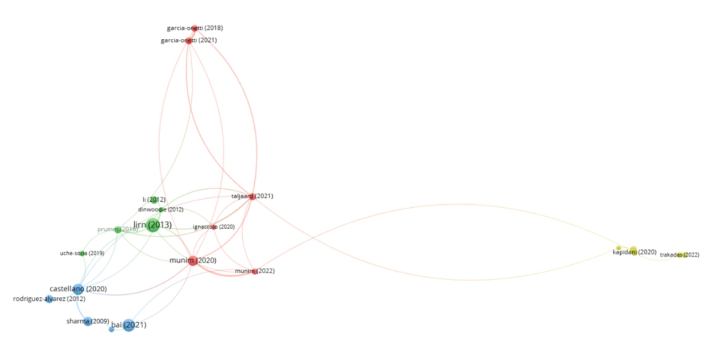
RESEARCH CLUSTERS IDENTIFICATION Research domains are composed by joint individual research clusters, whether emerging or established. In consistency with the above sentence, to analyze business analytics strategies in port economics from a systems- theory perspective, we build a key-word co-occurrence map through the bibliographical coupling of articles using the VOSviewer software. Bibliographic coupling analysis extends bibliometric analysis by connecting documents that cite the same records, which is then used in order to generate document clusters (Boyack and Klavans, 2010). This means that each pair of documents are probably discussing a common subject and can belong to a research cluster. Applying a minimum cut-off value of four citations for each document in VOSviewer resulted in the bibliometric sample being reduced from 142 to 21 articles (which met the citation criterion). Plotted in the graph in Figure 1 are the four well-established and connected clusters of studies on basis of document clustering, as following: (Cluster 1 - Red) Contemporary Maritime Transport Systems, (Cluster 2 - Green) Port Systems Analysis (Cluster 3 - Blue) Performance Optimization, and (Cluster 4 - Yellow) Data-Driven Decision Support.
VOSviewer is an interactive software tool for the creation and visualization of bibliometric maps (van Eck and Waltman, 2010). The map construction algorithm implemented by the VOSviewer operates based on two primary measurements: (1) Total citation; and (2) Total link strength (Jimenez et al., 2022). Utilizing an equal-weighted average of the two core measurement
Business Analytics Strategies in Port Economics From a Systems-Theory Perspective 73
properties in VOSviewer enabled the identification of 12 core articles with respect to Business Analytics Strategies in Port Economics from a Systems- Theory Perspective, of which the clustered articles are presented in Table 2.
Figure 1: The four emergent and interconnected research clusters.Table 2: Identified and selected articles allocated to respective research cluster.
Table available in the original PDF paper.
Cluster 1 Cluster 2 Cluster 3 Cluster 4 (Munim et al., 2020) (Lirn et al., 2013) (Bai et al., 2021) (Kapidani et al., 2020) (García-Onetti et al., 2021)
(Prumm and Iglesias, 2016)
(Castellano et al., 2020) (Brunila et al., 2021) (Taljaard et al., 2021) (Li et al., 2012) (Sharma and Yu, 2009) (Trakadas et al., 2022) The 12 Core articles are analysed with reference to analyze business analytics strategies in port economics from a systems-theory perspective to provide an in-depth content analysis and discussion of the four distinct research clusters and subclusters.
Cluster 1. Contemporary Maritime Transport Systems This research cluster examines port governance models, ecosystem services frameworks and environmental trade-offs, for the purpose of enhancing the sustainability of port operations. It is centered on data-driven environmental integration, stakeholder collaboration, and proactive planning to enhance socio-ecological resilience and port performance.
Subcluster 1.1. Green Governance and Decision – Making Models Munim et al. (2020) analyze four governance models by employing ANP and BWM, to evaluate green management along essential port practices in developing maritime systems. They find that private and landlord governance
74 Jugovi´c and Siroti´c
models perform best in the adoption of sustainable operations and advocate for targeted private engagement for greener maritime transport.
Subcluster 1.2. Ecosystem and Environmental Integration García-Onetti et al. (2021) map and classify environmental units, socio- ecological services, and port pressures in the Port of Imbituba, Brazil. They find that this detailed framework identifies key trade-offs and enables targeted management to enhance stakeholder well-being. Key trade- offs are expansion of ports and operational benefits while taking into consideration the retention of ecosystem services, local livelihoods and community well-being. Taljaard et al. (2021) study the implications of combining natural capital and infrastructure elements and tools, like Building with Nature, for port planning. They find that proactive, continuous environmental integration improves operational outcomes and sustainability, recommending coordinated data and stakeholder collaboration.
Cluster 2. Port Systems Analysis This cluster examines green sustainability metrics and ecosystem services integration to enhance environmental performance of port systems. It also investigates structural dynamics and comparative port system analyses to assess expansion impacts and inform tailored management.
Subcluster 2.1. Integrated Ecosystem Sustainability Lirn et al. (2013) formulate 17 detailed green performance indicators and apply the AHP and IPA models to three Asian ports. They find air pollution control, electric equipment use, and low-sulphur fuel are key, suggesting targeted investments for sustainability.
Subcluster 2.2. Structural Dynamics and Comparative Systems Prumm and Iglesias, 2016 simulated pre- and post-expansion scenarios of the Port of Ribadeo, analyzing channel and tidal delta changes. They found that enhanced infilling of the eastern channel, which reflects port expansion, may obstruct navigation and operations of local shipyards. Li et al. (2012) study port throughput, number of container ports, and port concentration in China and the US over several decades. They find disparities in growth processes and management modes, and suggest that customized policies could alleviate the regional and infrastructural heterogeneities.
Cluster 3. Performance Optimization This cluster explores evolving maritime transport research themes— particularly environmental management, supply chain integration, and alternative fuels—through structural topic modelling. It also assesses port economic and environmental performance using composite indicators, data envelopment analysis, and advanced benchmarking methodologies.
Business Analytics Strategies in Port Economics From a Systems-Theory Perspective 75
Subcluster 3.1. Thematic Trend Analysis Bai et al. (2021) used a structural topic model to extract eighteen research themes from three decades of maritime transport literature. They identified increasing importance that should be given toward environmental management and supply chain integration, signifying emerging industrial concerns and potential research avenues. Directions for future research include environmental governance, the vertical integration of supply chains and alternative fuels in shipping.
Subcluster 3.2. Efficiency Assessment and Benchmarking Castellano et al. (2020) assess Italian ports’ economic and environmental efficiency via composite indicators and the data envelopment analysis. They conclude that, among them, the adoption of the green policies increases the efficiency, reinforcing the necessity for a trade-off between economic and environmental strategies for the ports. Sought out green policies have been eco-design, green management practices and environmental certifications in use in Italian ports. Sharma & Yu, (2009) combine DEA and SOM to benchmark and stratify container terminal efficiency levels. They find this approach enables realistic, stepwise improvement projections, enhancing benchmarking accuracy and applicability for managers.
Cluster 4. Data – Driven Decision Support This cluster examines organizational, technical, and policy barriers hindering maritime port digital transformation for sustainable ICT adoption. It studies cloud–edge architectures and federated machine learning platforms to enhance data locality as well as the efficiency of port operations.
Subcluster 4.1. Digital Transformation and Adoption Barriers Kapidani et al. (2020) study the effect of knowledge, the role of IT management and organizational culture, on the adoption and use of ICT, in developing maritime organizations. They find a lower ICT system availability in non-EU institutions, that requires targeted policy and investments for a sustainable maritime digitalisation. Brunila et al. (2021) examine specific barriers, including incompatible systems, cyber-security threats, and financial and human resources during port digitalization. They found these difficulties regularly delay works - suggesting sea ports should focus on technical compatibility and training if the measures are to be operationally viable.
Subcluster 4.2. Cloud – Edge Architectures and ML – Assisted Platforms Trakadas et al. (2022) design RAMOS, a layered meta-OS architecture unifying resource abstraction, decentralized orchestration, and federated machine learning. Their results show RAMOS improves data locality, privacy, and operational efficiency, enabling real-time, domain-agnostic applications at the edge.
76 Jugovi´c and Siroti´c
FUTURE RESEARCH DIRECTIONS ESTABLISHMENT Establishing future research directions requires the identification of key research areas on current evidence and limitations (Mariani et al., 2025). Contemporary ports operate as complex adaptive systems involving multiple agents and interdependent sub-systems. Digital connectivity via IoT, blockchain and AI creates amounts of data throughout the port and hinterland, allowing for enhanced decision-making and efficiency in maritime supply chain networks (Jahangard et al., 2025; Argyriou & Tsoutsos, 2024). This system perspective underlines that the efficiency in ports is the outcome of coordinated processes and resources among shipping lines, terminal operators, and logistical service providers. Future research could investigate combined analysis considering combined data sources, nonlinear interactions, and adaptive strategies. For instance, integrating predictive and prescriptive analytics would connect forecasting to optimization, a research gap pointed out by the recent studies (Lepenioti et al., 2020). Scheduling and resource allocation can be done via machine learning models along with reinforcement learning that can adapt automatically to new circumstances; and predictive maintenance of cranes/vehicles can automate the management of equipment (Ong et al., 2022). System resilience and adaptability should be further investigated in future research, in particular, the possibility of designing control measures that may lead the port network to self-optimize under the effects of supply chain disruptions (Hong et al., 2025). Finally, the integration methods that combine operations research with machine learning do not seem to have been much explored, and may provide new optimisation methods for adaptive ports. If ports are treated as a system-of- systems, decision-support systems can be developed in the future to address complexity and dynamic reconfiguration to better enhance the robustness and sustainability of the maritime trade network (Kishore et al., 2025). On basis of the detailed content analysis of the selected articles, future research directions are established in the following subsections.
Improved Efficiency and Resource Allocation Future research should develop holistic, real-time performance measurement frameworks integrating environmental, operational, and digital metrics for adaptive port management. The identified articles from the content analysis belonging to this proposed future research direction are: (Lirn et al., 2013; Bai et al., 2021; Brunila et al., 2021; Trakadas et al., 2022).
The performance measure across various ports could be considered for future research by air pollution avoidance, low sulphur fuel use, electric powered equipment, wastewater treatment plants and noise management (Lirn et al., 2013). Taking the five indicators and consulting various stakeholders and types of terminals can lead to more accurate and actionable port sustainability strategies. Further study is required to quantify the precise port efficiency measurement by adopting real-time monitoring systems and predictive data analytics (Bai et al., 2021). Research on data-driven modelling methods to achieve better performance in monitoring resource allocation and assessing dynamic terminal performance is recommended.
Business Analytics Strategies in Port Economics From a Systems-Theory Perspective 77
Specific digital performance indicators that reflect efficiency, sustainability, and workflow bottlenecks of individual port operations need to be further developed in future studies (Brunila et al., 2021). Furthermore, the potential of coupling real-time data generation and predictive analytics to address proactive resource assignment and process optimization within the port could be investigated. In the future, context-aware performance measurement methods should be designed to dynamically evaluate latency, throughput, energy consumption, task completion rates, resource usage in edge environments (Trakadas et al., 2022). Improved models that provide these metrics in real-time can aid in optimizing resource allocation across the computing continuum.
Cost Optimization Future research should develop quantitative cost-efficiency frameworks integrating operational metrics, predictive maintenance, and real-time data to optimize port expenses. The identified articles from the content analysis belonging to this proposed future research direction are: (Munim et al., 2020; García-Onetti et al., 2021; Li et al., 2012; Castellano et al., 2020; Sharma & Yu, 2009).
Future studies should examine quantitatively how streamlined cargo operations, enhanced vessel turnaround and terminal automation reduce the operating costs in ports (Munim et al., 2020). Researchers may also study the potential financial gains from including predictive maintenance technologies and data-driven scheduling of equipment in different port governing models. Yet to be explored is how the integration of real-time environmental and operational data within socio-ecological frameworks may reduce ship waiting times, and logistic constraints (García-Onetti et al., 2021). Furthermore, research could investigate the extent to which predictive maintenance based on ecosystem monitoring can save costs and yet keep equipment reliable as well as operating in an environmentally friendly manner in a port. Future research could be quantitatively carried out to investigate the effect of vessel waiting time reduction and crane utilization improvement on the cost efficiency of ports in detail by taking into account the difference in throughput growth and market concentration of port (Li et al., 2012). Further research could extend this investigation to explore how predictive maintenance of port equipment might affect operation costs and combine with variations of port management and regional economic development. Subsequent research efforts should develop composite indicators measuring waiting cost, crane productivity and berth congestion separately (Castellano et al., 2020). By adding predictive maintenance costs and real-time equipment availability in these metrics one could gain further insights on cost optimization for port operations. Future research could use cost items such as fuel, labour hours and equipment downtime as part of the DEA reference set selection for sub-optimal terminals (Sharma & Yu, 2009). By examining improvement vectors which address individual cost drivers, such as crane idle times or container dwell times, practical and targeted interventions can be put in place to reduce costs and improve terminal efficiency.
78 Jugovi´c and Siroti´c
Cost Optimization Future research should develop real-time decision-support frameworks combining environmental monitoring, risk assessment and predictive analytics to optimize port sustainability. The identified articles from the content analysis belonging to this proposed future research direction are: (Taljaard et al., 2021; Prumm & Iglesias, 2016; Kapidani et al., 2020; Brunila et al., 2021; Trakadas et al., 2022).
Subsequent research could investigate how advanced environmental data platforms and real-time analytics enhance port site selection and infrastructure design processes in particular (Taljaard et al., 2021). Additional research is needed to evaluate the comparative performance of integrated risk assessment tools to consider environmental, economic and social trade-offs in master planning and operations of a port. Prospective studies might combine physical monitoring information and morphodynamic model to provide real-time risk assessments that would provide information to support short-term management decisions (Prumm & Iglesias, 2016). It should also concentrate on the quantification of trade-offs among dredging costs, ecological consequences, and navigation requests to define optimal sustainable estuary management operations. Further studies are required to investigate how the application of predictive analytics and real-time ICT systems affects tactical and operational decision-making within ports (Kapidani et al., 2020). Research could explore solutions to integrate environmental and safety data sources with business intelligence tools to support risk assessment and sustainability-informed decision making. In future studies, the effect of real-time data integration and analytics should be investigated on the speed and accuracy of decision-making in operations in ports (Brunila et al., 2021). Future research could investigate how digital risk dashboards and sustainability metrics assist port managers in predicting disruptions in compliance with regulations. Future work should develop edge-native decision frameworks that combine real-time sensor data, anomaly detection and predictive analytics for providing actionable insight (Trakadas et al., 2022). These can include risk scoring, automated mitigation strategies, resource allocation trade-offs and carbon footprint analysis in order to optimize operational sustainability and resilience.
CONCLUSION
Business Analytics Strategies in Port Economics from a Systems-Theory Perspective applies data-driven methods to optimize ports as complex systems. While significant progress has been achieved in the literature, there is still no clear consensus on the integrated business analytics strategies in port economics. In order to overcome this gap, the paper provides a systematic bibliometric analysis of papers on seminal port economics literature. Bibliographic coupling identified four research clusters: Contemporary Maritime Transport Systems, Port Systems Analysis, Performance Optimization, Data – Driven Decision Support. For future research, we suggest further developments in predictive analytics and monitoring to achieve efficiency gains, cost savings due to fewer delays and
Business Analytics Strategies in Port Economics From a Systems-Theory Perspective 79
need for maintenance, and data - based decision support for better decision making. The study provides a solid basis for future academic and applied research on the integrated port business analytics strategies.
ACKNOWLEDGMENT
This research endeavour received financial support from the University of Rijeka under the project line ZIP UNIRI, specifically allocated to the projects titled: (1) “The Influence of “Green” Maritime Policy on the Development of Seaports and Transport Flows” (UNIRI-ZIP-2103-1-22); and (2) “Logistical and Economic Aspects of the Development of Regional Economies in the Coastal Area” (UNIRI-ZIP-2103-5-22).
REFERENCES
Alzate, P., Isaza, G. A., Toro, E. M., Jaramillo-Garzón, J. A., Hernandez, S., Jurado, I., Hernandez, D., 2024. Operational efficiency and sustainability in smart ports: A comprehensive review. Mar. Syst. Ocean Technol. 19, 120–131. Aria, M., Cuccurullo, C., 2017. bibliometrix : An R-tool for comprehensive science
mapping analysis. Journal of Informetrics 11, 959–975. Bai, X., Zhang, X., Li, K. X., Zhou, Y., Yuen, K. F., 2021. Research topics and trends in the maritime transport: A structural topic model. Transport Policy 102, 11–24. Benavides-Sánchez, E. P., Moya-Clemente, I., Ribes-Giner, G., 2025. Bibliometric
analysis and systematic literature review of the relationship between sustainable development goals and sustainable entrepreneurship over time. Discov Sustain 6, 64. Boyack, K. W., Klavans, R., 2010. Co-citation analysis, bibliographic coupling, and direct citation: Which citation approach represents the research front most accurately? J. Am. Soc. Inf. Sci. 61, 2389–2404. Brunila, O.-P., Kunnaala-Hyrkki, V., Inkinen, T., 2021. Hindrances in port
digitalization? Identifying problems in adoption and implementation. European Transport Research Review 13, 62. Castellano, R., Ferretti, M., Musella, G., Risitano, M., 2020. Evaluating the economic and environmental efficiency of ports: Evidence from Italy. Journal of Cleaner Production 271, 122560. Ellegaard, O., Wallin, J. A., 2015. The bibliometric analysis of scholarly production:
How great is the impact? Scientometrics 105, 1809–1831. García-Onetti, J., Scherer, M. E. G., Asmus, M. L., García Sanabria, J., Barragán, J. M., 2021. Integrating ecosystem services for the socio-ecological management of ports. Ocean & Coastal Management 206, 105583. Jimenez, V. J., Kim, H., Munim, Z. H., 2022. A review of ship energy efficiency research and directions towards emission reduction in the maritime industry. Journal of Cleaner Production 366, 132888. Kapidani, N., Bauk, S., Davidson, I. E., 2020. Digitalization in Developing Maritime
Business Environments towards Ensuring Sustainability. Sustainability 12, 9235. Kenett, R. S., Zonnenshain, A., Swarz, R. S., 2018. Systems Engineering, Data Analytics, and Systems Thinking: Moving Ahead to New and More Complex Challenges. INCOSE International Symposium 28, 1608–1625. Li, K. X., Luo, Meifeng, and Yang, J., 2012. Container port systems in China and
the USA: A comparative study. Maritime Policy & Management 39, 461–478.
80 Jugovi´c and Siroti´c
Lirn, T., Wu, Y.-C. J., Chen, Y. J., 2013. Green performance criteria for sustainable ports in Asia. International Journal of Physical Distribution & Logistics Management 43, 427–451. Mariani, I., Mortati, M., Rizzo, F., Deserti, A., 2025. Future Research Directions.
In: Mariani, I., Mortati, M., Rizzo, F., Deserti, A. (Eds.), Design Thinking as a Strategic Approach to E-Participation: From Current Barriers to Opportunities. Springer Nature Switzerland, Cham, pp. 103–116. Munim, Z. H., Sornn-Friese, H., Dushenko, M., 2020. Identifying the appropriate governance model for green port management: Applying Analytic Network Process and Best-Worst methods to ports in the Indian Ocean Rim. Journal of Cleaner Production 268, 122156. Paraskevas, A., Madas, M., Zeimpekis, V., Fouskas, K., 2024. Smart Ports in Industry
4.0: A Systematic Literature Review. Logistics 8, 28. Prumm, M., Iglesias, G., 2016. Impacts of port development on estuarine morphodynamics: Ribadeo (Spain). Ocean & Coastal Management 130, 58–72. Rane, N. L., Rane, J., Paramesha, M., 2024. Artificial Intelligence and business
intelligence to enhance Environmental, Social, and Governance (ESG) strategies: Internet of things, machine learning, and big data analytics in financial services and investment sectors. Deep Science Publishing. Roman, E.-A., Stere, A.-S., Ro¸sca, E., Radu, A.-V., Codroiu, D., Anamaria, I., 2025.
State of the Art of Digital Twins in Improving Supply Chain Resilience. Logistics 9, 22. Sharma, M. J., Yu, S. J., 2009. Performance based stratification and clustering for benchmarking of container terminals. Expert Systems with Applications 36, 5016–5022. Su, Z., Liu, Y., Gao, Y., Park, K.-S., Su, M., 2024. Critical Success Factors for Green
Port Transformation Using Digital Technology. Journal of Marine Science and Engineering 12, 2128. Taljaard, S., Slinger, J. H., Arabi, S., Weerts, S. P., Vreugdenhil, H., 2021. The natural environment in port development: A ‘green handbrake’ or an equal partner? Ocean & Coastal Management 199, 105390. Trakadas, P., Masip-Bruin, X., Facca, F. M., Spantideas, S. T., Giannopoulos, A. E.,
Kapsalis, N. C., Martins, R., Bosani, E., Ramon, J., Prats, R. G., Ntroulias, G., Lyridis, D. V., 2022. A Reference Architecture for Cloud–Edge Meta-Operating Systems Enabling Cross-Domain, Data-Intensive, ML-Assisted Applications: Architectural Overview and Key Concepts. Sensors 22, 9003. Türkistanlı, T. T., Özispa, N., Tu˘gdemir Kök, G., Özdemir, Ü., Pehlivan, D., 2025.
Exploring Research Trends on Climate Change: Insights into Port Resilience and Sustainability. Sustainability 17, 3542. van Eck, N. J., Waltman, L., 2010. Software survey: VOSviewer, a computer program for bibliometric mapping. Scientometrics 84, 523–538.
LISTED IN THE AHFE DIGITAL BOOKSTORE CATALOGUE
Explore the complete digital volume
Human Systems Engineering and Design (IHSED2025): Future Trends and Applications
Read this individual research paper free through the original publisher, or explore the full digital proceedings book.
ISBN 978-1-964867-74-8
Explore this ISBN in the AHFE Bookstore ↗Listed in the July 2026 bookstore catalogue; search by ISBN to confirm current availability · Digital book purchase optional