Miljen Sirotic, Alen Jugovic (2023). Revisiting Port Supply Chain Integration Complexity from the Perspective of Systems Leadership: A Bibliometric Analysis and Future Research Directions. In: Human Systems Engineering and Design (IHSED 2023): Future Trends and Applications. AHFE Open Access, vol. 112, pp. 482–490. https://doi.org/10.54941/ahfe1004161
This paper provides a bibliometric analysis of 121 articles regarding the implications of the systems leadership perspective on the concept of port supply chain integration complexity. Since the systems leadership perspective characterizes an early stage of development and is still rare and has not been addressed nor studied widely, this paper reveals relevant results on the basis of citation analysis metrics. The bibliographic data is extracted from the world's most renowned scientific database ISI Web of Science, and analyzed via the VOSviewer and the HistCiteTM software. The bibliographic coupling methodology utilized in the VOSviewer software reveals four emergent and interconnected research clusters: (1) Port resilience and security vulnerabilities in complex maritime networks; (2) Big data and AI in ports; (3) Industry 4.0 essential elements for ports; and (4) Emerging best practices for systems leadership in ports – the case of BRI. A detailed and rigorous content analysis of the most impactful articles is conducted in order to reveal the intellectual structure of each research cluster, and the application of the HistCiteTM LCSe citation analysis metric reveals the trending articles within each research cluster, enabling the formation of future research directions for each research cluster. The findings obtained in this paper form the basis for advancing the perspective of systems leadership on the concept of port supply chain integration complexity because it provides scholars easy and quick access to the major articles forming the bedrock of each research cluster; while it may aid industry professionals with new information relevant for improving their decision capabilities, thus fostering the establishment of a more robust and better integrated maritime transportation system.
The occurrence of significant systemic developments within the maritime industry are manifesting themselves in the form of technological advance- ment, infrastructure expansions, the emergence of multimodalism, the intro- duction of co – modality, improvement in the mechanism of interoperability,
Revisiting Port Supply Chain Integration Complexity From the Perspective 483
and modern system design (Salleh, Zulkifli, & Jeevan, 2021). The evolu- tion of maritime supply chain management toward the Logistics 4.0 concept is prompting ports to alter their traditional role of loading and unloading activities facilitation to become a node in an extensive maritime logistics chain by being a critical part of global distribution channels. Even though scholarly endeavors have recognized and acknowledged the fact that ports are undergoing a critical period of port operations and port function trans- formation by addressing port supply chain integration from two concepts, namely: (1) Intermodalism; and (2) Organizational integration (Panayides & Song, 2009); the concept of port supply chain integration from the (3) Socio – technical transition concept is still rare and not been addressed nor studied widely. The newly – emerged significant dynamism in maritime supply chains requires port decision – makers to perceive complex port issues from multiple perspectives, honor insights from different disciplines and ways of knowing, and suspend their judgement by questioning their assumptions. Therefore, addressing the challenges of port leadership in decentralized, fragmented and networked maritime supply chains should be understood from the sys- tems leadership perspective. Systems leadership is a management approach for designing and realizing change – oriented networks of object flows (e.g., materials, information, values) on basis of pattern recognition, generaliza- tion, and self-organization, enabled through the usage of new technologies and innovative services in order to strengthen the skillset and capacity that any individual or organization can utilize to catalyze, enable and support the process of systems – level change (Lichtenstein & Plowman, 2009). Even though systems leadership is not yet an established management approach, it is a potentially valuable social systems engineering methodology for address- ing the dynamism and scale of the multi – dimensional challenges underlying port supply chain integration complexity.
BIBLIOMETRIC ANALYSIS METHOD RESULTS Bibliometric analysis is a statistical research methodology encompassing both quantitative and qualitative aspects for evaluating the impact of scientific lit- erature. The analysis aims to determine the maturity of the selected research domain of interest by examining the scientific quality, interdisciplinarity, net- work strength, and output volume of published studies (Ellegaard & Wallin, 2015). The advantages of the quantitative aspect of bibliometric analysis express themselves particularly via science mapping of extensive amounts of scientific literature, enabling the creation of scientific field structures and revealing their dynamics (Aria & Cuccurullo, 2017). The advantages of the qualitative aspect of the bibliometric analysis manifest themselves via guided content analysis to understand and derive contextual meaning from unstructured human communications media such as: (1) texts; (2) images; (3) symbols, to facilitate replicable and valid inferences (Aria & Cuccu- rullo, 2017). Consequently, it is indispensable for conducting: (1) replicable; (2) transparent; and (3) systematic scientific literature reviews as it pro- vides better reliable and objective scientific analyses (Ellegaard & Wallin, 2015).
484 Siroti´c and Jugovi´c
Bibliographic Citations Extraction Process The essential foundation of the bibliometric analysis is the collection of bib- liographic citations from the most renowned scientific database in academia, the ISI Web of Science. Table 1 indicates the thorough 10 – step keyword search process via Boolean search term utilization.
3. (“Maritime Transportation System*” OR “Maritime Logistic*” OR “Maritime Supply Chain*”)
283
4. ((“Maritime Transportation System*” OR “Maritime Logistic*” OR “Maritime Supply Chain*”) AND (“Port*”))
156
5. ((“Maritime Transportation System*” OR “Maritime Logistic*” OR “Maritime Supply Chain*”) AND (“Port*”) AND (“System*”))
156
6. ((“Maritime Transportation System*” OR “Maritime Logistic*” OR “Maritime Supply Chain*”) AND (“Port*”) AND (“System*” OR “Systems Leadership”))
156
7. ((“Maritime Transportation System*” OR “Maritime Logistic*” OR “Maritime Supply Chain*” AND (“Port*”) AND (“System*” OR “Systems Leadership” OR “Collaborative Thinking”))
121
8. Exclusion Criteria: Article 124 9. Exclusion Criteria: English Language 123 10. Exclusion Criteria: Article Manual Screening for Inquired Relevance
The first part of Table 1 encompasses steps one to seven, covering scien- tific studies addressing maritime transportation systems, maritime logistics, and the systems leadership paradigm. The second part constitutes scientific studies filtering to scientific articles, in order to obtain higher levels of scien- tific rigor. The third part consists of excluding non-English articles. The final and fourth part represents the manual screening of articles not relevant to the scope of this study and articles marginally addressing maritime transporta- tion systems leadership. The refinement process resulted in a bibliometric sample study of 121 scientific articles.
Identification of the Most Impactful Scientific Articles The adherence to bibliometric measures such as TLCS and LCSe the HistCiteTM software enables the evaluation of most influential scientific arti- cles. Total Local Citation Score constitutes the number of times an article is cited by any other articles within the sample of the study, thus enabling
Revisiting Port Supply Chain Integration Complexity From the Perspective 485
the identification of seminal articles constituting research clusters within the research domain (Aria & Cuccurullo, 2017). The utilization of TLCS ≥2 as the cut – off criteria further refined the bibliometric sample study down to 12 articles, indicating the top 10% of the articles. Local Citation Score ending constitutes the local citation frequency inside the bibliography data collection, starting with an arbitrary cut – off year, and including the last year of the time interval for which the bibliography data collection has been compiled (Ellegaard & Wallin, 2015). The application of 2019 as the arbi- trary cut – off year in relation to 2022 as the last year of the bibliography data collection time interval further refined the bibliometric sample study down to 9 articles, indicating the top 7% of the trending articles indispensable for proposing future research directions. Table 2 contains the most impact- ful scientific articles regarding the perspective of systems leadership for port supply chain integration complexity on basis of TLCS and LCSe bibliometric measures.
Table 2. The most impactful articles on basis of TLCS and LCSe bibliometric measures.
The in–depth analysis of the 12 most impactful scientific articles is pre- sented in the succeeding section to reveal research clusters and future research directions.
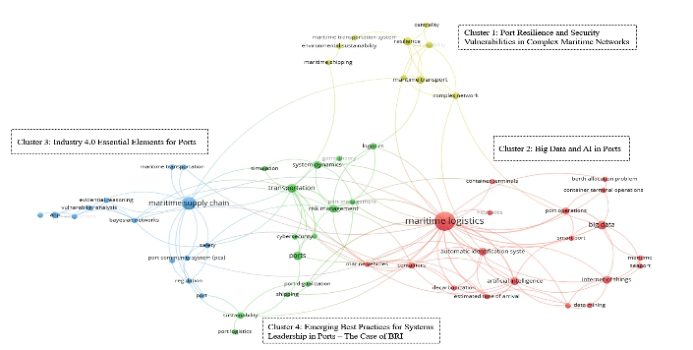
RESEARCH CLUSTERS AND FUTURE RESEARCH DIRECTIONS IDENTIFICATION Research domains are a collective sum of individual research clusters regard- less of emergence or establishment. In accordance with the aforementioned, we construct the keyword co-occurrence map regarding the perspective of systems leadership for port supply chain integration complexity on the basis of the bibliographically coupled scientific articles in the VOSviewer software by applying the minimum of two – keyword co-occurrence threshold (van Eck & Waltman, 2010). The keyword co-occurrence map in Figure 1 reveals four emergent and interconnected research clusters: (1) Port resilience and secu- rity vulnerabilities in complex maritime networks (Yellow cluster); (2) Big
486 Siroti´c and Jugovi´c
data and AI in ports (Red cluster); (3) Industry 4.0 essential elements for ports (Blue cluster); and (4) Emerging best practices for systems leadership in ports – the case of BRI (Green cluster).
Figure 1: The four emergent and interconnected research clusters.
The amalgamation of the keyword co-occurrence map and the guided content analysis enables to categorize the selected 12 scientific articles to analyse, assess, and discuss the four revealed research streams and their future research directions.
Port Resilience and Security Vulnerabilities in Complex Maritime Networks The efficient design and operations of resilient maritime supply chains is the main focus of this research cluster. The cluster is comprised of three scientific articles: (1) (Liu et al., 2018); (2) (Lam & Bai, 2016); and (3) (Polatidis et al., 2018). Liu et al. (2018) identify vulnerable ports in global maritime supply chain networks by applying the following two methods: (1) The multi – cen- trality model; and (2) Robustness analysis model. The scholars reveal that the port network is more susceptible to deliberate attacks on highly connected nodes but has stronger robustness against random failures. Lam & Bai (2016) develop an original Quality Function Deployment (QFD) approach to pri- oritize different resilience solutions for shipping lines, contributing to both research and practice. The authors indicate that contemporary maritime sup- ply chains tolerate low levels of visibility and deeper integration because the questionnaire revealed that the top three identified resilience measures are: (1) Contingency plan; (2) Monitoring and maintenance; and (3) Supply chain relationship management. Polatidis et al. (2018) propose that the existing attack graph generation methods characterize inadequacy for dynamic supply chain risk management environments. The scholars propose a new cyber – attack path discovery method by considering factors such as: (1) Attacker location; (2) Attacker capability; and (3) Propagation length.
Revisiting Port Supply Chain Integration Complexity From the Perspective 487
Future research directions propositions: Liu et al. (2018) is the identified trending paper within this cluster. The most important elements for the future development of this cluster are: (1) Dynamic network topology with flexible time windows; (2) Cargo traffic volumes regarding network vulnerability; and (3) Attack prediction and attack mitigation algorithm development.
Big Data and AI in Ports The main focus of this research cluster is projected on sustainability per- formance of ports by balancing business objectives with environmental sustainability within complex maritime networks. The cluster is comprised of three scientific articles: (1) (Heilig & Voß, 2017); (2) (Asgari et al., 2015); and (3) (Mansouri et al., 2015). Heilig & Voß (2017) structure port infor- mation systems into 10 groups and indicate the way they are indispensable for augmenting port competitiveness and facilitating secure and efficient: (1) Communication; and (2) Decision – making, in port operations. The authors conclude that the combination of: (1) Information systems; and (2) Optimiza- tion methods, enable effective and efficient port operations by supporting both short – term, and long – term decision – making. Asgari et al. (2015) address the challenges of data collection regarding port sustainability perfor- mance due to: (1) The inherent complexity of the topic; and (2) The limited number of experts with in – depth knowledge. The scholars conclude that the role of port authorities is indispensable in expanding and assessing the sustainable development of ports. Mansouri et al. (2015) explore the rising popularity of multi – objective optimization (MOO) methods in aiding port operators’ and ship liners’ informed decision – making via balancing of their business objectives with environmental sustainability. The authors reveal that the most prominent decision criterion is the minimization of fuel emissions, and that a lot scholarly attention is devoted to the analysis of trade – offs between emissions and other business performance measures.
Future research directions propositions: Heilig & Voß (2017) and Asgari et al. (2015) are the identified trending papers within this cluster. Thus, the future development of this cluster should focus on: (1) Adoption of integrated information systems within the port environment due to regulatory and com- petition requirements; and (2) Ranking port sustainability performance with novel MCDM methods with adherence to fuzzy parameters, uncertainties and subjective criteria involved in decision – making.
Industry 4.0 Essential Elements for Ports Port Community Systems (PCS) and Integrated Terminal Operating Systems (ITOS) are receiving the most attention within this research cluster. The clus- ter is comprised of three scientific articles: (1) (Carlan et al., 2016); (2) (Min et al., 2017); and (3) (Panayides & Song, 2009). Carlan et al. (2016) reveal the two main benefits PCS can ensure to port ecosystem stakeholders: (1) The digitalization of administrative procedures; and (2) Enhanced competi- tiveness due to being part of a community. However, the authors stress that the range of costs and benefits obtained by port stakeholders depends on the functionalities and design of each PCS. Min et al. (2017) affirm the fact
488 Siroti´c and Jugovi´c
that economic downturns and increased competition among terminal oper- ators result in a surplus of terminal – related logistics services. The scholars conclude that ITOS are capable of enhancing terminal operating efficiencies via reduction of duplicated investments in: (1) Terminal equipment; and (2) Standardizing terminal services. Panayides & Song (2009) identify four piv- otal parameters for the higher – order construct of Terminal Supply Chain Integration (TESCI): (1) Information and communication systems; (2) Value – added services; (3) Multimodal systems and operations; and (4) Supply chain integration practices. The scholars develop measures of seaport integration in global maritime supply chains by creating a TESCI benchmarking tool for: (1) Determining costs; (2) Revenues; (3) Performance; (4) Productivity; and (5) Competitive advantage, of ports in international maritime supply chains.
Future research directions propositions: Carlan et al. (2016) and Min et al. (2017) are the identified trending papers within this cluster. Communica- tions costs reduction and increasing the competitiveness of port stakeholders requires the most attention in future research in this research cluster.
Emerging Best Practices for Systems Leadership in Ports – The Case of the Belt and Road Initiative (BRI) This research cluster provides insights into how the Belt and Road Initiative (BRI) aims to significantly impact global trade through structural changes in: (1) Transportation networks; (2) International Logistics; and (3) Port net- works. The cluster is comprised of three scientific articles: (1) (Lee et al., 2018); (2) (Chen et al., 2018); (3) (Garg & Kashav, 2019). Lee et al. (2018) indicate key structural elements of the BRI: (1) Transport corridors, (2) City clusters; (3) Dry ports; (4) Infrastructure; (5) Zoning; and (6) Area devel- opment. The authors identify two main challenges of the BRI project: (1) Logistics cost reduction; and (2) Customs clearance capability. Chen et al. (2018) employ the Bonacich centrality to determine investment decisions in transportation networks. The scholars reveal that complementary business relationships in a port – hinterland container transportation network can demotivate players in investing in man – made unconventional emergency events prevention, contributing to: (1) Free – ride phenomenon: and (2) Peer effect phenomenon. Chen et al. (2018) develop a fuzzy analytic hierarchy process to aid carriers and port stakeholders in measuring their competitive edge over other competitors. The top three value – creating factors in their study are respectively: (1) Greater economies of scale; (2) More reliability and predictability; and (3) Consolidation, optimization and integration.
Future research directions propositions: Lee et al. (2018) is the identified trending paper within this cluster. Investigating the impacts of BRI corri- dors on the regional transport system structures by considering: (1) Network resilience; (2) Market concentration; and (3) Weaker player support for com- petition mitigation; require future research endeavours within this research cluster.
CONCLUSION
Systems leadership, although not yet an established approach, represents a potentially valuable social systems engineering methodology for addressing
Revisiting Port Supply Chain Integration Complexity From the Perspective 489
the dynamism and scale of the multi – dimensional challenges underlying port supply chain integration complexity. To bridge the identified gap, a bib- liographic coupling methodology on the basis of the most impactful articles reveals four emergent research clusters: (1) Port resilience and security vul- nerabilities in complex maritime networks; (2) Big data and AI in ports; (3) Industry 4.0 essential elements for ports; and (4) Emerging best practices for systems leadership in ports - the case of BRI. Further scholarly contribution on the implications of systems leadership on port supply chain integration complexity is materialized in future research directions propositions.
REFERENCES
Aria, M., & Cuccurullo, C. (2017). bibliometrix: An R-tool for compre- hensive science mapping analysis. Journal of Informetrics, 11(4), 959–975. doi: 10.1016/j.joi.2017.08.007. Asgari, N., Hassani, A., Jones, D., & Nguye, H. H. (2015). Sustainability ranking of the UK major ports: Methodology and case study. Transportation Research Part E- Logistics and Transportation Review, 78, 19–39. doi: 10.1016/j.tre.2015.01.014. Carlan, V., Sys, C., & Vanelslander, T. (2016). How port community sys-
tems can contribute to port competitiveness: Developing a cost–benefit frame- work. Research in Transportation Business & Management, 19, 51–64. doi: 10.1016/j.rtbm.2016.03.009. Chen, H., Lam, J. S. L., & Liu, N. (2018). Strategic investment in enhancing port-hinterland container transportation network resilience: A network game the- ory approach. Transportation Research Part B-Methodological, 111, 83–112. doi: 10.1016/j.trb.2018.03.004. Ellegaard, O., & Wallin, J. A. (2015). The bibliometric analysis of scholarly
production: How great is the impact? Scientometrics, 105(3), 1809–1831. doi: 10.1007/s11192-015-1645-z. Garg, C. P., & Kashav, V. (2019). Evaluating value creating factors in greening the transportation of Global Maritime Supply Chains (GMSCs) of container- ized freight. Transportation Research Part D-Transport and Environment, 73, 162–186. doi: 10.1016/j.trd.2019.06.011. Heilig, L., & Voß, S. (2017). Information systems in seaports: A categoriza-
tion and overview. Information Technology and Management, 18(3), 179–201. doi: 10.1007/s10799-016-0269-1. Lam, J. S. L., & Bai, X. (2016). A quality function deployment approach to improve maritime supply chain resilience. Transportation Research Part E-Logistics and Transportation Review, 92, 16–27. doi: 10.1016/j.tre.2016.01.012. Lee, P. T.-W., Hu, Z.-H., Lee, S.-J., Choi, K.-S., & Shin, S.-H. (2018). Research trends and agenda on the Belt and Road (B&R) initiative with a focus on maritime transport. Maritime Policy & Management, 45(3), 282–300. doi: 10.1080/03088839.2017.1400189. Lichtenstein, B. B., & Plowman, D. A. (2009). The leadership of emergence: A com-
plex systems leadership theory of emergence at successive organizational levels. The Leadership Quarterly, 20(4), 617–630. doi: 10.1016/j.leaqua.2009.04.006. Liu, H., Tian, Z., Huang, A., & Yang, Z. (2018). Analysis of vulnerabilities in maritime supply chains. Reliability Engineering & System Safety, 169, 475–484. doi: 10.1016/j.ress.2017.09.018. Mansouri, S. A., Lee, H., & Aluko, O. (2015). Multi-objective decision support to
enhance environmental sustainability in maritime shipping: A review and future directions. Transportation Research Part E-Logistics and Transportation Review, 78, 3–18. doi: 10.1016/j.tre.2015.01.012.
490 Siroti´c and Jugovi´c
Min, H., Ahn, S.-B., Lee, H.-S., & Park, H. (2017). An integrated terminal operating system for enhancing the efficiency of seaport terminal operators. Maritime Economics & Logistics, 19(3), 428–450. doi: 10.1057/s41278-017-0069-5. Panayides, P. M., & Song, D.-W. (2009). Port integration in global sup- ply chains: Measures and implications for maritime logistics. Interna- tional Journal of Logistics-Research and Applications, 12(2), 133–145. doi: 10.1080/13675560902749407. Polatidis, N., Pavlidis, M., & Mouratidis, H. (2018). Cyber-attack path discovery in
a dynamic supply chain maritime risk management system. Computer Standards & Interfaces, 56, 74–82. doi: 10.1016/j.csi.2017.09.006. Salleh, N. H. M., Zulkifli, N., & Jeevan, J. (2021). The emergence of very large container vessel (VLCV) in maritime trade: Implications on the Malaysian seaport operations. Wmu Journal of Maritime Affairs, 20(1), 41–61. doi: 10.1007/s13437-020-00225-9. van Eck, N. J., & Waltman, L. (2010). Software survey: VOSviewer, a computer program for bibliometric mapping. Scientometrics, 84(2), 523–538. doi: 10.1007/s11192-009-0146-3.
LISTED IN THE AHFE DIGITAL BOOKSTORE CATALOGUE
Explore the complete digital volume
Human Systems Engineering and Design (IHSED 2023): Future Trends and Applications
Read this individual research paper free through the original publisher, or explore the full digital proceedings book.
ISBN 978-1-958651-88-9
Explore this ISBN in the AHFE Bookstore ↗Listed in the July 2026 bookstore catalogue; search by ISBN to confirm current availability · Digital book purchase optional