Alen Jugović, Tanja Poletan Jugović, Renato Oblak, Dražen Žgaljić (2024). Artificial Intelligence in the Function of Enhancing Port Systems. In: Human Factors in Design, Engineering, and Computing. AHFE Open Access, vol. 159, pp. 23–32. https://doi.org/10.54941/ahfe1005564
Decision-making in port activities is characterized by speed, flexibility, rationality, efficiency and economy. However, the main role in their implementation is played by port employees who are not always able to be reliable, timely and objective. Likewise, their insufficient education, lack of professional knowledge and experience, and insufficient number of adequate port workforce can negatively affect the sustainable functioning of port systems. The introduction of new technologies and systems that can process a large amount of data and imitate human activities such as reasoning, learning, planning and creativity represents a fundamental challenge in achieving goals aimed at improving port operations. Therefore, the application of artificial intelligence seems inevitable because only it can provide a higher level of possibilities in the future development of the port. In this paper, a basic matrix of all the constituent elements that make up a complete port system with an applicable model of their computerization, digitization and automation is laid out. With such an approach, all port activities will be able to take place without direct human activity, and supervision over their implementation will be completely autonomous. In this way, the operations of the ports themselves will be more productive, more competitive, safer and more economical, and port users will get one open, simple and reviewed tool that will be able to meet all their needs for port services in one place in real time.
The basic function of ports is ensuring smooth maritime traffic. Considering their primary role, they differ from each other in reference to the importance and significance they have at the international or national level. Therefore, the ports themselves can be divided according to the above criteria into: world, international, national, regional and local ports. In this scientific paper we are focusing on the research of regional and local ports, considering their multiplicity and the specialness they have for the local community. In addition, the smaller number of port functions, activities and services provided in regional and local ports in relation to world, international and national ports enable a simpler analysis and application of artificial intelligence, which aims to achieve modern, advanced and sustainable port systems. On the Croatian coast of the Adriatic, which expands on 5,835 km, there are over 435 regional and local ports, i.e. ports open to public traffic of
county and local importance, which means that there is at least one port every 13 km. However, such large spatial distances, which include 47 inhabited Croatian islands, require an extremely complex logistical organization in daily basis port operations and management of the entire port system. Likewise, the unevenness of port activities in ports open to public traffic of county and local significance, which are primarily burdened in the summer months when maritime traffic is extremely dense and increased due to the tourist season, requires the authorities that manage the ports to engage additional port workforce in order to meet the needs of a large number of port users. This large disparity in the amount of port operations during one calendar year and the large distances between ports that are under the administration of individual port authorities require the implementation of new technologies that would make the port authorities operations faster, more flexible, more rational, more efficient and more economical. For these reasons, the introduction of artificial intelligence into the management system of the port system represents a serious challenge and an inevitable scenario if its long-term sustainability is to be achieved. Artificial intelligence (abbr. AI) is a branch of computer science that deals with system development and programs capable of thinking, learning, making decisions and performing tasks in a manner which could be considered “intelligent” if performed by a human person. Artificial intelligence is a concept that goes back decades, but in the last century it is experiencing a real renaissance thanks to advances in computer hardware and software, the development of algorithms and the availability of huge amounts of data (Kager, 2023). Artificial intelligence has caused a revolution in the way we live and work, and its potential has opened numerous development opportunities in enhancing the everyday work activities and processes. The available power and strength of artificial intelligence greatly facilitates the processes of production, distribution and consumption to be more sustainable, and the provision of services more reliable, timely and environmentally friendly. The application of artificial intelligence in the management of port systems includes various intelligent IT systems that perform comprehensive collection, processing and analysis of data from internal and external sources. Based on such collected and processed data, intelligent IT systems make operational decisions and manage numerous port activities. They also supervise the performance of port operations and carry out their control, while providing port administrations with statistical reports and updated databases of collected data and performed operations. With such an approach and organization, intelligent IT technologies significantly contribute to improving the operation of port systems and ensure their long-term sustainability. In the management of port systems, it includes various intelligent IT systems that carry out comprehensive collection, processing and analysis of data from internal and external sources. Based on the collected and processed data, intelligent IT systems make operational decisions and manage numerous port activities.
LITERATURE OVERVIEW Seaports have always been important strategic, economic, cultural and social centers that directly influenced the local, regional, national and international
Artificial Intelligence in the Function of Enhancing Port Systems 25
environment. However, the development of digitization, computerization and automation in the last decade strongly influenced complex social changes that directly reflected on the management of port systems. Today, traditional forms of business are being improved by the active introduction of artificial intelligence, e-platforms, the Internet, software applications, autonomous devices, robotics and machine learning (Maydanova and Ilin, 2019). The implementation of modern technologies and sophisticated port information systems plays an important role in the collection, exchange and distribution of numerous information and data that are necessary for all port stakeholders and users of port services. That is why innovative and advanced port applications are an important link in the development of daily port activities (Kapkaevaa et al., 2021). For this reason, today’s ports adopt the concept of smart ports that are equipped with modern devices and equipment, use technologies that correspond to the business orientation and types of port activities, integrate a large number of different stakeholders, strive for complete automation, process large amounts of different data, implement advanced ecological solutions, continuously they increase their efficiency and quality of service and strengthen their level of market flexibility and adaptability (Karas, 2020). Smart ports implement various innovative solutions in their daily operations and unite seven interrelated areas of interest that include: port operations, social community, environment, energy, human resources, security and smart infrastructure, equipment and technology (Belmoukari et al., 2023). Smart ports optimize incoming, internal and outgoing flows of goods, people and information, implement sustainable development processes and guarantee safe, resilient and uninterrupted port activities through the symbiosis of the wider port community and available modern technologies (Boullauazan et al., 2022). Technological development opens up new opportunities for improving port performance and efficiency, as well as providing a high level of security and reliability, but it also includes great demands on the fundamental form of IT port systems. Automation of port equipment and operations aimed at transforming ports into smart ports improves fluidity, reliability, security of information exchange and real-time decision-making. This approach increases the efficiency of the port itself, reduces operating costs and has a positive impact on environmental protection (Al-Fatlawi and Motlak, 2023). Due to extremely strong competition between ports, smart port models are no longer just an option, but a necessary and much-needed strategy. The adoption of IT technologies is of vital importance for the transformation of port systems into smart ports, because in this way access to data and information will be enabled for all stakeholders in the port sector (Bouhlal et al., 2022). Likewise, the dynamic nature of port systems presents significant challenges for port managers as they face increasing pressure to meet the diverse needs of port stakeholders while ensuring their own profitability in the face of growing global trade, accelerated technological progress and increased customer demands. This complex situation greatly complicates the work of port management, as it additionally burdens the identification, definition and implementation of basic port development processes and plans. However, if one wants to ensure an increase in port
26 Jugovi´c et al.
productivity, efficiency and effectiveness, it is necessary to continuously introduce new technologies such as digitization, automation and artificial intelligence (Klein and Spychalska-Wojtkiewicz, 2023). Artificial intelligence can play a significant role in promoting sustainability in various sectors, including the maritime and port sectors. By analysing large amounts of data and optimizing work processes with artificial intelligence, efficiency in daily port activities can be significantly improved. Likewise, artificial intelligence can help in solving various potential risks and predicting future events that can negatively affect port operations and activities (Allah Rakha, 2023). When introducing artificial intelligence into existing IT port systems, it is also necessary to ensure that such solutions are flexible enough to enable simple integration and use (Carlan and Vanelslander, 2021). The role of the main drivers in the introduction of artificial intelligence in port business is played by its stakeholders. The quality of adoption of artificial intelligence and its implementation in port systems depends on the level of their needs and the available port resources, (Ghazaleh, 2023). However, in order for artificial intelligence to achieve its basic scientific and practical goals and for port managers to use its fundamental advantages, all stakeholders of port systems and users of artificial intelligence must respect its legalities in terms of avoiding its abuse and fair and safe use (Freeman et al., 2021). If the aforementioned basic principles are not respected in the implementation of artificial intelligence, it can cause irreparable damage in the management of port systems.
BASIC PORT FUNCTIONS Ports and port systems, especially ports open to public traffic of county and local significance, play an important role in the overall economic and general social life of each individual region. Such an approach to looking at ports includes numerous port functions that aim to satisfy all the social and economic needs of the wider social community. For this reason, the basic functions of the port can be grouped according to each individual port activity, but also in relation to certain port users, as shown in Table 1.
Table 1. Basic port functions and port users (created by the authors).
Table available in the original PDF paper.
Type of Port Function Port Users Cargo traffic Consignors/recipients/cargo carriers Passenger traffic Domestic and foreign passengers Air traffic Domestic and foreign passengers Communal function Local population Nautical function Nautical officers Fishing function Fishermen Sports function Sports clubs Service function All users Safety function All users Ecological function All users Information function All users Urban function All users
Artificial Intelligence in the Function of Enhancing Port Systems 27
The port in the function of carrying out cargo traffic is aimed at meeting the needs of local and regional industry in terms of the import/export of raw materials and finished products. The port in the function of passenger traffic is focused on the international scheduled passenger traffic, international occasional passenger traffic (round trips), national scheduled passenger traffic and national occasional passenger traffic (round trips and excursions). The port in the function of air traffic is focused on the development of liner transport by seaplanes. The communal function of the port is aimed at meeting the needs of the local population for communal berths. The nautical function of the port is aimed at meeting the needs of domestic and foreign nautical tourists for nautical moorings. The fishing function of the port is aimed at meeting the needs of professional fishermen and their economic activities. The sports function of the port is aimed at meeting the needs of sports clubs connected to the sea (sailors, surfers, sports fishermen, etc.).
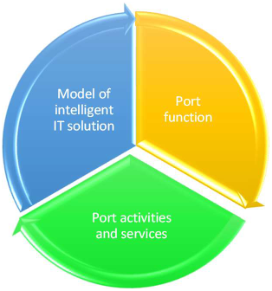
The service function of the port includes all port services aimed at all port users, including lifting/lowering vessels into the sea, repairing vessels, supplying vessels with drinking water, electricity and fuel, and other additional service services. The security function of the port includes all elements of navigation safety and order in the port area (rules of conduct, permitted and prohibited activities, navigation safety facilities, depths in the port area, etc.). The ecological function of the port includes all those activities related to the prevention of pollution of the sea and the marine environment and the disposal of all types of ship waste. The information function of the port includes all the necessary information that users of the port area must have when using the services of a particular port, including weather forecasts, sea changes, tide values, wind speeds, a plan of the port area with the locations of all contents and parts of the port, etc. The urban function of the port includes the necessity of meeting the social needs of the local population in terms of cultural, religious, recreational and other events in the port area. The variety of port functions, that is, groups of certain port activities and services, directly determines the possible implementation of a circular model of intelligent IT solution, which is the basic hypothesis of this scientific paper (Graph 1).
Figure 1: Graph 1. Circular model of the enhancement of port systems (created by the authors).
28 Jugovi´c et al.
The circular model of the enhancement of port systems is based on the implementation of artificial intelligence in reference to the set requirements of individual port activities or services, and in relation to the type of basic port function. Therefore, in the following chapter, all the constituent components of individual port functions are listed, the tasks that the bodies that manage the ports can fulfill, and the intelligent IT solutions that can be used to achieve the long-term sustainability of ports open to public traffic of county and local importance.
INTELLIGENT IT SOLUTIONS AND PORT ACTIVITIES AD SERVICES Intelligent IT solutions in port systems can have many and varied implementations. Given the hypothesis that intelligent solutions are introduced into port systems in accordance with individual port functions, i.e. interconnected groups of port activities and services, Table 2 shows possible intelligent IT and technical solutions that would significantly contribute to enhancing existing port systems.
Table 2. Intelligent solutions for different port functions (created by the authors).
Table available in the original PDF paper.
Port Function Port Activities and Services Intelligent IT and Technological Solutions Cargo traffic Ship announcement/departure On-line application Exchange of information and documentation
Optical sensors
On-line application between more stakeholders Mooring/Unmooring ships Automatic mooring systems Occupancy of operational piers and banks
On-line application
Carrier entry/exit Light signalling Loading processes On-line application Loading/Unloading of cargo Automation ramps and control systems Collection of port fees and charges Video surveillance Passenger traffic Ship announcement/departure Robotic systems Exchange of information and documentation Mooring/Unmooring ships On-line application Occupancy of operational piers and banks
Automatic ramps and control systems
On-line application between more stakeholders Passenger and vehicle entry/exit Automatic mooring systems Purchase of tickets and reservations Optical sensors Collection of port fees and charges Light signalling Air traffic Airliners announcement/departure On-line application Exchange of information and documentation
Vessel owners entry/exit Optical sensors
Occupancy of places On-line application Passengers entry/exit On-line application Purchase of tickets and reservations On-line application Collection of port fees and charges On-line application between more stakeholders Communal function Entry/exit of vessels from the port Light signalling Vessel surveillance on the berth On-line application
(Continued)
Artificial Intelligence in the Function of Enhancing Port Systems 29
Table 2. Continued Port Function Port Activities and Services Intelligent IT and Technological Solutions
Table available in the original PDF paper.
Automatic ramps and control systems
Stipulating contracts of communal berth and berth fees payment Vessel owners entry/exit On-line application Nautical function
Optical sensors
Entry/exit of vessels from the port On-line application Vessel surveillance on the berth Automatic ramps and control systems Stipulating contracts of nautical berth and berth fees payment Video surveillance Announcement of vessels and assigning free berths
Video surveillance
Fishing function Vessel owners entry/exit On-line application Entry/exit of vessels from the port Automatic ramps and control systems Vessel surveillance on the berth Optical sensors Stipulating contracts of fishing berth and berth fees payment
Video surveillance
Entry/exit of transporters of fish catch On-line application Exchange of dana regarding fish catch On-line application Sports function Vessel owners entry/exit Optical sensors Entry/exit of vessels from the port Light signalling Vessel surveillance on the berth Automatic ramps and control systems Service function Lifting/lowering of the vessel into the sea Optical sensors Supplying vessel with electricity, water and fuel On-line application Cleaning, washing and vessel repair announcement services
On-line application Procurement of spare parts with delivery in the port area
Optical sensors
Safety function Plan of the port area with sea depths On-line application between more stakeholders Location of navigation safety facilities Automatic ramps and control systems Documents of navigation safety and order in the port area Detection of port water pollution On-line application Box the vessel to the berth Video surveillance Ecological function
Announcement of the type and quantity of ship waste for disposal
Automatic cranes with the possibility of payment
By analysing the basic port functions, it can be concluded that if one wants to achieve complete computerization and automation of all port activities and services, it is necessary to introduce various intelligent IT and technical solutions into port operations. The reason for this lies in the fact that artificial intelligence is based on a model of data collection, their processing and autonomous decision-making, for which it is necessary to implement various hardware, software and technical systems in port operations, and it is also extremely important to properly configure and harmonize them. Given that different port functions have very similar or almost identical intelligent IT and technical solutions, but with a different purpose and interest group of users for which they are intended, a unique intelligent operating system can be implemented in port systems, which in some parts will be open to certain groups of users, while its remaining parts will be exclusively for the needs of the body that manages the port in question. By building and
30 Jugovi´c et al.
setting up a unique operational port system based on artificial intelligence and basic port functions, which can be applied in any port open to public traffic of county and local importance, it will significantly contribute to the enhancement of all port systems. In addition, in such a set model, only certain parts of the intelligent operating system can be used in each individual port, given that each port in its area does not have all the port activities listed in Table 2. Such a systematic thinking and method of approach can avoid unnecessary developing individual intelligent port solutions for individual ports, which would certainly contribute to significant financial and economic savings.
CONCLUSION
The sustainable development of regional and local ports, i.e. ports open to public traffic of county and local significance, is of utmost importance not only for society and the economy as a whole, but also for every local community in whose territory they are located. The port authorities that manage their development assume an important social, economic and social responsibility. Therefore, all business activities that contribute to the improvement of port systems, including the introduction of artificial intelligence in port operations, are the fundamental tasks of the bodies that manage them. The basic hypothesis of this scientific paper is based on the introduction of artificial intelligence into port systems in relation to defined basic port functions. Each individual port function includes certain port activities and services that directly determine the application of appropriate software, hardware and technical solutions with which specific port activity can be advanced and improved. The basic feature of the set model is the development and use of a single operating system that would combine all applicable intelligent IT and technical solutions, and which could be partially used, if necessary, depending on the total number and type of port functions that each individual port provides to its users. In this way, individual investments by the bodies that manage ports would be avoided and significant savings in financial resources would be achieved, which would be necessary for the development and implementation of individual intelligent solutions in port systems. The intelligent port operating system could, if necessary, be expanded and perfected in accordance with the observed additional needs and the appearance of new intelligent innovations on the market. The implementation of artificial intelligence, whose main goal is the improvement of port systems, would achieve the long-term sustainability of the ports themselves and provide port users with a modern and innovative port service.
ACKNOWLEDGMENT
This paper was funded under the projects line ZIP UNIRI of the University of Rijeka: (1) project UNIRI-ZIP-2103-5-22; (2) UNIRI-ZIP-2103-1-22”and (3) UNIRI-ZIP-2103-9-22.
Artificial Intelligence in the Function of Enhancing Port Systems 31
REFERENCES
Abu Ghazaleh, M. (2023) Smartening up Ports Digitalization with Artificial Intelligence (AI): A Study of Artificial Intelligence Business Drivers of Smart Port Digitalization, Management and Economics Review, Volume 8, No. 1, pp. 78–97. Al-Fatlawi, H. A., Motlak, H. J. (2023) Smart ports: towards a high performance,
increased productivity, and a better environment, International Journal of Electrical and Computer Engineering (IJECE), Volume 13, No. 2, pp. 1472–1482. Allah Rakha, N. (2023) Artificial Intelligence and Sustainability, International Journal of Cyber Law, Volume 1, No. 3. Almeida, F. (2023) Challenges in the Digital Transformation of Ports, Businesses,
Volume 3, pp. 548–568. Belmoukari, B., Audy, J. F., Forget, P. (2023) Smart port: a systematic literature review, European Transport Research Review, Volume 15, Art. no. 4. Bouhlal, A., Aitabdelouahid, R., Marzak, A. (2022) The internet of things for smart
ports, Procedia Computer Science, Volume 203, pp. 819–824. Boullauazan, Y., Sys, C., Vanelslander, T. (2022) Developing and demonstrating a maturity model for smart ports, Maritime Policy & Management, Volume 50, No. 4, pp. 447–465. Carlan, V., Vanelslander, T. (2021) Economic Aspects of Introducing Artificial
Intelligence Solutions in Logistics and Port Sectors: The Data Entry Case, Frontiers in Future Transportation, Volume 2. Du, Xinke (2023) Research on the path of artificial intelligence to empower intelligent port upgrading and transformation, E3S Web of Conferences, 4th International Conference on Urban Engineering and Management Science (ICUEMS2023), Volume 372. Foster, M. N., & Rhoden, S. L. N. H. (2020) The integration of automation and
artificial intelligence into the logistics sector: A caribbean perspective, Worldwide Hospitality and Tourism Themes, Volume 12, No. 1, pp. 56–68. Freeman, L., Rahman, A., Batarseh, F. A. (2021) Enabling Artificial Intelligence Adoption through Assurance, Social Sciences, Volume 10, No. 9, pp. 322. Garimella, R., Selva Balan, M., Shukla, V. K., Sreekanth, S. (2023) Role of artificial
intelligence based image-processing techniques for port development activities in physical tidal models, ISH Journal of Hydraulic Engineering, Volume 29, No. 1, pp. 243–254. Ghazaleh, M. (2023) Smartening up Ports Digitalization with Artificial Intelligence (AI): A Study of Artificial Intelligence Business Drivers of Smart Port Digitalization, Management and Economics Review, Volume 8, pp. 78–97. Gerlitz, L., & Meyer, C. (2021) Small and medium-sized ports in the ten-T network
and nexus of Europe’s twin transition: The way towards sustainable and Digital Port Service Ecosystems, Sustainability, Volume 13, No. 8, pp. 4386. González, R. A., N. González-Cancelas, M. B. Serrano, and A. C. Orive (2020) Preparation of a smart port indicator and calculation of a ranking for the Spanish port system, Logistics Volume 4, No. 2, pp. 9–31. Gurumurthy, A., and Bharthur, D. (2019) Impact of Digitalisation in the Ports Sector,
Artif. Intell. India, Volume 5. Heikkilä, M., Saarni, J., Saurama, A. (2022) Innovation in Smart Ports: Future Directions of Digitalization in Container Ports, Journal of Marine Science and Engineering, Volume 10, pp. 1925. Heilig, L., Lalla-Ruiz, E., Voß, S. (2017) Digital Transformation in maritime ports:
Analysis and a game theoretic framework, NETNOMICS: Economic Research and Electronic Networking, Volume. 18, Nos. 2–3, pp. 227–254.
32 Jugovi´c et al.
Kager, D. (2023) Umjetna inteligencija - razvoj i primjena, priruˇcnik za poˇcetno uˇcenje, Školska knjiga, Zagreb. Kapkaeva, N., Gurzhiyb, A., Maydanovac, S., Levinab, A. (2021) Digital Platform
for Maritime Port Ecosystem: Port of Hamburg Case, Transportation Research Procedia, Volume 54, pp. 909–917. Kara´s, A. (2020) Smart Port as a Key to the Future Development of Modern Ports, The International Journal on Marine Navigation and Safety of Sea Transportation, Volume 14, No. 1, pp. 27–31. Klein, M., Spychalska-Wojtkiewicz, M. (2023) Digitalization of small ports as a
step in achieving sustainable goals, Procedia Computer Science, Volume 225, pp. 3.381–3.387. Kusumawati, E. D., Karjono, K., & Karmanis, K. (2023) Review of Port Management Integrated Digitization System: A Pathway to Efficient and Sustainable Port Operations, Maritime Park Journal of Maritime Technology and Society, Volume 2, No. 2, pp. 55–60. Liao, H. T., Lo, T. M., Pan, C. L. (2023) Knowledge Mapping Analysis of Intelligent
Ports: Research Facing Global Value Chain Challenges, Systems, Volume 11, No. 88. Maydanova, S., Ilin, I. (2020) Strategic approach to global company digital transformation, Proceedings of the 33rd International Business Information Management Association Conference, IBIMA 2019: Education Excellence and Innovation Management through Vision 2020, pp. 8.818–8.833. Munim, Z. H., Dushenko, M., Jimenez, V. J., Shakil, M. H., Imset, M. (2020) Big
dana and artificial intelligence in the maritime industry: a bibliometric review and future research directions, Maritime Policy & Management, Volume 47, No. 5, pp. 577–597. Paulauskas, V., Philipp, R., Henesey, L., Paulauskas, D., Sutnikas, A., Meyer, C., Gerlitz, L., Heine, N., Kozyczkowski, K., Zigus, A., & Silonosov, A. (2021) Smart ports’ influence on coastal sustainability, Transport Means 2021, Sustainability: Research and Solutions: Proceedings of the 25th International Scientific Conference: October 6-8, 2021, Online Conference, Kaunas, Lithuania, Kaunas: Kaunas University of Technology, Pt 1, pp. 396–401. Paulauskas, V., Filina-Dawidowicz, L., Paulauskas, D. (2021) Ports Digitalization
Level Evaluation, Sensors, Volume 21, pp. 6134. Pham, T. Y. (2023) A smart port development: Systematic literature and bibliometric analysis, The Asian Journal of Shipping and Logistics, Volume 39, No. 3, pp. 57–62. Tijan, E., Jovi´c, M., Panjako, A., Žgalji´c, D. (2021) The Role of Port Authority in Port
Governance and Port Community System Implementation, Sustainability, Volume 13, pp. 2795. Triska, Y., Frazzon, E. M., Silva, V. M. D., Heilig, L. (2024) Smart port terminals: conceptual framework, maturity modeling and research agenda, Maritime Policy & Management, Volume 51, No. 2, pp. 259–282. Wahyuni, S., Alif, A. T., & Peng Hui, F. K. (2020) Exploring key variables of
port competitiveness: Evidence from indonesian ports, Competitiveness Review, Volume 30, No. 5, pp. 529–553.
LISTED IN THE AHFE DIGITAL BOOKSTORE CATALOGUE
Explore the complete digital volume
Human Factors in Design, Engineering, and Computing
Read this individual research paper free through the original publisher, or explore the full digital proceedings book.
ISBN 978-1-964867-35-9
Explore this ISBN in the AHFE Bookstore ↗Listed in the July 2026 bookstore catalogue; search by ISBN to confirm current availability · Digital book purchase optional