Miwa Nishinaka, Kunio Shirahada (2025). Toward the Inclusion of Human Factors in Intelligence Augmentation: Perspectives From a Bibliometric Analysis. In: The Human Side of Service Engineering. AHFE Open Access, vol. 182, pp. 74–84. https://doi.org/10.54941/ahfe1006408
1 Graduate School of Management, Kagawa University, Takamatsu, Kagawa, Japan ↗
2 School of Knowledge Science, Transformative Knowledge Management Research Area, Japan Advanced Institute of Science and Technology (JAIST), Nomi, Ishikawa, Japan ↗
In a society where generative AI is prevalent, theoretical advancements in Intelligence Augmentation (IA), particularly regarding human factors, are essential. Therefore, we review research trends in the IA literature to discuss the future of human intelligence interacting with machines. We analyzed previous IA literature using bibliometric and text mining approaches. This analysis resulted in the finding that IA research argues that not only complements human cognitive capabilities but also enhances the inherent cognitive capabilities of humans. Two large IA areas were also identified during the analysis: areas related to technology and medicine. IA was found to work as an umbrella concept bridging technology-related and medical fields. Finally, we highlight the importance of focusing on human intellect and wisdom to enhance human capabilities and research to theorize this.
Generative AI provides “human-like” responses in natural language processing, which explains its rapid spread (Holmström and Carroll, 2024). Human-like AI responses are utilized to implement cognitive computing and cognitive systems. Amid the negative views on AI, the possibility of using it to improve human capabilities has also been discussed (Bassano et al., 2020).
In the context of generative AI greatly changing the management of industries where interactions between machines and humans occur, such as the service industry, research into the management theory that forms the basis of generative AI is necessary to adopt and explain these situations. Moreover, human-machine interaction and its results in a social context, which includes the relationship between society and its actors and the resulting human intelligence, must be conceptualized.
Service-dominant logic (SDL) is a prominent theory that explains service interactions (Lusch and Vargo, 2019). In SDL, technology is considered an
Toward the Inclusion of Human Factors in Intelligence Augmentation 75
operant resource in service ecosystems (Akaka and Vargo, 2014), but it should be discussed to reflect the current situation of generative AI (Bassano et al., 2020). In other words, the knowledge that emerges from resource integration through human-machine interactions needs to be clarified.
Intelligence Augmentation (IA) has been discussed in this background. IA is the concept of extending human capabilities through technology (Barile et al., 2024; Zhou et al., 2023). IA emphasizes human-machine interaction (Paul et al., 2022). It extends human cognitive capabilities (Zhou et al., 2021) and supports problem solving and decision making (Barile et al., 2024).
Zhou et al. (2021) categorized and defined IA based on abilities, roles, and responsibilities. They also identified enabling technologies and applications, key research questions, challenges, and future opportunities based on a review of the IA literature (Zhou et al., 2021). Paul et al. (2022) focused on the sociotechnical aspects of IA and discussed IA emphasizing a human- centric approach that considers the factors of human and ethical matters regarding human-machine interactions.
As IA research accumulates, this study aims to discuss the future of human intelligence, that is, what direction human intelligence will take in its interaction with machines. To meet this objective, we pose the following research questions:
1. “What are the research trends in human intelligence augmentation?” 2. “What goals does IA aim to achieve?”
We investigated the overall trends in IA research using bibliometrics and text mining. The research gap is indicated and implications are proposed.
PREVIOUS STUDIES While defining IA, previous studies have emphasized the importance of humanity in human-machine interactions (Zhou et al., 2023). Concerns about AI have been illustrated by the point that augmentation should involve a symbiotic relationship between humans and machines, even before the expansion of generative AI (Davenport and Kirby, 2016). The notion that machines can amplify human capabilities has long been debated (Zhou et al., 2021). However, there are concerns about the possibility of machines controlling humans, leading to tensions between them.
Zhou et al. (2021) defined “IA as enhancing and elevating human ability, intelligence, and performance with the help of information technology (Zhou et al., 2021, p. 245).” Zhou et al. (2021) emphasized the aspects of human-machine collaboration, while focusing on human beings (Zhou et al., 2023). IA is regarded as a paradigm that constitutes two types of intelligence—human intelligence and AI—as a symbiotic system. Zhou et al. (2021) proposed that a holistic relationship between humans and machines is important. Although Zhou et al. (2021) did not explicitly use the term “systemic thinking,” they adopted a comprehensive approach to understanding the entire world as a system of interactions among elements in what could be considered a systemic thinking perspective. Zhou et al. (2021) argued that the intelligence of humans and machines, AI, is essentially of
76 Nishinaka and Shirahada
different types, such as specialized (AI) versus general (human), knowledge (AI), and wisdom (human), and that because they are complementary, a better society can be built through integration.
Zhou et al. (2021) categorized IA research based on a literature review and proposed seven categories: education (learning), medicine, business, disaster management, environmental and urban studies, human cognition, and regulation. Paul et al. (2022) followed Zhou et al.’s (2021) definition. Paul et al. (2022), citing Zhou et al. (2021) and Jain et al. (2021), stated that IA enhances human capabilities, intelligence, and performance. Paul et al. (2022) mentioned that augmenting human intelligence depends on the context and highlighted the importance of the goal of IA from an ethical perspective. Regarding the context, Paul et al. (2022) argued that IA improves society and individuals, and that augmented intelligence is an extension of the sociotechnical systems approach (Orlikowski and Scott, 2015). In other words, augmented intelligence improves society by enhancing the capabilities of individuals, and, thus, those of organizations and firms as groups of individuals. This perspective extends IA as a concept that describes actual society beyond its definition from a technological perspective.
Regarding the context in an actual business situation, Bassano et al. (2020) explained value co-creation between AI and humans as an operant resource of SDL, especially in the context of luxury goods. The Viable Systems Approach (VSA) and Variety Information Model (VIM) were applied to analyze whether human-machine interaction is an effective resource integration. The results demonstrate that interactions between AI and humans do not achieve value co-creation to meet expectations for luxury goods. Furthermore, Bassano et al. (2020) found that for technology to contribute to co-creation, not only the context and level of analysis but also the variety of information need to be considered, without which value co-creation cannot occur. The need to introduce a shift from AI to IA for responsive answers to address this gap has been presented.
There are frameworks for utilizing IA in actual business situations (Siddike et al., 2018). The framework introduced by Zhou et al. (2021) consists of five components: goals, humans, machines (technologies), governance, and the environment. The central component is the goal, which is surrounded by other components in the order in which they are listed. These components constitute the framework for designing IA systems for humans, such as business goals, individual needs, and environmental and technological factors.
SDL is an appropriate theoretical framework for interactions between humans and machines, which are operant resources in the processes of value co-creation (Bassano et al., 2020). SDL explains co-creation in the value context (Akaka et al., 2015; Nishinaka and Masuda, 2024), as well as actors in sustainability (Jaakkola et al., 2024). However, SDL must be extended to include technological actors in line with the rapid development of technologies, such as generative AI (Bassano et al., 2020). Studies also tend to extend SDL by applying systems thinking (Jaakkola et al., 2024). Further theoretical advances that can explain technological advances such as generative AI, including considerations of humanity, are desirable.
Toward the Inclusion of Human Factors in Intelligence Augmentation 77
METHOD
This study conducted bibliometrics and text mining to address the research question. The Scopus function, VOSviewer, and KH Coder were used. Kumar et al. (2024) and Zhou et al. (2021) were referenced for ensuring the flow of analysis using bibliometrics. We used Scopus as the bibliometric database because it covers the world’s largest titles of literature across many disciplines, whereas Zhou et al. (2021) used the Web of Science. The search keywords were “augment* intelligent*”, “intelligence augment*”, and “augment* human intelligence”, following Zhou et al. (2021). We searched these keywords in the titles, abstracts, and keywords using OR conditions. We specified “1977 to 2025 (present)” as the publication period because the oldest article was published in 1977. In total, 453 articles were selected for analysis (as of December 29, 2024).
VOSviewer (1.6.20) is free software widely used for visualizing bibliometric networks based on citations, co-citations, or co-authoring (van Eck and Waltman, 2010; 2020; VOSviewer.com, 2025). We used the co- occurrence functions of VOSviewer to examine the relationship between terms in the abstracts of the bibliographic information of IA-related literature and visualized some bibliometric networks to clarify the research topics, their relationships, and research trends. The normalization method is the association strength (Van Eck and Waltman, 2009, p. 1638; van Eck and Waltman, 2020, p. 22).
Network visualization comprises the circles of terms and the links between them. The results of visualizing the bibliometric networks of terms were clustered using a unified clustering technique (Waltman et al., 2010; van Eck et al., 2010). The size of the circles is determined by weights which indicate the importance of the terms. The weight attributes are assumed to have a ratio scale in VOSviewer. Therefore, larger circles are regarded as more important than smaller ones. The strength of a link represents the number of publications in which the terms co-occur (van Eck and Waltman, 2020).
In VOSviewer, the relationships between clusters and words in a context cannot be easily understood. Therefore, we analyzed the relationships between clusters using KH Coder 3, a text mining tool widely used in academic research (Higuchi, 2016; Nishinaka and Shirahada, 2023). Hierarchical cluster analysis and concordance analysis using Key Words in Context (KWIC) were adopted. In the hierarchical cluster analysis, the Jaccard coefficient for similarity calculation and Ward’s method for cluster analysis were used (Higuchi, 2016). The concordance analysis using KWIC shows the terms before and after the terms extracted by hierarchical cluster analysis. This analysis helps us understand the context in which the extracted words were used (Higuchi, 2016).
RESULTS
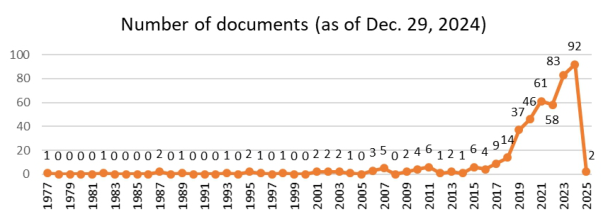
Figure 1 shows the number of IA publications retrieved from Scopus chronologically. Only a few papers were published between 1977 and 2016. The research on IA has also expanded with the progress of AI. In 2012, a seminal study on deep learning was published, heralding the success of
78 Nishinaka and Shirahada
unsupervised feature learning in detecting cat faces and human body images (Le et al., 2012). Around that time, GPU-based computation technology grew rapidly. In 2017 when the transformer was developed, nine publications were published. Since 2018, the number of publications has significantly increased, partly because of the popularity of generative AI, which responds with human-like answers.
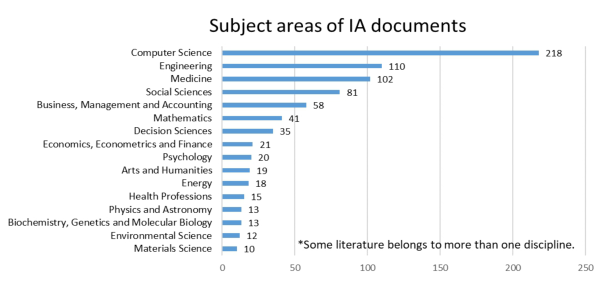
Figure 2 presents the subject areas of the IA publications. The subject with the most published was Computer Science. The second most common subject was Engineering. Medicine ranked third, which includes neurotechnology, diagnostic imaging, and radiology, with many studies related to image reading, such as X-rays. Social science ranks fourth, and the subject of Business, Management, and Accounting ranks fifth, showing that AI pervades society.
Figure 1: Number of published documents in Scopus (The data was retrieved on Dec. 29, 2024, so the number of 2025 is small).Figure 2: Subject areas of IA documents in Scopus (as of Dec. 29, 2024).
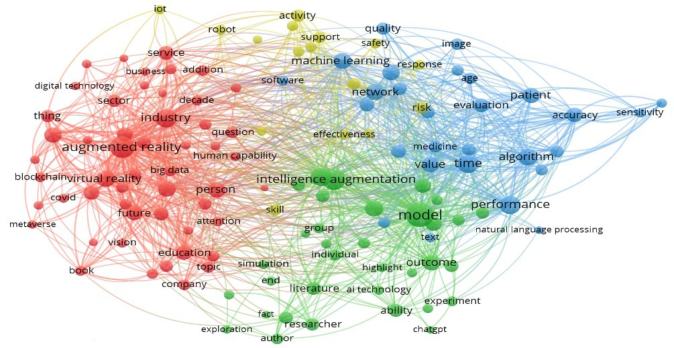
Figure 3 presents a network visualization map of the co-occurrence between terms in abstracts using VOSviewer. The network shows four clusters of different colors. According to the order in all the calculations of weights, the term “model” carries the heaviest weight. Thereafter, “augmented reality”and “intelligence augmentation”come as the second and third, respectively.
Toward the Inclusion of Human Factors in Intelligence Augmentation 79
Table 1 lists the 10 top terms in each cluster ranked by weight. The cluster categories were named based on the terms, and the number of terms in each cluster was recorded. The largest cluster, CL1 is “technology- related,” the second biggest CL2 is “Intelligence and informatics,” the third biggest CL3 is “Medicine,” and the fourth CL4 is “Engineering.” In CL1, the term with the heaviest weight is “augmented reality” followed by “industry.” This cluster contains terms such as “virtual reality,” “innovation,” “education,” “future,” “world,” also includes “service,” “organization,” and “society” which show the actual utilization of AI and technology in society. Terms such as “innovation,” “future,” and “world” imply the goals and purposes of IA. The term “person” might be considered humanity. In CL2, the term with the heaviest weight is “model,” followed by “intelligence augmentation” and “human” as the second and third, which suggests that extending human capabilities is being studied in IA research. This cluster includes “capability,” “ability,” and “decision making,” which indicates the augmentation of human intelligence. In CL3, the term with the heaviest weight is “performance,” followed by “time.” This cluster includes “patient,” “case,” “diagnosis,” and “image,” which suggests that CL3 is a clinical research cluster. In CL4, the term with the heaviest weight is “risk,” and the cluster contains “safety,” “operation” and “robot.”
The results confirm that IA-related research is being used in society through the terms of all the clusters. Human factors have been expanded and considered, especially in CL2 which is an intelligence and informatics cluster. IA is used in medicine in CL3 and in estimating risks and safety in engineering in CL4. The medical field is dominant and active in IA, suggesting that IA directly affects human health. Terms in CL1 refer to the goal or purpose of IA.
Figure 3: Network of co-occurrence between the terms of abstracts by VOSviewer.
80 Nishinaka and Shirahada
Table 1: Cluster categories and terms ranked by weight.
Table available in the original PDF paper.
Cluster Category Number Top 10 Terms Ranked by Weight CL1 (red) Technology-related 52 1. augmented reality 2. industry 3. virtual reality 4. person 5. innovation 6. internet 7. education 8. future 9. world 10. communication CL2 (green) Intelligence and
informatics
34 1. model 2. intelligence augmentation 3. human 4. machine 5. outcome 6. capability 7. decision making 8. ability 9. literature 10. researcher CL3 (blue) Medicine 28 1. performance 2. time 3. algorithm 4. network 5. machine learning 6. patient 7. value 8. year 9. accuracy 10. evaluation CL4 (yellow) Engineering 16 1. risk 2. activity 3. assessment 4. support 5. skill 6. safety 7. view 8. effectiveness 9. operation 10. point To clarify what AI could specifically augment, an analysis was performed using KH Coder on the abstract data retrieved from Scopus. A hierarchical cluster analysis of the terms in the abstract was performed, followed by a concordance analysis with KWIC to examine the context (Higuchi, 2016).
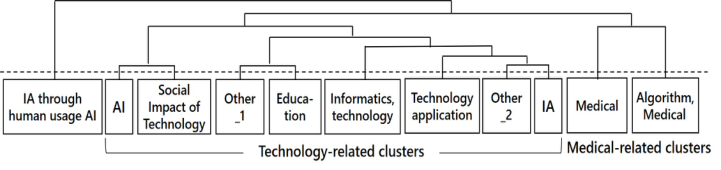
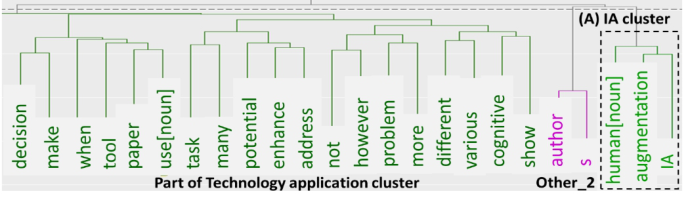
The hierarchical cluster analysis identified 11 appropriate clusters and their relationships (Figure 4). The clusters are named based on the terms. Figure 4 shows the overall results of the hierarchical cluster analysis, and Figure 5 shows an excerpt of the KH Coder output image (part of Technology application, Other_2, and IA clusters). Figure 4 shows that the medical- related cluster was independent, whereas the technology-related cluster formed a large cluster. Among the 11 clusters, “human,” “augmentation,” and “IA” are in the same cluster (A) (Figure 5), and it has a relationship with the technology application cluster (Figure 5).
In the technology application cluster (Figure 5), we focused on the terms “cognitive,” “potential and enhance,” and “decision and make.” A concordance analysis with KWIC was performed to examine the terms in the technology application cluster. The words used with “cognitive” were “cognitive services,” “cognitive computing,” “cognitive enhancement,” and related topics. “Cognitive services” refers to the identification of the key characteristics of business requirements. Many areas are included under the terms, “potential and enhance,” such as medical, organization, employee- related, and enhancement technology. The same is true for “decision and make,” which includes topics such as hiring, digital marketing, efficient healthcare, and related technologies and tools.
Toward the Inclusion of Human Factors in Intelligence Augmentation 81
Figure 4: Hierarchical cluster analysis result (written by the author. Eleven clusters and their relationships followed the output of the KH Coder).Figure 5: The result of the hierarchical cluster analysis by KH Coder (excerpt from the KH Coder graph, then characters are enlarged by the author).
DISCUSSION
To answer the research questions—“What are research trends in human intelligence augmentation and what goals does IA aim to achieve?”—we used VOSviewer and KH Coder, conducted bibliometrics and text mining analyses on the bibliographic information of previous studies obtained from Scopus, and investigated the overall trends in IA research.
The results show that IA-related research considers human factors, thus validating Zhou et al.’s (2023) findings. Further, VOSviewer identified “risk” as the term with the heaviest weight in Engineering cluster CL4, which demonstrates that AI is used for risk detection in the field. The results of the contextual analysis using KH Coder presented many “cognitive”- related topics. The VOSviewer and KH Coder demonstrated that intelligence augmented by IA includes cognitive awareness that humans would not normally notice. Zhou et al. (2021) stated that the knowledge of humans and machines differs; machines provide knowledge that complements human abilities. Our results demonstrate that IA enables humans to extend their inherent cognitive capabilities through interactions with machines. This finding strengthens the findings of previous studies, such as those of Paul et al. (2022).
Within the scope of this analysis, the research on the goals mentioned by Paul et al. (2022) was not concretely shown, although it was implied in the VOSviewer results to a small extent. However, in the future, it
82 Nishinaka and Shirahada
will become more important to consider which goals (purposes) can be achieved with extended abilities, and further research is required. In addition, IA theory, which is more ethical and significant, is expected to become increasingly necessary in practice. Furthermore, in each academic area, a theory that conforms to that area is required; however, more research is necessary. Additionally, the results of the analysis in this study did not present contextual understanding (Bassano et al., 2020; Paul et al., 2022), in which research is insufficient and future expansion is desired.
In the hierarchical cluster analysis using the KH Coder, the clusters that presented categories such as education (learning), medicine, and business were the same as those shown by Zhou et al. (2021). In addition, the technology-related cluster was the largest in both the VOSviewer and KH Coder results. These results demonstrate the significance of IA for the social application of technology. From the results of VOSviewer and KH Coder, we identified two major clusters in IA research: those related to technology and medicine. The medical field is concerned with image reading research, while the technology-related cluster includes studies on the impact of IA research on business, education, and society. The finding that technology-related clusters form a single large cluster that includes social impact supports the findings of previous studies that have identified IA as systems thinking (Jakkola et al., 2024; Paul et al., 2022; Zhou et al., 2021). In other words, it objectively supports the idea that the IA functions as an umbrella concept by bridging the two clusters.
The results of the literature review suggest that the contribution of IA to human intelligence is consistent with that of its general recognition. This suggests that although many IA studies use and are concerned with the term enhancement of “human intelligence,” the results of technological advances indicate that the problem of human intelligence sophistication has not yet been resolved. For example, even if AI can create highly technical works like Beethoven’s, it will not be able to absorb the spirituality, emotion, or musical perspectives that Beethoven had in creating his work, as Bassano et al. (2020) mentioned regarding high-quality products. Further, human spirituality cannot be advanced through the influence it receives from AI works. Going forward, we must seriously consider expanding IA research into the field of human intellect (e.g., Wilhelms, 1969) and wisdom (e.g., Jeste et al., 2019), where the focus is on the human mind, and think about the specific contributions of science and technology.
CONCLUSION
To discuss the future of human intelligence, this study conducted a bibliometric and text mining analysis of previous IA studies obtained from Scopus and examined the overall trends in IA research. The study found that IA research argues that not only complements human cognitive capabilities but also enhances them. In addition, it was objectively demonstrated that IA functions as an umbrella concept, bridging fields related to technology and medicine, which are the two major areas of IA research. The limitation of this study is the use of Scopus data only. Further research with more data
Toward the Inclusion of Human Factors in Intelligence Augmentation 83
is required. There is little research on contextual understanding and human wisdom in IA, and research to theorize this, such as expanding SDL applying IA, is a future challenge.
ACKNOWLEDGMENT
This work was supported by Grants-in-Aid for Scientific Research (KAKENHI) from the Japan Society for the Promotion of Science (JSPS) (grant number JP20K01912) and JSPS Co-creation of academic knowledge JPJS00124017859.
REFERENCES
Akaka, M. A., & Vargo, S. L. (2014). Technology as an operant resource in service (eco) systems, Information Systems and e-business Management, 12, pp. 367–384. Akaka, M. A., Vargo, S. L., & Schau, H. J. (2015). The context of experience, Journal
of Service Management, 26(2), pp. 206–223. Barile, S., Bassano, C., Piciocchi, P., Saviano, M., & Spohrer, J. C. (2024).
Empowering value co-creation in the digital age, Journal of Business & Industrial Marketing, 39(6), pp. 1130–1143. Bassano, C., Barile, S., Saviano, M., Pietronudo, M. C., & Cosimato, S. (2020).
AI technologies & value co-creation in luxury context, Proceedings of the 53rd Hawaii International Conference on System Sciences, pp. 1618–1627. Davenport, T. H., & Kirby, J. (2016). Only humans need apply: Winners and losers in the age of smart machines. New York: Harper Business, pp. 1–281. Higuchi, K. (2016). KH Coder 3 Reference Manual. Available at: https://khcoder.ne
t/en/manual_en_v3.pdf (Accessed: Jan. 1, 2025). Holmström, J., & Carroll, N. (2024) (in press). How organizations can innovate with generative AI, Business Horizons. Jain, H., Padmanabhan, B., Pavlou, P. A., & Raghu, T. S. (2021). Editorial for
the special section on humans, algorithms, and augmented intelligence: The future of work, organizations, and society, Information Systems Research, 32(3), pp. 675–687. Jaakkola, E., Kaartemo, V., Siltaloppi, J., & Vargo, S. L. (2024). Advancing servicedominant logic with systems thinking, Journal of Business Research, 114592. Jeste, D. V., Lee, E. E., Cassidy, C., Caspari, R., Gagneux, P., Glorioso, D., Miller,
B. L., Semendeferi, K., Vogler, C., Nusbaum, H., & Blazer, D. (2019). The new science of practical wisdom, Perspectives in biology and medicine, 62(2), pp. 216–236. Kumar, R., Saxena, S., Kumar, V., Prabha, V., Kumar, R., & Kukreti, A.
(2024). Service innovation research: A bibliometric analysis using VOSviewer, Competitiveness Review: An International Business Journal, 34(4), pp. 736–760. Le, Q., Ranzato, M., Monga, R., Devin, M., Chen, K., Corrado, G. S., Dean, J., & Ng, A. Y. (2012). Building High-Level Features Using Large Scale Unsupervised Learning, Proceedings of the 29th International Conference on Machine Learning (ICML 2012), pp. 507–514. Lusch, R. F., & Vargo, S. L. (2019). An overview of service-dominant logic, in Vargo,
S. L., & Lusch, R. F. (eds.), The SAGE handbook on service-dominant logic. London: Sage, pp. 3–21.
84 Nishinaka and Shirahada
Nishinaka, M., & Masuda, H. (2024). Co-Creation of “Value-in-Context” in High- Quality Service: A Case Study, in: Leitner, C., Nägele, R., Bassano, C., & Satterfield, D. (eds), The Human Side of Service Engineering, 143, USA: AHFE International, pp. 75–82. Nishinaka, M. & Shirahada, K. (2023). Emergent Process of Shared Leadership
for Innovative Knowledge Creation: Text-Mining Approach to Discussion Data, International Journal of Innovation and Technology Management, 20(3), 2350013. Orlikowski, W. J., & Scott, S. V. (2015). The algorithm and the crowd: Considering the materiality of service innovation, MIS Quarterly, 39(1), pp. 201–216. Paul, S., Yuan, L., Jain, H. K., Robert, L. P., Spohrer, J., & Lifshitz-Assaf, H.
(2022). Intelligence Augmentation: Human Factors in AI and Future of Work, AIS Transactions on Human-Computer Interaction, 14(3), pp. 426–445. Siddike, M. A. K., Spohrer, J., Demirkan, H., & Kohda, Y. (2018). People’s Interactions with Cognitive Assistants for Enhanced Performances, Proceedings of the 51st Hawaii International Conference on System Sciences, pp. 1641–1648. van Eck, N. J., & Waltman, L. (2009). How to normalize cooccurrence data? An
analysis of some well-known similarity measures, Journal of the American society for information science and technology, 60(8), pp. 1635–1651. van Eck, N. J., & Waltman, L. (2010). Software survey: VOSviewer, a computer program for bibliometric mappin, Scientometrics, 84(2), pp. 523–538. van Eck, N. J., & Waltman, L. (2020). VOSviewer manual version 1.6.20.
Available at: https://www.vosviewer.com/documentation/Manual_VOSviewer_1. 6.20.pdf (Accessed: Jan. 1, 2025). van Eck, N. J., Waltman, L., Dekker, R., & Van Den Berg, J. (2010). A comparison of two techniques for bibliometric mapping: Multidimensional scaling and VOS, Journal of the American Society for Information Science and Technology, 61(12), pp. 2405–2416. VOSviewer.com. Available at: https://www.vosviewer.com/ (Accessed: Jan. 12,
2025). Waltman, L., Van Eck, N. J., & Noyons, E. C. M. (2010). A unified approach to mapping and clustering of bibliometric networks, Journal of Infometrics, 4(4), pp. 629–635. Wilhelms, F. T. (1969). The Education of Intellect: The Influence of Environment
and Education, The bulletin of the National Association of Secondary School Principals, 53(336), pp. 1–36. Zhou, L., Paul, S., Demirkan, H., Yuan, L., Spohrer, J., Zhou, M., & Basu, J. (2021). Intelligence Augmentation: Towards Building Human-Machine Symbiotic Relationship, AIS Transactions on Human-Computer Interaction, 13(2), pp. 243–264. Zhou, L., Rudin, C., Gombolay, M., Spohrer, J., Zhou, M., & Paul, S. (2023). From
Artificial Intelligence (AI) to Intelligence Augmentation (IA): Design Principles, Potential Risks, and Emerging Issues, AIS Transactions on Human-Computer Interaction, 15(1), pp. 111–135.
LISTED IN THE AHFE DIGITAL BOOKSTORE CATALOGUE
Explore the complete digital volume
The Human Side of Service Engineering
Read this individual research paper free through the original publisher, or explore the full digital proceedings book.
ISBN 978-1-964867-58-8
Explore this ISBN in the AHFE Bookstore ↗Listed in the July 2026 bookstore catalogue; search by ISBN to confirm current availability · Digital book purchase optional