Porruthai Boonswasd, Kunio Shirahada (2022). Empowering Futures Literacy through a Knowledge-based Service Innovation Workshop. In: The Human Side of Service Engineering. AHFE Open Access, vol. 62, pp. 109–116. https://doi.org/10.54941/ahfe1002548
During stepping into an era of rapidly changing world and constantly disruption, companies need to generate new value to unlock opportunities and drive the growth (Lee et al., 2009). Innovation is a key initiative for competitive advantage as the main driver of economic growth (Lopez, 2012). Nevertheless, as the environment changes, regulations evolve, new technologies emerge, and even consumer behavior changes, businesses may not have a clear picture of how they will survive or succeed. Companies should increase individuals' futures literacy capacities in order to strengthen firms' sensing dynamic capabilities (Rhisiart et al., 2015). UNESCO has addressed the urgent need to enhance people's capacities and skills by empowering everyone to better use the future to prepare for potential crises or overcome major challenges (UNESCO, 2021). However, there is no established approach for developing these competencies in service innovation. Therefore, we aim to enhance individuals ability by cultivating future literacy, which is a basis of human skill for future service design (Bell, 2009; Miller, 2018).Kononiuk et al. (2021) stated a future study by providing tools to facilitate futures thinking, including trend and scenario analysis. Rohrbeck (2011) listed future-oriented capabilities as the ability to gather external data, and apply creativity to find opportunities and take risks. Therefore, we believe that the global and business scanning, such as megatrend, technology trends or research direction through intellectual property, will be an essential part of enhancing future literacy. Technology trends alone usually cannot cover all organizational scenarios (Lee, 2013). Predicting the future requires not just recognizing and assessing opportunities, but also taking into account potential risks (Morris et al., 2013; Dannenberg and Grapentin, 2016; Haarhaus & Liening, 2020). In addition to considering the potential and impacts of technology breakthroughs, the climate change also influences business and financial decisions (TCFD, 2021). Unexpected business losses may caused by climate-related economic costs, such as rising global temperatures or natural disasters. Firms will be better able to take responsibility and foresight if they are aware of the challenges (TCFD, 2020). Based on the background, we developed knowledge-based service innovation workshop. We have presented megatrend, technology trends and relevant patent information to demonstrate the likelihood of technological advancement. As a reference for comprehending possible scenarios, we also present probable climate-related economic costs. Then, leveraging the future vision as a starting point to generate innovative ideas.This paper discusses the success of promoting future literacy for corporate innovation with the knowledge-based service innovation workshop. We conducted an idea generating workshop for employees at various levels to help them in developing innovative ideas for both internal and external environments. We developed our brainstorming workshop in conjunction with providing of megatrend, technology trends, business-related intellectual property, and trustworthy climate-related financial information. It also considers employee feedback on how to motivate creativity through the provision of future opportunities. The outcomes of this study will contribute to the enhance human resource competencies in order to cope with the future, which will lead to sustainable service innovation development.
During stepping into an era of rapidly changing world and constantly dis- ruption, companies need to generate new value to unlock opportunities and drive the growth. Innovation is a key initiative for competitive advantage as the main driver of economic growth (Lopez, 2012). Nevertheless, as the environment changes, regulations evolve, new technologies emerge, and even consumer behavior changes, businesses may not have a clear picture of how they will survive or succeed.
UNESCO has addressed the urgent need to enhance people’s capacities and skills by empowering everyone to better use the future to prepare for potential crises or overcome major challenges. Futures literacy research has studied and mentioned various case studies such as utilities, social and scien- tific, education, policy, and so on (Kononiuk et al., 2021; Mercier-Laurent and Edvinsson, 2021; Miller, 2007, 2018; UNESCO, 2021). In order to
strengthen firms’ sensing dynamic capabilities, companies need also raise employees’ futures literacy capacities (Rhisiart et al., 2015). However, we found that earlier studies had greater emphasis on the future life, with less attention on business innovation, particularly in the field of services. The- refore, we aim to enhance individuals’ ability by cultivating futures literacy, which is a basis of human skill for future service design (Miller, 2018). In this study, we conducted a knowledge-based service innovation workshop where we designed content that promotes futures literacy and analyzed the results of participants’ feedback on how to motivate creativity by imaging future.
KNOWLEDGE-BASED SERVICE INNOVATION WORKSHOP Kononiuk et al. (2021) stated a future study by providing tools to facili- tate futures thinking, including trend and scenario analysis. Rohrbeck (2011) listed future-oriented capabilities as the ability to gather external data and apply creativity to find opportunities and take risks. Therefore, we believe that the global and business scanning, such as megatrends, technology trends or research direction through intellectual property, will be an essential part of enhancing futures literacy.
Futures Literacy Futures literacy is the capacity and skill to imagine the future for various rea- sons and in different ways. There are several sets of assumptions that generate different kinds of imaginary futures. It’s enhancing people ability to prepare, recover and invent as changes occur (UNESCO, 2021). UNESCO addresses the urgent need to transform human governance by empowering everyone to use-the-future more effectively and efficiently. Its purpose is to prepare for potential crises or to overcome major challenges and achieve the fundamental goals of Agenda 2030.
Workshop Curriculum Technology trends alone usually cannot cover all organizational scenarios (Lee, 2013). Predicting the future requires not just recognizing and asses- sing opportunities, but also taking into account potential risks (Dannenberg and Grapentin, 2016; Haarhaus and Liening, 2020; Morris et al., 2013). In addition to considering the potential and impacts of technology breakth- roughs, the climate change also influences business and financial decisions (TCFD, 2021). Unexpected business losses may cause by climate-related eco- nomic costs, such as rising global temperatures or natural disasters. Firms will be better able to take responsibility and foresight if they are aware of the challenges (TCFD, 2020).
Based on the background, we developed knowledge-based service inno- vation workshop. We have presented megatrends, technology trends and relevant patent information to demonstrate the likelihood of technological advancement. As a reference for comprehending possible scenarios, we also present probable climate-related economic costs. Then, leveraging the future visualization as a starting point to generate innovative ideas.
Empowering Futures Literacy Through a Knowledge-Based Service Innovation Workshop 111
An approach for demonstrating prospective future scenarios is to imagine the future through storytelling (Miller, 2007). This workshop therefore pro- vides a brainstorming session for sharing and discussing the organization’s future routine in the next 10 years. Then, through storytelling, participants share their imaginations in order to inspire others to come up with new ideas that correspond with those futures.
ANALYSIS AND EVALUATION The methods we employed for analysis and evaluation, as well as the results we obtained, are described following.
METHODS
Online Knowledge-Based Service Innovation Workshop A knowledge-based service innovation workshop consists of three phases: Part I, Training, comprises megatrends, technological trends, business-related intellectual property, and climate-related financial information, according to the workshop curriculum. Part II and III are interactive activities. Part II, Imagining the future of organization and storytelling, to share each group’s perspective. Part III, brainstorming activities was launched to generate ideas for service innovation.
For the megatrends and technological trends, we use data from PwC and Gartner’s hype cycle (Kasey Panetta, 2021; PwC United Kingdom, 2021). In terms of business-related intellectual property, the data used comes from Scopus and WoS-based research, and related-patents from Patsnap. We have also provided an environmental perspective based on TCFD reports to raise awareness of the financial impacts related to climate (TCFD, 2020). Due to the coronavirus pandemic, we have organized an online workshop using Zoom. The Breakout rooms session was used to break participants into smal- ler groups for brainstorming sessions on share boards using Miro: The Visual Collaboration Platform (https://miro.com/).
Survey Evaluation Tool A survey tool was developed to evaluate participants’ views and capture the learning from the knowledge-based service innovation workshop. The survey evaluation tool was designed to be used pre- and post-workshop on how to encourage creativity through the provision of future opportunities.
The pre-survey evaluation tool assesses respondents’ perspectives on the importance of imagining the future and previous experience in using future visualization to generate innovative ideas. The post-survey evaluation tool focuses on participants’ opinions on the workshop’s achievement.
Data Collection and Evaluation The workshop was organized for a case study firm that provides its clients international shipping services and facilities. The data was collected during a one-day workshop held in Bangkok, Thailand, in December 2021. The aim of workshop was to enhance individuals’ ability by cultivating futures
112 Boonswasd and Shirahada
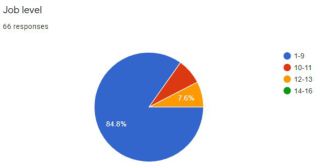
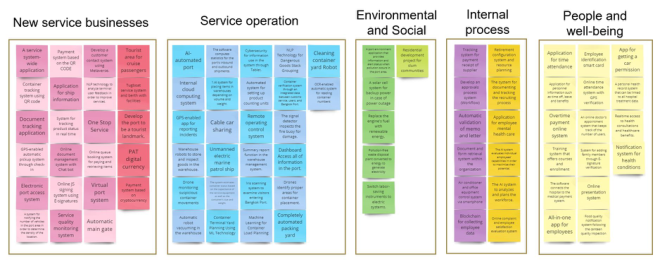
Figure 1: Job level and functions of 66 participants.Figure 2: Innovative ideas obtained from brainstorming sessions in the workshop.
literacy and generating the creative ideas for service innovation. The 66 par- ticipants were divided into five groups. Brainstorming sessions (Part II, III) will be conducted when the proposed curriculum (Part I) has been comple- ted. Participants are given time before and after the session to complete a self-evaluation online survey using Google Forms.
RESULTS
There were 66 participants from various positions and functions (Figure 1). The number of self-evaluation respondents before and after the workshop was 66 and 43, respectively. The result produced five innovative concepts related to internal and external corporate services, including new service busi- nesses, service operation, environmental and social, internal process, and people and well-being. After grouping and filtering duplicate content, 83 ideas were obtained. Figure 2 depicts all the ideas received after grouping. Example of innovative ideas is shown in Table 1.
Attitude and Prior Experience of Performing Futures Literacy To assess attitude and prior experience of performing futures literacy, they were asked about their attitudes regarding the necessity of imagining the future and previous experiences in performing future visualization to gene- rate innovative ideas. The questionnaire was conducted using a five-point Likert scale ranging from Strongly Disagree (1) to Strongly Agree (5). A total of 66 participants completed the survey.
Empowering Futures Literacy Through a Knowledge-Based Service Innovation Workshop 113
Table 1. Example of innovative ideas.
Table available in the original PDF paper.
Concepts Innovative ideas Relevant resources New service businesses Megatrend Tech trend Customer contact system using Metaverse, tourist area for cruise passengers, tugboat service system and berth with facilities, digital currency, etc.
Service operation
Megatrend Tech trend
AI-automated port, OCR-enabled automatic system for container number, unmanned electric marine patrol ship, etc.
Environmental and social
Megatrend TCFD
Pollution alert app, pollution-free waste disposal plant converted to energy to generate electricity, residential development project for slum communities, etc.
Tech trend Patent data
Internal process
Blockchain for collecting employee data, automatic validation of memo and letter, approvals process system, etc.
People and well-being
Megatrend Tech trend
Online time attendance system with GPS verification, notification system for health conditions, etc.
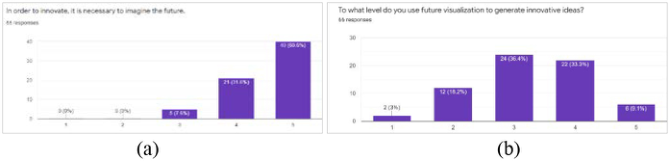
Figure 3: Prior experience of futures literacy (a) the necessity of imagining the future (b) previous experiences in applying future visualization to generate innovative ideas.
The result as outlined in Figure 3 (a) Most respondents agreed that imagi- ning the future is necessary for generating innovative ideas. (b) There are 22 and 6 respondents with a score of 4 and 5 respectively in used future visuali- zation to generate innovative ideas, accounting for 42.4% of all participants. The rest were given scores of 1, 2, 3 with a total of 2, 12, 24 respondents. The results clearly demonstrate a range of experiences.
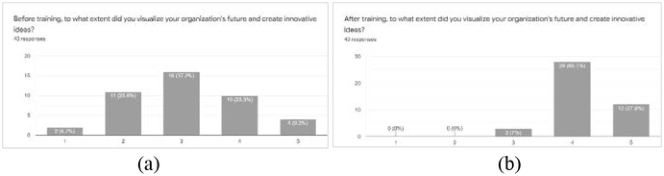
Futures Literacy Enhancement Following the workshop, participants were asked about utilizing an organi- zation’s future visualization to generate innovative ideas in this workshop. As shown in Figure 4, the survey was completed by 43 participants in total.
114 Boonswasd and Shirahada
Figure 4: The evaluation results of before and after workshop (a) Before (b) After.Figure 5: The results of the participants’ ratings of each topic on what level of contributed the generation of innovative ideas.Figure 6: ‘Imagining the future and sharing it through storytelling allows me and my colleagues to see more opportunities for innovation.’
There are 12, 28 and 3 respondents, with scores of 5, 4 and 3 respecti- vely. It was a preliminary conclusion that they were able to use their future imaginations to create more innovatively during the workshop.
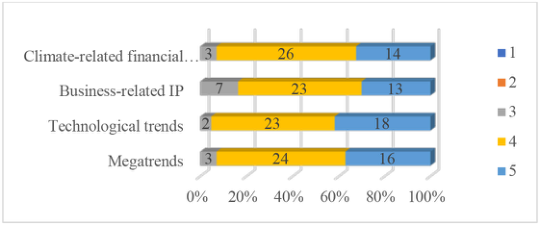
Participants were asked at what level each topic we presented contribu- ted the generation of innovative ideas. The questionnaire was conducted using a five-point Likert scale ranging from Strongly Disagree (1) to Stron- gly Agree (5) to evaluate the workshop’s contents in Part I The results shown in Figure 5, the strongest levels of agreement were recorded with the technological trends, megatrends, climate-related financial information and business-related intellectual property, respectively.
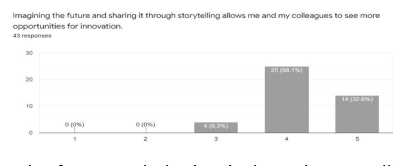
To evaluate Part II of the workshop, imagining the future of organization and storytelling. The participants were asked to rate the statement ‘Imagining the future and sharing it through storytelling allows me and my colleagues to see more opportunities for innovation.’ Most respondents agreed to the statement, as outlined in Figure 6.
Empowering Futures Literacy Through a Knowledge-Based Service Innovation Workshop 115
Based on the workshop and feedback survey, we found that participants expressed their opinion that the entire workshop’s content had a contribu- tion on organization’s future imaging and innovative idea generation. This implied that it would promote future literacy and service innovation. Thus, this approach has the potential to facilitate individuals in the service sector and beyond to improve their future literacy.
CONCLUSION
The researchers primarily aim was to enhance futures literacy, which is a basis of human capability for future service design. The purpose of this study is to explore the factors that contribute to the development of futures literacy, in order to generate ideas for service innovation.
The workshop resulted in 83 innovative ideas related to internal and external corporate services as a consequence of participants using their future imaginations to develop more innovatively throughout the program. We’ve found that when delivering future-related knowledge-based content, it helps to create the future visualization. Future knowledge-based content that influences innovative thinking includes megatrends, technological trends, business-related intellectual property, climate-related financial information. In addition, the visualization of the future through storytelling also encou- rages creativity in innovative ideas. Based on the workshop and feedback survey, we found that this approach has the potential to facilitate individuals in the service sector and beyond to improve their future literacy. The outco- mes of this study will contribute to the enhance human resource competencies to cope with the future, which will lead to sustainable service innovation development.
REFERENCES
Dannenberg, S. and Grapentin, T. (2016), “Education for sustainable development
- Learning for transformation. The example of Germany”, Journal of Futures Studies, Vol. 20 No. 3, pp. 7–20. Haarhaus, T. and Liening, A. (2020), “Building dynamic capabilities to cope with environmental uncertainty: The role of strategic foresight”, Technological Forecasting and Social Change, Elsevier, Vol. 155 No. September 2019, p. 120033. Kasey Panetta. (2021), “3 Themes Surface in the 2021 Hype Cycle for Emerging
Technologies”, available at: https://www.gartner.com/smarterwithgartner/3-them es-surface-in-the-2021-hype-cycle-for-emerging-technologies. Kononiuk, A., Sacio-Szyma´nska, A., Ollenburg, S. and Trivelli, L. (2021), “Teaching foresight and futures literacy and its integration into university curriculum”, Foresight and STI Governance, Vol. 15 No. 3, pp. 105–121. Lee, S. (2013), “Linking technology roadmapping to patent analysis”, Techno-
logy Roadmapping for Strategy and Innovation: Charting the Route to Success, available at:https://doi.org/10.1007/978-3-642-33923-3_17. Lopez, J. (2012), “Competitive Advantage and Business Transformation: Innovation Key Initiative Overview”, Gartner. Mercier-Laurent, E. and Edvinsson, L. (2021), Prototyping Societal Innovation,
World Class Cooking for Solving Global Challenges: Reparadigming Societal Innovation, available at:https://doi.org/10.1108/978-1-83867-122-820211004.
116 Boonswasd and Shirahada
Miller, R. (2007), “Futures literacy: A hybrid strategic scenario method”, Futures, Vol. 39 No. 4, pp. 341–362. Miller, R. (2018), Transforming the Future (Open Access): Anticipation in the
21st Century, Transforming the Future (Open Access): Anticipation in the 21st Century, available at:https://doi.org/10.4324/9781351048002. Morris, M.H., Webb, J.W., Fu, J. and Singhal, S. (2013), “A competency-based perspective on entrepreneurship education: Conceptual and empirical insights”, Journal of Small Business Management, Vol. 51 No. 3, pp. 352–369. PwC United Kingdom. (2021), “Megatrends”, available at: https://www.pwc.co.uk/
issues/megatrends.html. Rhisiart, M., Miller, R. and Brooks, S. (2015), “Learning to use the future: Developing foresight capabilities through scenario processes”, Technological Forecasting and Social Change, Elsevier Inc., Vol. 101, pp. 124–133. Rohrbeck, R. (2011), Corporate Foresight: Towards a Maturity Model for the Future Orientation of a Firm, Heidelberg: Physica-Verlag, available at:https://doi.org/https:// doi.org/10.1007/978-3-7908-2626-5. TCFD. (2020), “Guidance on Scenario Analysis for Non-Financial Companies”, No.
October. TCFD. (2021), “Task Force on Climate-related Financial Disclosures”, available at: https://www.fsb-tcfd.org/. UNESCO. (2021), “Futures Literacy”, available at: https://en.unesco.org/futureslit eracy.
LISTED IN THE AHFE DIGITAL BOOKSTORE CATALOGUE
Explore the complete digital volume
The Human Side of Service Engineering
Read this individual research paper free through the original publisher, or explore the full digital proceedings book.
ISBN 978-1-958651-38-4
Explore this ISBN in the AHFE Bookstore ↗Listed in the July 2026 bookstore catalogue; search by ISBN to confirm current availability · Digital book purchase optional