Nita Aribah Hanif, Achmad Nurmandi (2022). Sustainable Transport Development Strategy in Developed and Developing Countries. In: Human Interaction & Emerging Technologies (IHIET 2022): Artificial Intelligence & Future Applications. AHFE Open Access, vol. 68, pp. 174–180. https://doi.org/10.54941/ahfe1002729
This study aims to explore the idea of sustainable transportation in the United States, China, Canada, and South Korea. Sustainable transportation has an essential role in developing a sustainable city that pays attention to an effectiveness-oriented transportation system that impacts the economy, the environment, and the quality of social life. The selection of case studies in four countries motivated the top four countries from the keywords sustainable transportation. This study uses a bibliometric analysis method using data sources from 306 articles (Scopus). The data search was carried out using the keyword "sustainable transportation" from 2012-to 2022. The highest number of research trends in the United States is 166 articles; China has 102 pieces, Canada has 46 papers, and South Korea has 26 articles. The data analysis stage was carried out using the Vos Viewer and Nvivo 12 Plus software. The results show that each country has a different focus measured from three aspects: planning, information, and investment. Planning factors include types of transportation, routes, costs, carbon emissions, and applications. The information aspect consists of estimation, trip, and performance. The investment aspect includes current demands and issues to shape future policies. Development strategy Sustainable Transportation in the planning stage only focuses on the use of vehicle emissions. In contrast, in the information aspect, it focuses on travel modes, then in the investment aspect, there is no attention to future policies related to issues that occur today. In the planning part of Sustainable Transportation, China has a varied focus, such as the type of transportation used, emissions, and the route used for transportation. In contrast, the Chinese state has not paid attention to this focus on the information and investment aspects. Meanwhile, Canada and South Korea have not focused on planning, information, and investment aspects. From these findings, it is hoped that it can provide input for various countries to pay more attention to these aspects to achieve sustainable transportation in smart cities. The concept of sustainable transportation is also helpful for achieving SDG's 11th goal.
Concern for environmental quality has sparked great attention to sustainabi- lity in recent decades (Marleau Donais et al., 2022). Governments in various countries have also begun to declare sustainable development efforts through the Sustainable Development Goals (SDGs) agenda. Sustainable development can be reflected in multiple infrastructure systems that can be measured by economic aspects environmental and social impacts (Guo and Zhang, 2021) and (Liu et al., 2015). One component of intelligent city sustainability is sustainable transportation and access (Mahmoudi et al., 2019). This is also explained by (Lee et al., 2017), who state that sustainable transport is one of
Sustainable Transport Development Strategy in Developed and Developing Countries 175
the principles of sustainable development efforts in the transportation sector. The issue of transportation in the context of sustainability was brought up by Willim R. Black (2001) in “An Unpopular Essay on Transportation”(Xu, Aziz and Guensler, 2019). It discusses nine predictions related to transpor- tation in the future. The predictions have proven to be accurate, including the prediction of the transportation revolution that contributes to the sustai- nability of transport. This is because the development of transportation is about the speed and sophistication of vehicles and the need to consider the use of energy and the production of the resulting emissions. The massive use of public transportation is also considered to reduce energy use and the dispo- sal of harmful emissions to environmental sustainability. As stated by (Rice et al., 2020), the use of emissions is detrimental to public health.
Intelligent city transportation is also often combined with techno- logical developments such as implementing the Intelligent Transporting System (ITS), one of the innovative city applications that utilize 5G tech- nology (Gohar and Nencioni, 2021). The use of sensors in city infrastructure such as roads (Badii et al., 2019), automated electric buses to optimize public transportation (Bublyk et al., 2020), and the use of big data in the develo- pment of intelligent city transportation (Gohar, Muzammal and Ur Rahman, 2018). However, there are still very few governments that pay attention to sustainable transport from a policy aspect that can affect the long term. Mea- nwhile, determining the right policy requires careful planning and integrated information delivery. Seeing this urgency, it is essential to pay attention to several aspects of policymaking based on current issues to be evaluated and used as capital in policy formation in the future. This study aims to deter- mine the four countries’ tendency to discuss sustainable transportation based on the aspects that are of concern in this study. The output generated from this research is to provide input to various countries to pay more attention to these aspects in developing sustainable transportation to realize the 11th SDGs goal.
RESULT AND DISCUSSION
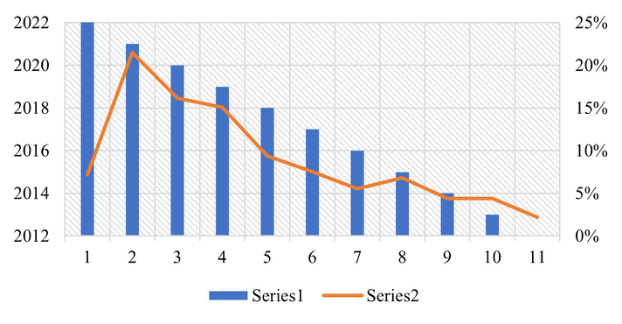
Sustainable Transportation Publication Trend Analysis The results of the analysis of 538 journal articles that discuss sustainable transportation with a range from 2012 to 2022 show quite varied data. This paper analyzes based on several classifications such as the number of articles per year, country, affiliation, author, and the dominant scientific field in the last ten years.
In the last ten years, the number of journal articles has fluctuated from year to year. The picture above shows that from 2012 to 2022, the lowest num- ber of pieces produced in 2012 was 12 articles, then the highest number of reports was issued in 2021 with 117 articles. There was a decline from 2015 to 2016 by seven pieces. This condition shows that the discussion regarding sustainable transportation has enough dynamics from year to year.
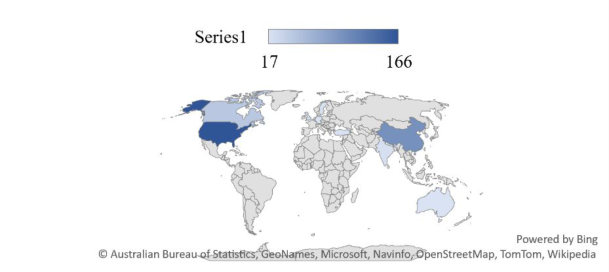
The United States has the highest number of articles on sustainable tran- sportation, with 166 reports. They are then followed by China with 103 pieces, Canada with 46 articles, and then South Korea with 26 articles.
176 Hanif and Nurmandi
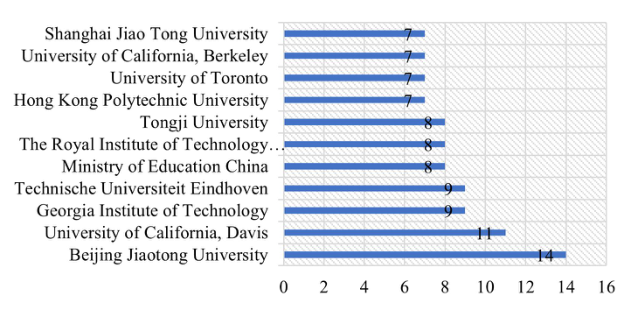
Figure 1: Graph of sustainable transportation trends 2012-2021. Source: Author, 2022.Figure 2: Sustainable transportation trends by country. Source: Author, 2022.Figure 3: Sustainable transportation trends by affiliation. Source: Author, 2022.
Several other countries are also developing research on sustainable transpor- tation, such as the Netherlands and the United Kingdom. From these data, it can be seen that several developed countries have considered the preservation of nature when talking about transportation.
Sustainable Transport Development Strategy in Developed and Developing Countries 177
Table 1. Sustainable transportation trends by author.
Table available in the original PDF paper.
Authors Article Choi, K. 4 Kucukvar, M. 4 Rasouli, S. 4 Antoniou, C. 3 Frederick, C. 3 Fujii, S. 3 Gao, L. 3 Haghshenas, H. 3 Krizek, K.J. 3 Onat, N.C. 3 Rodriguez-Valencia, A. 3
Source: Author, 2022.
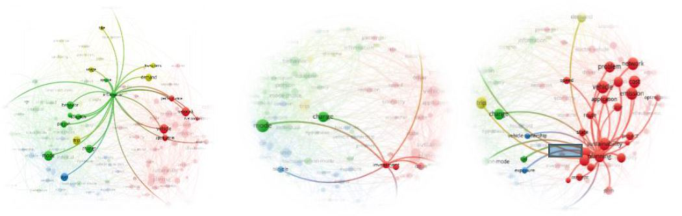
Figure 4: Visualization of sustainable transportation trends. Source: Vosviewer Data Processing.
The picture above shows that Beijing Jiaotong University is an affiliate of the university that has conducted the most research related to sustaina- ble transportation, namely 14 articles in the last ten years—then followed by the University of California, Davis, which showed 11 studies. Other universities conducting the same research are the Georgia Institute of Tech- nology, Technische Universiteit Eindhoven, and the Ministry of Education of China, which are the top five in developing research on sustainable transportation.
Choi, Kucukvar, and Rasouli are the researchers with the most studies discussing sustainable transportation. Meanwhile, other researchers only have three articles that pay attention to aspects of sustainable transport in their research.
Analysis of Developed and Developing Country Publication Trends Data mapping through the Vosviewer application helps find and discuss sustainable transportation. Based on the mapping, several aspects could be the focus of a strategy for sustainable transport. From the mapping results of previous research, it is hoped to provide an exciting picture of each country that has its focus on discussing sustainable transportation. The following is the result of displaying data from the VosViewer application:
178 Hanif and Nurmandi
The planning aspect is one of the strategic focuses in the discussion of sustainable transportation because careful planning is needed to get to sustai- nable transport. Careful planning can be measured from several indicators, namely the preparation of transportation support applications to make it easier for the public to access them, the type of transportation that supports sustainable transport, the travel routes used in which areas are essential in urban settings towards sustainable planning (Billones et al., 2021) , emissi- ons and costs incurred in implementing the transportation. In addition to the planning aspect, the information aspect is urgent because achieving sustai- nable transport requires adequate information about travel and performance estimates used to disseminate this information to the broader community. It was also mentioned (Bernhardt et al., 2020) that information technology intervention creates a smart ecosystem by combining Information Commu- nication Technology (ICT) with city infrastructure. Then another aspect that has urgency in sustainable transportation is long-term policy investment. A good policy can be a long-term investment in a better direction. Therefore, it is crucial in policymaking to pay attention to currently developing issues to be evaluated.
The US has enough attention on sustainable transportation in the planning aspect, which is indicated by several articles that discuss it. As (Balali, Fathi and Aliasgari, 2020) state, the management of transportation modes is not only related to the sophistication and effectiveness of travel time, but it is also essential to consider other aspects such as aspects of sustainability, fuel consumption, and costs incurred. The US has several articles that discuss the information aspect in the information aspect (Chaudhary et al., 2019), which state that information infrastructure supports innovative city ecosystems in the intelligent transportation sector. However, in terms of long-term tran- sportation policy, the US has not paid more attention, which seems to have no articles discussing it. In contrast to the theme from China, the planning aspect concerns a little about emissions, costs, and modes of transportation. They are more interested in discussing sustainable transport from the side of urban spatial planning as in the study (Gao et al., 2021) examining indu- strial land use for intelligent cities. Regarding information and its relation to sustainable transportation, no article from China discusses it. Still, China has articles related to monitoring smart roads with the help of modern infor- mation technology (Liu et al., 2021). Meanwhile, China has not conducted further studies based on the current situation in terms of long-term policy.
Meanwhile, Canada has several articles related to sustainable transpor- tation, but most articles only emphasize the urgency of using bicycles as a mode of public transportation to achieve sustainable transport. Research (Larsen, Patterson and El-Geneidy, 2013), (Amiri and Sadeghpour, 2015), and (Edge, Goodfield and Dean, 2020) discuss the use of bicycles to reduce emissions expenditure and support sustainable transportation. Meanwhile, in the aspect of transportation planning, information, and long-term policy, research from Canada has not yet been found that discusses this matter. Then in South Korea, there are several focuses of research on sustainable tran- sportation, such as research (Ban and Hyun, 2019) that bicycles can reduce
Sustainable Transport Development Strategy in Developed and Developing Countries 179
pollution rates. However, some articles from South Korea have not develo- ped sustainable transportation in the aspects of planning, information, and long-term policies in detail.
CONCLUSION
This study found some interesting findings that each country has its focus on discussing sustainable transportation, especially when viewed from the aspect of planning, information, and long-term policy investment.US has a Sustaina- ble Transportation in the planning stages focusing solely on vehicle emissions. On the other hand, the mode of travel becomes an information aspect; then, there is no attention to future policies related to current investments. In the planning element of Sustainable Transport, China focuses on various factors: the type of transportation used, emissions, and routes. On the other hand, China has paid less attention to this focus on information and investment aspects. Meanwhile, Canada and South Korea have not focused on planning, information, and investment.
REFERENCES
Amiri, M. and Sadeghpour, F. (2015) ‘Cycling characteristics in cities with cold weather’, Sustainable Cities and Society, 14(1), pp. 397–403. doi: 10.1016/j.scs.2013.11.009. Badii, C. et al. (2019) ‘Sii-mobility: An IoT/IoE architecture to enhance smart city mobility and transportation services’, Sensors (Switzerland), 19(1). doi: 10.3390/s19010001. Balali, V., Fathi, S. and Aliasgari, M. (2020) ‘Vector maps mobile application for sustainable eco-driving transportation route selection’, Sustainability (Switzer- land), 12(14). doi: 10.3390/su12145584. Ban, S. and Hyun, K. H. (2019) ‘Designing a user participation-based bike rebala-
ncing service’, Sustainability (Switzerland), 11(8). doi: 10.3390/su11082396. Bernhardt, J. R. et al. (2020) ‘Life in fluctuating environments’, Philosophical Transactions of the Royal Society B, 1814(375). Billones, R. K. C. et al. (2021) ‘Smart Region Mobility Framework’, 11(13). Billones, R. K. C. et al. (no date) ‘(2021). Smart Region Mobility Framework.
Sustainability, 13(11), 6366.’ Bublyk, M. et al. (2020) ‘Intelligent system of passenger transportation by autopiloted electric buses in Smart City’, CEUR Workshop Proceedings, 2604, pp. 1280–1294. Chaudhary, R. et al. (2019) ‘BEST: Blockchain-based secure energy trading in
SDN-enabled intelligent transportation system’, Computers and Security, 85, pp. 288–299. doi: 10.1016/j.cose.2019.05.006. Edge, S., Goodfield, J. and Dean, J. (2020) ‘Shifting gears on sustaina- ble transport transitions: Stakeholder perspectives on e-bikes in Toronto, Canada’, Environmental Innovation and Societal Transitions, 36, pp. 197–208. doi: 10.1016/j.eist.2020.07.003. Gao, J. et al. (2021) ‘Intensive-use-oriented identification and optimization of industrial land readjustment during transformation and development: A case study of Huai’an, China’, Habitat International, (118).
180 Hanif and Nurmandi
Gohar, A. and Nencioni, G. (2021) ‘The role of 5g technologies in a smart city: The case for intelligent transportation system’, Sustainability (Switzerland), 13(9), pp. 1–24. doi: 10.3390/su13095188. Gohar, M., Muzammal, M. and Ur Rahman, A. (2018) ‘SMART TSS: Defining tran-
sportation system behavior using big data analytics in smart cities’, Sustainable Cities and Society, 41(March), pp. 114–119. doi: 10.1016/j.scs.2018.05.008. Guo, Y. and Zhang, Y. (2021) ‘Understanding factors influencing shared e-scooter usage and its impact on auto mode substitution’, Transportation Research Part D: Transport and Environment, 99. doi: 10.1016/j.trd.2021.102991. Larsen, J., Patterson, Z. and El-Geneidy, A. (2013) ‘Build It. But Where? The Use of
Geographic Information Systems in Identifying Locations for New Cycling Infra- structure’, International Journal of Sustainable Transportation, 7(4), pp. 299–317. doi: 10.1080/15568318.2011.631098. Lee, J. et al. (2017) ‘Changes in service and associated ridership impa- cts near a new light rail transit line’, Sustainability (Switzerland), 9(10). doi: 10.3390/su9101827. Liu, A. Y. et al. (2021) ‘Design of a low-power road monitoring system for smart cities based on Wireless Sensor Network.’, 53, pp. 183–196. Liu, Y. et al. (2015) ‘Road centrality and landscape spatial patterns in Wuhan
Metropolitan Area, China’, Chinese Geographical Science, 25(4), pp. 511–522. doi: 10.1007/s11769-015-0749-y. Mahmoudi, M. et al. (2019) ‘Accessibility with time and resource constraints: Computing hyper-prisms for sustainable transportation plan- ning’, Computers, Environment and Urban Systems, 73, pp. 171–183. doi: 10.1016/j.compenvurbsys.2018.10.002. Marleau Donais, F. et al. (2022) ‘Municipal decision-making for sustainable transportation: Towards improving current practices for street rejuvenation in Canada’, Transportation Research Part A: Policy and Practice, 156, pp. 152–170. doi: 10.1016/j.tra.2021.12.009. Rice, C. et al. (2020) ‘Willingness to pay for sustainable aviation depends on
ticket price, greenhouse gas reductions and gender’, Technology in Society, 60. doi: 10.1016/j.techsoc.2019.101224. Xu, X., Aziz, H. M. A. and Guensler, R. (2019) ‘A modal-based approach for estimating electric vehicle energy consumption in transportation networks’, Tran- sportation Research Part D: Transport and Environment, 75, pp. 249–264. doi: 10.1016/j.trd.2019.09.001.
Read this individual research paper free through the original publisher, or explore the full digital proceedings book.
ISBN 978-1-958651-44-5
Explore this ISBN in the AHFE Bookstore ↗Listed in the July 2026 bookstore catalogue; search by ISBN to confirm current availability · Digital book purchase optional