Irham Maulida, Achmad Nurmandi (2022). Comparative Analysis of Public Transportation Development in Developing and Developed Countries. In: Human Interaction & Emerging Technologies (IHIET 2022): Artificial Intelligence & Future Applications. AHFE Open Access, vol. 68, pp. 535–543. https://doi.org/10.54941/ahfe1002774
This study to analyze the development of Public Transportation in the application of smart cities in the United States, China, Italy, and Brazil. The result of public transportation services dramatically contributes to increase mobility, and safety, as well as having a positive impact in urban areas. This research method uses a qualitative approach to bibliometric analysis. The data source is taken from the Scopus and articles searched for the last ten years (2012-2021) using keywords smart city and public transportation. The data found, 293 articles, with the top four countries having the highest number of articles. United States by 41, China by 32, Italy by 23, and Brazil by 20. The data analysis technique in this study used the Nvivo12plus and Vosviwer. The study results there are three concept findings in the development of public transportation; mobility, policy, and connectivity. The four countries have different focuses on implementing public transportation. United States focuses on mobility, policy, and connectivity with indicators such as urban mobility, intelligent transportation management, and governance. China focuses on mobility and connectivity, smart urban mobility, criteria, infrastructure, economy, and the environment, China is not the policy concept. Italy and Brazil also focus on the idea of mobility and policy with indicators that focus on the progress of urban mobility analysis and efforts to improve the convenience of public transportation to increase demand. The concept of connectivity has not been a concern for Italy and Brazil. Within these four countries, the United States dominates the development of public transportation, because it has fulfilled the three concepts of public transportation, namely mobility, policy, and connectivity. It is hoped that from the analysis of the development of this research, the four countries can further improve technological advances based on the Intelligent Transport System (ITS) to make public transportation smarter.
Smart Cities have emerged as a strategy to solve problems faced by cities today, such as traffic, resource management, waste, pollution, etc. The smart city concept is fundamentally associated with sustainable development and living conditions in modern cities (Rybka-Iwa´nska & López, 2019). To ach- ieve strategic goals, smart cities have characteristics such as information and communication technology readiness, accessibility and standards of public
transport, connections with other cities and states, access to health care, high-quality education, and freedom (Semanjski et al., 2017). Studying public transportation as part of the Intelligent Transport System (ITS), part of the smart city concept, will compare the effectiveness of implementing smart cities on public transportation (Farsi & Achuthan, 2018). Intelligent Tran- sportation Systems (ITS) aims to integrate sensing, control, analysis, and communication technologies into travel and transportation infrastructure to improve mobility, convenience, safety, and efficiency (Hahn et al., 2021).The Intelligent Transport System (ITS) is the application of advanced technology in electronics, computers, and telecommunications combined with strategic management principles to improve the overall function of public transpor- tation (Hahn et al., 2021). The role of ITS in holistic urban planning and tracking services throughout the city can improve public transportation while reducing traffic congestion, maintaining citizen safety, enabling sustainable economic growth, and improving the quality of citizens’ lives (Kazmi et al., 2019). ITS advanced technology as the key to a smart city has also delive- red an impetus to improve travel experiences and safety and a consistent desire to travel faster and more comfortably (Zhao & Jia, 2021). As cities grow, urban mobility is one measure of smart city initiatives, and mobi- lity aims to support the use of public transport and reduce the number of private cars (Zimmermann et al., 2020).Public transportation with the ITS system can extract useful mobility information from big data, which is very important to improve the decision/policy-making process in public transit in smart cities (Fabbiani et al., 2017). The success of public transportation also influences policymakers who want to increase sustainable mobility in smart cities (Carreras et al., 2012). ITS plays an essential role in optimizing public transportation and big data in the development of smart city transportation (M Gohar et al., 2018). However, the implementation of the ITS system on public transit is still very little used by the government in several countries, both developed and developing countries (Farooq et al., 2019). Therefore, it is essential to pay attention to the ITS aspect in implementing policies on public transportation to increase urban mobility and improve connectivity aspects in developed (the United States and Italy) and developing countries (China and Brazil).
RESULTS AND DISCUSSION
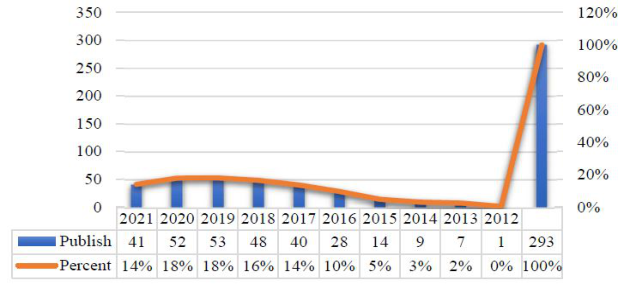
Smart Public Transportation Publication Trend Analysis The existence of public transportation occurs in several developed and deve- loping countries. It can be seen in the development of public transport from the discovery of publication data obtained through Scopus that public tran- sportation has become the focus of researchers from various worlds. In ten years, there were 293 publications related to public transit 2012 to 2021. The year with the lowest number of publications was 2012, with one publication or 0%. And the highest year of publication was 2019, with 53 publications reaching 18%. However, in 2021 it decreased by 4% with 41 journals. There- fore, it can be seen from the trend in the number of research related to public
Comparative Analysis of Public Transportation Development 537
Figure 1: Graph of public transportation trends 2012-2021. Source 1: Author data processing (2022).Table 1. Top 10 publications by country.
Table available in the original PDF paper.
Country Documents United States 41 China 32 Italy 23 Brazil 20 India 16 Spain 14 Uruguay 13 Canada 10 France 10 Germany 10
Source: Author data processing (2022)
transportation that the attention of scholars on public transport is increasing from year to year as the field of study develops.
The development of the trend toward smart public transportation has begun to be considered necessary by several countries. From 2012 to 2021, the State sources that published the most on public transit in Scopus were; the United States with 41 documents, China with 32 papers, Italy with 23 papers, Brazil with 20 articles, India with 16 papers, Spain with 14 papers, Uruguay with 13 documents, Canada with ten documents, France with ten papers, and Germany with ten papers. The top four countries dominate publications related to public transportation.
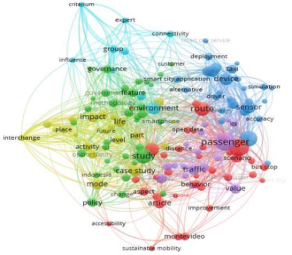
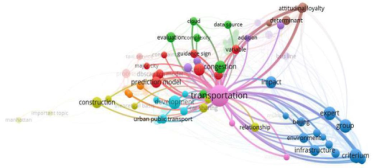
In general, research publications focus on different topics in the discussion of public transportation. This difference is motivated by a different scientific focus according to the needs of academics. The development of smart cities in public transportation that is most relevant to the study of government science is mobility in the red cluster, policy in the green cluster, and connectivity in the blue cluster.
The concept of mobility in the study of public transportation is conside- red very important because smart mobility aims to provide infrastructure for
538 Maulida and Nurmandi
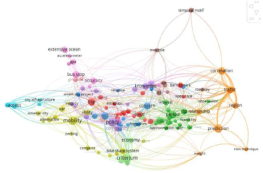
Figure 2: Visualization of the network map for smart public transportation develo- pment. Source 2: Author data processing (2022).Figure 3: Visualization of united states trends. Source 3: Author data processing (2022).
ITS and a sustainable transportation system (sustainability of transportation) (Hariani et al., 2017). To facilitate the use of smart public transportation. As for the indicators of smart mobility, according to Boyd Cohen (Hariani et al., 2017), first, responsiveness is a mobility system that can meet the needs, desi- res, and expectations of the actual movement of its users. Second, Innovative, namely a mobility system that allows the movement of people and goods effectively and efficiently. Third, Competitive, namely a mobility system that provides many travel options. Providing appropriate, effective, and intelligent public transportation services for service quality can result in social welfare (Yu et al., 2018). The next concept is policy. In public transportation, the policy is the basis of public transportation in the urban realm to improve the standardization of urban mobility public transit in a country. (Budi et al., 2019). For the concept of connectivity, intelligent traffic planning, public transport efficiency, and increasing connectivity of all road users in the city are the characteristics of smart city mobility. An efficient public transpor- tation system plays an important role (Thiranjaya et al., 2018). Unlimited connectivity for applications and services is ensured by implementing a con- nectivity system through various access technologies that rely on different dynamic context-based mechanisms (Luchian et al., 2017).
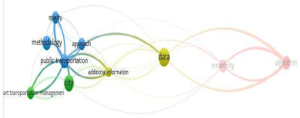
Analysis of Developed Country Publication Trends The United States and Italy have developed countries that dominate the publi- cation of public transportation in Scopus. However, these two countries have different focus trends related to public transit. It can be seen from the trend visualization network that the two countries have very significant differences.
Comparative Analysis of Public Transportation Development 539
Figure 4: Visualization of italian trends. Source 4: Author data processing (2022).
In the United States, mobility has four links; First is urban mobility. Urban mobility in public transportation is part of the implementation of smart cities so that rapid urban development is supported by adequate information and technology (Ota et al., 2017). Second, access and route, a mobility system that provides many travel options for the quality of delivering appropriate, effective, and smart public transportation services that can result in social welfare in urban areas (Yu et al., 2018). Third, the economy, in the develo- pment of public transportation mobility, also plays a role in cooperation with private transportation parties to improve service quality.In the United States policy concept that focuses on the community, in determining the points of government policies, input from various parties is needed to provide policy results in public transportation services to improve conditions and public transport services (Staleti´c et al., 2020). Smart transportation management, how is the policy in managing management affairs in public transportation efficiently. And the government must also think about the demand for public transit so that it continues to grow and reduce the number of private cars (Zimmermann et al., 2020). In contrast, the concept of connectivity focuses on governance to provide the best service in public transportation. In terms of monitoring access and routes, the internet must be standardized by ITS so that the system used can be used effectively and efficiently (Hariani et al., 2017). Then build relationships to target urban mobility services and enhance envi- ronmental perception (Santa et al., 2020). In general, the United States has implemented public transportation using concepts that have been formula- ted, and the technology used is already based on ITS.The following developed country is Italy in the concept of mobility. Italy focuses on the mobility pat- tern, and public transportation requires a strategic way to run according to expectations and to the needs of each country (Kaledi & Herwangi, 2019). It also focuses on mobility analysis to analyze the development of mobility in urban public transportation and improve mobility services. Improving the quality of services in urban areas has become the focus of many countries in improving the quality of resources from various aspects, including public transportation (Trippner-Hrabi & Podgórniak-Krzykacz, 2018). The Italian policy concept only focuses on policymakers to enhance the quality of service. Meanwhile, the idea of connectivity and technology based on the Intelligent Transport System (ITS) has not become Italy’s concern.
Analysis of Developing Country Publication Trends This section will explain the development of public transportation studies in developing countries, namely China and Brazil, with 52 documents. Then the
540 Maulida and Nurmandi
Figure 5: Visualization of china’s trends. Source 5: Author data processing (2022).Figure 6: Visualization of Brazil Trends. Source 6: Author data processing (2022).
researcher will describe the development of public transportation in develo- ping countries using the VOSviewer, which can show the development of the themes discussed. Figures 5 and 6 show the growth of public transportation in developing countries from the results of Scopus 2012 to 2021.
In China, the concept of mobility focuses on innovative urban mobility, influence, and criteria. This illustrates that mobility in public transporta- tion in China has begun to develop in urban activities with many standards for public transit. The development of public transit has also influenced many parties to contribute to the development of public transportation (Trippner-Hrabi & Podgórniak-Krzykacz, 2018). The concept of connecti- vity focuses on infrastructure, economy, environment, novelty, and urban planning. Presenting infrastructure that relies on Intelligent Transport System (ITS)-based technology in public transportation networks shows the feasi- bility of connectivity options (Su et al., 2016). Connectivity by developing a series of sensors to target urban economic improvement enhanced envi- ronmental perception efficiently, and city operation speed for vehicles with communication capabilities using ITS-based technology to collect data (Santa et al., 2020). Because basically, the goal of Intelligent Transportation Systems (ITS) is to integrate sensor, control, analysis, and communication technolo- gies into travel and public transportation infrastructure to improve mobility, convenience, security, and efficiency (Hahn et al., 2021). China, which focu- ses on the concept of connectivity, Brazil does not yet have a focus on this concept. However, Brazil tends to concentrate on policy concepts related to smart transportation management, passenger demand, and cooperation. This is related to more effective and efficient management arrangements, improving services so that user demand increases, and building coopera- tion between the government and various parties in formulating policies to improve the quality of public transportation services. Meanwhile, the mobi- lity concept focuses on smart urban mobility, available urban transportation, and decision support. China is very focused on urban systems that are smart
Comparative Analysis of Public Transportation Development 541
in making policies or decisions. However, China has not implemented Intelli- gent Transportation System (ITS)-based technology in public transportation activities.
CONCLUSION
The analysis of the scope of public transportation between developed and developing countries represented by four countries (United States, Italy, China, and Brazil) from 2012 to 2021 is considered to be entirely developed with 293 documents published on Scopus. This study found that the country that best met all the criteria for the concept determined; mobility, policy, and connectivity is the United States, with the highest publication of 41 docu- ments. This research hopes that the use of public transportation in developed and developing countries is increasing. And the use of technology-based in the use of the Intelligent Transport System (ITS) in public transportation as a form of smart city that aims to integrate sensing, control, analysis, and communication technology into travel and transportation infrastructure to improve mobility, convenience, security, and efficiency.
REFERENCES
Amugongo, LM, Ngada, SN, & Sieck, J. (2016). Leveraging on open data to solve city challenges: A case study of Windhoek municipality. 3rd MEC Inter- national Conference on Big Data and Smart City, ICBDSC 2016, 129–134. https://doi.org/10.1109/ICBDSC.2016.7460355 Badii, C., Bellini, P., Difino, A., & Nesi, P. (2019). Sii-mobility: An IoT/IoE
architecture to enhance smart city mobility and transportation services. Sensors (Switzerland), 19 (1). https://doi.org/10.3390/s19010001 Bublyk, M., Matseliukh, Y., Motorniuk, U., & Terebukh, M. (2020). Intelligent system of passenger transportation by autopiloted electric buses in Smart City. CEUR Workshop Proceedings, 2604, 1280–1294. Budi, PA, Buchori, I., Riyanto, B., & Basuki, Y. (2019). Smart mobility for rural areas: Effect of transport policy and practice. Internatio- nal Journal of Scientific and Technology Research, 8 (11), 239–243. https://www.scopus.com/inward/record.uri?eid=2-s2.~0--85075160977&pa rtnerID=40&md5=b9e5ceffa1eec38e31bc7f2d3c2ad8d6 Carreras, I., Gabrielli, S., Miorandi, D., Tamilin, A., Cartolano, F., Jakob, M.,
& Marzorati, S. (2012). SuperHub: A user-centric perspective on sustaina- ble urban mobility. 6th ACM Workshop on Next Generation Mobile Com- puting for Dynamic Personalized Travel Planning, Sense Transport’12, 9–10. https://doi.org/10.1145/2307874.2307882 Fabbiani, E., Vidal, P., Massobrio, R., & Nesmachnow, S. (2017). Distributed big data analysis for mobility estimation in intelligent transportation systems. In BHCJ, GI, & KJ (Eds.), 3rd Latin American Conference on High Perfor- mance Computing, CARLA 2016 (Vol. 697, pp. 146–160). Springer Verlag. https://doi.org/10.1007/978-3-319-57972-6_11 Farooq, A., Xie, M., Stoilova, S., & Williams, EJ (2019). The application of
smart urban mobility strategies and initiatives: Application to Beijing. European Transport - Transport Europei, 71. https://www.scopus.com/inward/record.uri?e id=2-s2.~0--85064516103&partnerID=40&md5=d90b9336b6396bce4bc9dfb 21c227589
542 Maulida and Nurmandi
Farsi, WAA, & Achuthan, G. (2018). Analysis of the effectiveness of smart city implementation in the transportation sector in Oman. 2nd Majan International Conference, MIC 2018, 1–6. https://doi.org/10.1109/MINTC.2018.8363163 Gil-Garcia, JR, & Aldama-Nalda, A. (2013). Smart city initiatives and the policy
context: The case of the rapid business opening office in Mexico city. 7th Inter- national Conference on Theory and Practice of Electronic Governance, ICEGOV 2013, 234–237. https://doi.org/10.1145/2591888.2591931 Gohar, M, Muzammal, M., & Ur Rahman, A. (2018). SMART TSS: Defining transportation system behavior using big data analytics in smart cities. Sustainable Cities and Society, 41, 114–119. https://doi.org/10.1016/j.scs.2018.05.008 Gohar, Moneeb, Muzammal, M., & Ur Rahman, A. (2018). SMART TSS: Defining transportation system behavior using big data analytics in smart cities. Sustainable Cities and Society, 41 (March), 114–119. https://doi.org/10.1016/j.scs.2018.05.008 Hahn, D., Munir, A., & Behzadan, V. (2021). Security and privacy issues in intelligent transportation systems: Classification and challen- ges. IEEE Intelligent Transportation Systems Magazine, 13 (1), 181–196. https://doi.org/10.1109/MITS.2019.2898973 Hariani, P., Safina Hsb, L., & Hsb, JS (2017). City Smart Transportation as Medan’s
Strategy Towards Smart City. Journal of Urban Development, 5 (2), 50–58. http://ejpp.balitbang.pemkomedan.go.id/index.php/JPP Hiban, MI, Purnomo, EP, & Nurkasiwi, A. (2020). Smart City in Fulfilling the Rights of Persons with Disabilities in Yogyakarta “Case Study: Public Transportation Infrastructure in Fulfilling the Rights of Persons with Disabilities.” Journal of Government and Politics, 5 (2), 69–73. https://doi.org/10.36982/jpg.v5i2.1034 Kaledi, S., & Herwangi, Y. (2019). Public Transportation-Based Smart Mobi-
lity Development Strategy in Yogyakarta City. REGION: Journal of Regional Development And Participatory Planning, 14, 113–123. Kazmi, A., Serrano, M., & Lenis, A. (2019). Smart governance of heterogeneous internet of things for smart cities. 12th International Conference on Sensing Technology, ICST 2018, 2018 - Decem, 58–64. https://doi.org/10.1109/ICSensT.2018.8603657 Luchian, E.-F., Taut, A., Ivanciu, I.-A., Lazar, G., & Dobrota, V. (2017).
Mobile wireless sensor network gateway: A raspberry Pi implementation with a VPN backend to OpenStack. In BD, SM, RJ, & RN (Eds.), 25th Inter- national Conference on Software, Telecommunications and Computer Netw- orks, SoftCOM 2017. Institute of Electrical and Electronics Engineers Inc. https://doi.org/10.23919/SOFTCOM.2017.8115561 Ota, K., Kumrai, T., Dong, M., Kishigami, J., & Guo, M. (2017). Smart Infrastructure Design for Smart Cities. IT Professionals, 19 (5), 42–49. https://doi.org/10.1109/MITP.2017.3680957 Rybka-Iwa´nska, K., & López, ES (2019). Smart cities and the search for global talent.
In Smart Cities: Issues and Challenges Mapping Political, Social and Economic Risks and Threats (pp. 171–184). Elsevier. https://doi.org/10.1016/B978-0-12- 816639-0. 00010–7 Santa, J., Bernal-Escobedo, L., & Sanchez-Iborra, R. (2020). On-board unit to connect personal mobility vehicles to the IoT. In SE, Y. AUH., & MH (Eds.), 17th International Conference on Mobile Systems and Perva- sive Computing, MobiSPC 2020 (Vol. 175, pp. 173–180). Elsevier BV https://doi.org/10.1016/j.procs.2020.07.027
Comparative Analysis of Public Transportation Development 543
Semanjski, I., Gautama, S., Ahas, R., & Witlox, F. (2017). Spatial con- text mining approach for transport mode recognition from mobile sen- sed big data. Computers, Environment and Urban Systems, 66, 38–52. https://doi.org/10.1016/j.compenvurbsys.2017.07.004 Staleti´c, N., Labus, A., Bogdanovi´c, Z., Despotovi´c-Zraki´c, M., & Radenkovi´c, B. (2020). Citizens’ readiness to crowdsource smart city services: A developing country perspective. Cities, 107. https://doi.org/10.1016/j.cities.2020.102883 Su, Q., Jaffrès-Runser, K., Jakllari, G., & Poulliat, C. (2016). An effi- cient content delivery infrastructure leveraging the public transportation network. 19th ACM International Conference on Modeling, Analysis and Simulation of Wireless and Mobile Systems, MSWiM 2016, 338–347. https://doi.org/10.1145/29882872989152 Thiranjaya, C., Rushan, R., Udayanga, P., Kaushalya, U., & Rankothge, W.
(2018). Towards a Smart City: Application of Optimization for a Smart Transportation Management System. 9th IEEE International Confere- nce on Information and Automation for Sustainability, ICIafS 2018. https://doi.org/10.1109/ICIAFS.2018.8913376 Trippner-Hrabi, J., & Podgórniak-Krzykacz, A. (2018). Innovations in Local Public Transport-Significance for the Local Community. European Spatial Research and Policy, 25 (2), 117–135. https://doi.org/10.18778/1231-1952.25.2.07 Vierling, D., & Schmuelling, B. (2018). Driver Information System for sustainable public transportation. 3rd International Conference on Sustai- nable Information Engineering and Technology, SIET 2018, 278–282. https://doi.org/10.1109/SIET.2018.8693186 Yu, JJQ, Lam, AYS, & Lu, Z. (2018). Double Auction-Based Pricing Mechanism
for Autonomous Vehicle Public Transportation System. IEEE Transactions on Intelligent Vehicles, 3 (2), 151–162. https://doi.org/10.1109/TIV.2018.2804161 Zhao, L., & Jia, Y. (2021). Intelligent transportation system for sustainable environment in smart cities. International Journal of Electrical Engineering Education. https://doi.org/10.1177/0020720920983503 Zimmermann, S., Schulz, T., & Gewald, H. (2020). Salient attributes of mobility apps: What does it really matter for the citizen? 24th Pacific Asia Conference on Information Systems: Information Systems (IS) for the Future, PACIS 2020. https://www.scopus.com/inward/record.uri?eid=2-s2. 0– 85090622563&partnerID=40&md5=3ba8e2b93625e1183e8647ad70b0b0a0
Read this individual research paper free through the original publisher, or explore the full digital proceedings book.
ISBN 978-1-958651-44-5
Explore this ISBN in the AHFE Bookstore ↗Listed in the July 2026 bookstore catalogue; search by ISBN to confirm current availability · Digital book purchase optional