Masayuki Ihara, Hiroki Murakami, Hiroko Tokunaga, Shinpei Saruwatari, Kazuki Takeshita, Akihiko Koga, Takashi Yukihira, Shinya Hisano (2022). A case study of motivating care workers for cooperation with a long-term co-creation project. In: Human Interaction & Emerging Technologies (IHIET 2022): Artificial Intelligence & Future Applications. AHFE Open Access, vol. 68, pp. 84–91. https://doi.org/10.54941/ahfe1002716
3 Data Science Design Team, ADSP, R-IH, RIKEN, Wako, 3510198, Japan; Shirakawa Hospital, Omuta, 8370926, Japan ↗
4 Data Science Design Team, ADSP, R-IH, RIKEN, Wako, 3510198, Japan; Faculty of Fukuoka Medical Technology, Teikyo University, Omuta, 8368505, Japan ↗
5 Data Science Design Team, ADSP, R-IH, RIKEN, Wako, 3510198, Japan; Faculty of Health and Welfare, Prefectural University of Hiroshima, Mihara, 7230053 Japan ↗
Human-computer interaction technologies play an important role in configuring a service to be delivered to end users. For a sustainable service, not only user-centered but also service-provider-centered design is important since an acceptance of the service provider is also essential to maintain a reasonable operation for the service. A co-creation project with busy employees of the service provider company has a difficulty in building a rapport due to their psychological burden to join it. In particular, health care companies suffer from labor shortage that causes a large burden on one worker at care site. It is not easy to intervene in such a busy work site to offer the opportunity of co-creation project.This paper introduces a case study of motivating busy care workers for building a rapport toward a cooperative co-creation project. A workshop was conducted to make them feel the successful experience at the beginning of the long-time project to improve their daily tasks or to create a novel health care service. The workshop was expected to provide them with a small successful experience under the following tough constraints. The workshop participants are all workers at the nursing facility and consideration for preventing their turnover is required. They do not have any extra space in their mind due to the busyness of daily tasks then every workshop must be finished only in 30 minutes.The workshop was held as a 3-time event to design a leaflet to introduce their nursing facility. The first objective of the workshop is that workshop participants contemplate their daily tasks, recognize the attractiveness of a care worker’s job, and feel proud of their own job. The second is that the participants discover the problems of their daily tasks and are aware of improvement of their operations by recognizing their facility. These objectives were set with a viewpoint of employee education towards the project cooperation. We evaluated the effectiveness of the workshop by a sense of accomplishment for the leaflet prototyping work and by three types of motivation; awareness of understanding and improving daily tasks, pride of job, and willingness to work.Questionnaire survey results revealed that the workshop was effective in making them aware of understanding and improving their daily tasks and in increasing their pride and willingness to work towards fostering awareness of cooperation for the project. The correlation and regression analyses for the results showed that pride of job leads to willingness to work and that the pride and willingness to work lead to the motivation to understand and improve their work.The contributions of this work are introduction of a case study under tough constraints and confirmation of the workshop effectiveness. Though most participatory design workshops are conducted by selected participants with relatively higher motivation outside their main job, our study was conducted under the tough and real constraints at the nursing facility. A current stage of our work is a hypothesis search for building a better service-provider-centered design methodology. Future work will be more practices of co-creation design processes.
Human-computer interaction technologies play an important role in configu- ring a service to be delivered to end users. For a sustainable service, not only user-centered but also service-provider-centered design is important since an acceptance of the service provider is also essential to maintain a reasona- ble operation for the service. In case of employing a novel technology, it is effective for a designer and a service provider to co-create a service with con- sideration of how to apply the technology to the service. The co-creation with busy employees of the service provider company has a difficulty in buil- ding a rapport even though the manager accepts the proposal of the project
A Case Study of Motivating Care Workers for Cooperation 85
(Bjerknes et al. 1995). This paper introduces a case study of motivating care workers for building a rapport toward a long-term cooperative co-creation project.
ISSUES ADDRESSED Most health care companies suffer from labor shortage. The operation of care service consists of a wide variety of tasks. For example, at one outpati- ent rehabilitation facility, there are 151 check items per day such as picking users up at their home in the morning. Thus, it is not easy to intervene in such a busy care work site to offer the opportunity of co-creation project. The care workers get no extra salary for joining the project and the effectiveness and value of the cooperation is unclear at the beginning even though a coopera- tion is one of the most important factors (Kensing et al. 1998, Steen 2011). They do not have any extra space in their mind due to the busyness of daily tasks. Moreover, were an external organization to propose the project, the workers would be more skeptical. An affiliation and personality of the person who proposes it may negatively affect them with suspicion of exploiting their cooperation. For the successful co-creation project, a designer should build a rapport with workers and provide them with an experience to improve their motivation. In this research, we tried to improve it with a WS that provides them with a small successful experience by prototyping a leaflet to introduce their nursing facility.
A LONG-TERM CO-CREATION PROJECT In this research, a national research institution in Japan proposes a 3-year co-creation project to a hospital which has an outpatient rehabilitation faci- lity. The aim of the project consists of creating a concrete new care service and building a methodology to create a service. For a successful project, we need to continue considering interactions with care workers based on a long- term perspective (Bossen et al. 2010). Our co-creation project is a kind of participatory design (PD) with a stakeholder of care workers. PD has some impediments to achieving a design result: arenas for design, conflicting views, and real-life complexities (Bratteteig et al. 2010). Bosson pointed out the lack and necessity of evaluating PD projects (Bossen et al. 2016). In gene- ral, the success of PD depends on many kinds of consideration. Particularly in our case, we should give a highest consideration for prevention of a wor- ker’s quitting a current job due to the amplification of negative feeling. Our co-creation is conducted by two stakeholders of different position and back- ground; a designer who is responsible for academic research results as an employee of a research institution, and care workers who are employed by a service provider company. We should consider this difference (Rothmann et al. 2016).
A LEAFLET PROTOTYPING WORKSHOP To provide care workers with a small successful experience, we designed a 3- time 30-minute WS to prototype a leaflet introducing their nursing facility.
We expected the two effects on their motivation improvement. One is to con- template their daily tasks, recognize the attractiveness of a care worker’s job, and feel proud of their own job. The other is to discover the problems of their daily tasks and are aware of improvement of their operations by reco- gnizing their facility with an objective view. 14 care workers at the facility participated in the WS. With a consideration for avoiding busy time of their daily tasks, the WS was held as a 30-minute event in the evening just before finishing the work of the day. The WS was held at their care site due to a real problem, lack of time to move to another place, even though Muller proposed the importance of a “third space” (Muller 2002). Most workers are mothers caring for their own children and want to go home to prepare dinner imme- diately after work. Thus, the extension of the WS time is not permitted. The participants were divided into three groups of 4 or 5 people in expectation that they would get noticed by each other at the group discussion. The WS was held every two weeks based on the design thinking process: (1) Empath- ize (Aug. 19, 2021), (2) Define and Ideate (Sep. 1, 2021) and (3) Prototype and Test (Sep. 14, 2021). In this WS, we omitted an iteration of the design thinking process to refine the idea due to the priority of quick completion. The goal of the WS was set to fixing a draft layout of leaflet elements on a sheet. Prior to the WS, we informed the participants that all the draft layouts of leaflet created by three groups would be shown to a designer at a printing company and might be adapted to the next version of the real leaflet.
Before the first WS, we asked the participants to collect leaflets, pamph- lets, or brochures of other facilities or services which are placed in hospitals, museums, shopping malls, train stations, etc. and to list the strengths of those collected advertising papers in advance. At the first WS, each parti- cipant wrote those strengths on sticky notes and discussed them with group members. Table 1 shows the results of discussing strengths to be considered in designing a leaflet.
The second WS is to define problems of the current version of the leaflet of the facility and to ideate to solve them. The participants were requested for evaluating the current version according to each strength in Table 1 and for discussing which part should be improved (See Table 2). After defining the problem, they discussed the strengths of their facility to be promoted on the leaflet.
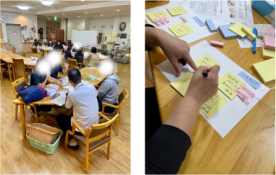
The third WS is a group work to prototype a leaflet by reference to the ideas and the strengths defined in the second WS. The participants prototyped a leaflet by placing a variety of sizes of sticky notes onto a sheet. They wrote a name or description of each element on the note and made a layout with those notes on the sheet. Figure 1 shows a scene and operation of prototyping. After the prototyping, the participants voted for each’s own favorite prototype.
EVALUATION In order to evaluate the effectiveness of the WS, we conducted a questionnaire survey. The questions of the survey are shown in Table 3. A 5-point Likert scale is used for Q1 to Q6. A 11-point Likert one of 100 to 0 point is used for Q7.
A Case Study of Motivating Care Workers for Cooperation 87
Table 1. Results of discussing strengths to be considered in designing a leaflet.
Table available in the original PDF paper.
Category Strengths (# of Same Opinion)
Content
An advantage of a service is easy to understand. (3) A characteristic strength is shown. Many strengths are shown according to user’s purpose. Information that users want to know is shown. A real scene in use is shown by pictures or a schedule. A facial expression that gives a good impression is shown. Access info or a map is shown. A QR code for detailed info is shown.
Appearance
A picture is understandable. (5) A font is large enough. (2) An illustration is understandable. Not only text or pictures but also a diagram is used. The look shows what the facility is. There are few colors used.
Layout
Important info is shown first. Strengths are conspicuous. A wide picture attracts attention.
Table 2. The ideas to improve the leaflet.
Table available in the original PDF paper.
Category Ideas to Improve the Leaflet (# of Same Opinion)
Content
Emphasize a strength by a color or size of font. (5) Restrict the number of strengths shown. (3) Show a picture to present the strength. (4) Promote the strength of rehabilitation facilities. (7) Promote the strength of bathing care service. (3) Promote the strength of delicious meals. (2) Show what users can or what users want to know. (2) Show the availability of a facility tour or trial use. Show the time schedule of one day. (5) Show the availability of a short stay. Show a detailed map or access info. (2) Show fares. Introduce comments from users. Show a QR code for detailed info. (2)
Appearance
Show one large picture to present an atmosphere. Display pictures and text without overlapping. Use more illustrations. Use a modern illustration. Use a font color that is easy to read. Make sure a reader understands strengths before opening a leaflet.
Our project is based on participatory design in which each participant should work together as a co-designer. Then we evaluated their feeling of being a designer through the WS experience (Q1). We also evaluated a sense
Figure 1: A scene (left) and operation (right) of the prototyping.Table 3. The questions of the questionnaire survey.
Table available in the original PDF paper.
Question Q1 Did you feel yourself like you were a designer? Q2 Did you get a sense of accomplishment? Q3 After a printing company completed a leaflet, do you want to use it as a recommendation tool for your friends and family? Q4 Did the workshop increase your awareness of understanding or improving your daily tasks? Q5 Did the workshop increase your pride of job? Q6 Did the workshop increase your willingness to work? Q7 How do you rate your contribution to the workshop?
of accomplishment for the prototyping work which was rough but finished (Q2) since the purpose of the WS is to make the participants feel a success experience. The goal of the WS is to fix a draft layout of leaflet elements on a sheet and the result is handed over to a designer at a printing company. We evaluated whether the participants wanted to use the completed version of the leaflet as a recommendation tool for their friends and family or not (Q3). Regarding the motivation of the participants, we evaluated the following three factors. Q4 is a question to evaluate their awareness of understanding or improvement of their daily tasks. Q5 and Q6 are to evaluate the increase of their pride and willingness to work, respectively. The self-evaluation of their contribution to the WS was also rated (Q7).
RESULTS
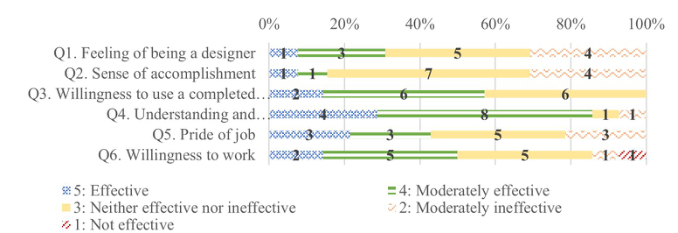
The results of the questionnaire of Q1 to Q6 are shown in Figure 2. 14 par- ticipants answered most of the survey questions, but one did not answer to Q1 and Q2.
Sense of Accomplishment As shown in Figure 2, the score of sense of accomplishment (Q2) is not very high though that of willingness to use a completed leaflet (Q3) is relatively high. The mean values for Q2 and Q3 were 2.9 and 3.7, respectively. The mean value for self-rating of contribution (Q7) was 58.6. The low score of Q7 may lead to the low score of Q2. The number of participants of each WS was 13(first WS), 11(second WS), and 10(third WS). The decrease of participants
A Case Study of Motivating Care Workers for Cooperation 89
Figure 2: Questionnaire results (N = 14).
may also negatively affect the result. We investigated the answer data of 4 par- ticipants who did not join the third WS and confirmed that two of them rated their sense of accomplishment 2 and the other two rated it 3. The low rating of Q2 may be caused by the absence of the leaflet completing experience at the third WS. According to the comments written in a free answer space of the questionnaire, the difficult tasks may also negatively affect the result. In the WS, we did not show the participants a qualitative goal about prototyping, then they did not know the required level of perfection in quality. Although the unclear goal might inhibit their sense of accomplishment, we think it was a good experience for the participants. This is because they need to solve such a difficult problem in which a goal is unclear in the future co-creation pro- ject. The WS experience was valuable as a trial of solving a wicked problem which is difficult to solve because of incomplete, contradictory, and changing requirements.
Motivation of the Participants As shown in Figure 2, the score of understanding and improvement of daily tasks (Q4) is high. The mean value is 4.1. The scores of their pride (Q5) and willingness to work (Q6) are relatively high. The Pearson product-moment correlation coefficient between Q5 and Q6 is 0.92. The simple regression analysis of willingness to work as a dependent variable and pride as an inde- pendent variable resulted in R2 = 0.74, p = 0.00005 (<0.01), t = 6.12. This result shows that improvement of their pride may make them moti- vated to work. Both the pride (Q5) and the willingness to work (Q6) have a strong correlation (correlation coefficient = 0.81) with the understanding and improvement of daily tasks (Q4). The multiple regression analysis of understanding and improvement of daily tasks as a dependent variable resul- ted in R2 = 0.37, p = 0.012 (<0.05), t = 2.92. This result shows that the pride and willingness to work lead to the motivation to understand and improve their work.
Analysis for the Co-Creation Project In Figure 2, the score of feeling of being a designer (Q1) is not very high. The mean value is 3.1. However, the correlation coefficient between the Q1 and Q2 is strong (correlation coefficient = 0.81). The multiple regression
analysis of the feeling of being a designer as a dependent variable resulted in R2 = 0.81, p = 0.034 (<0.05), t = 3.32. This result suggests that designing an experience to make participants feel a sense of accomplishment leads to a cooperative co-creation through the awareness of being a co-designer. In the questionnaire, some participants commented “The workshop provided me a good experience.” On the other hand, one commented “What we want is not a leaflet. Please improve our daily tasks. The new leaflet may make us busy. I am very worried about the future.” We found the importance of designing an event to directly bring effectiveness to their daily tasks.
CONCLUSION
This paper introduced a case study of motivating care workers for a long- term co-creation project. The questionnaire survey results showed that the WS was effective in making them aware of understanding or improving their daily tasks and in increasing a sense of pride and willingness to work towards fostering awareness of cooperation for the project. The contributions of this paper are introduction of a case study to make employees motivated for a long-term cooperative co-creation project under the tough constraints, con- firmation of the effectiveness of motivating busy employees, and utilization of a leaflet to make a value of their jobs recognized. Though most participa- tory design WSs are conducted by selected participants with relatively higher motivation outside their main job, our study was conducted under the tough and real constraints at the nursing facility. A current stage of our work is a hypothesis search for building a better service-provider-centered design meth- odology. Future work will be more practices of co-creation design processes and will include building a design methodology based on detailed findings on the benefits of participatory design.
ACKNOWLEDGMENT
We thank all the employees at the outpatient rehabilitation facility “Magokoro” in Omuta city, Japan who cooperated on the workshop and questionnaire.
REFERENCES
Bjerknes, Gro and Bratteteig Tone. (1995) “User participation and democracy: a discussion of Scandinavian research on systems development”, Scand. J. Inf. Syst. Volume 7 No. 1, pp. 73–98. Bossen, Claus. Dindler, Christian and Iversen, Ole Sejer. (2010) “User gains and
PD aims: assessment from a participatory design project”, in: Proc. of the 11th Biennial Participatory Design Conference. New York, NY, USA, pp. 141–150. Bossen, Claus. Dindler, Christian and Iversen, Ole Sejer. (2016) “Evaluation in participatory design: a literature survey”, in: Proc. of the 14th Participatory Design Conference: Volume 1. New York, NY, USA, pp. 151–160. Bratteteig, Tone and Wagner, Ina. (2016) “What is a participatory design result?”,
in: Proc. of the 14th Participatory Design Conference: Full papers - Volume 1. New York, NY, USA, pp. 141–150.
A Case Study of Motivating Care Workers for Cooperation 91
Kensing, Finn and Blomberg, Jeanette. (1998) “Participatory Design: Issues and Concerns”, Comput. Supported Coop. Work. Volume 7 No. 3-4, pp. 167–185. Muller, Michael J. (2002) “Participatory design: the third space in HCI”, in: The
human-computer interaction handbook: fundamentals, evolving technologies and emerging applications. L. Erlbaum Associates Inc., USA, pp. 1051–1068. Rothmann, M. J. Danbjørg, D. B. Jensen, C. M. and Clemensen, J. (2016) “Participatory design in health care: participation, power and knowledge”, in: Proc. of the 14th Participatory Design Conference: Short Papers, Interactive Exhibitions, Workshops - Volume 2. New York, NY, USA, pp. 127–128. Steen, Marc. (2011) “Cooperation, curiosity and creativity as virtues in participa-
tory design”, in: Proc. of the Second Conference on Creativity and Innovation in Design. New York, NY, USA, pp. 171–174.
Read this individual research paper free through the original publisher, or explore the full digital proceedings book.
ISBN 978-1-958651-44-5
Explore this ISBN in the AHFE Bookstore ↗Listed in the July 2026 bookstore catalogue; search by ISBN to confirm current availability · Digital book purchase optional