Tasya Nurian Afifah, Erwan Sudiwijaya, Aly Aulia (2022). Utilizing Social Media in Tourism Industry Sustainability Strategy in Indonesia Post COVID-19 Pandemic. In: Human Interaction & Emerging Technologies (IHIET 2022): Artificial Intelligence & Future Applications. AHFE Open Access, vol. 68, pp. 774–780. https://doi.org/10.54941/ahfe1002805
This study aims to analyze the Indonesian government’s social media as a follow-up to promote the tourism industry after the COVID-19 pandemic. This study used a Qualitative Data Analysis Software (QDAS) approach. The source of this research data was @Kemenparekraf, the Ministry of Tourism and Creative Economy’s official Twitter account. The research data analysis phase used the NvivoPlus12 software tools to present descriptive quantitative data. The results of data analysis showed that @Kemenparekraf social media had high activity in November with 181 tweets and at least 126 tweets in August. Each information on the Ministry of Tourism’s Twitter account was different, thus confirming that the Ministry of Tourism and Creative Economy’s account was active in providing information about tourism and the cultural wealth of Indonesia. Social media utilization was carried out through various promotions through hashtags. The results showed that the Ministry of Tourism and Creative Economy had three different hashtags with the highest percentage of hashtags #sobatparekraf with 249 tweets, #wonderfulindonesia with 149 tweets, and #bangkitbersamakemenparekraf with 80 tweets. The hashtag continues to be massively carried out to provide information related to the policies during the COVID-19 pandemic. Of the three hashtags, the highest one showed that the Ministry of Tourism and Creative Economic accounts’ content provided information about tourism and Indonesian culture, which is expected to provide more knowledge to the audience.
The pandemic has caused damage to all sectors of the economy, including the tourism industry, which is the leading economic sector in many develo- ping countries (Abiad, Arao and Dagli, 2020). The damage was the impact of the global COVID-19 pandemic since 2020 (Carvache-Franco, Carvache- Franco and Carvache-Franco, 2022). The tourism sector has been one of the most affected, with a significant impact on the number of canceled reservations, a decline in international travel, and changes in consumption behavior (Toubes, Araújo Vila and Fraiz Brea, 2021). Due to COVID-19, the tourism sector has experienced a slump, so purchasing power has decre- ased drastically due to reduced visitors, both local and foreign tourists,
Utilizing Social Media in Tourism Industry Sustainability Strategy 775
generating income and foreign exchange through the tourism sector (Guridno and Guridno, 2020).
The tourism sector has an essential role in line with government poli- cies to help build a sustainable economy, and the COVID-19 pandemic has impacted transportation, trade, health, and tourism. Lockdown policies were taken by several countries to prevent the further spread of COVID-19, hampered economic activity, and put pressure on the pace of world econo- mic growth, including Indonesia’s economic growth (Susilawati, Falefi and Purwoko, 2020). Indonesian tourism requires considerable support to accele- rate recovery from the COVID-19 pandemic (Esquivias et al., 2021). In 2018, Indonesia proposed ten new destinations and launched a massive tourism destination campaign, “Wonderful Indonesia” (Rudenko and Tedjakusuma, 2018). The Ministry of Tourism and Creative Economics has created the CHS (Cleanliness, Health, and Safety). This program to restore tourist destinati- ons after the COVID-19 pandemic involves tourism industry players and the creative economy. The government’s policy through the program is a step to restore Indonesian tourism to create comfortable and safe tourism (Sutrisno, 2020). Steps taken by the government to encourage an increase in local and international tourism are branding and promotion. The aim is to get public attention using social media. Indonesia’s social media users make it a promo- tional medium, especially tourism promotion. Tourist attraction managers who publish tourist facilities through social media can increase their selling points and popularity (Manipuspika, Indhiarti and Sudarwati, 2021). Fast information is needed in promoting tourism through social media that high internet users support. Based on data from We Are Social, in 2021, internet users in Indonesia experienced a significant increase from the previous year, reaching 202.6 million active users. Social media Twitter is now one of the most widely used applications. According to Monetizable Daily Active Users (MDAU), the average active Twitter user at the end of 2021 reached 217 million users worldwide. In Indonesia alone, in 2020, active Twitter users reached 10.65, increasing to 3.4 million users in 2021 with 14.05 million users.
Previous research has shown that the COVID-19 outbreak can facilitate the restructuring of the tourism market and encourage the transformation of tourism values into a sustainable direction. In response to the COVID-19 shock, Vietnam’s tour operator has four strategies: thrift, persistence, inno- vation, and exit. Most Vietnamese tour operators focus on developing short- and medium-term crisis response strategies (Do et al., 2022). In contrast, this study aims to analyze the Indonesian government’s social media users as a follow-up to tourism promotion after the COVID-19 pandemic. This study has two research questions. The first question is how social media plays a role in tourism promotion during the COVID-19 pandemic. The second question is about the communication strategy for tourism promotion in Indonesia during the COVID-19 pandemic.
Tourism Promotion Strategy on Social Media Media play an important role in disseminating accurate and responsible infor- mation in all situations (Widyastuti, 2021). The concept of social media is interpreted in several ways. Social media is an open information platform delivered through blogs, forum-style media, videos, photos, and audio recor- dings. In general, pages contain social networking sites and all content with different appearances that make up other social networks (Eley and Tilley, 2009). Media has been categorized as a group of internet-based applications that allow creating and modifying user-generated content based on the tech- nological and ideological foundations of the internet (Kaplan and Haenlein, 2010; Rakhmadani, 2020). The national and international tourism sectors, in their marketing activities, are expected to apply developments to the media and maintain success, benefits, and profitability. However, it is essential to ensure efficient internet users for tourism activities. The tourism indu- stry requires considerable investment. A significant return on investment is obtained from stable sales with targeted numbers of socio-economic touri- sts (Yavuz and Haseki, 2012). The internet makes it easier for companies to communicate more briefly and directly with the target group via the web, short messages, forums (Babacan, KAMANLIO ˘GLU and Yeniçeri Alemdar, 2008).
Tourism During the Pandemic The impact of the COVID-19 pandemic on tourism resilience and recovery policies and strategies continues, and the lack of data obtained makes it challenging to research (Hao, Xiao and Chon, 2020). Despite the highly successful vaccination campaigns, the COVID-19 pandemic is still out of control, and mutations in the SARS-CoV-2 increase the uncertainty of the pandemic, making research essential to facilitate the recovery of tourism and related industries (Chang, McAleer and Ramos, 2020). The pandemic caused by the COVID-19 virus poses a significant challenge worldwide. The tourism industry has been on hold for several months since March 2020. Tourism is a vulnerable economic sector in combating the pandemic (Gössling, 2020). Now tourism needs to be redefined and directed by taking into account the rights and interests of the community and the national interest (V˘arzaru, Bocean and Cazacu, 2021).
METHOD
This study aims to analyze the Indonesian government’s social media as a follow-up to the promotion of the tourism industry after the COVID-19 pandemic. This study used a descriptive qualitative approach to convey results regarding social media in tourism sustainability strategies after the COVID-19 pandemic. This study also used a qualitative data analysis sof- tware (QDAS) approach to analyze social media data and the NvivoPlus12 software to present quantitative descriptive data. The data was obtained from the Twitter account of the Ministry of Tourism and Creative Economy (@kemenparekraf) with content restrictions taken in early 2021.
Utilizing Social Media in Tourism Industry Sustainability Strategy 777
RESULT
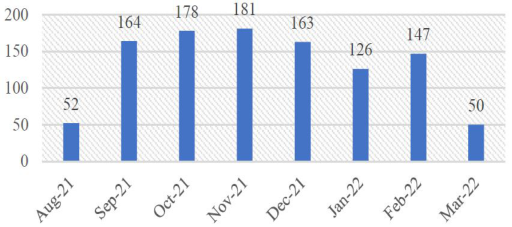
The @kemenparekraf account in April 2021 had 221.9 thousand follow- ers. From year to year, @kemenparkraf actively provides information about tourism and tourism activities in Indonesia. In 2020, the tourism industry in Indonesia had weakened due to the COVID-19 pandemic. All tourism sectors ceased to operate to reduce interaction and spread the virus. In 2021, @kemenparekraf was active again in providing information related to tou- rism during the pandemic, with information about tourist places that are re-opening. Based on Figure 1, @kemenparekraf provides relatively high con- tent per month. Thus, @kemenparekraf is relatively optimal in providing information about the tourism sector after the pandemic.
Figure 1: Twitter account activity (adapted from NVivo 12 plus software).
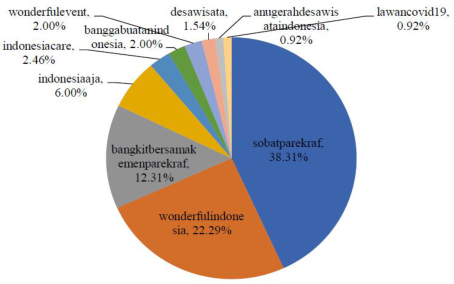
The data above came from @kemenparekraf for the last eight months. The most tweets were in November 2021, with181 posts. In December 2021, the @kemenparekraf account generated 163 tweets, but in the following month, it decreased considerably to 126 posts in one month. In February 2022, there is a reasonably high increase with 147 tweets. Based on Figure 2, the hash- tags accompany the Ministry of Tourism and Creative Economy’s Twitter activities on tweets. The hashtag used has three indicators that discuss the sustainability of Indonesian tourism after the COVID-19 pandemic. The indi- cators in question are tourism policies, information on tourism activities, and health protocols.
Figure 2: @kemenparekraf’s Twitter hashtag activities (adapted from NVivo 12 plus software).Table 1. Hashtag activity Twitter (adapted from NVivo 12 Plus software).
Based on Table 1, the hashtags on @kemenparekraf can be categorized into three indicators. There are at least five hashtags with the highest percen- tage. #sobatparekraf with 38.31% represents information about tourism and health protocols. #wonderfulIndonesia and #bangkitbersamakemenpa- rekraf by 22.29% and 12.31% discuss tourism policies, information on tourism activities, and health protocols. In contrast, #diIndonesiaaja with 6.00% only focuses on information on tourism activities in Indonesia. Finally, #Indonesiacare with 2.46% discusses health protocols.
The mentions feature on Twitter can be used as a promotional strategy to be conveyed to the public. This feature can facilitate the delivery of informa- tion that the public will receive. @kemenparekraf is quite active in interacting with the @sandiuno account, as the minister of tourism and the creative eco- nomy should be actively involved in promoting the tourism industry through social media
Table 2. Mentions Twitter account (adapted from Nvivo 12 plus software).
Table available in the original PDF paper.
Account Categorization Mention
Government Total Presentage Non-government Total Presentage sandiuno 74 76% motogp 2 2% kemenparekraf 14 14% agradaya 1 1% jokowi 3 3% angelatanoe 1 1% idtourismforum 2 2% apresiasikreasi 1 1% total 93 95% 5 5%
Based on Table 2, the table above shows that the highest interaction by @kemenparekraf is with @sandiuno at 76%, followed by the @kemenpare- kraf account with 14%. Then, the Indonesian president @jokowi is by 3%. From the data obtained, the @kemenparekraf account often interacts with the @sandiuno account, proving that the tourism promotion is quite active.
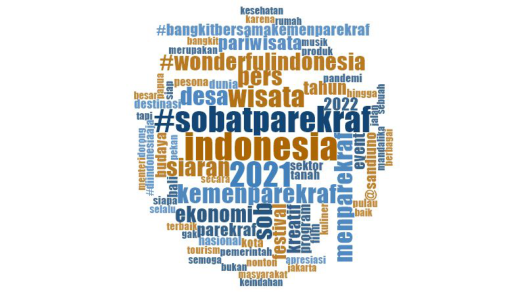
The following analysis uses word frequency to find the most frequently used words. Word frequency makes it easier to conclude the outline of topics on the Twitter account of the Ministry of Tourism and Creative Economy regarding tourism sustainability strategies after the COVID-19 pandemic.
Utilizing Social Media in Tourism Industry Sustainability Strategy 779
Figure 3: Word frequency results from the @kemenparekraf account.
Based on Figure 3, Indonesian words and hashtags rank the most frequen- tly used in the @kemenparekraf account, proving a relationship between the hashtag #sobatparekraf and Indonesia.
CONCLUSION
Based on the explanation, the researcher argues that the functionality of @kemenparekraf to encourage the promotion of new tourist attractions, sustainable tourism, infodemic, tourist villages in that category seen from the type of information on the intensity of tweet hashtags and mentions, so the account @ The Ministry of Tourism and Creative Economy has functionally utilized social media to promote post-pandemic tourism.
REFERENCES
Abiad, A., Arao, R.M. and Dagli, S. (2020) ‘The economic impact of the COVID-19 outbreak on developing Asia’. Babacan, E., KAMANLIO ˘GLU, E.B. and Yeniçeri Alemdar, M. (2008) ‘Pazarlama
˙Ileti¸simi ve Halkla ˙Ili¸skiler Uygulamalarında ˙Internet Kullanımı: ˙Izmir’de Yer Alan Seyahat Acenteleri Üzerine Bir Ara¸stırma’, ˙Istanbul Üniversitesi ˙Ileti¸sim Fakültesi Dergisi, 2008(31), pp. 5–24. Carvache-Franco, O., Carvache-Franco, M. and Carvache-Franco, W. (2022) ‘Coastal and marine topics and destinations during the COVID-19 pandemic in Twitter’s tourism hashtags’, Tourism and Hospitality Research, 22(1), pp. 32–41. doi:10.1177/1467358421993882. Chang, C.-L., McAleer, M. and Ramos, V. (2020) ‘A charter for sustainable tourism
after COVID-19’, Sustainability. Multidisciplinary Digital Publishing Institute, p. 3671. Do, B. et al. (2022) ‘Strategic responses to COVID-19: The case of tour operators in Vietnam’, Tourism and Hospitality Research, 22(1), pp. 5–17. doi:10.1177/1467358421993902. Eley, B. and Tilley, S. (2009) ‘Online Marketing Inside Out. SitePoint Pty Ltd’, Victoria [Preprint]. Esquivias, M.A. et al. (2021) ‘Impacts and Implications of a Pandemic on Tou-
rism Demand in Indonesia’, Economics and Sociology, 14(4), pp. 133–150. doi:10.14254/2071-789X.2021/14-4/8.
Gössling, S. (2020) ‘Risks, resilience, and pathways to sustainable aviation: A COVID-19 perspective’, Journal of Air Transport Management, 89, p. 101933. Guridno, E. and Guridno, A. (2020) ‘COVID-19 impact: Indonesia tourism in
new normal era’, International Journal of Management and Humanities, 4(11), pp. 31–34. Hao, F., Xiao, Q. and Chon, K. (2020) ‘COVID-19 and China’s hotel industry: Impacts, a disaster management framework, and post-pandemic agenda’, International journal of hospitality management, 90, p. 102636. Kaplan, A.M. and Haenlein, M. (2010) ‘Users of the world, unite! The challenges
and opportunities of Social Media’, Business horizons, 53(1), pp. 59–68. Manipuspika, Y.S., Indhiarti, T.R. and Sudarwati, E. (2021) ‘Pemanfaa- tan Blog Sebagai Sarana Promosi Kampung Wisata Di Masa Pandemi’, SELAPARANG Jurnal Pengabdian Masyarakat Berkemajuan, 5(1), p. 676. doi:10.31764/jpmb.v5i1.5370. Rakhmadani, R. (2020) ‘Objektivitas Media di Tengah Pandemi Covid-19: Analisis Isi Berita tentang Penerapan New Normal di Indonesia pada Media Tirto.id’, Jurnal Audiens, 1(2). doi:10.18196/ja.12030. Rudenko, S. and Tedjakusuma, A.P. (2018) ‘Wonderful Indonesia" country marke-
ting campaign-how visible Indonesia as a tourism destination for Europeans’, in 15th International Symposium on Management (INSYMA 2018) Atlantis Press. Susilawati, S., Falefi, R. and Purwoko, A. (2020) ‘Impact of COVID-19’s Pandemic on the Economy of Indonesia’, Budapest International Research and Critics Institute (BIRCI-Journal): Humanities and Social Sciences, 3(2), pp. 1147–1156. doi:10.33258/birci.v3i2.954. Sutrisno, E. (2020) ‘Strategi Pemulihan Ekonomi Pasca Pandemi Melalui Sektor
UMKM Dan Pariwisata’, Jurnal Kajian Lembaga Ketahanan Nasional Republik Indonesia, 09(November), pp. 87–96. Toubes, D.R., Araújo Vila, N. and Fraiz Brea, J.A. (2021) ‘Changes in consumption patterns and tourist promotion after the COVID-19 pandemic’, Journal of Theoretical and Applied Electronic Commerce Research, 16(5), pp. 1332–1352. V˘arzaru, A.A., Bocean, C.G. and Cazacu, M. (2021) ‘Rethinking tourism indu-
stry in pandemic covid-19 period’, Sustainability (Switzerland), 13(12), pp. 1–19. doi:10.3390/su13126956. Widyastuti, D.A.R. (2021) ‘Using New Media and Social Media in Disaster Communication’, Komunikator, 13(2), pp. 100–111. doi:10.18196/jkm.12074. Yavuz, M.C. and Haseki, M.˙I. (2012) ‘Konaklama i¸sletmelerinde e-pazarlama uygu-
lamaları: E-medya araçları temelinde bir model önerisi’, Ça˘g Üniversitesi Sosyal Bilimler Dergisi, 9(2), pp. 116–137.
Read this individual research paper free through the original publisher, or explore the full digital proceedings book.
ISBN 978-1-958651-44-5
Explore this ISBN in the AHFE Bookstore ↗Listed in the July 2026 bookstore catalogue; search by ISBN to confirm current availability · Digital book purchase optional