Wafie Anisah, Filosa Gita Sukmono (2022). Promotional Strategies of Local Governments in Improving Tourists’ Post Pandemic Experience: Case Study in Yogyakarta, Indonesia. In: Human Interaction & Emerging Technologies (IHIET 2022): Artificial Intelligence & Future Applications. AHFE Open Access, vol. 68, pp. 495–501. https://doi.org/10.54941/ahfe1002769
This study aims to find out how to manage the official Twitter social media account of the Indonesian local government after the pandemic. Twitter has become an important part of the government’s social media, one of which is an effective tourism industry promotion medium. This condition is supported by Indonesian social media users reaching 170 million of the total population. Therefore, the authors to look at how social media work for the Yogyakarta City Government, creating tourism industry promotion after the COVID-19 pandemic. This study used a Qualitative Data Analysis Software approach, with NvivoPlus 12 as the data analysis tool. The source of this research data came from @humas_jogja, the official Twitter account of the Yogyakarta City Government. The findings of this study indicated that, first, social media worked well as a tourism industry promotion medium for Yogyakarta after the pandemic. Second, as a communication medium, the Yogyakarta City Government encourages people to be vaccinated before traveling to Yogyakarta. Third, as a medium for mitigation tourism industry, new adaptations are promoted through the health protocol campaign while traveling to Yogyakarta. Fourth, as an educational medium, @humas_jogja encourages history-based tourism industry for students. These findings are based the intensity of information submitted by the @humas_jogja account using the tagline of special areas as a characteristic of Yogyakarta.
The COVID-19 virus from Wuhan, China, has widely spread to Indonesia since March 2, 2020 (Tim detik.com, 2020). The spread significantly affe- cted people’s lives, including tourism industry (Syafrida and Hartati, 2020). Tourism is designated as a leading sector in increasing economic growth, and according to Baltagi, the number of Indonesian tourists since 2009 increa- sed (Fafurida et al., 2020). As an industry based on people’s mobility, the COVID-19 virus outbreak hit the tourism industry (Guridno and Guridno, 2020). Since 2020, global visitors have decreased dramatically due to the pandemic affecting the rate of economic growth (Atmojo and Fridayani, 2021).
Therefore, the Indonesian government has implemented health proto- cols and PSBB (Large-Scale Social Restrictions) policies (Putri, 2020). These regulations influence Indonesia’s economic and tourism sectors during the COVID-19 pandemic (Atmojo and Fridayani, 2021). Despite limited govern- ment capacity, innovation at the local level plays an important role in ensuring the community’s economic viability (Nugroho and Negara, 2020). One of many tourist cities in Indonesia, Yogyakarta has been missing inter- national and domestic tourists (Nugroho and Negara, 2020). The Special Region of Yogyakarta is known as a city of history, a cultural center, and a center for education and tourism industry (Kamaludin et al., 2021).
The increasing number of social media users in Indonesia by 170 million, which equals 61.8% of the total population in January 2021 (Stephanie, 2021), has made social media as media to promote tourism sector (Kurniawan, Wahyuni and Sutan, 2021). Internet for marketing purposes is one of the most important developments in the overall performance of marke- ting activities, especially in promotions (Popesku, 2014; Endri and Prasetyo, 2021). Social media as a marketing tool is becoming increasingly important, especially after the COVID-19 pandemic (Mason et al., 2021).
Previous research explained that promotion strategies for tourism indu- stry through social media with planning, creation, integration, and marketing were effective (Kurniawan, Wahyuni and Sutan, 2021). Then, in improving crisis marketing related to digital marketing strategies for tourism destina- tions during the COVID-19 pandemic, there are three categories: media strategy, message strategy, and audience strategy (Ketter and Avraham, 2021). This research focuses on how the local government’s promotion strategy is to increase tourism after the COVID-19 pandemic. The data source in this study came from @humas_jogja, the Yogyakarta City Government’s Twitter account (Endri and Prasetyo, 2021).
Social Media as Promotional Tools Besides making friends and socializing, social media can help run a business and promote other activities (Purwaningwulan et al., 2019). Social media offers a competitive advantage for each type of target audience of an orga- nization (Vinerean, 2017). Schmalleger and Carson explained that social media is a promotional tool for interactive marketing. Kaplan and Haenlein considered that social media could achieve these goals with a higher level of efficiency (Todua, 2017). The development of social media promotions will greatly assist in the compiling an integrated communication that aims to provide information about goods or services to support product sales online (Siregar, Weny and Yuliawan, 2020). According to Zeng, utilizing social media to market tourism has proven a good strategy. Many countries consider social media an important tool to promote their tourism industry (Buted et al., 2014).
Tourism Promotion Strategy Tourism destinations use promotional and marketing communication stra- tegies to influence the destination image (Govers, Go and Kumar, 2007).
Promotional Strategies of Local Governments in Improving Tourists’ 497
Promotional activities must be well planned to create a conducive atmosph- ere so that consumers can find out and become interested in the product being promoted (Briandana, Doktoralina and Sukmajati, 2018). Promo- ting tourism through social media requires a strategy that integrates online and offline activities (Mekonen, 2016). According to Inskeep, Jain, Ulaga, and Chacour, tourism planning requires a tourism development strategy that accommodates the roles and tasks of tourism elements by empowering tourism potential related to marketing strategies and product development strategies (Briandana, Doktoralina and Sukmajati, 2018). It is essential to have an effective way of marketing through social media so that the offer can be highlighted and appear attractive (Boz, 2011).
METHOD
This study focuses on the local government’s promotion strategy of increasing Yogyakarta tourism after the pandemic. This study used a descriptive quali- tative approach and Q-DAS (Qualitative Data Analysis Software) to analyze the data and Nvivo 12 plus as a data content analysis tool. Data retrieval was through the government’s Twitter account because the government promotes and restores tourism in Yogyakarta by using @humas_jogja.
RESULT
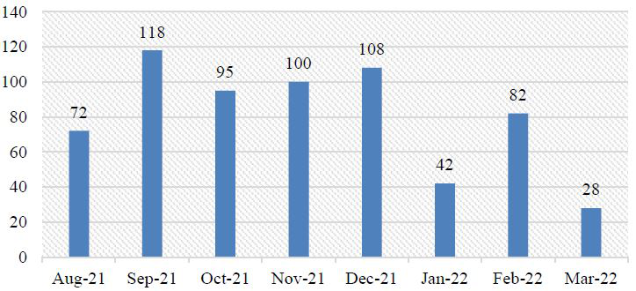
The dissemination of information about COVID-19 carried out by @humas_jogja is relatively active. The following is a description of the account’s activity.
Figure 1: @humas_jogja’s account activities (Source: NVivo 12 plus software).
The data above is taken from the official Twitter account @humas_jogja from August 2021 to March 2022, which has tweeted 645 posts. The most tweets are in September 2021 with 118 tweets, and the lowest is in March 2022 with 28 tweets. The minimum number of posts per month is 20 twe- ets. In conveying information via Twitter, it is considered effective to use the hashtag feature. From the hashtags used by @humas_jogja, there are four categories of information discussed regarding the increase in tourists after the
498 Anisah and Sukmono
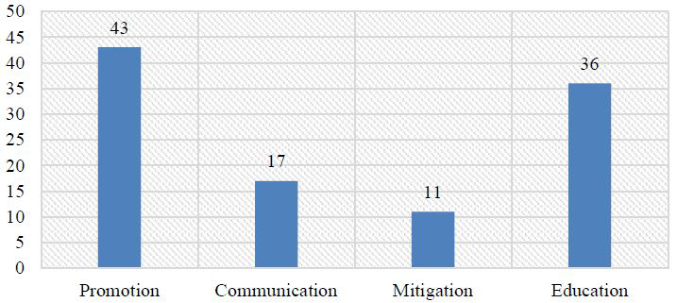
pandemic. The categories are promotion, communication, mitigation, and education, as seen in Figure 2.
Figure 2: Tourism as the topic discussion (Source: NVivo 12 plus software).
Based on Figure 2, most tweets are in the promotional category, with 43 posts regarding new tourism promotions during COVID-19. Second, the communication category is tweeted 17 times, encouraging people to be vacci- nated before coming to Yogyakarta. Third, 11 tweets are from the mitigation category, applying health protocols while traveling In Yogyakarta. Fourth, the education category has been tweeted 36 times, encouraging history-based tourism for students through social media. The data below is taken from the hashtag on the @humas_jogja Twitter account. The data below explains that this account prioritizes information with the promotion category over other categories.
Table 1. Hashtag samples used by @humas_jogja (Source: NVivo 12 plus software).
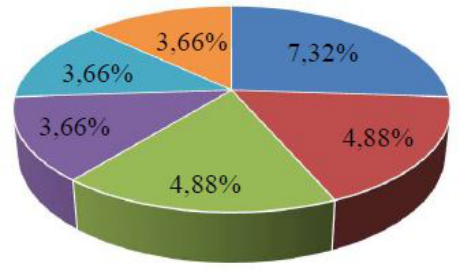
The mention feature on Twitter can be a strategy for delivering information to the public to make it more efficient. The @humas_jogja account often interacts with several accounts to support their tourism promotion activities.
Figure 3 shows that the highest interaction carried out by @humas_jogja is the @kominfodiy account with 7.32%, followed by @humassleman and @pemkotjogja with 4.88%. Furthermore, @kominfo_sleman, @mc_sleman and @poldajogja interact with @humas_jogja by 3.66%.
Promotional Strategies of Local Governments in Improving Tourists’ 499
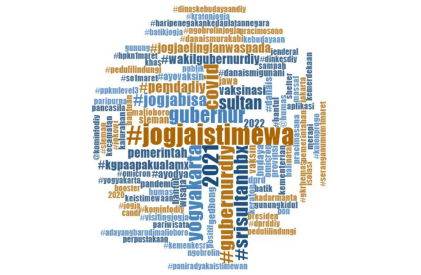
Figure 3: Most mentioned Twitter accounts by @humas_jogja (Source: NVivo 12 plus software).Figure 4: Results of word frequency from @humas_jogja (Source: NVivo 12 plus software).
The next analysis uses Word Cloud to find words often used by @humas_jogja, as seen in Figure 4.
Based on Figure 4, of 645 tweets, #jogjaistimewa ranks the highest. Apart from being a characteristic of Yogyakarta, the hashtag also contains various information, especially regarding Yogyakarta tourism during the pandemic.
CONCLUSION
Based on the results of the research above, it can be concluded that the Yog- yakarta City Government uses the official Twitter account @humas_jogja to increase post-pandemic tourism with the functions of promotion, com- munication, mitigation and education. The category is seen from the type of information and the intensity of hashtags and mentions tweets, so the @humas_jogja account has succeeded in utilizing social media to increase tourism after the pandemic.
ACKNOWLEDGMENT
Communication Studies Program, Universitas Muhammadiyah Yogyakarta, has supported this research. The authors would like to thank the review team from The International Conference on Human Interaction & Emerging Technologies.
500 Anisah and Sukmono
REFERENCES
Atmojo, M. E. and Fridayani, H. D. (2021) ‘An Assessment of Covid-19 Pandemic Impact on Indonesian Tourism Sector’, Journal of Governance and Public Policy, 8(1), pp. 1–9. doi: 10.18196/jgpp.811338. Boz, M. (2011) ‘Successful Promotion Strategy in Destination Tourism Marketing
Through Social Media; Queensland , Australia Case’, Accelerating the world’s research, pp. 467–472. Briandana, R., Doktoralina, C. M. and Sukmajati, D. (2018) ‘Promotion analysis of marine tourism in Indonesia: A case study’, European Research Studies Journal, 21(1), pp. 602–613. doi: 10.35808/ersj/973. Buted, D. R. et al. (2014) ‘Effects of Social Media in the Tourism Industry of Batangas
Province’, Asia Pacific Journal of Multidisciplinary Research, 2(3), pp. 123–131. Endri, E. P. and Prasetyo, K. (2021) ‘Strategi Komunikasi Pemasaran Produk Kopi Kawa Daun Tanah Datar dalam Membangun Brand Awareness’, Jurnal Audiens, 2(1), pp. 134–142. doi: 10.18196/jas.v2i1.9836. Fafurida, F. et al. (2020) ‘Tourism and economic development in Indonesia’, Interna-
tional Journal of Scientific and Technology Research, 9(3), pp. 6476–6479. Govers, R., Go, F. M. and Kumar, K. (2007) ‘Promoting Tourism Destination Image’, Journal of Travel Research, 46(1), pp. 15–23. doi: 10.1177/0047287507302374. Guridno, E. and Guridno, A. (2020) ‘Covid-19 Impact: Indonesia Tourism in
New Normal Era’, International Journal of Management and Humanities, 4(11), pp. 31–34. doi: 10.35940/ijmh.k1049.0741120. Kamaludin, N. K. et al. (2021) ‘Analysis Strategy of Tourism Development During the Pandemic in Yogyakarta’, ACM International Conference Proceeding Series, pp. 12–14. doi: 10.1145/3484399.3485667. Ketter, E. and Avraham, E. (2021) ‘#StayHome Today So We Can #Travel-
Tomorrow: Tourism Destinations’ Digital Marketing Strategies During the Covid-19 Pandemic’, Journal of Travel and Tourism Marketing, pp. 1–14. doi: 10.1080/10548408.2021.1921670. Kurniawan, D., Wahyuni, H. and Sutan, A. J. (2021) ‘Analysis of Tourism Promotion Strategies Through Twitter Social Media: A Case Study in Yogyakarta’, Journal of Local Government Issues, 4(1), pp. 76–89. doi: 10.22219/logos.v4i1.14732. Mason, A. N. et al. (2021) ‘Pandemic Effects on Social Media Marketing Behaviors in India’, Cogent Business and Management, 8(1), pp. 1–14. doi: 10.1080/23311975.2021.1943243. Mekonen, T. A. (2016) ‘The Role of Media in Tourism Promotion: A Case Study
in Ethiopia’, Journal of Hospitality Management and Tourism, 7(5), pp. 50–56. doi: 10.5897/jhmt2016.0177. Nugroho, Y. and Negara, S. D. (2020) ‘COVID-19’s Impact on Micro, Small, & Medium Enterprises and Tourism in Indonesia’, ISEAS Yusof Ishak Institute, pp. 1–11. Popesku, J. (2014) ‘Social Media As a Tool of Destination Marketing Organisations’,
Sinteza, pp. 715–721. doi: 10.15308/sinteza-2014-715-721. Purwaningwulan, M. M. et al. (2019) ‘The Existence Of Social Media As A Promotional Media In The Hijab Image Revolution In Indonesia’, Library Philosophy and Practice, pp. 1–15. Putri, R. N. (2020) ‘Indonesia dalam Menghadapi Pandemi Covid-19’, Jurnal
Ilmiah Universitas Batanghari Jambi, 20(2), pp. 705–709. doi: 10.33087/ji- ubj.v20i2.1010.
Promotional Strategies of Local Governments in Improving Tourists’ 501
Siregar, M. Y., Weny and Yuliawan, E. (2020) ‘The Influence of Promotion Strategies through Social Media on Purchasing Decisions of Oriflame Products on Students of STIE Mikroskil Medan’, Budapest International Research and Critics Institue- Journal, 3(3), pp. 1838–1846. doi: https://doi.org/10.33258/birci.v3i3.1116. Stephanie, C. (2021) Berapa Lama Orang Indonesia Akses Internet dan Medsos
Setiap Hari?, tekno.kompas.com. Available at: https://tekno.kompas.com/read/ 2021/02/23/11320087/berapa-lama-orang-indonesia-akses-internet-dan-medso s-setiap-hari (Accessed: 9 February 2021). Syafrida, S. and Hartati, R. (2020) ‘Bersama Melawan Virus Covid 19 di Indonesia’, SALAM: Jurnal Sosial dan Budaya Syar-i, 7(6), pp. 495–508. doi: 10.15408/sj- sbs.v7i6.15325. Tim detik.com (2020) Kapan Sebenarnya Corona Pertama Kali Masuk RI?,
news.detik.com. Available at: https://news.detik.com/berita/d-4991485/kapan- sebenarnya-corona-pertama-kali-masuk-ri?single=1 (Accessed: 13 March 2022). Todua, N. (2017) ‘Social Media Marketing for Promoting Tourism Industry in Georgia’, pp. 168–171. Vinerean, S.(2017) ‘Importance of Strategic Social Media Marketing’, Expert Journal
of Marketing, 5(1), pp. 28–35. doi: 10.1515/mt-1999-417-807.
Read this individual research paper free through the original publisher, or explore the full digital proceedings book.
ISBN 978-1-958651-44-5
Explore this ISBN in the AHFE Bookstore ↗Listed in the July 2026 bookstore catalogue; search by ISBN to confirm current availability · Digital book purchase optional