One of the major interests of higher education institutions is the creation of transformative methods that favor the instructional process, where students participate in their academic training through the generation of dynamic and open areas of interaction. This study describes the development of a strategy to understand the stock market with the application of technological tools based on 3D virtual environments. These environments known as Metaverses are immersive platforms that create experiences in an extended reality. The strategy consisted of designing and building a virtual learning environment on the Second Life platform to strengthen students' stock market skills. The instructional design was developed with the ADDIE (Analysis, Design, Development, Implementation and Evaluation) methodology focused on five themes: The world financial system, capital markets, products traded on the stock exchange, stock market indexes and famous cases in stock markets. The proposal was evaluated with 73 students of business administration career of a private university in Ecuador. According to the statistical information, 56% of the students have not used a metaverse before, 56% have not even practiced in real environments or simulators to learn the dynamics of the stock markets, 85% have not interacted with an avatar in cyberspace before, 78% consider the use of interactive spaces interesting, 79% were motivated to participate in 3D virtual environment strategies, 95% of students were engagement with active methodologies, 97% support the continuation of classes in the Second Life platform and 100% mention that it is necessary to create metaverses that allow them to interact and learn in a better way. The implementation of virtual worlds in e-learning platforms reinforces knowledge and management skills in the stock market
Humanity has experienced dizzying changes in technological development in recent times, coupled with the problem of the global pandemic; same that, ironically has triggered the advance of years in implementation of techno- logical tools to the daily lives of individuals; being education one of the most obvious factors in this momentous change, due to the need for coun- tries and regions not to slow down this fundamental pillar in the economic development of society, digital communities and network society in which we live.
One of the greatest interests of educational institutions at the higher level is the creation of transformative methods that favor the instructional process where the learner actively participates in their academic training through the generation of areas of dynamic and open interaction, making the leap from the physical classroom and in real time in which the teacher, through the lecture class became the center of the teaching-learning process, and students were placed as mere spectators of this dynamic; to a process in which, through virtual classrooms and an interaction in asynchronous and synchronous time, a process of inverted classroom is transcended, in which the process of appro- priating knowledge goes hand in hand with digital competences essential for the management of virtual learning environments.
Thus, the emergence of metaverses and 3D digital tools have opened a threshold with a vast horizon to develop learning through creativity, innova- tion and ingenuity; mechanisms that would revolutionize the aforementioned traditional systems.
In particular, the study of stock markets has traditionally been presented as a complicated and unattractive subject for business administration students, since it is a training project that requires a different dynamic to capture the students’ attention. For this reason, the objective of this article is the creation of a virtual world using 3D tools such as Second Life, where the main actor is the student from its initial conception of generating his avatar that will experience real experiences in the virtual world, and that will build his lear- ning based on challenges and obtaining badges, where the teacher becomes a mentor and companion of the process, through the use of various strategies such as gamification, digital narratives, storytelling, etc., transforming the scenario of yesteryear in an environment of interest that evokes passion in the student to learn to advance their ultimate goal; transforming the scena- rio of yesteryear into an environment of interest that evokes passion in the student to learn in order to advance in their final goal.
Building knowledge based on personal experiences is much more assertive in virtual worlds. Global trends in the areas of business, marketing, enter- tainment, social net-works and others are making great strides in inviting and seducing people to get involved or use these new tools and technological devices that have transformed the way of living and educating.
RELATED WORK
The advancement of technology has influenced the lives of human beings, its evolution has generated ways of establishing new social relationships. Thus, in the educational field, Information and Communication Technologies have ventured into teaching and learning through virtual platforms, educational software and computer resources, reducing the use of traditional paradigms.
In this aspect, the work concluded by (Mendoza, 2019) with the topic Application of technological tools for teaching-learning of students of the Faculty of Administration, carried out at the National University of Hua- ncavelica, is mentioned, stating that audiovisual resources increase levels of knowledge, while the elaboration of materials benefits in the fulfillment of programmed activities.
3D Virtual Learning Environments to Reinforce Stock Market Competences 599
Continuing with the advances in technology, researchers (Alves, Miranda, Morais, & Melare, 2018), state that virtual environments enable learners to acquire experiences through the use of virtual space. Thus, to improve the pedagogical work, teachers have received training in the use of platforms, among others Cava, Socrative, Skype, and the web, while the presence of the Internet has promoted the usability of Google Chrome, which due to its advantages surpasses the Mozilla, and Safari.
It is highlighted that the time of confinement increased the use of social networks, which are technological tools used by students, teachers and parents with the purpose of improving performance. Along the same lines, the use of virtual platforms has motivated comprehension and understan- ding, for this reason teachers must acquire skills and competencies that help students in the academic process.
At present, several investigations have been carried out regarding vir- tual worlds and specifically Second Life, although this was not created as a learning environment, however, several international studies recognize its potential in the training process Inman, Wright & Hartman (2010); Bowers, Ragas & Neely, (2009); Atkins & Caukill, (2009); Deutschmann, Panichi, & Molka, (2009); Helmer (2019).
Continuing with the use of technological tools, the study carried out by (Campazzo, Agüero, Guzmán, & Martínez, 2010) with the theme 3D Vir- tual Worlds, a new paradigm in E-learning, is mentioned. Case: SLEVA at the National University of La Rioja, affirm that a technological environment is a software system developed to support teachers in the management and admi- nistration of courses, opening a space for dialogue, discussion and debate, which through other resources of Web 2.0 encourages group work, leading to significant learning.
Scholars Quinche & González (2011) carry out research regarding the design and implementation of the first prototype of the Innova-T3D Virtual Campus at the Minuto de Dios University Corporation in Bogotá, Colombia; In this sense, the implementation of tools that allow the interconnection of E-Learning platforms with 3D Virtual Worlds is tested, which leads to the cre- ation of an innovative learning space, significantly promoting collaborative work and the construction of collective knowledge in higher education.
The researchers Ramón, Russo, Esnaola, Alonso, Fochi & Padovani, (2014) in the study they carry out propose the design, coordination and implementation of a 3D virtual environment applied to the university context, the purpose is to take advantage of the advantages offered by technologies in virtuality, determine that the use of synchronous communication tools is transcendental to interact with the student, they also reveal that virtual laboratories benefit the contents learning in exact science careers, while simulation enriches teaching practices and student’ experience.
In the research carried out by Sánchez (2017) at the University of Huelva with the purpose of knowing the importance of the educational possibilities that the 3D virtual world mentions that there is a need to make changes in the pedagogical area regarding technological skills and the advancement of science, in this way it contributes to university academic training through the use of 3D virtual worlds, where the teacher plays the role of guide, counselor,
600 Hernández and Jadán-Guerrero
and designer of instruction in a framework of methodological updating that leads to improving the innovation process.
The researchers Ahmad, Sarobe, Russo, Tessore, & Moretti (2019) in the study carried out plan to analyze the collaborative experiences of students in 2D and 3D environments, they mention that technologies benefit manage- ment systems learning that lead to incorporate Web 2.0 resources and tools; through interactivity it promotes interaction between teachers and students; determines that virtual worlds are online communities used as simulators of physical spaces in three dimensions, it can be real or not, however through the use of their avatars it allows to use, elaborate and exchange objects.
According to the work carried out by the researchers mentioned above, it follows that the pedagogical work is related to technological advances that include virtual environments for teaching and learning. In this context, the constant advances in technology have offered new designs to the field of edu- cation. The incorporation of Web 2.0 technology and electronic devices has paved the way for the development of designs based on specific technologies such as computer-assisted learning and mobile-assisted learning (Tulgar, A. T. 2019).
METHOD
The research applied to the present work is of a qualitative and quantitative approach; due to the nature of the data and information. The qualitative approach applied to the study of the literature review and content of the theoretical framework, with a holistic and objective comprehensive vision through induction, systematizing some thoughts in relation to the fulfillment of the objectives proposed in the inquiry (Navarrete & Mendieta, 2018), and the quantitative approach used in the statistical analysis and interpretation of the results of the applied survey.
For its part, the design of the research was documentary, through the review of the literature carried out in the databases: Scopus, Dialnet, Redalyc, Scielo and Google Scholar that contributed in obtaining documentary infor- mation (primary and secondary).
The type of Exploratory-Descriptive Research, given the topic of virtual 3D learning environments as a strategy to develop stock market skills little studied, explored and recognized, contributed to the collection of data rela- ted to real aspects. The deepening of the research allowed us to understand, compare and interpret reality and answer the questions: what? why? and how? the study is carried out. It also contributed to the generation of the hypothesis in order to extract results and conclusions that contributed to the solution of the problem detected (Baena, 2014).
Participants In the present research, the population under study is made up of 73 students of the Business Administration Career of the Technological University Indo- américa. We will work with the total population, that is, a census is applied, for this reason the sample calculation is not carried out.
3D Virtual Learning Environments to Reinforce Stock Market Competences 601
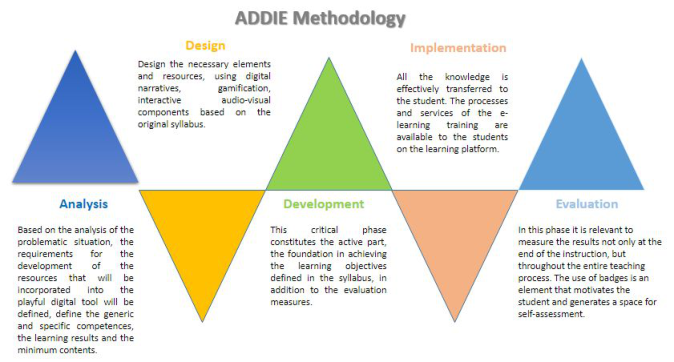
Figure 1: ADDIE methodology.
Materials and Supplies We used a virtual learning environment on the Second Life platform and the instrument applied was the questionnaire that allowed integrating the data obtained through the collection process, achieving precision in the answers, thus generating reliable information. The questionnaire with 10 questions was ceated to carry out an exploration, description, prediction and expla- nation of a succession of characteristics concerning the population under study.
Data Collection Process In the collection of information related to virtual 3D learning environments for the study of stock market skills in the Business Administration Career of the Technological University Indoamérica, the following process was carried out:
Selection of the technique (survey) and the instrument (questionnaire).
Writing 10 questions (five concern the independent variable and five the dependent).
Application of the instrument (questionnaire) through Google Forms survey administration software.
Tabulation and organization of information through the presentation of tables and graphs
Drafting of the analysis and interpretation of the data obtained.
Establishment of conclusions and recommendations.
For the research process, the ADDIE methodology was applied, which is shown in Figure 1.
The proposed methodology, through instructional design, adapts to the teaching-learning process, in harmony and synchronization with technologi- cal tools such as Second Life and 3D, thus achieving an adequate learning result and reaching the generic and specific skills of the training project.
602 Hernández and Jadán-Guerrero
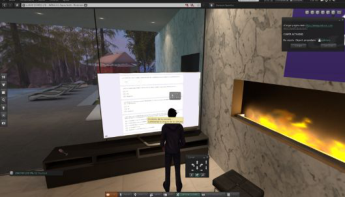
Figure 2: Second life virtual world.
3D ENVIRONMENT IMPLEMENTATION The proposal is based on the application of a 3D tool focused on the teaching-learning process in stock market education aimed at students of the Technological University Indoamerica, Business and Business Administration Faculty, specifically in the study of Financial Markets with the support of teachers and students from this area.
In the background it was identified that the students had some problems in showing interest in how capital markets work because it is a new topic and not so widespread, to contribute to a solution the iteration of the students in a virtual world has been incorporated where they will find a series of activities that invite you to enter a different adventure and therefore in a environment that facilitates the incorporation of new knowledge.
With the use of Second Life, it is intended to focus on meaningful learning, which allows the use of gamification oriented in university education, beco- ming a playful-technological experience of an experiential nature, generating motivation in students, being a challenge to reach the final objective and somehow add innovative and competitive elements at the time of starting this new process versus the traditional processes worked in the classroom. Figure 2 shows an example of the 3D Virtual learning build.
RESULTS
Among the results obtained from the research, it can be highlighted that the majority of surveyed indicate that they have never used 3D tools in their lear- ning processes. Result that is framed by the forceful response of the surveyed, when asked about the predisposition to use this type of tools in training pro- jects such as financial markets, in order to optimize resources and innovate the teaching and learning method, would be a user of the environment vir- tual 3D information obtained, it follows that students would strengthen their knowledge through practice in virtual environments.
Likewise, the answer to the question Do you think that the 3D virtual environment will help you in the learning process of stock market education? Indicates 95% approval by the respondents, which allows corroborating the need to incorporate technologies to transform educational practices by pro- viding learners with possibilities of intercommunication and interconnection. In this way, traditional classes will be transformed into virtual or online
3D Virtual Learning Environments to Reinforce Stock Market Competences 603
environments that promote simulation and the combination of resources, advancing in the understanding of curricular contents.
CONCLUSION
It is deduced that the application of strategies through 3D learning techno- logy tools is important to strengthen stock market skills in students of the Business Administration Career of the Technological University Indoamérica, strengthening digital skills and the way of teaching and learning.
It is diagnosed as factors that affect the development of stock market skills, 56% of the students state that the use of 3D tools is insufficient, 48% consi- der that innovative strategies are not used; 56% state that the generation of real or imaginary environments is scarce; 48% affirm that there is a need to innovate the methodology applied in the classroom.
Due to the above, the use of the 3D digital tool in Second Life as a stra- tegy to develop stock market skills in students of the Business Administration Career is significant; in this way it will contribute to the progress of the expe- riential possibilities in three-dimensional virtual environments that promote interaction, design and construction of knowledge. Future work is expected to create reusable 3D objects to facilitate the construction of virtual worlds for other subjects (Santorum et al., 2021).
ACKNOWLEDGMENT
The authors would like to acknowledge to Technological University Indoa- mérica and its Maestría en Educación mención Pedagogóia en entornos digi- tales for contributing to this research to participate in the 8th International Conference on Human Interaction and Emerging Technologies (IHIET 2022). Special thanks to the students, teachers, and authorities of Technological University Indoamérica for participating in this research.
REFERENCES
Ahmad, T., Sarobe, M., Russo, C., Tessore, J., & Moretti, N. (2019). Experiencias colaborativas en entornos virtuales 2D y 3D. In XIV Congreso Nacional de Tecno- logía en Educación y Educación en Tecnología. Universidad Nacional de San Luis. Obtenido de https://repositorio.uta.edu.ec/bitstream/123456789/29588/1/ T4495ig.pdf Alves, P., Miranda, L., Morais, C., & Melare, D. (2018 ). Estilos de apren-
dizaje de los estudiantes de la educación superior y el acceso a las herra- mientas de entornos virtuales . Tendencias Pedagógicas (31), 13. Obtenido de https://repositorio.uam.es/bitstream/handle/10486/680832/TP_31_6.pdf?sequ ence~\protect$\relax=$~1&isAllowed\protect$\relax=$y Atkins, C., & Caukill, M. (2009). In book: Teaching and Learning in the Virtual World of Second Life. Publisher: Tapir Academic Press, 79-89. Baena, G. (2014). Metodología de la Investigación. México, México: Grupo Editrial
Patria. Bowers, M., Ragas, J., & Neely, K. (2009). Virtual Possibilities: A Constructivist Examination of the Educational Applications of Second Life. Semantic Scholar.
604 Hernández and Jadán-Guerrero
Campazzo, E., Agüero, A., Guzmán, A., & Martínez, M. (2010). Mundos Virtuales 3D como nuevo paradigma en E-learning. Caso: SLEVA en la Universidad Nacional de La Rioja. Universidad Nacional de La Rioja, 10. Obtenido de https://core.ac.uk/download/pdf/301039425.pdf Deutschmann, M., Panichi, L., & Molka, J. (2009). Designing oral participation in
Second Life – a comparative study of two language proficiency courses. Umea University. doi: 10.1017/S0958344009000196 Helmer, J. (2019). How burning is your platform?. Digital transformation calls for a leap of faith if your market doesn’t Inman, C., Wright, V., & Hartman, J. (2010). Use of Second Life in K-12 and Higher
Education: A Review of Research (Vol. 9). Journal of Interactive Online Learning. Mendoza, J. (2019). Aplicación de herramientas tecnológicas para la enseñanza aprendizaje de los estudiantes de la Facultad de Administración de la Universidad Nacional San Luis Gonzaga de ICA 2017. Universidad Nacional de Huancave- lica. Obtenido de https://repositorio.unh.edu.pe/bitstream/handle/UNH/2525/T. ACAD-SEGEPE-FED-2019-MENDOZA%20REJAS.pdf?sequence=1&isAllowe d=y Moreno, N., López, E., & Leiva, J. (2018). El uso de las tecnologías emergentes
como recursos didácticos en ámbitos educativos. International Studies on Law and Education, 29(30), 131–146. Navarrete, G., & Mendieta, R. (2018). Las tic y la educación ecuatoriana en tiempos de internet: breve análisis. Espirales. Revista Multidisciplinaria de Investigación Científica, 2(15), 123–136. Quinche, J., & González, F. (2011). Entornos Virtuales 3D, Alternativa Pedagógica
para el fomento del aprendizaje colaborativo y gestión del conocimiento en Uni- minuto. Formación Universitaria, 4(2), 10. Obtenido de https://scielo.conicyt.cl/ pdf/formuniv/v4n2/art06.pdf Ramón, H., Russo, C., Esnaola, L., Alonso, N., Fochi, N., & Padovani, F. (2014).
El uso de los Entornos Virtuales 3D como una herramienta innovadora en propu- estas educativas mediadas con tecnología. Revista Iberoamericana de Tecnología en Educación y Educación en Tecnología, 12, 72–80. Sánchez, A. (2017). Uso de herramientas web 2.0 en educación superior. Universidad de Burgos . Obtenido de https://riubu.ubu.es/bitstream/handle/10259/5126/Sanc hez_Ibanez.pdf?sequence~\protect$\relax=$~1&isAllowed\protect$\relax=$y Santórum, M., Carrión-Toro, M., Guacapiña, M., Acosta-Vargas P. and Jadán-
Guerrero, J. (2021). A Case Study: Developing reusable Learning Objects, 2021 Second International Conference on Information Systems and Software Techno- logies (ICI2ST), 2021, pp. 79–86, doi: 10.1109/ICI2ST51859.2021.00019. Tulgar, A. T. (2019). In between reality and virtuality: Augmented reality in teaching English to young learners. Selçuk Üniversitesi Sosyal Bilimler Enstitüsü Dergisi, (41), 356–364.
Read this individual research paper free through the original publisher, or explore the full digital proceedings book.
ISBN 978-1-958651-44-5
Explore this ISBN in the AHFE Bookstore ↗Listed in the July 2026 bookstore catalogue; search by ISBN to confirm current availability · Digital book purchase optional