Noemí Suárez Monzón, Vanessa Gómez Suárez, Janio Jadán-Guerrero, Karina Elizabeth Delgado Valdivieso (2023). Pedagogical use of technologies for children with Specific Educational Learning Needs. A training strategy for teachers. In: Training, Education, and Learning Sciences. AHFE Open Access, vol. 109, pp. 142–148. https://doi.org/10.54941/ahfe1003160
Studies indicate the presence of a wide number of specific needs in children who require support in different educational institutions. In Ecuador, the most common include motor, sensory and intellectual special needs, communication disorders and difficulties, attention deficit hyperactivity disorder, educational compensation and high intellectual capacities. At the same time, advances in technologies applied to education show successful results in the design of several tools and creative technologies, however, their use by teachers is not always tailored to the diversity of students' needs to achieve significant learning. The aim of the study was to expose the limitations of teachers to make an adequate pedagogical use of technologies adjusted to the diversity of students’ needs in classrooms. The research was carried out under a non-experimental quantitative design and a descriptive scope. A web questionnaire was conducted to a non-probabilistic sample of 263 teachers who were studying for an educational master's degree at an Ecuadorian university, they agreed to the publication of the results under informed consent, those between 25 and 40 years old prevailed. The results are part of a broader study on teacher attitudes, professional satisfaction and the use of teaching methodologies in children with specific learning needs. Specifically, for this study purpose, we only took into account the variables associated with: identification of the different educational needs, level of satisfaction with the profession, level of stress with the profession when working with children with Specific Educational Learning Needs; relevance of technologies in learning, knowledge of educational technologies on a whole; pedagogical use of technologies in conditions of classroom diversity and also areas of knowledge were taken into account for the analysis. The descriptive analysis of the data shows that limitations start from the coexistence of several needs in the same classroomwith an average of at least two or three different typologies. It may explain why 82.5% of teachers express high levels of stress with the profession when they have children with Specific Educational Learning Needs in classroom. In spite of this striking data, 75% consider having a high level of satisfaction with the profession. A more favorable data concerns to the significance given by teachers to the use of technologies. Although there is an overall concern about technologies that can be used in classrooms, this is not the case of the knowledge and adequate pedagogical use of those that can be used for the different learning needs and areas of knowledge. This research leads to the presentation of a training structured strategy for teachers with five actions that can contribute to mitigate the problem of adequate use of technologies in diverse educational contexts. The impact of the proposed training process will be assessed in the future.
Previous studies around the world show the existence of several students with specific educational needs (SEN) that require support in educational institutions. In Ecuador, the most common SEN include motor, sensory and intellectual disabilities, communication disorders and difficulties, attention deficit hyperactivity disorder, educational compensation and high capaci- ties. At the same time, advances in technologies applied to education show successful results in the design of multiple products to manage educatio- nal processes for these kids, tools and creative technologies facilitate their learning.
An earlier study in Ecuador-which researched about access for students with disabilities- investigated 212 kids located in five schools, the 2.36% of them had mild disabilities, 22.17% moderate, 13.21% gave and 14.15% very grave. Moreover, it has been described that 21.70% had profound disabili- ties, 16.51% were severe and 0.47% had no disabilities, 9.43% of students
Pedagogical Use of Technologies for Children With Specific Educational Learning Needs 143
did not report any information. The inquiry about access to technological equipment shows that 32.54% of students use tablets, 23.58% smartphones and only 16.98% own a desktop computer; 77.35% connect to the Wi-Fi service at home.
These data reveal that access to technological equipment by children with some SEN does not constitute itself a limitation to their learning (Delgado & Jadan-Guerrero, 2022). However, access to technology is not the only factor that influences these kids’ learning, teachers training to use technology is also relevant. Other studies display teachers’ inadequacies by using technologi- cal tools and they propose innovative didactic management in some areas of knowledge (Mosquera-Esparza, Mosquera-Esparza, & Suárez-Monzón, 2023; Kumar & Salim, 2019). However, such research results do not analyze the theoretical and practical difficulties that teachers face to focus curriculum on diverse students and also achieve synergies between SEN and the use of technological tools that facilitate learning in a particular area of knowledge.
The fact of having access to multiple options offered by technology to meet different SEN brings tension to teachers because they do not achieve their use for didactic purposes during their learning. This issue cannot be solved with the current training processes for teachers (Cagiltay et al. 2019). The aim of the current study is to describe the limitations that teachers face to make an adequate pedagogical use of technologies adjusted to the diversity of students with SEN in classrooms, directions for a required change are also suggested.
SPECIFIC EDUCATIONAL NEEDS SEN may be associated with a disability or any other educational need, but facing their problems is not exclusive to the individual student, but it keeps reciprocity with contexts. Hence, particular limitations in mobility, commu- nication, language or social interaction and development become demands to which educational, personal and social responses must be given under a social interdependence point of view. The capacity created is the result of coexiste- nce and social cooperation, the dependence on each other, then the diversity becomes positively valued and part of our social basis as human beings (Parra & Luque-Rojas, 2013). Thus, the development of social and educational inte- rventions with purpose of inclusion, achieve a social value for all those who have SEN (Delgado & Jadan-Guerrero, 2022). Consequently, the emphasis is not on what the person cannot do, but on the formation and development of the person, which is the essential matter.
Attention to SEN by granting educational support is based on normative principles in most countries and on the provision of services. The response to students has two fronts of action: the attention to the development of their abilities and interests, through compensation and curricular adaptation; and the assistance in access and mastery of situations in order to achieve levels of equality with their peers. This requires the breaking down of psychological and physical barriers, moreover, actions aimed at developing the capacity of the person from a design of “everything for everyone” (Freer, 2021).
Attention to SEN represents getting resources, support and adaptations as help elements and compensation during students’ development.
EDUCATIONAL TECHNOLOGIES Nowadays, ICT offer countless possibilities and scenarios to rethink the way of working. In education, these technologies provide resources and materials which benefit the student’s learning process in diverse contexts.
The teachers creativity and innovative perspective favor the incorpora- tion of technologies in their work. Teacher training in the application of innovative teaching methodologies is essential, as it implies a substantial change when considering technological resources, psycho-pedagogical cur- rents and new forms of teaching, especially in diverse contexts. The creation of educational resources using text formats, images, videos, audios, intera- ctive environments and hyperlinks encourage active learning. In this way, with an adequate instructional design and pedagogical use, a new form of teaching-learning can be created (Cavazos & Torres, 2016).
TEACHERS’ TRAINING FOR PEDAGOGICAL USE OF TECHNOLOGIES One of the barriers most described in literature is the scarce knowledge of teachers about SEN, their characteristics, manifestations and especially the pedagogical ways to address them. Another neuralgic point is the teachers’ perceptions about technologies, which are associated with the use of Internet on computers, tablets or other devices, however, they are not clear about the pedagogical use of video, audio, among others, nor the new applications that help to better understand during the teaching-learning process (Heras, Orden & Serrano, 2020).
Another study shows a different perception about the use of tecnologies by teachers in training, allowing the generation of new environments, meth- odologies and resources that bring a differentiated attention to students in a more appropriate way, but its main result is the intermediate level of digital competence they show (Marín et al., 2022).
From the above, it is understood that there may be a synergy betw- een the knowledge of: specific needs that require educational support, the most appropriate technologies that can be used in each one, as well as the expansion of the teachers’ training for their appropriate pedagogical use.
METHODOLOGY
The current research tried to understand limitations that teachers face when working with SEN related to the use of technology. It was carried out using a non-experimental design under a descriptive scope. A web questionnaire was used to collect information. A total of 263 teachers studying for a master’s degree at an Ecuadorian university participated in the research as a non- probabilistic sample, they agreed with the publication of the results under informed consent. Those who were between 25 and 40 years old prevailed, 75% of them were female. Thirteen teachers work in special education class- rooms, the rest in regular ones. The results are part of a broader study about
Pedagogical Use of Technologies for Children With Specific Educational Learning Needs 145
teacher attitudes, level of satisfaction and the use of teaching methodologies in kids with SEN.
In the current study, the variables associated with the pedagogical use of technologies in conditions of classroom diversity were only analysed: diffe- rent educational needs teachers manage in their classrooms, level of satisfa- ction with the profession, level of stress with the profession when there are children with SEN; relevance of technologies in learning, pedagogical use of educational technologies to meet these needs and teacher training for the achievement of these objectives.
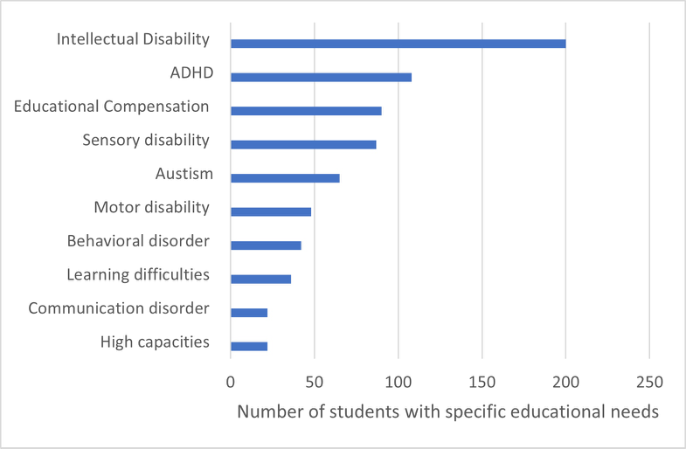
ANALYSIS AND DISCUSSION OF THE RESULTS The descriptive analysis of the data shows that limitations start from the exi- stence of several students with SEN in the same classroom, which, on average, range between two or three different typologies. A total of 264 teachers were surveyed, 800 children with SEN were found, it can be inferred that approxi- mately every teacher has an average of 3 students in this condition; none of them reported not having students with SEN. The particularities are shown in Fig. 1.
This may explain why 82.5% express high levels of stress with the profes- sion when they have children with SEN. Despite this striking data, 75% have a high level of satisfaction with the profession.
A more favourable data regards to the relevance given by teachers to the use of technologies, since the great majority match the maximum value of the scale. Although there is a general knowledge about technologies that can be used in classrooms, this is not the case of the adequate pedagogical use of those that support learning for kids with SEN in different areas of knowledge.
Figure 1: Specific educational needs referred by teachers.
According to the previous result, the percentages of teachers who use the most appropriate technologies by type of SEN do not exceed 20% in most cases. Nor has teacher training been a priority issue. There is a high number of studies that reveal the need to include all kids regardless their SEN, but the real situation of teachers in the Ecuadorian context is far from being able to face this differentiated teaching methodology using technology.
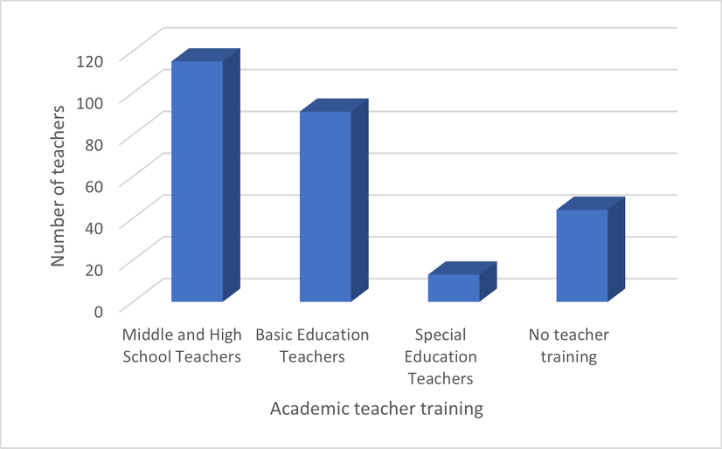
Figure 2 shows that although there are 78% of teachers who have been trained as teachers, this general training is not enough to embrace techno- logical advances and apply them to the diversity of SEN, on the one hand, because of their status as digital migrants -more than half of teachers are over 42 years old- and on the other, because the training curricula did not include training to meet such specific needs.
There is also another smaller group, but also significant in this study, who have not been trained as teachers as they have migrated from other professi- ons to the educational sector, which is an important limitation, since in these cases do not have sufficient knowledge of the psycho-pedagogical manage- ment for different age groups, nor teaching methodologies when using the available technologies.
This research also presents a training alternative for teachers structured in five actions that can contribute to mitigate the problem of the adequate use of technologies in diverse educational contexts. Currently, the presence of several technological tools in the field of education showed their potential to transform teaching in diverse contexts, which makes feasible the construction of training plans that involve at least five actions, they can contribute to mitigate the problem of adequate use of technologies in diverse educational contexts.
These can be summarized as: 1) specialized training in the different types of educational needs, socio-psychological characteristics of kids with SEN;
Figure 2: Academic teachers training.
Pedagogical Use of Technologies for Children With Specific Educational Learning Needs 147
2) provide a database with the type of technology, its use, and the areas of knowledge susceptible for their application; 3) specialize the teacher in micro- curricular design with emphasis on curricular adaptations; 4) training the teacher in the didactic organization of the class making use of technologies; 5) these actions can be concretized in a specialization in SEN and use of educational technologies. The trainers should use case studies and universal design for learning, taking advantage of the participants’ experiences, the course facilitators’ way of acting is the best example for the replication among teachers being trained.
CONCLUSION
Teachers face challenges in managing the teaching process for heterogene- ous groups in terms of SEN diversity. The teachers training on pedagogi- cal use of technologies in children with SEN has not promoted forms of professionalization, neither in initial nor in continuing education.
The wide possibilities of technological development make it possible to improve the teaching-learning processes and thus the students’ learning. There are tools for all areas of knowledge and student needs according to the contribution of those who design technological alternatives for educa- tion. The findings indicate multiple problems related to depth knowledge about the pedagogical uses of technological tools for learning among kids with SEN, thus, a training program is needed.
ACKNOWLEDGMENT
The authors thank Universidad Iberoamericana del Ecuador for funding this study through the project “Transformation of postgraduate teacher training”.
REFERENCES
Baranowska, W. & Leszka, J. (2019). The Normative Definitions of Inclusive Education Developed by Teachers from Numerous Schools and of Varied Professional Experience. Przegla˛d Bada´n Edukacyjnych, 2(29), pp. 75–90. DOI [Consultado 15-10-2022]. Cagiltay, K., Cakir. H., Karasu, N., Faruk, O. & Cicek, F. (2019) “Use of Educational
Technology in Special Education: Perceptions of Teachers. Participatory”, Edu- cational Research (PER), 6(2), pp. 89–205. DOI: 10.1016/j.ssaho.2019.100003. [Consultado 21-12-2022]. Cavazos, R. L. & Torres, S. G. (2016) “Diagnóstico del uso de las tecnologías en el proceso de enseñanza y aprendizaje en la educación superior”, RIDE. Revista Ibe- roamericana para la Investigación y el Desarrollo Educativo, 7(13), pp. 273–292. DOI:10.12775/PBE.2019.017. [Consultado 17-01-2023]. Delgado Valdivieso, K. & Jadan-Guerrero, J. (2022) “La neurodidáctica: una
experiencia educación inclusiva aplicada a las TIC”, Texto Livre. Linguagem e Tecnología, (15), pp. 1–15. DOI: 10.35699/1983- 3652.2022.40509. Disponible en [Consultado 8-12-2022].
Freer, J. (2021) “The Tripartite Intervention: Breaking Down Attitudinal Barriers in Education” Journal of Disability Studies in Education, 2, pp. 50–76. Dispo- nible en https://brill.com/view/journals/jdse/2/1/article-p50_50.xml?language=en. [Consultado 11-01-2023]. Heras, M. A., Orden, R. M. & Serrano, J. (2020) “Las tecnologías en la organización
de un aula inclusiva para niños con capacidades especiales”, Revista Scientific, 5 (16), pp. 334–351. DOI: https://doi.org/10.29394/Scientific.issn.2542-2987. 2020.5.16.18.334-351. [Consultado 26-12-2022]. Kumar, D. & Salim Al-Mamri, M. R. (2019) “Investigation of Tech- nological Tools used in Education System in Oman”, 1(100003). Doi:10.1016/j.ssaho.2019.100003. [Consultado 12-12-2022]. Marín, D., Gabarda, V., Gabarda, C. & Adrian, J. (2022) “Future teachers facing the use of technology for inclusion: A view from the digital competence”. Educa- tion and Information Technologies, pp. 1–19. DOI: 10.1007/s10639-022-11105- 5. [Consultado 15-01-2023]. Mosquera-Esparza, Z. A., Mosquera-Esparza, M. E. & Suárez-Monzón, N. (2023)
“Estrategias para la mejora de la gestión de la innovación didáctica en los docentes de la Unidad Educativa “Los Andes”, Revista Metropolitana de Ciencias Apli- cadas, 6(1), pp. 168–177. Disponible en https://remca.umet.edu.ec/index.php/RE MCA/article/view/612/618. [Consultado 22-01-2023]. Parra, D. & Luque-Rojas, M. (2013). Necesidades Específicas de Apoyo Educativo del alumnado con discapacidades sensorial y motora”, Summa psico- lógica UST, 10(2), pp. 57–72. Disponible en http://pepsic.bvsalud.org/scielo.ph p?script=sci_arttext&pid=S0719-448x2013000200006&lng=pt&tlng=es. [Con- sultado 12-10-2022 ].
LISTED IN THE AHFE DIGITAL BOOKSTORE CATALOGUE
Explore the complete digital volume
Training, Education, and Learning Sciences
Read this individual research paper free through the original publisher, or explore the full digital proceedings book.
ISBN 978-1-958651-85-8
Explore this ISBN in the AHFE Bookstore ↗Listed in the July 2026 bookstore catalogue; search by ISBN to confirm current availability · Digital book purchase optional