Larriza Joy Carmelotes, Jasel Anne Mingua, Kyle Jerome Santos, Kyle Aleen Umayam, Joehanna Ngo, Yoshiki Kurata (2023). Factors affecting Perceived Earthquake Preparedness Behavior among Senior High School Graduates in the Philippines. In: Training, Education, and Learning Sciences. AHFE Open Access, vol. 109, pp. 102–111. https://doi.org/10.54941/ahfe1003156
The Philippines is known to be highly vulnerable to disasters brought on by natural calamities and hazards, including surges, cyclones, droughts, earthquakes, tsunamis, and landslides. Currently, the country expects that the worst-case earthquake, known as “The Big One,” stretches from the Philippines’ West Valley fault, which will cause catastrophic events such as property damage, livelihood loss, and human casualties. With the recent improvements in the primary education curriculum in the Philippines, disaster risk reduction and management (DRRM) have been incorporated as core subjects to be taken by students in senior high school. The research aimed to know the factors affecting the perceptions of Filipino senior high school graduates regarding earthquake preparedness through the integration of Protection Motivation Theory and the Theory of Planned Behavior through Structural Equation Modeling. A total of 505 Filipino senior high school graduates volunteered to answer a self-administered online questionnaire consisting of 66 questions (11 latent variables and 57 indicators). Results show that Intention to prepare (I) has the highest direct significance effect on Actual behavior (AB), Actual behavior to Perceived preparedness (PP). Moreover, Actual behavior (AB) has the highest direct relationship with Perceived Preparedness (PP). Media (M), Hazard Knowledge (HK), and Risk Perception (RP) affect the Perceived Severity (SV). Media (M) and Hazard knowledge (HK) were also found to have significant effects on Perceived Vulnerability (VN). Thus, Perceived Severity (SV), Perceived Behavioral Control (PBC), and Attitude towards the Behavior (AB) directly affects Response Efficacy (RE). Lastly, Perceived Behavioral Control (PBC) and Attitude towards the Behavior (AB) have a substantial effect on the Intention to prepare (I). Recommendations presented in this paper such as securing items at home, preparing an emergency kit, storing consumables, mustering information about evacuation sites and earthquake risks, and participating in drills or practices, are expected to improve earthquake awareness and preparedness among students and aid in reducing the disaster severity effects.
Numerous catastrophes are occurring mainly in the Philippines, such as typh- oons, floods, and landslides; earthquakes are more deadly. It is difficult to track or predict and can strike without warning. There were typically 20 earthquakes each day, based on the Philippine Institute of Volcanology and Seismology (PHIVOLCS), and 100–150 earthquakes were estimated to occur annually [Ong et al., 2022]. Filipinos anticipate the worst-case earthquake, known as “The Big One,” which will cause intense property damage, liveli- hood loss, and human casualties. Based on the article of Teves (2021), the Big One is caused by the West Valley Fault, a 100-kilometer fault that would threaten six cities in Metro Manila and the surrounding provinces. According to the United Nations Office for Disaster Risk Reduction (UNDRR) (2019), response plans and well-conceived emergency preparedness saved lives and properties and often contributed to resilience and post-disaster recovery by lessening the impact of the disaster. Everyone should be ready to respond safely and successfully to mitigate its effects during these events, even in a school setting. With that, the K-12 Act in the Philippines, also known as the Enhanced Basic Education Act of 2013, strengthens the students’ education in terms of understanding natural and human-induced hazards and disaster risk management. The Senior High School students take core subjects focusing on disaster risk reduction and management. The insufficiency of earthquake preparation and mitigation studies in the Philippines, mostly among children, necessitates assessing younger Filipinos’ perceived earthquake preparedness behavior and the factors that affect it. This research would aid in reducing disaster risks and impact and preparing high schools regarding their facili- ties, safety equipment, investments and finances, and earthquake education. The study would also help develop strategies to improve earthquake educa- tion and practices in high schools and investigate the effectiveness of Disaster Risk Reduction and Management (DRRM) courses.
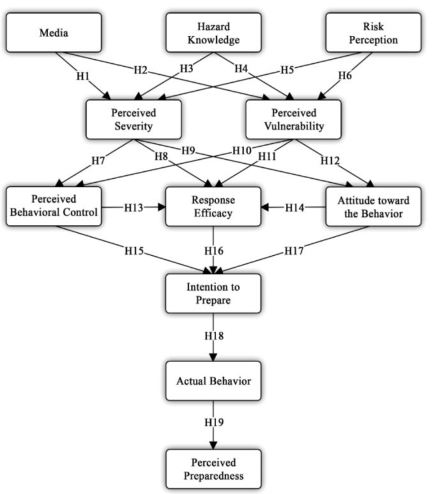
The framework (see Figure 1) presents variables integrated from the Theory of Planned Behavior (TPB) and Protection Motivation Theory (PMT). Variables from the Theory of Planned Behavior are (a) Attitude toward the Behavior and (b) Perceived Behavioral Control. On the other hand, the Protection Motivation Theory variables are (c) Perceived Severity, (d) Percei- ved Vulnerability, and (e) Response Efficacy. Moreover, variables from both theories, (f) Intention to Prepare and (g) Actual Behavior, and three (3) addi- tional variables are also studied: (h) Media, (i) Hazard Knowledge, and (j) Risk Perception. The researchers aim to find the relationship between the ten (10) factors mentioned above and conclusively determine if the identified factors significantly affect the eleventh variable: (k) perceived preparedness. It shows the relationships of each of the nineteen (19) hypotheses (see Table 1) to one another.
The perceived disaster preparedness behavior of the people is directly affected by TPB and PMT as well as the given variables in the study. Accor- ding to the hypothesized variables, people’s attitudes and responses rely on their base knowledge and evaluation of their situation. The people’s assessments are vital to their perceived preparedness as their intention and
Figure 1: Conceptual framework.
behavior must be solidified to reduce their vulnerabilities in a negative event.
METHODS
The researchers targeted the study’s respondents as male and female senior high school graduates from private and public schools aged 16 to 24 years old residing in Luzon, Philippines, where the “Big One” worst-case earthqu- ake scenario will occur. Moreover, students with Disaster Risk Reduction and Management (DRRM) under their curricula were the focus of the study to determine the effectiveness. The researchers constructed a self-administered survey questionnaire based on the observed variables of the conceptual fra- mework (see Figure 1) formed from related literature. It is a structured form in which respondents complete the survey without the researchers’ intervention (i.e., the interviewer) upon collecting the data. The gathered respondents’ profiles can provide useful information for this and future stu- dies and interventions to improve earthquake preparedness behavior among senior high school graduates in the Philippines. It included the following sections: (1) demographic information such as age, gender, types of gradua- ted school, location of the school, graduated senior high school strand, and graduated batch, and (2) the observed measures that recognized the signifi- cant factors influencing the earthquake preparedness behavior of the target participants. The researchers used a 5-point Likert scale to measure indica- tors and gathered five hundred and five (505) responses. Structural Equation Modeling (SEM) was used to analyze the data to identify their factors and
No. Hypotheses H1 The media has a direct significance to people’s perception of the severity of an earthquake scenario. H2 The media has a direct significance to the perceived vulnerability of the people during an earthquake scenario. H3 The hazard knowledge of the people has a direct significance to their perception of the severity of an earthquake scenario. H4 The hazard knowledge of the people has a direct significance to their perceived vulnerability during an earthquake scenario. H5 The risk perception of the people has a direct significance to their perceived severity of an earthquake scenario. H6 The risk perception of the people has a direct significance to their perceived vulnerability during an earthquake scenario. H7 The perceived severity of the people has a direct significance to their perceived behavioral control during an earthquake scenario. H8 The perceived severity of the people has a direct significance to their response efficacy during an earthquake scenario. H9 The perceived severity of the people has a direct significance to their attitude toward earthquake preparedness behavior during an earthquake scenario. H10 The way people perceive their own vulnerability has a direct significance to the way they perceive their control of the behavior. H11 The way people perceive their own vulnerability has a direct significance to their response efficacy. H12 The way people perceive their own vulnerability has a direct significance to their attitude toward earthquake preparedness behavior. H13 The perception of people on how they control the behavior has a direct significance to their response efficacy. H14 The attitude of people toward earthquake preparedness behavior has a direct significance to their response efficacy. H15 The perception of people on how they control the behavior has a direct significance to their intention to prepare. H16 The response efficacy of people has a direct significance to their intention to prepare. H17 The attitude of people toward the earthquake preparedness behavior has a direct significance their intention to prepare. H18 The intention of people to prepare has a direct significance to their actual behavior during an earthquake scenario. H19 The actual behavior of the people has a direct significance to how they perceive their own preparedness.
their correlation to other variables. This technique seeks to explain the cau- sal interrelationships among variables expressed in a series of equations. The researchers utilized SPSS Amos in deriving SEM to determine the reliabi- lity and validity of the framework and provide the relationships between variables.
RESULTS
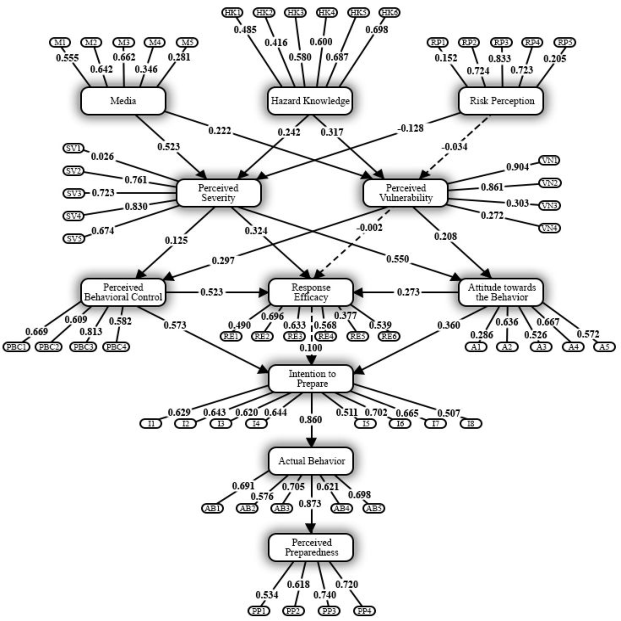
The initial SEM model (see Figure 2) was constructed from the conceptua- lized framework and using the gathered data from the administered survey, covering eleven (11) latent variables and 57 indicators representing the nine- teen (19) hypotheses. The framework along with data was ran through
Figure 2: Initial SEM model.
SPSS Amos to determine the beta coefficients of each indicator and each latent variable-relationship. Insignificant factors having regression weights less than 0.5 were removed to fit the model better and arrive at the final SEM model (see Figure 3). These were also considered ineffectual measures of the latent construct [Ong, Kurata et al., 2022].
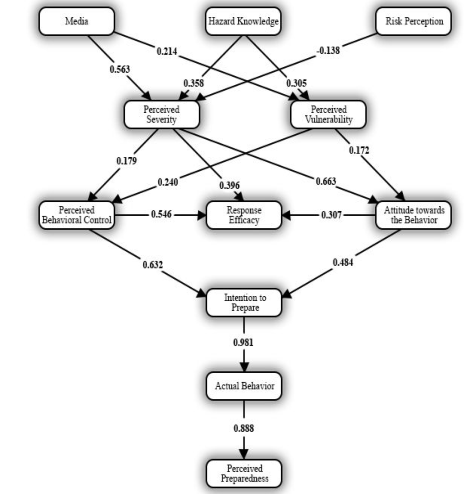
The fit indices used in the study are commonly used in structural equa- tion modeling (SEM) to evaluate the fit of a model to the observed data. Each index provides a different measure of model fit, and together they offer a comprehensive assessment of how well the model fits the data. Based on the results of the model fit indices: Incremental Fit Index (IFI), Tucker Lewis Index (TLI), Comparative Fit Index (CFI), Goodness of Fit Index (GFI), and Adjusted Goodness of Fit Index (AGFI), were within the minimum cut-off of 0.8 [Gefen et al. 2000], and the Root Mean Square Error of Approximation (RMSEA) implies a good model fit as it was less than 0.07 [Steiger, 2007] (see Table 2). The researchers found that one’s intention to prepare significantly affected their actual behavior in an earthquake. The relationship between the two factors was the highest beta value equating to 0.981 (p = 0.002). Securing items at home, preparing an emergency kit, storing consumables, mustering information about evacuation sites and earthquake risks, and participating in
Figure 3: Final SEM model.Table 2. Model fit indices.
Table available in the original PDF paper.
Suggested by
Goodness of Fit Measures Parameter Estimates
Minimum Cut-off
0.051 < 0.07 [Steiger 2007]
Incremental Fit Index (IFI) 0.858 > 0.80 [Gefen et al. 2000] Tucker Lewis Index (TLI) 0.842 > 0.80 [Gefen et al. 2000] Comparative Fit Index (CFI) 0.856 > 0.80 [Gefen et al. 2000] Goodness of Fit Index (GFI) 0.822 > 0.80 [Gefen et al. 2000] Adjusted Goodness of Fit Index (AGFI) 0.800 > 0.80 [Gefen et al. 2000] Root Mean Square Error of Approximation (RMSEA)
drills or practices had significantly affected how they prepare for an earthqu- ake. Also, Media (M) has a significant relationship with Perceived Severity (SV) (β = 0.564; p = 0.001). Using new media played an essential part in the effectively transmitting and communicating disaster information [Kavota et al, 2020]. The results coincide with Hong et al. (2019) where traditional and new media, had a positive significant effect on emergency preparedness and perceived severity of disasters. Also, it was discovered that it is positively associated with Perceived Vulnerability (VN) (β = 0.214; p = 0.001). The media provided an important public service during disasters through bro- adcasting alerts and advisories, playing an integral part in the individual’s susceptibility to earthquake events.
Furthermore, Hazard Knowledge (HK) was found to be a significant factor towards Perceived Severity (SV) (β = 0.358; p = 0.001). Ong et al. (2022) sta- tes that the understanding and awareness of earthquakes, taking precau- tionary measures and knowledge of affected areas and evacuation sites,
were positively associated with perceived severity and perceived vulnerability. Also, it had a significant direct effect towards Perceived Vulnerability (VN) (β = 0.305; p = 0.002). An individual’s awareness of earthquakes which may cause loss of lives and damage to environment and property affects perception of threat of the respondents. According to Becker et al. (2017) having a true understanding of the consequences and a reflection of their own vulnerability helped develop hazard preparedness and may be an influence in motivating people to be more prepared.
While Perceived severity (SV) significantly impacts the Perceived Behavioral Control (PBC) with direct effect value and p-value (β = 0.179; p = 0.009). As a result, people considered the earthquake a threat that may provide danger to citizens, livelihood, and community, which caused the participants to take precautionary measures to prepare for any earthquake event and damage. Jou et al. (2022) mentioned that individual perspecti- ves on the severe consequences to the surroundings greatly impact people’s behavior to respond. Similarly, Ong et al. (2021) showed a connection betw- een people’s perceived severity of earthquake risks towards preparedness and fear of the situation. Also, it affected Response Efficacy (RE) signi- ficantly, accumulating the values (β = 0.396; p = 0.001). With that, the potential risks caused by earthquakes increase the ability of people to take the recommended actions to prevent damage and injuries. Gumasing et al. (2022) stated that when people feel vulnerable to natural disasters, people adopt protective measures. Regarding this, Kurata et al. (2022) discussed how perceived severity influences people’s responses to the seriousness of the situation when human lives, properties, or livelihood are at risk. It is concluded that seeing the perceived severity of the aftermath provides an individual with better response efficacy. Additionally, its significant relati- onship with Attitude towards the Behavior (A) with the third highest direct effect value (β = 0.663; p = 0.003) resulted that the adverse outcomes of earthquakes associated with every individual affected their response beha- vior when preparing for earthquake events. Kurata et al. (2022) livelihood and resource rebuilding significantly impact people’s preparedness behavior in disasters. Also, Tyas, R. A., & Pujianto (2020) states that knowledge about the physical vulnerability of residential homes and buildings was essential to understanding since it influenced people’s attitude to be ready and immer- sed in anticipating disasters, especially for those who lived in disaster-prone areas.
Furthermore, the Risk Perception (RP) had a significant effect on Percei- ved Severity (SV) (β = −0.138; p = 0.007). The personal judgment of a person towards potential harm affected how severe an individual perceives the adverse effects in the event of an earthquake. Interestingly, Perceived Vulnerability (VN) had a directly significant relationship to Perceived Beha- vioral Control (PBC), accumulating the values of (β = 0.240; p = 0.001). The vulnerability of the people and community to earthquakes influe- nced the behavior to take necessary measures to avoid dangers from the disaster. The study by Ong et al. (2021) stated that indicators such as residence vulnerability, experience-based exposure, and suspect that the family and community will be affected increase the perceived behavioral
control of every individual. Also, Kurata et al. (2022) explained that people improve their preparedness behavior due to community vulnerabi- lity and personal disaster experiences. Then, it directly and significantly affects Attitude towards the Behavior (A) with a beta value and p-value (β = 0.172; p = 0.005). The perceived vulnerability of the person, in terms of their susceptibility, affected the behavior regarding the effects of earthquakes.
Perceived Behavioral Control (PBC) has a significant direct effect on Response Efficacy (RE) with direct effect value and p-value (β = 0.546; p = 0.003). It depicted that the confidence or the participant’s to take pre- cautionary measures against the earthquake damages, directly affected the person’s belief of whether a recommended action or behavior will effectively avoid the threat. Also, it had a significant direct effect on Intention to Pre- pare (I) with direct effect value and p-value (β = 0.632; p = 0.002). The participant’s behavior regarding the effects of earthquakes directly affected encouragement in terms of preparedness intention, which interacts with the actual behavior or actual earthquake preparedness of a person. While the Attitude towards the behavior (A) had a significant direct effect on Response Efficacy (RE) with direct effect value and p-value (β = 0.307; p = 0.027). It showed that the person’s behavior regarding the effects of earthquakes directly affects the individual’s belief of whether a recommended action or behavior will effectively avoid the threat. Then, its direct relationship with the Intention to Prepare (I), accumulating the value β = 0.484 with a signi- ficance of p = 0.002 indicated that people’s attitude toward the behavior directly affects their intentions to prepare for an earthquake.
The respondents’ perception of preparedness is directly affected by their actual behavior in an earthquake scenario (β = 0.888; p = 0.002). Due to familiarity with tasks to perform, willingness to gain knowledge and learn new skills, integration, gathering relevant information, and attenti- veness to earthquakes, people may become more confident in their know- ledge, skills, and understandings from earthquake education programs and training.
Additionally, the relationship of Risk Perception (RP) to Perceived Vulnerability (VN), Perceived Vulnerability (VN) to Response Efficacy (RE), and Risk Efficacy (RE) to Intention to Prepare (I). since their p-values were greater than 0.05. The perception of people in terms of safety and occurre- nce of earthquakes in the localities did not affect the human and community’s susceptibility to every earthquake event. The perception of people on earth- quake risks had no implications on how vulnerable the participants were during earthquake. While, the perceived vulnerability of the people, in terms of their judgments, did not affect the people’s belief of whether a recommen- ded action or behavior will effectively avoid the threat. Thus, the assessments had no implications on how the individuals’ actions affected the behavior to minimize or prevent the effects of an earthquake. Lastly, the person’s belief in the efficacy of a response did not affect their intention to prepare for an ear- thquake. With that, the person’s belief that the recommended action would mitigate the threat had no implications on people’s intention to be ready for disaster.
The results also show that the perception of senior high school graduates in terms of risk quite challenges them, as 16.2% of the respondents are unsure of the safety of their locality, and 10.4% are hesitant due to their home’s abi- lity to withstand an earthquake. In these instances, the Centers for Diseases Control and Prevention (CDC) (2020) suggests familiarizing sturdy parts or furniture of the house for shelter during earthquakes (e.g., beds, tables, or desks) and should avoid outer walls, windows, hanging objects, and firepla- ces during and after earthquakes. A certain percentage of the respondents (7.4%) are unaware of the earthquake plan of their schools, and 12.6% are unaware of the active faults near their homes.
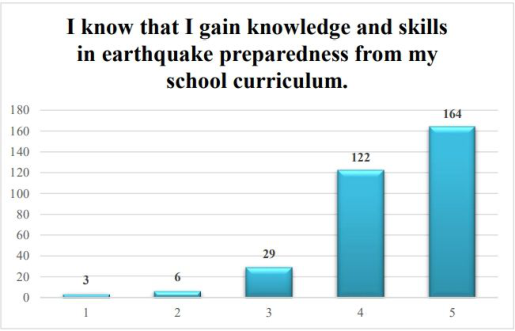
Additionally, Disaster Risk Reduction and Management education may help raise awareness by understanding first the hazards and vulnerabilities of various earthquake situations and discussing the actions and preventive measures. The results for item PBC4 (see Figure 4) explain that the stu- dents know that they gain knowledge and skills in earthquake preparedness from their school curriculum. Students who took STEM and GAs strands (64.16% of the respondents) mostly agree, which indicates that their DRRM course effectively teaches them the knowledge and skills needed to prepare for earthquakes.
Figure 4: PBC4 responses.
CONCLUSION
The results explain that students’ perception of their own preparedness depends on their actual behavior during earthquakes. Additionally, disa- ster risk reduction and management education may enhance awareness by first comprehending the risks and vulnerabilities of various earthquake circumstances and then going over the actions and preventative measures.
This study offers new advancements in research on disaster risk reduction and management. The Philippines is disaster-prone, and studies on natural disasters are insufficient. Additionally, this offers fresh perspectives and noti- ons on disaster risk reduction and management that were not discussed in earlier research journals. Research on the usefulness of senior high school disaster management programs is needed.
Becker, J. S., Paton, D., Johnston, D. M., Ronan, K. R., & McClure, J. (2017).
The role of prior experience in informing and motivating earthquake pre- paredness. International Journal of Disaster Risk Reduction, 22, 179–193. doi: 10.1016/j.ijdrr.2017.03.006. Gefen, David; Straub, Detmar; and Boudreau, Marie-Claude (2000) “Structural Equation Modeling and Regression: Guidelines for Research Practice,” Com- munications of the Association for Information Systems: Vol. 4, Article 7. DOI: 10.17705/1CAIS.00407. Gumasing, M. J. J., Prasetyo, Y. T., Ong, A. K. S., & Nadlifatin, R. (2022). Determina-
tion of factors affecting the response efficacy of Filipinos under Typhoon Conson 2021 (Jolina): An extended protection motivation theory approach. International Journal of Disaster Risk Reduction, 70, 102759. https://doi.org/10.1016/j.ijdrr. 2021.102759. Hair, J., Black, W., Babin, B., & Anderson, R. (2019). Multivariate Data Analysis.
Cengage Learning. Hong Y. X., Kim J. S., Xiong L. H. Media exposure and individuals’ emergency preparedness behaviors for coping with natural and human-made disasters. J Environ. Psychol. 2019;63:82–91. doi: 10.1016/j.jenvp.2019.04.005. Kavota J. K., Kamdjoug J. R. K., Wamba S. F. Social media and disaster management:
Case of the north and south Kivu regions in the Democratic Republic of the Congo. Int. J. Inf. Manag. 2020:102068. doi: 10.1016/j.ijinfomgt.2020.102068. Kurata, Y., Prasetyo, Y., Ong, A., Nadlifatin, R., Persada, S., Chuenyindee, T., & Cahigas, M. (2022). Determining factors affecting preparedness beliefs among Filipinos on Taal volcano eruption in Luzon, Philippines. International Journal of Disaster Risk Reduction, 76, 103035. doi: 10.1016/j.ijdrr.2022.103035. Ong, A., Prasetyo, Y., Lagura, F., Ramos, R., Sigua, K., & Villas, J. et al. (2021).
Factors affecting intention to prepare for mitigation of “the big one”earthquake in the Philippines: Integrating protection motivation theory and extended theory of planned behavior. International Journal of Disaster Risk Reduction, 63, 102467. doi: 10.1016/j.ijdrr.2021.102467. Prasetyo, Y., Kurata, Y., Acosta, A., Aben, A., Persada, S., Nadlifatin, R., & Redi, A. (2021). Factors affecting response actions of the 2020 Taal Volcano eruption among Filipinos in Luzon, Philippines: A structural equation mode- ling approach. International Journal of Disaster Risk Reduction, 63, 102454. doi: 10.1016/j.ijdrr.2021.102454. R A Tyas and Pujianto 2020 J. Phys.: Conf. Ser. 1440 012086. Steiger, J. H. (2007). Understanding the Limitations of Global Fit Assessment in Stru-
ctural Equation Modeling. Personality and Individual Differences, 42, 893–898. https://doi.org/10.1016/j.paid.2006.09.017. Teves, C. (2021, August 13). NAMRIA seeks safe open spaces for the “Big One.” Philippine News Agency. https://www.pna.gov.ph/articles/1150374#: %7E: text=The%20%E2%80%9CBig%20One%E2%80%9D%20is%20a, Volcano- logy%20and%20Seismology%20(Phivolcs). UN Office for Disaster Risk Reduction. (2019). Essential Nine: Ensure Effective
Disaster Response. Retrieved from https://www.unisdr.org/campaign/resilientcit ies/home/article/essential-nine-ensure-effective-disaster-response.html. Wang, J. & Tsai, N. (2022). Factors affecting elementary and junior high school teachers’ behavioral intentions to school disaster preparedness based on the theory of planned behavior. International Journal of Disaster Risk Reduction, 69, 102757. https://doi.org/10.1016/j.ijdrr.2021.102757.
LISTED IN THE AHFE DIGITAL BOOKSTORE CATALOGUE
Explore the complete digital volume
Training, Education, and Learning Sciences
Read this individual research paper free through the original publisher, or explore the full digital proceedings book.
ISBN 978-1-958651-85-8
Explore this ISBN in the AHFE Bookstore ↗Listed in the July 2026 bookstore catalogue; search by ISBN to confirm current availability · Digital book purchase optional