Joehanna Ngo, Yoshiki Kurata, Zyra Mae Sicat, Dannah Isabelle Buñas, Jaylord Gutierrez, Pamela Pangilinan, Pamela Ann Mae Pascual (2022). Lifestyle-related Factors affecting Physical Inactivity Issues among Filipino Aging Population during the COVID-19 Pandemic: A Multiple Regression Approach. In: Global Issues: Disease Control and Pandemic Prevention. AHFE Open Access, vol. 24, pp. 37–45. https://doi.org/10.54941/ahfe1001357
Publisher statistics will load when you open Metrics.
AHFE OPEN ACCESS OPEN ACCESS CONFERENCE PROCEEDINGS PAPER
Lifestyle-related Factors affecting Physical Inactivity Issues among Filipino Aging Population during the COVID-19 Pandemic: A Multiple Regression Approach
In the Philippines, physical inactivity is a significant concern among the elderly population. Due to the COVID-19 pandemic, most elderly people have stayed inside their residences, limiting to their routine requirements of daily physical activities and prevention in their exposure to the virus. Alcohol consumption and motivation contributes to how elderly population were limited to basic physical activities. This paper aimed to determine the factors affecting less physical inactivity among the ninety-seven Filipino elderly population through multiple regression analysis. Results were gathered through online surveys and showed that alcohol consumption (p-value = 0.015) and motivation (p-value = 0.000) contribute to how elderly population were limited to do basic physical activities. Recommendations include a weekly physical activity guide plan and low-intensity physical activities such as walking and stretching without compromising government restrictions due to the COVID-19 pandemic.
Aging is known as one factor affecting the decline in physical activity [Moncatar et al. 2020]. In older adults aged 50–64 years old, 25% declared themselves physically inactive (Watson 2016). (Kivimaki et al. 2019) stated that insufficient physical activity is consistently associated with an increased risk of chronic illnesses. Globally, the estimated annual number of deaths rela- ted to physical inactivity is over 5 million (Roschel et al. 2020). The benefits provided by physical activities are categorized according to immediate and long-term benefits as immediate benefits include improving the quality of
sleep, reducing feelings of anxiety, and reducing blood pressure. On the other hand, long-term benefits include reduction of risks of developing dementia (including Alzheimer’s disease) and depression, lowers the risk of heart dise- ase, stroke, type 2 diabetes, and eight cancers such as bladder, breast, colon, endometrium, esophagus, kidney, lung, and stomach [Centers for Disease Control and Prevention 2020].
Further, regular physical activity is shown to impact senior citizens’ phy- sical and mental health positively; hence, performing regular exercise and maintaining an active lifestyle may benefit aging [Yen & Lin 2018, Carlson et al. 2018]. [Warburton & Bredin 2019] stated that maintaining an active lifestyle and engaging in physical activity has shown to have risk reducti- ons of 20% to 30% for premature mortality and has improved the quality of life in patients with cardiovascular diseases as well as chronic medical conditions such as asthma, Parkinson’s disease, Alzheimer’s disease, arth- ritis, and diabetes. This study aimed to determine the factors leading to physical inactivity among senior citizens using multiple linear regression. Moreover, the study is deemed vital as it seeks to recommend an exercise plan that would potentially aid difficulty in commencing physical activities campaigning withdrawal of harmful habits such as vices or improper eating habits.
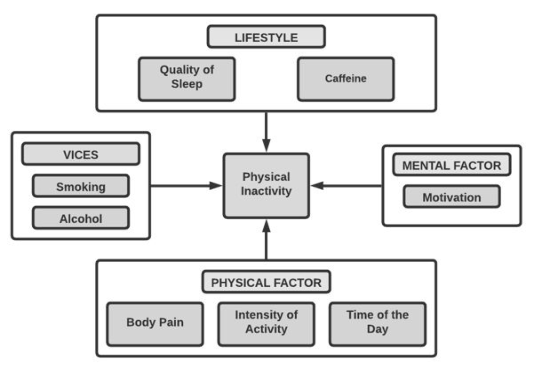
CONCEPTUAL FRAMEWORK The researchers developed the conceptual model to pinpoint the factors that lead to physical inactivity among Filipino senior citizens [Rai et al. 2019]. Based on literature assessments done, the intensity of physical activity dra- matically contributes to physical inactivity among senior citizens. Factors in the study considered the independent variables such as Smoking, Alco- hol, Caffeine Intake, Level of Physical Activity, Time of the Day, Quality of Sleep, Body Pain, and Motivation, while Sedentary Lifestyle as the dependent variable.
These factors were considered for the following reasons: Smoking pro- duces carbon monoxide, a component of tobacco products that attaches to red blood cells and displaces oxygen when inhaled [Caponnetto et al. 2018]. This directly impacts a person’s physical endurance due to a lack of effici- ent oxygen supply to muscles and other bodily tissues, which affects active smokers’ airways and lungs, as well as regular inhalation of second-hand smoke [Gibbs et al. 2016]. Thus, it causes shortness of breath and difficulty in performing physical activities. Most smokers typically consume alcohol, which causes central nervous system depression, leading to poor motor skills, coordination, delayed reactions, impaired judgment, and impaired balance, depending on the dose [Siekaniec 2017]. Thus, smokers and alcohol drinkers have the possibility of contributing to lesser physical activities. Moreover, coffee, along with energy drinks, is the primary source of caffeine and is one of the most widely consumed liquids on the planet [Reyes & Cornelis 2018]. According to [Schrager 2017], reducing senior citizens’ caffeine intake will help maximize sleep and reduce the effects of mood, risk of falling, daytime sleepiness, and next-day physical activity.
Lifestyle-related Factors Affecting Physical Inactivity Issues among Filipino 39
Figure 1: Conceptual framework.
Performing physical activity regularly is significant in keeping in shape, and one of the determinants influencing physiological outputs from exercise is the time of movement. Time of the day is considered since exercising while fasted (often first thing in the morning) is better for weight maintenance than exercising while fed (Sato et al. 2019). Motivation is also a key aspect in sustaining exercise to lose weight which is linked to various positive health effects and is thus a necessary factor. Studies suggest that consciously valuing a goal and intrinsic motives such as overcoming challenges and enjoying a workout predict physical activity [Rodrigues 2018]. One-third of older peo- ple in the Philippines (33%) said they are frequently bothered by pain, with no obvious gender difference. More than half of those in pain (58%) had moderate pain, while a tenth has severe pain (Cruz et al. 2019). Thus, this also shows that bodily pains directly contribute to immobility, thus decre- asing the physical capabilities of senior citizens. With this in consideration, body pain is also considered a factor.
METHODS
The subjects considered in this study are senior citizens living within the Philippines’ metropolitan and nearby rural areas. The researchers used a descriptive-normative survey as the developed questionnaire was distribu- ted online due to the restrictions imposed by the COVID-19 restrictions and quarantine rules. In developing the questionnaire, the researchers deter- mined the appropriate tools and considered these as good data collection instruments. To measure the intensity of activities by the respondents, this paper utilized the Physical Activity Scale for the Elderly (PASE) and com- puted it daily. Second, in measuring for the body pain experienced, the developed chronic pain measurement of [Parsons et al. 2006] was used. Lastly, sleep quality was determined using the Pittsburgh Sleep Quality Index (PSQI).
Table 1. Descriptive statistics of participants (n = 97).
Table available in the original PDF paper.
Demographics Frequency Percentage Gender Male 39 40.21 Female 52 53.61 Rather not say 6 6.19 Age 60 – 64 years old 37 38.14 65 – 68 years old 31 31.96 69 – 72 years old 15 15.46 73 – 76 years old 5 5.15 77 – 80 years old 7 7.22 81 – 84 years old 2 2.06 Marital Status Single 14 14.43 Separated 4 4.12 Married 54 55.67 Widowed 25 25.77 Residence Urban 83 85.57 Rural 14 14.43 Still Working? Yes 16 16.49 No 81 89.69
In this study, 97 older people participated (see Table 1). With the absence of physical interactions in gathering pertinent data for the paper, the researchers considered the lack of technical knowledge among the aging population in the Philippines. To aid the older people in answering the developed question- naire, with the help of social media, the researchers conducted data gathering through interviews done online or through telephone calls. Table 2 shows the data measures used in gathering the data.
To answer the research hypotheses, the researchers utilized the Minitab Statistical Software to calculate and analyze the parameters set in the study. Multiple regression and correlation analyses were done to determine the significant factors affecting the physical inactivity among aging people, and its level of relationship to forecast its trend [Necio et al. 2019].
RESULTS
Spearman’s correlation was used to analyze any association between the study’s variables. This analysis will then produce a table with a correlation coefficient r or ρ (rho) that will indicate the strength of the relationship betw- een two variables. The coefficient r-values can range from −1.00 to 1.00, wherein 1.00 translates to a perfect linear relationship. Thus, the values clo- ser to 1 present a stronger relationship. The coefficient r values above imply that smoking and alcohol have the strongest association with an r-value of 0.689 while sedentary and motivation follow with an r-value of 0.607. Both pairs above have a p-value of 0.000 which means both relationships are significant.
Regression analysis was performed to determine the statistically signifi- cant factors influencing the physical inactivity of Filipino senior citizens.
Lifestyle-related Factors Affecting Physical Inactivity Issues among Filipino 41
Table 2. Data measures (instrumentation).
Table available in the original PDF paper.
References
Factor Unit of Measurement
Measurement Instrument
Cronbach’s Alpha
- -
Smoking Packs per week* Questionnaire - - Alcohol Intake
Bottles/cans per week**
0.87 Heaton (2012)
Caffeine Intake
Cups per week*** Periods Questionnaire - - Time of the Day
Intensity of Activity
Likert Scale Questionnaire 0.75 Physical Activity Scale for the Elderly (PASE) Sleep Quality
Likert Scale Questionnaire 0.83 Pittsburgh Sleep Quality Index (PSQI) Body Pain Likert Scale Questionnaire 0.91 Parsons et al., (2006) Motivation Likert Scale Questionnaire 0.84 RM 4–FM: Motivation for Physical Activity Questionnaire *Packs of cigarette = 29 milligrams of Nicotine content × Number of cigarette packs per week **Bottle/can per week = 5% alcohol by volume ***Cups per week = Caffeine content (in milligrams) × Number of intake
Table 3. Spearman’s correlation analysis.
Table available in the original PDF paper.
Factor Smoking Alcohol Caffeine Time
Sedentary Intensity of Day Body Pain of activity Sleep Diffi- culty
−0.135 0.023 0.295
Alcohol 0.689 Caffeine 0.084 0.217 Time of Day −0.014 0.084 0.280 0.285 0.276 Sedentary −0.118 −0.211 0.174 0.002 Intensity of activity
Based on the results generated by Minitab statistical software, factors such as Alcohol (p-value = 0.015), Motivation (p-value = 0.000), Time of Day (p-value = 0.000), and Body pain (p-value = 0.000). According to [Dela Cruz 2016], there is an association between the physical activity partici- pation of older adults and lack of time, social influence, and willpower,
Coefficients Term Coef SE Coef T-Value P-Value VIF
Constant 1.216 0.150 8.10 0.000 Alcohol −1.941 0.772 −2.51 0.015 1.36 Motivation 0.1240 0.0125 9.91 0.000 1.41 Time of Day −0.514 0.115 −4.45 0.000 1.58 Body Pain 0.759 0.301 2.52 0.015 1.25
which are all related to a person’s motivation, thus resulting in a direct con- tributor to physical inactivity. Based on our data, most physically active respondents are motivated by intrinsic factors related to their health and self-satisfaction.
On another note, even if dose-dependent, the general consumption of alcohol can lead to impaired motor skills, reduce coordination, deferred reactions, misjudgements, and loss of balance [Siekaniec 2017], which can affect physical movements and eventually lead to physical inactivity. More- over, considering time of the day, exercising while fasted (commonly in the morning) is better for weight maintenance than in a fed state [Chomistek et al. 2016]. It is a prominent factor in physical inactivity because senior citizens’ will to exercise is lessened when missing the ideal morning time. Lastly, an elderly person that is affected by a disease or bone fractures often experie- nces a lack of mobility and pain. It usually sets when bones and muscle groups need to be stimulated but cannot be, further reducing mobility and thus cre- ating more pain [UEW 2018]. Therefore, this indicates that bodily pains directly contribute to immobility, thus decreasing the physical capabilities of senior citizens.
The results’ variance inflation factors (VIF) are significant indicators or measures of the multicollinearity presence in each data set [Kurata & Matias 2018]. In general, a VIF should not exceed a value of 5. As the highest variance inflation factor in this paper is 1.58, the study concludes that no multicollinearity exists in the study’s data.
Lifestyle-related Factors Affecting Physical Inactivity Issues among Filipino 43
CONCLUSION
Based on the results, four factors were found to significantly contribute to Physical inactivity among senior citizens in the Philippines. Motivation, time of day, and body pain exhibit the most influence with a coefficient P-value of 0.000, while alcohol has a P-value of 0.015. According to the [Statista Rese- arch Department 2021], 33.3 percent of those aged 60 to 69 were consumers of alcohol in the Philippines during 2019. Alcohol drinkers made up 49.4% of males and 14.8% of females in the aging population during the same year, apparently because drinking is considered as one of the social norms. With this, the elderly must focus and keep a close eye on their alcohol consumption, as too many leads to physical inactivity and various illnesses. As a recom- mendation, older adults should participate in a 50-minute aerobic activity of moderate intensity or 75-minute aerobic activity of vigorous-intensity, as well as muscle-strengthening activities for two or more days per week. Addi- tionally, it is recommended that each barangay or small community conduct weekly activities and seminars that promote and encourage senior citizens to participate in physical activities. With the goal of improving their physical, psychological, and social health, most of the elderly population are motiva- ted to engage in physical activities by the advice of a physician and a desire to regain their full function. Aging Filipinos are also motivated to improve their aerobic condition and flexibility for increased mobility, strengthen their legs and upper body, and refine their balance and coordination to prevent falls. The older adults will comply with an exercise program that has personal relevance to them. They can benefit from group exercises that will encou- rage their social interaction with a friendly instructor, songs with mid-range vocals, and music with moderate tempo and an easily identified beat. Adhe- rence to the exercise program will continue if it consistently provides positive experience to the individual.
Furthermore, older adults must also engage in physical activities that are not too difficult to follow to stimulate bones and muscle groups to reduce immobility and prevent body pain. An early morning workout is recom- mended and best for weight loss as the fat burn is highest when exercising before breakfast. These factors will generate the feeling of belongingness, a key ingredient in motivating older adults to exercise. With all these conside- red, maintaining an active lifestyle can reduce the risk of developing diseases among older adults that might otherwise arise if they are not prevented.
REFERENCES
Caponnetto, P., Maglia, M., Prosperini, G., Busà, B., Polosa, R., (2018). Carbon monoxide levels after inhalation from new generation heated tobacco products. Respir Res 19, 164. https://doi.org/10.1186/s12931-018-0867-z Carlson, Susan A.; Adams, E. Kathleen; Yang, Zhou; Fulton, Janet E. (2018). Percen-
tage of Deaths Associated With Inadequate Physical Activity in the United States. Preventing Chronic Disease, 15(), 170354–. doi:10.5888/pcd18.170354 Chomistek, Andrea K., Shiroma, Eric J., Lee, I-Min (2016). The Relationship between Time of Day of Physical Activity and Obesity in Older Women. Journal of Physical Activity and Health, 13(4), 416–418. doi:10.1123/jpah.2015-0152
Cruz, C. J. P., Cruz, J. C. P., Sait¯o, Y., Economic Research Institute for ASEAN and East Asia, & Demographic Research And Development Foundation, I. (2019). Ageing and Health in the Philippines. Economic Research Institute for ASEAN and East Asia (ERIA). Dela Cruz, J., Monte, R., & Buan, A. (2016). Physical activity participation and
perception of older adults living in a Philippine rural community Authors. Asia Life Sciences, 25(1), 281–290. https://www.researchgate.net/publication /289608026_Physical_activity_participation_and_perception_of_older_adults_l iving_in_a_Philippine_rural_community Gibbs K., Collaco J. M., & McGrath-Morrow S. A. (2016). Impact of tobacco smoke and nicotine exposure on lung development. Chest Journal, 149(2), 552–561.10.1378/chest.15-1858 Health benefits of physical activity for adults. (2020, December 2). Centers for Dis-
ease Control and Prevention. http://www.cdc.gov/physicalactivity/basics/adults/h ealth-benefits-of-physical-activity-for-adults.html Hayes, A. (2021, March 30). Multiple Linear Regression (MLR) Definition. Investopedia. https://www.investopedia.com/terms/m/mlr.asp Kivimaki, M., Singh-Manoux, A., Pentti, J., Sabia, S., Nyberg, S., Alfredsson, L.,
Goldberg, M., Knutsson, A., Koskenvuo, M., Koskinen, A., Kouvonen, A., Nor- din, M., Oksanen, T., Stranberg, T., Suominen, S., Theorell, T., Vahtera, J., Vaananen, A., Virtanen, M., Jokela, M. (2019). Physical inactivity, cardiometa- bolic disease, and risk of dementia: An individual-participant meta-analysis. BMJ Clinical Research. doi:10.1136/bmj.l1495 Kurata, Y. B., & Matias, A. C. (2018). Work-Related Factors Affecting Sustained Alert State Among Bank Security Personnel in the Philippines. In L. E. Freund & W. Cellary (Eds.), Advances in The Human Side of Service Engineering (pp. 193–202). Springer International Publishing. Moncatar, TJ Robinson; Nakamura, Keiko; Siongco, Kathryn Lizbeth; Rahman,
Mosiur; Seino, Kaoruko (2020). Prevalence and Determinants of Self-Reported Injuries among Community-Dwelling Older Adults in the Philippines: A 10-Year Pooled Analysis. International Journal of Environmental Research and Public Health, 17(12), 4372–. Doi: 10.3390/ijerph17124372 Necio, A. J. F., Batac, N. E. C., Odias, T. M. P., Ricafort, J. L. B., Salazar, R. R., & Kurata, Y. B. (2019). Postural Analysis among Machinists Experiencing Work- related Musculoskeletal Disorders in the Philippines. IEEE International Con- ference on Industrial Engineering and Engineering Management, 2015, 59–63. https://doi.org/10.1109/IEEM44572.2019.8978765 Parsons, S., Carnes, D., Pincus, T., Foster, N., Breen, A., Vogel, S., & Underw-
ood, M. (2006). Measuring troublesomeness of chronic pain by location. BMC Musculoskeletal Disorders, 7(1). doi:10.1186/1471-2474-7-34 Rai, Rajni; Jongenelis, Michelle I.; Jackson, Ben; Newton, Robert U.; Pettigrew, Simone (2019). Factors influencing physical activity participation among older people with low activity levels. Ageing and Society, (), 1–21. doi:10.1017/S0144686X1900076X Rodrigues, F., Bento, T., Cid, L., Pereira Neiva, H., Teixeira, D., Moutão, J., . . .
Monteiro, D. (2018). Can interpersonal behavior influence the persistence and adherence to physical exercise practice in adults? A systematic review. Frontiers in Psychology, 9. doi:10.3389/fpsyg.2018.02141 Roschel, H., Artioli, G., & Gualano B. (2020). Risk of Increased Physical Inactivity during COVID-19 Outbreak in Older People: A Call for Actions. PubMed. https://pubmed.ncbi.nlm.nih.gov/32392620/
Lifestyle-related Factors Affecting Physical Inactivity Issues among Filipino 45
Sato, Shogo; Basse, Astrid Linde; Schönke, Milena; Chen, Siwei; Samad, Muntaha; Altınta¸s, Ali; Laker, Rhianna C.; Dalbram, Emilie; Barrès, Romain; Baldi, Pierre; Treebak, Jonas T.; Zierath, Juleen R.; Sassone-Corsi, Paolo (2019). Time of Exercise Specifies the Impact on Muscle Metabolic Pathways and Systemic Energy Homeostasis. Cell Metabolism, (), S1550413119301834–. doi:10.1016/j.cmet.2019.03.013 Schrager, M.A. (2017). Addictive Substances and Neurological Disease || Sleep,
Caffeine, and Physical Activity in Older Adults. , (), 365–371. doi:10.1016/B978- 0-12-805373-7.00031-1 Siekaniec, M. C. S. (2017, June 1). The Effects of Alcohol on Athletic Performance. NSCA. https://www.nsca.com/education/articles/nsca-coach/the-effects-of-alcohol- on-athletic-performance2/ Statista. (2021, November 23). Share of the ageing population who drinks alcohol Philippines 2019, by age group. http://www.statista.com/statistics/1116303/phil ippines-share-ageing-population-who-drinks-alcohol-by-age-group/ Warburton, D., & Bredin, S. (2019). Health Benefits of Physical Activity: A Strengths-
Based Approach. Journal of Clinical Medicine. doi: https://doi.org/10.3390/jc m8122044 Watson, K. B., Carlson, S. A., Gunn, J. P., Galuska, D. A., O’Connor, A., Greenlund, K. J., & Fulton, J. E. (2016). Physical Inactivity Among Adults Aged 50 Years and Older — United States, 2014. MMWR. Morbidity and Mortality Weekly Report, 65(36), 954–958. https://doi.org/10.15585/mmwr.mm6536a3 Yen, H., & Lin, L. (2018). Quality of life in older adults: Benefits from the produ-
ctive engagement in physical activity. PubMed. https://pubmed.ncbi.nlm.nih.gov/ 30662493/ UEW Team (2019, August 6). Managing Movement Pain in Seniors. UEW Healthcare. https://www.uewhealth.com/managing-movement-pain-seniors/
LISTED IN THE AHFE DIGITAL BOOKSTORE CATALOGUE
Explore the complete digital volume
Global Issues: Disease Control and Pandemic Prevention
Read this individual research paper free through the original publisher, or explore the full digital proceedings book.
ISBN 978-1-958651-00-1
Explore this ISBN in the AHFE Bookstore ↗Listed in the July 2026 bookstore catalogue; search by ISBN to confirm current availability · Digital book purchase optional