Reich Alexandria Balubal, Hristos Wee Hugo Beronio, Gabriel Angelo Cabral, Eurica Shane Casao, Yoshiki Kurata (2026). Determining Factors Influencing Purchase Decision of Eco-Friendly Products among Filipino Generation Z Consumers. In: Human Factors, Business Management and Society. AHFE Open Access, vol. 215, pp. 182–191. https://doi.org/10.54941/ahfe1007599
Despite increasing environmental awareness, eco-friendly purchasing among youth remains inconsistent. This study examined the factors influencing eco-friendly product purchasing decisions among Filipino Generation Z consumers using the Theory of Planned Behavior and the Pro-Environmental Behavior Theory. The study analyzed the effects of attitudes, social norms, perceived behavioral control, education and eco-label awareness, green consciousness, green perceived value, and cultural values on eco-friendly product purchase. A descriptive-correlational research design was applied through an online survey of 500 Filipino Gen Z respondents aged 18–28 from different regions of the Philippines. The questionnaire consisted of demographic items and Likert-scale measures adapted from validated sources. Data were processed through the Partial Least Squares Structural Equation Modeling (PLS-SEM). Findings revealed that education, eco-label awareness, green consciousness, and perceived green value significantly influenced attitudes, social norms, and perceived behavioral control. These variables significantly affected behavioral intention, which strongly predicted actual eco-friendly product purchase. Cultural values significantly affected attitudes and social norms, but had no significant effect on perceived behavioral control. The study provides practical implications for marketing strategies, environmental education, and policy development to promote sustainable consumption.
According to Austria (2026), the Philippines is among the leading contributors to global marine plastic pollution. Despite Philippine government policies such as the Ecological Solid Waste Management Act of 2000, which mandates waste segregation, collection, and recycling, the implementation of this legislation has remained inconsistent (Official Gazette, 2001). As a result, plastic waste continues to accumulate in waterways and coastal areas.
Determining Factors Influencing Purchase Decision of Eco-Friendly Products 183 A major contributor to this problem is the excessive consumption of single-use plastics. The situation is further intensified by the Philippines’ characterization as a sachet economy, where consumer goods are commonly sold in small, single-use packaging to accommodate price-sensitive consumers. This system is largely driven by tingi culture, a retail practice in which products are purchased in small, affordable quantities (Montero, 2024).
In response to the growing waste management crisis, industries have introduced sustainable alternatives. Eco-friendly products, also referred to as sustainable or environmentally friendly products, are designed to minimize environmental harm throughout their life cycle, from production and usage to disposal (Loughlin, 2023). The increasing presence of these products in the Philippine market reflects rising awareness of sustainability concerns. However, their widespread adoption remains limited due to accessibility and affordability issues (Joshi et al., 2019).
Given the urgency of the environmental crisis, understanding the purchasing decisions of younger consumers, particularly Generation Z, is essential in shaping future consumption patterns and environmental policies. Born between 1997 and 2012, Generation Z represents a growing segment of the consumer market and is highly engaged with environmental and climate- related issues. While approximately 75% of Generation Z consumers show an inclination to purchase eco-friendly products, this does not guarantee a translation into actual purchasing behavior (Warren, 2024; Wood, 2022; Advincula and Cayabat, 2024). Identifying the factors that contribute to this gap is critical for promoting sustainable consumption.
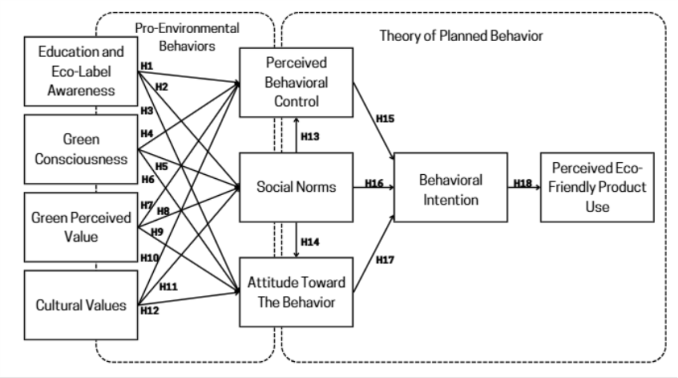
This study examined the main factors that affect eco-friendly product purchasing decisions among Filipino Generation Z consumers by combining the Theory of Planned Behavior (TPB) with the Pro-Environmental Behavior (PEB) framework using Partial Least Squares–Structural Equation Modeling (PLS-SEM) (see Figure 1). Moreover, the key hypotheses in the study can be referred in Table 1.
Figure 1: Theoretical research framework.Table 1: Research Hypotheses.
H2 Education and awareness of eco-labels significantly shape social norms.
H3 Education and eco-label awareness significantly affect attitude toward the behavior.
H4 Green consciousness significantly affects perceived behavioral control.
H5 Green consciousness significantly affects social norms.
H6 Green consciousness significantly affects attitude toward the behavior.
H7 Green perceived value significantly affects perceived behavioral control.
H8 Green perceived value significantly affects social norms.
H9 Green perceived value significantly affects attitude toward the behavior.
H10 Cultural values significantly affect perceived behavioral control.
H11 Cultural values significantly affect social norms.
H12 Cultural values significantly affect attitude toward the behavior.
H13 Social norms significantly affect perceived behavioral control.
H14 Social norms significantly affect attitude toward the behavior.
H15 Perceived behavioral control significantly affects behavioral intention.
H16 Social Norms significantly affect behavioral intention.
H17 Attitude toward the behavior significantly affects behavioral intention.
H18 Behavioral intention significantly affects perceived eco-friendliness of product purchase.
METHODOLOGIES The study employed a descriptive-correlational design to determine the factors influencing Filipino Gen Z consumers’ eco-friendly product purchasing decisions among males and females aged 18 to 28 from various regions across the Philippines. The paper presents two aspects: the descriptive component summarizes respondents’ characteristics and purchasing behaviors, while the correlational component analyzes relationships among psychological and behavioral factors.
A sample of 500 respondents was targeted to adequately represent the study’s nine latent variables (Hair et al., 2019). Data were collected through a structured survey questionnaire, which was adapted from previously validated measurement scales and tailored to suit Filipino participants. Responses were recorded on a five-point Likert scale, ranging from Strongly Disagree (1) to Strongly Agree (5). The final questionnaire was distributed online via Google Forms using a combination of convenience and snowball sampling methods, reaching participants through social media platforms, email, and online communities.
According to Prasetyo et al. (2024), Partial Least Squares–Structural Equation Modeling (PLS-SEM) is a statistical analysis technique used to examine the complex cause–and–effect relationships among latent variables.
Determining Factors Influencing Purchase Decision of Eco-Friendly Products 185 PLS-SEM simultaneously estimates both the measurement and structural models, making it suitable for examining integrated frameworks and is utilized for models that may not require a normal distribution (Roquid et al., 2026).
RESULTS AND DISCUSSION
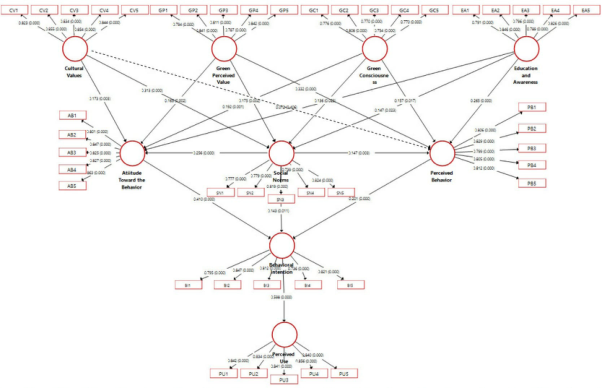
The initial Structural Equation Model (SEM) (see Figure 2) illustrates all hypothesized relationships between the latent constructs and their corresponding indicators.
Figure 2: Initial SEM model.Table 2: Initial bootstrapping results.
Table available in the original PDF paper.
Original Sample
T Statistics (|O/ STDEV|) P-Values Original Sample
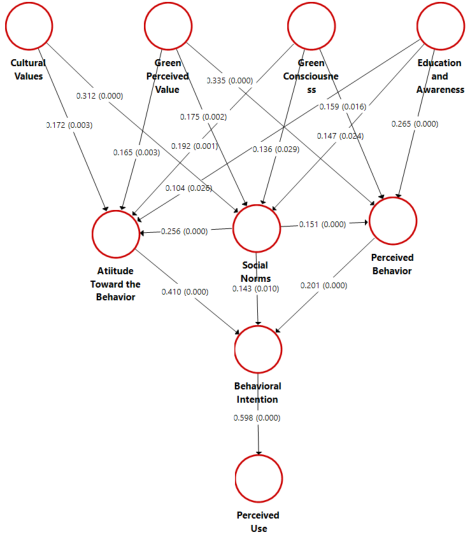
Table 2 was evaluated using t-statistics and p-values (Hair et al., 2019). Most hypothesized paths were significant; however, cultural values did not significantly affect perceived behavior (Hypothesis 10) (β = 0.012; p = 0.401). Thus, the identification of this non-significant path prompted model refinement (see Figure 3).
Figure 3: Final SEM model.Table 3: Reliability and validity results.
Table available in the original PDF paper.
Cronbach’s Alpha rho_A Composite Reliability
Average Variance Extracted (AVE) AB 0.889 0.891 0.919 0.694
BI 0.862 0.865 0.901 0.645 CV 0.898 0.900 0.924 0.709
EA 0.869 0.869 0.905 0.656 GC 0.834 0.835 0.883 0.602
GP 0.874 0.876 0.908 0.665 PB 0.869 0.870 0.905 0.656
PU 0.898 0.899 0.924 0.710 SN 0.847 0.851 0.891 0.621
Based on Table 3, both Cronbach’s alpha and composite reliability values were above 0.70, demonstrating consistent measurement. The average variance extracted (AVE) values exceeded the 0.50 threshold, indicating convergent validity (Hair et al., 2019). In addition, the square roots of the AVE values were higher than the correlations between constructs, indicating all constructs share more variance with their indicators than with other constructs. An AVE square root exceeding the correlations with other constructs is generally accepted as evidence of adequate discriminant validity (Hair et al., 2021) (see Table 4).
Table 4: Fornell-Larcker Criterion.
Table available in the original PDF paper.
AB BI CV EA GC GP PB PU SN AB 0.833 BI 0.626 0.803
Lastly, all HTMT ratios were below the conservative threshold of 0.85, as suggested by Hair et al. (2019), indicating sufficient discriminant validity and minimal overlap among the constructs.
Table 6: Model fit summary.
Table available in the original PDF paper.
Saturated Model Estimated Model SRMR 0.047 0.083
d_ULS 2.269 7.146 d_G 0.904 0.973
Chi-Square 2586.386 2700.976 NFI 0.826 0.819
According to Hair et al. (2021), SRMR values of 0.08 or lower show acceptable model fit. In this study, the SRMR values were 0.047 for the saturated model and 0.083 for the estimated model, showing an acceptable fit. The d_ULS and d_G values were also shown to be within range, supporting stability. The Chi-square value of 2700.976 is sample-size-sensitive but useful alongside other indices. The NFI was 0.819, above the 0.70 minimum, confirming a satisfactory fit.
DISCUSSION
The results reveal several significant relationships that explain how Filipino Generation Z consumers form purchase intentions and make purchase decisions for eco-friendly products. Education and eco-label awareness positively influenced perceived behavioral control (β: 0.265, p < 0.001), indicating that informed consumers feel more capable of making sustainable choices. This supports prior studies showing that eco-label knowledge enhances self-efficacy and confidence in evaluating green products (Andika et al., 2024; Alam et al., 2023).
Education and eco-label awareness also significantly affected social norms (β: 0.147, p = 0.020) and attitudes toward eco-friendly behavior (β: 0.104, p = 0.030). These findings imply that consumers with greater knowledge are more responsive to social expectations and tend to form more positive attitudes toward sustainability. This outcome aligns with TPB concepts and is supported by previous studies conducted by Abner et al. (2026), Asrul et al. (2018), and Lukmawan (2024).
Green consciousness was identified as an important factor influencing eco-friendly behavior, positively influencing perceived behavioral control (β: 0.159, p = 0.017), social norms (β: 0.136, p = 0.027), and attitudes (β: 0.192, p = 0.001). This indicates that environmentally conscious consumers perceive fewer barriers, stronger social expectations, and more positive evaluations of green products (Roquid et al., 2026; Khairunnisa et al., 2021; Li et al., 2025). Green perceived value was one of the strongest predictors in the model, significantly influencing perceived behavioral control (β: 0.335, p < 0.001), social norms (β: 0.175, p = 0.002), and attitudes (β: 0.165, p = 0.003). These findings suggest that when consumers view eco-friendly products as valuable and beneficial, they tend to feel more confident, socially aligned, and positive toward purchasing them (Joshi and Rahman, 2019; Wang et al., 2014).
Moreover, cultural values did not significantly influence perceived behavioral control (β: 0.012, p = 0.408), suggesting that feelings of capability are more strongly shaped by personal resources and product- related factors than by cultural orientation. However, cultural values significantly influenced social norms (β: 0.312, p < 0.001) and attitudes (β: 0.172, p = 0.004). This suggests that cultural influences play an integral part in shaping social expectations and individuals’ evaluations of eco- friendly behaviour (Nagy et al., 2022; Rassafi et al., 2022; Wang et al., 2014). Social norms also positively influenced perceived behavioral control (β: 0.151, p = 0.001) and attitudes (β: 0.256, p < 0.001), highlighting the importance of social support in strengthening confidence and favorable evaluations of sustainable behavior.
Finally, perceived behavioral control (β: 0.201, p < 0.001), social norms (β: 0.143, p = 0.010), and attitudes (β: 0.410, p < 0.001) significantly predicted behavioral intention, with attitudes showing the strongest effect. Behavioral intention, in turn, strongly influenced actual eco-friendly purchasing (β: 0.598, p < 0.001), supporting the idea that intention is the most direct predictor of behavior (Ajzen, 1991; Yadav et al., 2017).
Overall, the strongest pathways were Behavioral Intention and Actual Purchase, Attitude and Behavioral Intention, and Green Perceived Value and Perceived Behavioral Control. These findings indicate that Gen Z consumers
Determining Factors Influencing Purchase Decision of Eco-Friendly Products 189 are more inclined to buy eco-friendly products when they recognize clear valuey, hold positive attitudes, and feel confident and socially supported in making sustainable choices.
CONCLUSION
Results reveal that Education and Eco-Label Awareness, Green Consciousness, and Green Perceived Value significantly shape Attitude Toward the Behavior, Social Norms, and Perceived Behavioral Control. Cultural Values did not directly affect Perceived Behavioral Control, suggesting that community- oriented values alone do not boost confidence in sustainable purchases when practical barriers exist. However, they influenced attitudes and social norms, highlighting the role of social approval and the impact of community. Behavioral Intention strongly predicted actual purchase, confirming the applicability of the Theory of Planned Behavior. Attitude and Social Norms were key in linking awareness and consciousness to intention, indicating that favorable perceptions and social pressures promote eco-friendly purchasing behavior. Overall, sustainable purchasing is shaped by knowledge, personal values, social expectations, and perceived capability. Promoting eco-friendly behavior requires not just awareness, but also empowerment, trust, and social engagement to drive lasting change.
RECOMMENDATIONS AND LIMITATIONS The study provides actionable insights for promoting eco-friendly consumption among Filipino Gen Z. First, companies can use Education and Eco-Label Awareness by clearly and engagingly communicating environmental benefits. Strategies like QR codes, educational vouchers, and sustainable packaging can boost knowledge, perceived value, and purchase confidence. Third-party organizations can support by providing accessible and credible eco-label standards. Second, Green Consciousness and Green Perceived Value highlight the need to offer products that are both eco-friendly and perceived as high- quality, affordable, and beneficial. Emphasizing tangible and emotional benefits can foster perceived usefulness, repeat purchases, and brand loyalty. Educational programs, workshops, campaigns, and digital content can reinforce positive attitudes toward sustainable behavior. Third, Social Norms and Cultural Values can guide campaigns that leverage peer influence, social approval, and shared responsibility. Online platforms and influencers can amplify sustainable practices and signal socially accepted behaviors.
Although the study offers valuable insights, it also has certain limitations. First, focusing only on Filipino Generation Z limits generalizability; future research could examine other age groups to see if awareness, social norms, and perceived behavioral control operate similarly. Second, external factors like price sensitivity, product accessibility, trust in government, social media influence, and marketing strategies were not considered. Considering the high digital engagement of Generation Z, future studies could examine how online platforms influence sustainable consumption behaviors. Third, while Education and Eco-Label Awareness were included, future research could
assess knowledge of environmental regulations and labeling standards, as well as the ability to identify authentic eco-labels, to clarify how awareness informs purchasing. Finally, because the study used a quantitative approach, it may not fully reveal participants’ underlying motivations. Employing qualitative or mixed methods approaches, such as interviews or focus groups, could offer more in-depth understanding of the cultural, emotional, and practical factors that shape long-term eco-friendly behaviors.
REFERENCES
Abner, T.A.G., Galotera, P.C., Lobederio, M.D.C., Kurata, Y.B. (2025). Factors Affecting Filipinos’ Perception of Purchasing Life Insurance: An Integration of the Theory of Planned Behavior. In: Jin, S., Kim, J.H., Kong, YK., Park, J., Yun, M.H. (eds) Proceedings of the 22nd Congress of the International Ergonomics Association, Volume 3. IEA 2024. Springer Series in Design and Innovation, vol. 41. Springer, Singapore. https://doi.org/10.1007/978-981-96-9330-6_70 Advincula, G., & Cayabat, C. V. (2024). Green Product Awareness and Green
Purchas-ing Behavior of Generation Z: The Case of State Universities in Region 4A, Philippines. Sriwijaya International Journal of Dynamic Economics and Business, 8(3), 303-314. https://doi.org/10.29259/sijdeb.v8i3.303-314 Ajzen, I. (1991). The theory of planned behavior. Organizational Behavior and Human Decision Processes, 50(2), 179–211. Alam, S. S., Wang, C.-K., Masukujjaman, M., Ahmad, I., Lin, C.-Y., & Ho, Y.-H. (2023).
(2024). From awareness to action: How knowledge of energy-saving labels drives sus-tainable consumer behavior towards energy-efficient home appliances in Indonesia. In-ternational Journal of Environmental Impacts, Vol. 7, No. 2, pp. 277–286. https://doi.org/10.18280/ijei.070212 Asrul, S. A., Bakar, S. A., Hashim, N. H., & Yahya, W. K. (2018). Social influence and eco-label factors towards purchase intention of home products: A PLS approach. https://doi.org/10.24191/jeeir.v6i3.04 Austria, R. (2026). World Bank: Philippines among top global marine plastic polluters.
Manila Bulletin - World Bank: Philippines among top global marine plastic polluters Hair, J. F., Black, W.C., Babin, B. J., & Anderson, R. E. (2019). Multivariate Data Analysis (8th ed.). Cengage Learning. Hair, J. F., Hult, G. T. M., Ringle, C. M., & Sarstedt, M. (2021). A primer on partial
least squares structural equation modeling (PLS-SEM) (3rd ed.). Sage Publications. Hussain S and Huang J (2022). The impact of cultural values on green purchase intentions through ecological awareness and perceived consumer effectiveness: An empirical investigation. Front. Environ. Sci. 10:985200. doi: 10.3389/fenvs.2022.985200 Joshi, Yatish & Rahman, Zillur (2019) “Consumers’ Sustainable Purchase Behaviour:
Modeling the Impact of Psychological Factors,” Ecological Economics, Elsevier, vol. 159I, pages 235–243. https://doi.org/10.1016/j.ecolecon.2019.01.025 Khairunnisa, H., & Kusumawati, N. (2021). The influence of environmental awareness on purchase intention in buying green FMCG product. Journal of Business and Man-agement, 10(3). Retrieved from https://journal.sbm.itb.ac.id/index.php/jbm/ article/view/4316 Loughlin, B. (2023). What are environmentally friendly products?. Retrived from https://
Determining Factors Influencing Purchase Decision of Eco-Friendly Products 191 Lukmawan, W. R., & Wulandari, R. (2024). Does Green-Label Influence Green
Purchase Intention, Attitude, Subjective Norms, Behavioral Control, and Willingness To Pay as Moderation?. https://doi.org/10.21632/irjbs.17.2.143-161 Montero, Janssen Angelo. (2024). Small Portions, Big Impact The Economic, Cultural, and Environmental Dimensions of Sari-Sari Store’s Tingi Culture and Sachet Marketing. 10.13140/RG.2.2.33747.08482. Nagy, S., & Molnarne, C. K. (2022). The effects of Hofstede’s cultural dimensions on
pro-environmental behaviour: How culture influences environmentally conscious be-haviour. arXiv. Retrieved from https://arxiv.org/abs/2301.04609 Official Gazette. (2001). Republic Act No. 9003 | Official Gazette of the Republic of the Philippines. Retrived from https://www.officialgazette.gov.ph/2001/01/26/ republic-act-no-9003/ Prasetyo, Y. T., Kurata, Y. B., Zahra, K., Cahigas, M. M. L., Nadlifatin, R., & Gumasing,
M. J. J. (2024). Factors affecting compliance with vehicular environmental laws and pro-environmental behavior in Lahore, Pakistan. Acta Psychologica, 251, 104614. https://doi.org/10.1016/j.actpsy.2024.104614 Rassafi, A. and Toorzani, A. (2022). The effect of cultural values on pro-environmental attitude in the context of travel mode choice: A hierarchical ap-proach. Transportation Research Part D: Transport and Environment, 88 291–308. https://doi.org/10.1016/j. trf.2022.05.009 Roquid, J. P. R., Prasetyo, Y. T., Kurata, Y. B., Cahigas, M. M. L., Nadlifatin, R., &
Gumasing, M. J. J. (2025a). Bridging the green gap in laboratory practices: Examining the influence of organizational culture, environmental literacy, and sustainability communication on pro-environmental behaviors. Environmental Development, 57, 101348. https://doi.org/10.1016/j.envdev.2025.101348 Wang, S., Fan, J., Zhao, D., Yang, S., & Fu, Y. (2014). Predicting consumers’ intention to adopt hybrid electric vehicles: Using an extended version of the theory of planned behavior model. Transportation, 41(6), 1–22. https://doi.org/10.1007/ s11116-014-9550-9 Warren, K. (2024). Generation Z (Gen Z): Definition, Birth Years, and Demographics.
Retrieved from https://www.investopedia.com/generation-z-gen-z-definition-5218554 Wood, J. (2022). Gen Z cares about sustainability more than anyone else – and is starting to make others feel the same. World Economic Forum. https://www.weforum. org/agenda/2022/03/generation-z-sustainability-lifestyle-buying-decisions Yadav, Rambalak & Pathak, Govind S. (2017). Determinants of Consumers’ Green
Purchase Behavior in a Developing Nation: Applying and Extending the Theory of Planned Behavior. Ecological Economics, 134, 114–122. Zhang, Y., & Liu, H. (2024). New media environment, green technological innovation and corporate total factor productivity: Evidence from Chinese manufacturing enter-prises. Technological Forecasting and Social Change, 198, 122123. https:// doi.org/10.1016/j.techfore.2024.122123
LISTED IN THE AHFE DIGITAL BOOKSTORE CATALOGUE
Explore the complete digital volume
Human Factors, Business Management and Society
Read this individual research paper free through the original publisher, or explore the full digital proceedings book.
ISBN 978-1-964867-91-5
Explore this ISBN in the AHFE Bookstore ↗Listed in the July 2026 bookstore catalogue; search by ISBN to confirm current availability · Digital book purchase optional