Lorianie Moore-Stroble, Juan Murillo-Morera, Janio Jadán-Guerrero (2022). Didactic Strategy with Mobile Devices: An Approach for the correct use of English Verb Tenses. In: Human Factors and Systems Interaction. AHFE Open Access, vol. 52, pp. 364–372. https://doi.org/10.54941/ahfe1002177
In the teaching-learning process, didactic strategies have become a valuable methodological tool, which allows learning a difficult subject in a structured way. In English, the correct conjugation of verb tenses: simple and progressive in the elementary level, requires a structured and innovative methodology to motivate their learning. The main problem of this research consists of the increasing difficulty of the fifth-grade students from an institution located in the district 04 of Costa Rica, in correctly assimilating the conjugation of the simple and progressive verb tenses of the English language. For its solution, the design, implementation and validation of a didactic strategy was proposed as a way to support the teaching-learning process of the correct conjugation of the simple and progressive verb tenses, through the use of mobile devices. The methodology followed presented a mixed study (qualitative-quantitative) through the application of surveys, expert judgment and a case of execution, as sources to collect and validate the proposed didactic strategy, within the context of philosophy and methodology of action research. The results obtained from both, teachers and students, have been representative. The teachers have identified a great interest of the students in learning the subject, making use of the proposed strategy, causing this, motivation and openness. In fact, the students who used the strategy as a supportive tool for their evaluations, obtained better academic performance on average: 5C (74.28%) compared to those who did not use it as a supportive tool: 5A (44.76%) and 5B (64%).
The teaching-learning process of language is a complex task that requires innovative ideas. The English Language, like other languages, has topics that become complicated for learners. One of these topics is the correct conju- gation and application of the simple and progressive verb tenses; its correct grammatical use being one of the main fields of research in the area (Moreno, 2015). The use of technology in general, and the use of mobile devices in parti- cular to support the teaching-learning process, is an innovative element since mobile learning is based mainly on the use of mobile technologies as a base
in the learning process. In this way, the mobile devices benefit the students in the way that they do not have to be in a specific place to develop a task, making this an important advance in the learning process at any time and any place which brings us closer to the U-Learning (Roura and Sanchez, 2012).
Based on the above information and the work context, the main purpose of the research is to solve the increasing difficulty of fifth-grade elementary students from an institution in District 04 of Costa Rica, in correctly assimila- ting the application of the English verb tenses simple and progressive through the use of mobile devices. Based on the suggestion the related question would be: What characteristics must a didactic strategy contain in order to support the English learning process, specifically in the correct application of the sim- ple and progressive verb tenses of fifth-grade from an institution in District 04 of Costa Rica throughout the use of mobile devices? To solve the suggested problem, it is proposed to design a didactic strategy, taking into account that it entails the selection of activities in different for- mative moments, methods and resources in the teaching and learning process (Velazco and Mosquera, 2010).
The didactic strategies are also a big help to keep the learners interested in the subject, since its structured form contributes to the monitoring of activities with a clear thread.
As a main objective, it is proposed to design and evaluate a didactic stra- tegy that supports the learning of the correct application of the simple and progressive verb tenses in fifth-grade students of an institution in District 04 of Costa Rica through the use of mobile devices.
In section 2, the related work and the contributions of other authors in the same line of research will be explored. In section 3, some definitions or concepts necessary to understand the problem, will be given. Regarding section 4, the materials and methods used in the investigation will be descri- bed. The results and the discussion will be addressed in section 5. Finally, the conclusions will be presented in section 6.
RELATED WORK
The related work is presented below. At a global level, the proposal of Garcia and Garzon (2016), the interaction of the student under study with the platform of interactive games generated from the European project, online platform for language learning is considered.
On the other hand, Barahona (2017), presents a study that raises the importance of technological integration in education. In this study it is esta- blished that the way of learning has changed, becoming more dynamic and interactive. Being the most visual learners when learning, therefore, this rese- arch aimed to use more mobile applications in the teaching-learning process of the English language.
Finally, Yauri (2018) presents a study that determines the relationship between mobile applications and the learning of English language in stu- dents of the language center of the Catholic University Los Angeles de Chimbote-2018, (Peru). In this study, the correlation coefficient quanti- fied the relationship between the variable mobile applications and English
language learning, determining that both variables were positively related. Therefore, it was found that the students in general who used any of the applications, learned more easily and mastered the English language by 71.91%. At the level of Costa Rica, Navarro and Ruiz (2012) present different strategies applicable in an English class to improve the understanding of the subject being studied. Some of the didactic strategies proposed in this study, work on topics that develop skills such as: writing, reading, speaking and listening (ex: physical descriptions of people, describing details of a particular figure, guessing the verb tenses, occupations, among others).
In turn, de la Nuez and Suarez (2014) argue in their study that the impor- tance of the use of mobile devices for teaching and learning English language implies a deep exploration of our teaching practice and design.
Another important contribution is made by Moreno (2015), who develops a methodology to support oral skills in simple and progressive verb tenses at the Instituto Nacional de Aprendizaje (INA). He carried out an approach known as communicative used in the INA, which is proven to enhance the learning of the different modules of English language. In this proposal, the use of mobile devices was also considered as a motivating and innovative resource.
On the other hand, Gomez (2016) presents a study about the use of mobile devices in the teaching of English language in preschool and primary sch- ool children. In this study, the author points out: “that mobile devices have become a success in recent years. Their software and hardware components make it possible to use new forms of interaction specifically, screens, touch screens and the interpretation of gestures”. (p. 21).
BACKGROUND
According to Velazco and Mosquera (2010), a didactic strategy “is a group or set of pedagogical activities and practices in different formative moments, methods and resources in the teaching-learning processes” (p. 2). In other words, they are those activities or methods that the educator plans to intro- duce a specific topic in order for the learners to understand the content of the topic in a faster and more creative way.
The strategies are classified in two types: learning and teaching strate- gies. Learning strategies consist of a procedure or set of steps or skills that a learner acquires and uses intentionally as a flexible instrument to learn meaningfully and solve problems associated with academic demands. On the other hand, teaching strategies are all those aids proposed by the educator which provide the learner to facilitate a deeper processing of the information (Diaz and Hernandez, 1999).
According to Navarro and Ruiz (2013), the didactic strategies present a structure that brings together the following elements: 1) Skills or abilities: they clearly define which is or which are the skills to be strengthened or deve- loped. 2) List of apps: define which is or which are the most suitable apps according to the objectives and the skills or abilities to develop or streng- then. 3) Objectives: They define which is the north or the direction that you
Didactic Strategy With Mobile Devices 367
want to reach in a specific and clear way. 4) procedures: they define the set of activities that must follow a logical sequence and that must have a clear beginning and end. 5) They mainly define any type of recommendations, cur- rently they are for software and hardware, but they can be increased as the didactic strategy is refined, including both technical and human aspects.
In order to innovate in the field of teaching strategies according to current technological development, the use of mobile devices is important. Mobile technologies are going to configure a new social, cultural and educational paradigm. (Cantillo, Roura and Sanchez, 2012).
The use of mobile devices in education helps in the construction of know- ledge, since with the use of these technologies, the possibilities for students to interact with each other increase, in addition communication is improved: therefore, the gap between educators and learners is reduced. The current trend towards the use of mobile devices in education is focused on these devi- ces being used more and more in classrooms and in educational and cultural centers (Cantillo, Roura and Sanchez, 2012).
According to Garcia and Garzon (2016), it is important to use mobile devi- ces and the application of video games as tools for autonomous learning or to strengthen the teachings given in different educational settings and levels. Mobile technology facilitates interactive, ubiquitous and individualized lear- ning, allowing you to work at your own pace.
MATERIALS AND METHOD The approach used corresponds to action research, which can be defined as an action project formed by action strategies and where there is a link betw- een research educators and/or research teams. It is a process characterized by its cyclical nature, which implies a repetition of steps in the form of a dialecti- cal spiral between action and reflection, both moments being integrated and complementing each other. The process is flexible and interactive in all pha- ses or steps of the cycle. It is made up of four moments or phases: planning, acting, observing and reflecting (Bisquerra, 2014).
The study population consisted of fifth-grade students from an institution in District 04 of Costa Rica. It is important to note that at the time of the study, the institution had three groups of fifth-grade: 5th A (21 students), 5th B (20 students), and 5th C (21 students), adding together a total of 62 students.
The sample was chosen by applying a sampling by intention or convenience (Blanco and Castro, 2007). The reason for choosing this type of sampling was due to the fact that, of the 62 students, it was not known how many could participate or not in the process, because there was no parental consent for said activity. Thus, only that population that had the authorization of their parents participated in the project.
Among the specific objectives of the research were: 1) Characterize accor- ding to the literature, teaching strategies used to learn the correct use of verb tenses: simple and progressive. For which a systematic literature review based on Kitchenham (2012) was carried out. 2) Determine the contents and acti- vities to be used in the proposed teaching strategy. For this objective, the
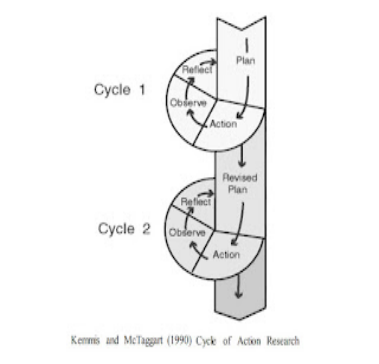
Figure 1: The cycle of action research (Kemmis and MC Taggart, 2002).
systematic revision of the previous point was considered, the application of a questionnaire and the consultation of expert judgment of two teachers with knowledge in linguistics and didactics in the area of English of the school of philosophy and letters of the National University of Costa Rica. 3) check the validity of the didactic strategy by executing an action-research plan. For this objective, an action-research plan was developed, following the iterative cycle methodology, proposed by (Bisquerra, 2014). Figure 1 shows the pha- ses that were followed in the proposed methodology. It is important to note that during each cycle more refined versions of the strategy were obtained.
According to Figure 1 and attending the last specific objective of the research, the following phases were developed: Phase 1- Planning: The literature focused on teaching strategies in the English area was reviewed: this, in order to obtain an innovative idea for the design of the proposed teaching strategy. In this phase, a questionnaire was also designed and applied to a group of five teachers from the institution under study. In addition, one of the three groups of fifth-grade students was chosen to use a first version of the didactic strategy.
Phase 2- Acting: The responses to the questionnaire were analyzed and later a first version of the didactic strategy was designed. The strategy was validated by means of two expert professors in the area of English from the National University of Costa Rica; both with studies in linguistics in the English language. The didactic strategy was put into practice with one of the three groups of the fift-grade students (5C) from the institution under study during four sessions of 1 hour and 40 minutes each session.
Phase 3- Observing: A quiz, composed of five complete items, was applied to the three groups of fifth-graders (5A, 5B, 5C) from the institution under study, where each one, for analysis purposes, was considered with a value of 20% out of 100%. During the application of the quiz, behaviors of the expe- rimental group of students were observed such as: security, execution time of the instrument, greater stimulation, self-confidence and better understanding on the subject.
Didactic Strategy With Mobile Devices 369
Phase 4- Reflecting: for the elaboration and development of the activi- ties that make up the didactic strategy, the experimental group was divided into small subgroups, which demonstrated ease and acceptance to work col- laboratively. The reaction of the group of students was also studied when supporting the subject under study, with the support of mobile devices. In general, their reactions and attitudes were positive, since they were able to enrich their knowledge, and they were also able to learn from the opinions and activities of the other groups of learners.
RESULTS AND DISCUSSION
The process that was carried out to review the literature is summarized in the following steps: 1) We proceeded to create a search string composed of the following words: teaching + learning + english + didactic + stra- tegy + school. 2) Articles were searched taking into account the previously defined search chain in at least four open access databases: Springer, Scopus, EBSCOhost , Books and arbitration and indexed sources (theses, projects), all attached to the UNA portal (https://www.siduna.una.ac.cr/index.php/rec ursos-electronicos/). 3) Forty articles were reviewed, of which, due to their relationship with the topic, the ten most relevant were chosen, considering both national and international studies. 4) The ten most relevant articles, considering the application of didactic strategies were: Navarro & Pineiro (2012); Pumilia-Gnarini (2013); Ontaneda (2016); Hengki et al. (2017); Zhang et al. (2017); Star (2017); Capperucci et al. (2018); Moreno (2018); Camelo (2018); Bautista (2019); Velazco, M. and Mosquera, R. (2010).
Subsequently, a survey was applied to the teaching staff of the institution under study. The questions of the applied survey were divided into secti- ons: demographic information, problems under study, teaching strategy and mobile devices. Among the results, there was a predominance of the female gender, since 100% of those surveyed were women and were older than 30 years, with two predominant groups; those who were between 31-40 years old (40%) and those older than 50 years (40%).
From the above, it can be inferred a teaching group with experience and maturity teaching the classes to the students. In turn, 100% of the teachers (5/5), presented more than 7 years of experience teaching classes specifically on the topic of the correct use of verb tenses: simple and progressive. Fur- thermore, 100% of the teachers (5/5) stated that they had received training in teaching strategies and learned about the use of technology to teach their classes.
On the other hand, 80% of the teachers (4/5) determined that indeed the subject of simple and progressive verb tenses has been considered a difficult subject for students.
Regarding the didactic strategies, a deficiency was identified regarding the application of said strategies since they stated that they applied more the use of individualized activities and technological resources such as: games, power point, posters, YouTube songs, use of tablets and virtual games. In relation to the assessment instruments applied to assess the subject of simple and progressive verb tenses, from the teachers’ perspective they are: perhaps;
the most used instruments in 80% (4/5), dictations and oral presentations in 20% (1/5). Regarding the activities applied in class for the teaching of simple and pro- gressive verb tenses, 100% (5/5) were obtained in practice sheets, 80% (4/5) of application of games, and 60% (3/5) in song applications, mainly. Oral presentations 20% (1/5) and interviews 0% (0/5 in total) had little or no impact. Regarding the elements of a didactic strategy that they would main- tain, the teachers rescued: hands On or memory games, oral presentations and reading, division of the class into two groups, so that the students are the ones who propose their own activities.
On the other hand, the teachers stated that the elements of a didactic strategy that they would integrate are: interviews, oral presentations, use of tablets, projects integrated with other subjects where each group must pre- sent the approach of their game to the rest of the class, and later share it with fifth grade students. Among the improvements of a didactic strategy, they stated: having more time, consistency and use of the language, in addi- tion, asking students to make changes on activities of the strategy, according to their learning styles. In turn, the teachers stated that they would mainly omit the quizzes and written practices because they are traditional evaluation strategies, not oriented to modern learning such as skills and abilities.
Finally, and in relation to the use of mobile devices, 80% of the teachers (4/5) stated that the controlled use of mobile devices in the teaching-learning of English seemed correct and necessary. On the other hand, there was 20% (1/5) who considered that mobile technology was not important as a support tool. Based on whether the use of mobile devices could serve as support in the use of new teaching strategies, 80% agreed with their use, and 20% (1/5) did not corroborate the previous statement.
Regarding how mobile technology would be applied in the implementation of new strategies, the teachers’ responses were: online games and dictionary, audiovisual access, projects and searches. In addition to this, give students the opportunity to make their own games so that they can share and present their results.
Once the inputs were obtained: systematic review of literature, perception of the teaching staff and expert judgment of professors of the School of Phi- losophy and Letters of the National University, the didactic strategy was elaborated in https://shorturl.at/ktJY0. The strategy consisted of a general structure and three specific structures. Each structure has: title, skills, apps, category, objectives, specific strategies/procedures and suggestions.
Within the application of the strategy, it was obtained that the average score of the 5C group that used the strategy was higher with respect to the 5A and 5B groups. This shows that there was a better academic performance in the instrument used (perhaps) by the experimental group. The 5C group within the minimum grades did not obtain a grade of 0, unlike the other groups 5A and 5B, whose minimum grade was 0. The 5C group obtained a rate of 52.38% (11/21) in grades of 100. The result establishes an increase of a score of 100 with respect to the other two groups whose rates were 19.04% (4/21), and 35% (7/20) respectively. Group 5A had a passing rate (score > 70) of 28.57% (6/21). In turn, group 5B had an approval rate of 45% (9/20) and
Didactic Strategy With Mobile Devices 371
5C had an approval rate of 61.90% (13/21), with group 5C (experimentation group) having the highest rate of approval. Group 5A had an approval rate (grade >70) of 28.57% (6/21). In turn, group 5B had an approval rate of 45% (9/20) and 5C had an approval rate of 61.90% (13/21), with group 5C (experimentation group) having the highest rate of approval.
CONCLUSION
The proposed didactic strategy has been the product of the characteristics of other relevant strategies in the literature, the contribution of the teachers who work in the institution through interviews carried out, as well as the criteria of expert teachers in the linguistic and didactic area. In addition to the opinions of the students themselves regarding a pilot test.
As part of the results of the application of the strategy, it was observed that the group of experimentation students identified more quickly the difference between the simple and progressive verb tenses, and as part of the develo- pment of the activities, they demonstrated the mastery of correctly applying each tense using the different applications. In addition, the group of students stated that working outside the classroom, when the activities were in groups, they found it more fun and stimulating to share knowledge.
Another important factor identified is that the classes were more intera- ctive; the group of learners participated actively and dynamically. Therefore, each student managed to cope with greater ease and comfort with their team. In relation to the use of technology, specifically the management of mobile devices, an investigation is carried out on which apps are most useful accor- ding to the objectives set by specific strategy and the conclusion was that there is no better app for a determined strategy, given that the combina- tion of several apps gives better results in some cases in the opinion of those involved.
However, among the apps that were adopted to the proposed strategy are: Filmora Go, Irregular Verbs of English, English Tenses in Action and Padlet.
According to the above, it can also be concluded that the characteristics of a didactic strategy for it to be successful, must contemplate the topic to be developed, the context of the actors to whom the strategy would be applied and a rigorous and strictly ordered structure. It is in this way that the main characteristics that a didactic strategy must contain are the following: 1) abilities or skills 2) list of apps 3) objectives and 4) procedures. Among the limitations of the research are: 1) The non-consent of parents for their children to be recorded in the different activities of the proposed strategy, 2) little access and time provided by the institution to implement the proposed strategy, 3) the execution time of the strategy coincided with the extracurricular activities of the institution.
Within the future work there is: 1) To carry out a version of the strategy for collaborative work that allows to enhance the group talent of the students, 2) To adapt the strategy to other verb tenses, for example: perfect tenses, and perfect progressive tenses, 3) adapt the strategy to other topics of the language, for example: adverbs helping verbs, and linking verbs.
REFERENCES
Barahona Lagla, N. X. (2017). Applications app/aplicaciones móviles en el proceso enseñanza-aprendizaje del idioma inglés en estudiantes de noveno año de edu- cación general básica de la unidad educativa Los Shyris, DM Quito, periodo 2016 (Bachelor’s thesis, Quito: UCE). Bautista Salazar, F. S. (2019). Didactic strategy to develop the a-2 level students’ com-
municative competence in the english language according to the common euro- pean framework of reference for languages at puce esmeraldas. 2018 (Doctoral dissertation, Ecuador-PUCESE-Escuela de Lingüística Aplicada). Camelo Cruz, J. A. (2018). Learning english with a didactic strategy in elementary school at Gimnasio Nuevos Andes School in Bogotá, Colombia. Cantillo, C., M. Roura, and A. Sanchez. “Tecnologías asociadas al m-Learning y su
evolución en los últimos tiempos.” La educación 1.147 (2012): 4–21. Capperucci, D., Muzzi, R. F., & Niccolai, E. (2018). An English Island methodology: didactic strategies for learning English in Italian primary schools. Studi sulla Formazione/Open Journal of Education, 21(2), 125-145. Estrella Crespo, A. (2017). Didactic strategies in english pronunciation in second
bachillerato students at unidad educativa sofos in Guayaquil during the school year 2017-2018 (Bachelor’s thesis, Guayaquil: ULVR, 2017.). García, M. M. R., & Garzón, J. E. A. (2016). Aprendizaje móvil de inglés mediante juegos de espías en Educación Secundaria/Mobile language learning through spy games in secondary education. Revista Iberoamericana de Educación a Distancia, 19(1). Gómez Ibañez, J. M. (2016). Criterios teóricos y prácticos que orientan el uso de
dispositivos móviles en la comunicación familiar con adolescentes. Hengki, H., Jabu, B., & Salija, K. (2017). The effectiveness of cooperative learning strategy through english village for teaching speaking skill. Journal of Language Teaching and Research, 8(2), 306–312 Hernández, R., Baptista, P & Fernández, C. (2010). Metodología de la Investigación.
México. McGraw Hill. Kitchenham, B. A. (2012, September). Systematic review in software engineering: where we are and where we should be going. In Proceedings of the 2nd inter- national workshop on Evidential assessment of software technologies (pp. 1–2). ACM.
LISTED IN THE AHFE DIGITAL BOOKSTORE CATALOGUE
Explore the complete digital volume
Human Factors and Systems Interaction
Read this individual research paper free through the original publisher, or explore the full digital proceedings book.
ISBN 978-1-958651-28-5
Explore this ISBN in the AHFE Bookstore ↗Listed in the July 2026 bookstore catalogue; search by ISBN to confirm current availability · Digital book purchase optional